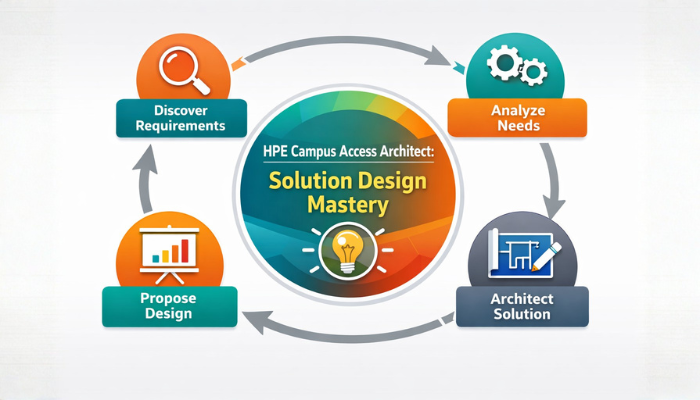
HPE Aruba Networking Certified Professional – Campus Access Architect (HPE7-A11) certification validates an IT professional’s advanced skills in designing and architecting modern, secure, and highly available campus access networks using Hewlett Packard Enterprise (HPE) and Aruba solutions. This credential signifies a deep understanding of customer requirements, complex network analysis, and the ability to propose robust architectural designs that meet stringent business and technical demands. It’s an essential qualification for those looking to spearhead the evolution of enterprise networking, ensuring seamless connectivity and fortified digital environments.
Mastering HPE Campus Network Design Principles
Architecting high-performance campus networks requires a comprehensive understanding of current technologies and future trends. The HPE Network Campus Access Professional Architect role centers on translating complex business needs into resilient and scalable network designs. Professionals in this domain ensure that the underlying infrastructure can support demanding applications, provide consistent user experiences, and offer robust security measures against evolving threats. This involves a strategic approach to network segmentation, policy enforcement, and seamless integration of various access technologies.
Understanding Core Architecture Components
A robust campus network architecture depends on meticulously planned components that work in harmony. Architects must be adept at selecting and configuring the right hardware, software, and services to achieve desired outcomes. This includes everything from wireless access points and switches to network management tools and security gateways.
- Access Layer Design: Focusing on user and device connectivity, including wired and wireless access points, PoE considerations, and port security.
- Aggregation Layer Design: Centralizing access layer traffic, implementing routing protocols, and ensuring high availability through redundancy.
- Core Layer Design: Providing high-speed backbone connectivity, often involving advanced routing and switching features to handle aggregate traffic.
- Network Management and Monitoring: Integrating solutions like Aruba Central for centralized configuration, monitoring, and troubleshooting across the entire network.
Designing Secure HPE Campus Networks
Security is paramount in modern campus environments, where threats can emerge from various vectors. An HPE Network Campus Access Professional Architect excels at embedding security into every layer of the network design, not merely as an add-on. This proactive approach protects sensitive data, ensures compliance, and maintains operational integrity.
Implementing a Zero Trust framework, for instance, requires architects to define granular access policies and continuously verify user and device identities regardless of their location within the network. This often involves leveraging advanced authentication mechanisms and intrusion detection systems.
- Policy-Based Segmentation: Dividing the network into logical segments to control traffic flow and limit the blast radius of security incidents.
- Role-Based Access Control (RBAC): Assigning network access privileges based on user roles and responsibilities, ensuring least-privilege access.
- Guest Access and IoT Security: Designing secure onboarding and management strategies for transient users and a growing number of IoT devices.
- Threat Detection and Prevention: Integrating security appliances and software to identify and mitigate various cyber threats in real-time.
Navigating the HPE7-A11 Certification Landscape
Achieving the HPE Aruba Networking Certified Professional – Campus Access Architect certification marks a significant milestone in an IT professional’s career. The HPE7-A11 exam is meticulously structured to assess a candidate’s practical architectural skills and theoretical knowledge, affirming their readiness to tackle real-world networking challenges. This certification is globally recognized, reflecting Hewlett Packard Enterprise’s commitment to setting industry standards for network professionals.
Key Exam Details for HPE7-A11 Candidates
Understanding the logistical framework of the HPE7-A11 exam is the first step towards successful preparation. Candidates should familiarize themselves with the exam specifics to plan their study trajectory effectively. The exam is designed to be comprehensive, testing a broad range of architectural competencies required for modern campus networks.
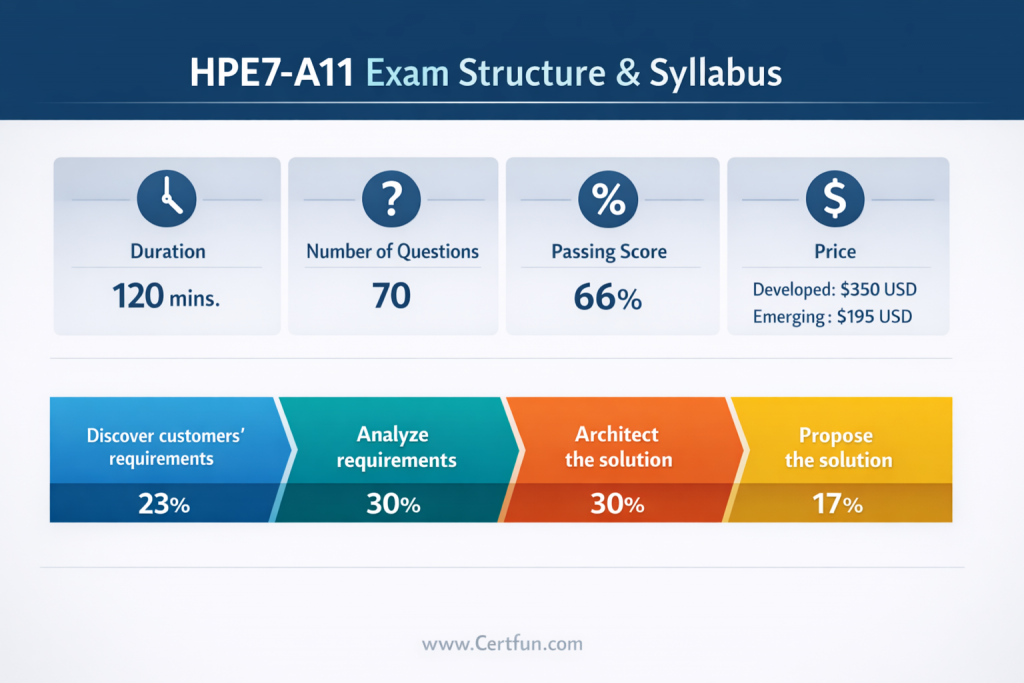
- Exam Code: HPE7-A11
- Exam Name: HPE Aruba Networking Certified Professional – Campus Access Architect
- Duration: Candidates are allotted 120 minutes to complete the examination.
- Number of Questions: The exam comprises 70 multiple-choice and complex scenario-based questions.
- Passing Score: A score of 66% or higher is required to pass the exam.
- Exam Price: The cost varies by region; $350 (USD) in Developed Countries and $195 (USD) in Emerging Countries.
Deconstructing the HPE7-A11 Syllabus Objectives
The HPE7-A11 exam objectives are structured to evaluate a candidate’s proficiency across the entire network design lifecycle, from initial requirement gathering to solution proposal. Each domain carries a specific weight, indicating the importance and depth of knowledge required in that area. A balanced study approach, aligning with these percentages, is crucial for optimal preparation.
- Discover Customers’ Requirements (23%): This involves understanding business goals, technical constraints, user profiles, and application demands. Architects must be skilled in eliciting crucial information to form the basis of their design.
- Analyze Requirements (30%): Translating raw requirements into actionable technical specifications. This includes assessing current infrastructure, identifying gaps, and performing site surveys to gather environmental data.
- Architect the Solution (30%): The core design phase, where candidates demonstrate their ability to conceptualize, plan, and detail the network architecture using HPE Aruba campus access solutions. This encompasses selecting appropriate technologies, designing network topology, and planning for scalability and security.
- Propose the Solution (17%): Presenting the designed solution to stakeholders, articulating its benefits, explaining technical details, and justifying design choices in alignment with customer objectives and budgetary considerations.
Driving Career Advancement with HPE Certification
The HPE Network Campus Access Professional Architect certification serves as a powerful accelerator for career growth in the competitive IT landscape. It distinguishes individuals as experts capable of designing and implementing complex networking solutions. Professionals holding this credential often find themselves in roles that command higher salaries and greater influence within their organizations, contributing significantly to strategic IT initiatives. This certification signals to employers a commitment to excellence and a verified skill set in HPE networking architect career path progression.
Elevating Your Professional Profile
Certification by a leading vendor like HPE validates specialized knowledge that is directly applicable to real-world scenarios. It boosts credibility and opens doors to advanced positions such as Senior Network Architect, Solutions Consultant, or Technical Lead. The ability to articulate and implement sophisticated campus network designs is a highly sought-after skill in today’s digital enterprises. This makes the certification a vital asset for professionals aiming for leadership roles.
Many organizations actively seek certified professionals to manage their critical infrastructure, recognizing that these individuals bring proven expertise and adherence to industry best practices. Employers understand that a certified architect can reduce operational risks and enhance network efficiency. Explore further opportunities and insights on HPE solutions by visiting the HPE Community forums.
Recognizing the Benefits of HPE Network Campus Access Professional Architect Certification
The investment in obtaining the HPE Network Campus Access Professional Architect certification yields numerous tangible and intangible benefits that extend beyond immediate career progression. These advantages contribute to long-term professional satisfaction and continued relevance in a rapidly evolving technological field.
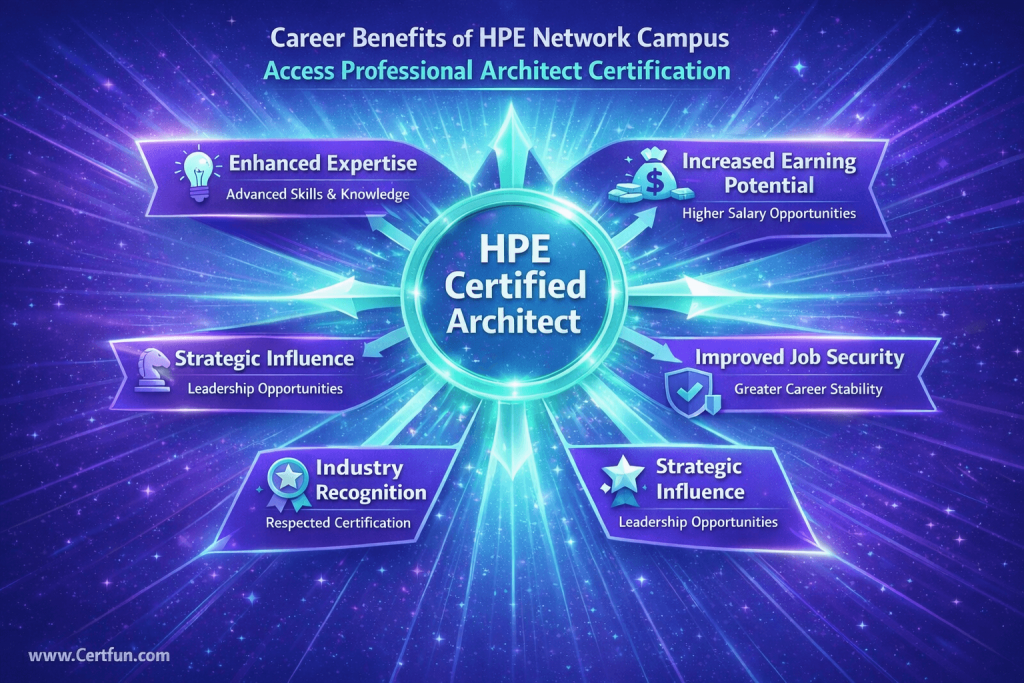
- Enhanced Expertise: Deepens understanding of HPE Aruba campus access solutions and architecture principles, leading to more robust and innovative designs.
- Increased Earning Potential: Certified professionals typically command higher salaries due to their specialized and validated skill set.
- Improved Job Security: Demonstrates a commitment to continuous learning and staying current with cutting-edge networking technologies.
- Industry Recognition: Gains respect among peers and employers as a certified expert in HPE networking infrastructure.
- Strategic Influence: Positions you to drive critical network design decisions and contribute to the overall IT strategy of an organization.
Architecting Resilient Connectivity with Aruba Solutions
The HPE Network Campus Access Professional Architect certification focuses heavily on leveraging HPE Aruba’s comprehensive portfolio to create future-proof network infrastructures. Aruba’s reputation for secure, intelligent, and flexible networking solutions makes it a cornerstone for modern campus designs. Architects learn to integrate these tools seamlessly to deliver unparalleled performance and reliability. Understanding the nuances of HPE Aruba campus access solutions is crucial for designing networks that adapt to evolving demands.
Implementing Advanced Wireless and Wired Access
Modern campuses demand seamless connectivity, whether users are accessing resources via Wi-Fi or wired connections. Architects must design solutions that provide consistent performance, high availability, and secure access across both mediums. This involves strategic placement of access points, intelligent switching configurations, and unified policy management.
For large-scale deployments, managing thousands of devices and ensuring optimal signal strength requires sophisticated planning and utilization of tools like Aruba Central. This platform streamlines configuration, monitoring, and troubleshooting, offering a single pane of glass for network operations. Learn more about HPE’s broader educational offerings at HPE Education.
- High-Density Wi-Fi Design: Planning for environments with numerous users and devices, such as lecture halls or common areas, to ensure optimal performance.
- Unified Wired and Wireless Management: Implementing solutions that allow for consistent policy enforcement and streamlined operations across both network types.
- Intelligent Edge Switching: Utilizing HPE Aruba switches with advanced features like dynamic segmentation, high-performance uplinks, and robust security.
- Location Services Integration: Designing networks that can support indoor navigation, asset tracking, and proximity-based services.
Ensuring Network Performance and Reliability
Beyond basic connectivity, a campus network must deliver exceptional performance and unwavering reliability. An HPE Network Campus Access Professional Architect is tasked with designing networks that can sustain demanding applications, high bandwidth usage, and critical communications without interruption. This involves careful consideration of redundancy, traffic management, and proactive monitoring. Keeping an eye on HPE’s innovations can also be beneficial, like through their official YouTube channel.
- Redundancy and High Availability: Implementing redundant links, power supplies, and control planes to minimize downtime and ensure continuous operation.
- Quality of Service (QoS): Prioritizing critical applications (e.g., voice, video) to guarantee their performance even under heavy network load.
- Bandwidth Management: Allocating and managing network resources efficiently to prevent congestion and ensure equitable access for all users.
- Network Monitoring and Analytics: Deploying tools that provide real-time insights into network health, performance metrics, and potential issues.
Strategizing for HPE7-A11 Exam Preparation
A well-defined preparation strategy is indispensable for success in the HPE7-A11 exam. Candidates need to go beyond rote memorization, focusing instead on understanding the underlying architectural principles and their practical application. Effective study involves a combination of official documentation, hands-on experience, and rigorous self-assessment. Planning your HPE7-A11 exam prep journey thoughtfully can significantly boost confidence and readiness. For industry context, insights into Hewlett Packard Enterprise’s history can be found on Wikipedia.
Crafting an Effective HPE Network Campus Access Professional Architect Study Guide
Developing a personalized study guide tailored to the HPE7-A11 exam topics is a crucial step. This involves breaking down the syllabus into manageable sections, allocating study time based on weightage and personal familiarity with the topics, and utilizing a variety of learning resources. The goal is to build a comprehensive understanding, not just to pass the test.
- Review Official Documentation: Dive deep into HPE and Aruba’s technical documentation, whitepapers, and solution guides to grasp product capabilities and best practices.
- Leverage Training Courses: Consider enrolling in official HPE Network Campus Access Professional Architect training courses offered by authorized providers to gain structured knowledge and practical insights.
- Engage with Labs and Simulations: Practical experience configuring and troubleshooting HPE Aruba solutions in a lab environment reinforces theoretical concepts.
- Form Study Groups: Collaborating with peers can provide different perspectives, clarify doubts, and make learning more interactive and engaging.
Utilizing Practice Questions and Mock Exams
To solidify knowledge and prepare for the exam’s format, incorporating HPE7-A11 practice questions into your study routine is non-negotiable. Practice tests help identify knowledge gaps, improve time management, and build confidence by simulating the actual exam environment. This approach is far more beneficial than relying on unauthorized “dumps,” which undermine genuine learning and ethical certification practices. A reputable platform like Certfun offers HPE7-A11 practice questions to help candidates evaluate their readiness. You can find high-quality practice tests and study materials for HPE certifications on their dedicated page: HPE7-A11 practice questions.
- Simulate Exam Conditions: Take full-length practice tests under timed conditions to get accustomed to the pressure and pace of the actual exam.
- Analyze Performance: Review incorrect answers thoroughly to understand the underlying concepts and strengthen weak areas.
- Focus on Scenario-Based Questions: The HPE7-A11 exam often includes complex scenarios; practice analyzing these to apply your knowledge effectively.
- Avoid Brain Dumps: Rely solely on legitimate study materials and practice tests. Using “dumps” compromises the integrity of your certification and your professional credibility.
Sustaining Expertise in HPE Networking Architecture
Earning the HPE Network Campus Access Professional Architect certification is a monumental achievement, yet it marks a beginning, not an end. The field of networking is in perpetual motion, with new technologies, security threats, and architectural paradigms emerging constantly. Sustaining expertise requires a commitment to ongoing learning, continuous professional development, and active engagement with the broader networking community. Staying updated with industry trends through resources like HPE on LinkedIn is vital for long-term success.
Embracing Continuous Professional Development
The journey of a network architect is characterized by relentless learning. Keeping abreast of the latest HPE Aruba campus access solutions, software updates, and industry best practices is crucial for maintaining a competitive edge and ensuring that proposed solutions remain cutting-edge and effective. This proactive approach ensures that your architectural designs are not just functional today, but also resilient for tomorrow’s challenges.
- Follow HPE Announcements: Stay informed about new product releases, feature updates, and technology roadmaps from Hewlett Packard Enterprise.
- Participate in Webinars and Conferences: Engage with expert sessions and industry events to learn about emerging trends and network with peers.
- Explore Advanced Certifications: Consider pursuing higher-level or complementary certifications that broaden your skill set or deepen your specialization.
- Contribute to Online Forums: Share your knowledge and learn from others by actively participating in technical discussions and community platforms.
Evolving with Network Campus Access Architecture Principles
The fundamental principles of network architecture may remain constant, but their application evolves with technological advancements. Architects must continually refine their understanding of how these principles apply to new paradigms like AI/ML in networking, advanced IoT integration, and heightened cybersecurity demands. This adaptable mindset is key to designing networks that are truly future-ready and capable of supporting the next generation of digital experiences.
For instance, the rise of edge computing necessitates new approaches to distributed network architectures, ensuring that processing power and data reside closer to the source of action. An HPE Network Campus Access Professional Architect must be equipped to design these complex, interconnected systems, ensuring security, performance, and manageability across a vast and diverse landscape.
Conclusion
The HPE Network Campus Access Professional Architect certification is more than a credential; it’s a testament to your capability to design, implement, and optimize the very backbone of modern digital enterprises. It’s an investment in your future, positioning you at the forefront of networking innovation. By thoroughly preparing for the HPE7-A11 exam, you not only validate your technical prowess but also unlock a world of opportunities, driving your career towards leadership and impactful contributions in the field of advanced campus networking. Embrace this challenge to transform your expertise and your professional trajectory.
Ready to validate your architectural expertise and accelerate your career? The HPE Network Campus Access Professional Architect certification can be your gateway to designing robust, secure, and scalable campus networks. Begin your structured learning journey today and explore the range of certifications available to elevate your skills and professional standing. Discover more about certified HPE professionals and their career paths on HPE certifications.
Frequently Asked Questions
1. What is the HPE Network Campus Access Professional Architect certification?
The HPE Network Campus Access Professional Architect certification, also known by exam code HPE7-A11, validates an individual’s advanced skills in designing modern, secure, and highly available campus access networks using HPE and Aruba solutions. It covers requirements analysis, solution architecture, and proposal development.
2. What skills does the HPE7-A11 exam validate?
The HPE7-A11 exam validates a candidate’s ability to discover and analyze customer requirements, architect comprehensive network solutions using HPE Aruba technologies, and effectively propose these solutions to stakeholders. It emphasizes design principles for scalability, security, and high availability.
3. How long does the HPE7-A11 exam take and what is the passing score?
The HPE7-A11 exam has a duration of 120 minutes. Candidates must achieve a minimum score of 66% to pass the certification exam. There are 70 questions covering various aspects of campus network architecture.
4. What are the career benefits of becoming an HPE Network Campus Access Professional Architect?
Achieving this certification can significantly advance your career by enhancing your professional credibility, increasing earning potential, and opening doors to senior architectural and consulting roles. It demonstrates expertise in a critical area of IT infrastructure, making you a highly valued asset to employers.
5. What resources are recommended for HPE7-A11 exam preparation?
Recommended resources for HPE7-A11 exam preparation include official HPE training courses, comprehensive study guides, HPE Aruba technical documentation, and practice questions. Engaging in hands-on lab exercises and joining study groups can also be highly beneficial.


