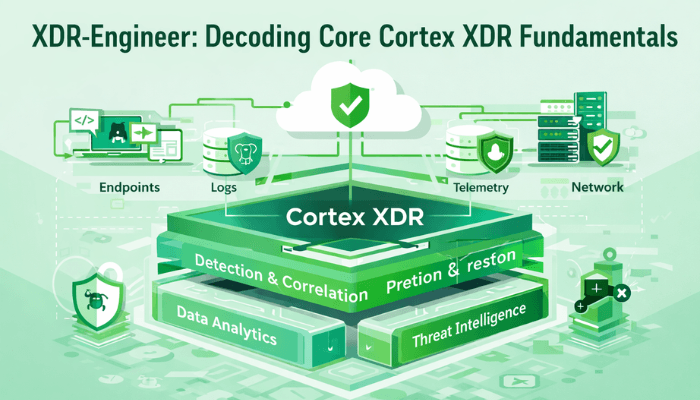
The Palo Alto Networks XDR Engineer (XDR-Engineer) certification validates a professional’s expertise in deploying, configuring, and managing the Palo Alto Networks Cortex XDR platform for comprehensive threat detection and response. This credential is crucial for security professionals, analysts, and engineers dedicated to enhancing their capabilities in contemporary security operations. While highly valued, many candidates encounter significant hurdles during their preparation and exam attempts. This article thoroughly examines the common pitfalls that often lead aspiring XDR Engineers to fail, offering practical guidance to navigate these complexities and successfully achieve this important certification. It aims to equip candidates with the critical insights needed to avoid these mistakes and achieve success.
Clarifying the Palo Alto Networks XDR Engineer Role
The Palo Alto Networks XDR Engineer certification identifies professionals capable of operating the Cortex XDR platform to protect endpoints, networks, and cloud environments from advanced threats. Achieving this certification validates a candidate’s skill in leveraging Cortex XDR’s powerful capabilities, including endpoint protection, detection and response, analytics, and automation. Candidates demonstrate their ability to implement, manage, and optimize the platform for proactive security posture and swift incident resolution. Understanding the full scope of this role is the first step toward successful preparation, ensuring alignment with the rigorous demands outlined on the official certification page.
Examining the XDR-Engineer Assessment Structure
Candidates preparing for the Palo Alto Networks XDR Engineer exam should familiarize themselves with its specific structure to plan an effective study strategy. The XDR-Engineer certification is a challenging assessment designed to test practical knowledge and theoretical understanding across several critical domains. Recognizing these details upfront helps in allocating study time efficiently and focusing on high-weightage areas.
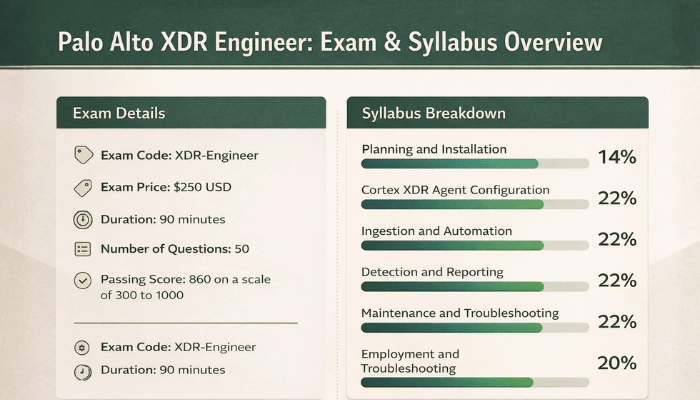
Key details of the XDR-Engineer exam include:
- Exam Code: XDR-Engineer
- Exam Price: $250 USD
- Duration: 90 minutes
- Number of Questions: 50
- Passing Score: 860 on a scale of 300 to 1000
These metrics underscore the need for precise knowledge and efficient problem-solving under time pressure. A common flaw is underestimating the scoring scale, which demands a high level of accuracy across all questions.
Decoding the XDR-Engineer Syllabus Domains
A deep understanding of the Palo Alto Networks XDR Engineer certification syllabus is non-negotiable for success. Each domain represents a crucial aspect of Cortex XDR operations, and candidates must possess a balanced proficiency across all areas. Many candidates falter by focusing excessively on familiar topics while neglecting less comfortable but equally important sections.
The syllabus is broadly categorized into the following weighted sections:
- Planning and Installation (14%): This involves understanding deployment prerequisites, architecture, and initial setup procedures.
- Cortex XDR Agent Configuration (22%): Covers agent deployment methods, profile management, and endpoint protection settings.
- Ingestion and Automation (22%): Focuses on data source integration, external integrations, and playbook automation for security workflows.
- Detection and Reporting (22%): Emphasizes creating and managing detection rules, alerts, incident management, and reporting capabilities.
- Maintenance and Troubleshooting (20%): Includes system health monitoring, log management, upgrades, and resolving common issues within Cortex XDR.
Each percentage indicates the relative importance of the domain, guiding candidates to prioritize their study efforts effectively. Overlooking any of these critical areas can create significant gaps in a candidate’s readiness, directly contributing to exam failure.
Overlooking Foundational Cortex XDR Concepts
One of the most significant reasons candidates fail the Palo Alto Networks XDR Engineer exam is a superficial understanding of Cortex XDR’s fundamental principles. Many dive directly into advanced configurations without fully grasping the underlying architecture, data flow, and core functionalities. This oversight leads to challenges when faced with scenario-based questions that require a holistic view of the platform. True mastery of the Palo Alto certification journey demands a robust foundation.
Grasping Core Cortex XDR Architecture
The XDR-Engineer exam demands candidates understand the complete Cortex XDR ecosystem. This includes knowing how agents communicate with the cloud, the role of various components like the Broker VM, data lakes, and policy engines. Without a solid grip on how these elements interconnect, troubleshooting and optimizing the platform become incredibly difficult. Candidates often struggle with questions involving complex data ingestion pathways or how different security modules interact to form a cohesive defense. Focus must be placed on understanding the logical and physical architecture, data flow, and threat intelligence integration.
Deciphering Agent Deployment Challenges
Cortex XDR agents are the bedrock of endpoint protection. A common mistake is a lack of detailed knowledge about agent deployment strategies, different installation methods, and troubleshooting common deployment failures. The exam delves into scenarios covering Windows, macOS, and Linux agents, including considerations for persistent versus non-persistent VDI environments. Understanding agent communication, update mechanisms, and the impact of network configurations on agent functionality is paramount. Candidates must not only know *how* to deploy but also *why* certain methods are preferred in specific environments and how to validate successful installations effectively.
Insufficient Practical Experience with Cortex XDR
Theoretical knowledge alone is rarely enough to pass the XDR-Engineer certification. The Palo Alto Networks XDR Engineer role is inherently hands-on, requiring practical application of skills. A critical flaw for many candidates is the reliance on textbook knowledge without sufficient real-world or simulated lab experience. The exam tests a candidate’s ability to solve practical problems, which is best developed through direct engagement with the Cortex XDR platform. This practical gap is a common theme across many Palo Alto certification programs.
Simulating Real-World Threat Scenarios
To truly prepare, candidates need to go beyond simple configuration tasks and actively simulate threat scenarios within a Cortex XDR environment. This involves setting up test endpoints, running various malware simulations, and observing how Cortex XDR detects, prevents, and responds to these threats. Understanding the lifecycle of an incident from alert generation to remediation is vital. Practical exercises help reinforce theoretical concepts like exploit prevention modules, behavioral threat analysis, and file analysis. Without this hands-on practice, candidates may struggle to interpret dashboard data or recommend appropriate response actions during the exam.
Mastering XDR Incident Response Workflows
The XDR-Engineer exam heavily emphasizes incident response capabilities within Cortex XDR. Many candidates fail to practice the full spectrum of incident management, from investigation to resolution. This includes utilizing the XDR console for forensic analysis, understanding causality chains, and isolating compromised endpoints. Mastery means not just knowing the tools, but knowing *when* and *how* to use them effectively to minimize an attack’s impact. Practicing incident playbooks and understanding the integration with other security tools strengthens this crucial skill area, bridging the gap between knowledge and practical application.
Mismanaging Threat Detection and Response Strategies
Effective threat detection and response are at the heart of the Palo Alto Networks XDR Engineer role. A significant pitfall is failing to grasp the nuanced strategies required to configure Cortex XDR for optimal security posture and efficient incident handling. Candidates often struggle with the practical implications of detection rule tuning or the proper procedures for alert triage. For a detailed guide on what to expect, reviewing a detailed exam blueprint can provide valuable context.
Fine-Tuning Detection Rules and Alerts
Creating effective detection rules and managing alerts within Cortex XDR is a critical skill tested in the XDR-Engineer exam. A common mistake is a shallow understanding of rule syntax, alert correlation, and false-positive reduction techniques. Candidates must be proficient in writing custom rules, understanding pre-defined rules, and tailoring alert thresholds to minimize noise while maximizing threat visibility. The ability to distinguish between different alert types (e.g., behavioral, malware, network) and their appropriate response workflows is essential. Without this precision, security teams can become overwhelmed, and critical threats may be missed.
Conducting Effective Threat Hunting
Beyond automated detections, the XDR Engineer is expected to perform proactive threat hunting. This requires a strong grasp of data exploration within Cortex XDR, including using XQL queries to search for anomalous activities across endpoint, network, and cloud data. Many candidates lack experience in developing robust threat hunting queries or understanding how to pivot between different data sources to identify sophisticated threats. Practicing advanced search techniques, understanding common threat hunting methodologies, and knowing how to interpret the results are indispensable skills that are frequently overlooked.
Neglecting Ingestion and Automation Principles
Modern security operations rely heavily on seamless data ingestion and intelligent automation. The XDR-Engineer exam assesses a candidate’s proficiency in these areas, and neglecting them is a common flaw. Candidates often underestimate the complexity of integrating diverse data sources and building efficient automation playbooks within Cortex XDR. Understanding these areas is crucial for enhancing the efficiency and effectiveness of a security operations center.
Optimizing Data Ingestion Pipelines
Cortex XDR aggregates data from various sources, including firewalls, identity providers, and cloud environments. A frequent mistake is not fully understanding the requirements and configurations for each data source to ensure proper ingestion. This includes knowledge of syslog configurations, API integrations, and the impact of data quality on detection capabilities. The exam may present scenarios where candidates need to troubleshoot ingestion failures or optimize data routing. Mastery here involves ensuring all relevant security telemetry is correctly channeled into Cortex XDR for comprehensive analysis.
Scripting Automated Response Actions
Automation is a cornerstone of efficient incident response. The XDR-Engineer certification expects candidates to understand how to design and implement automated playbooks within Cortex XDR. This includes integrating with external systems, defining triggers, and orchestrating response actions like quarantining endpoints, blocking IP addresses, or resetting user passwords. A critical flaw is a lack of experience in building and testing these playbooks, leading to a weak grasp of conditional logic, API calls, and the broader impact of automated actions. Candidates must be comfortable with the principles of security orchestration and automation response (SOAR) within the Cortex XDR context.
Poor Exam Day Time Management and Tactical Approach
Beyond technical knowledge, the XDR-Engineer exam demands strategic execution under pressure. Many technically competent candidates stumble due to poor time management or a lack of familiarity with effective test-taking strategies. The 90-minute duration for 50 questions means approximately 1.8 minutes per question, leaving little room for error or excessive deliberation. This aspect of the exam is often underestimated, leading to rushed decisions and missed points.
Common tactical errors include:
- Spending too much time on complex questions, leaving simpler ones unanswered.
- Failing to read questions carefully, leading to misinterpretations.
- Not reviewing flagged questions effectively if time permits.
- Lacking a systematic approach to breaking down scenario-based questions.
Developing a pacing strategy during practice exams can significantly improve performance on the actual test. Understanding the flow of the exam and how to approach different question formats can be as crucial as the technical knowledge itself.
Relying on Unreliable Study Materials and Brain Dumps
A critical and often “fatal” flaw in preparing for the Palo Alto Networks XDR Engineer exam is relying on unauthorized or outdated study materials, particularly “brain dumps.” While the temptation to seek shortcuts is understandable, these materials are often inaccurate, incomplete, or designed to mislead, ultimately undermining genuine learning and ethical certification practices. Such resources not only provide incorrect information but also devalue the certification itself.
Ethical preparation involves using official documentation, authorized training courses, and reputable practice exams. Candidates should prioritize hands-on labs, comprehensive study guides, and engaging with the official Palo Alto Networks documentation. For effective self-assessment, engaging with a simulated exam environment can provide valuable insights into exam format and question styles without compromising integrity. This approach ensures a deeper understanding and readiness for real-world application, which is the true value of the XDR Engineer certification.
Overlooking Maintenance and Troubleshooting Practices
The final critical area where many XDR Engineer candidates fall short is in the domain of Maintenance and Troubleshooting. While the glamour might be in detection and response, ensuring the continuous health, performance, and operational integrity of the Cortex XDR platform is equally vital. The exam dedicates a significant portion to this, and neglecting these practical, often less exciting, aspects can prove costly.
This domain covers essential operational tasks, including:
- System Health Monitoring: Understanding how to monitor Cortex XDR components for issues, reviewing system logs, and utilizing dashboards to identify performance bottlenecks or errors.
- Platform Updates and Upgrades: Knowledge of upgrade procedures, potential impacts, and best practices for maintaining a current and secure platform.
- Log Management and Retention: Configuring log forwarding, understanding data retention policies, and optimizing storage for compliance and investigative needs.
- Common Issue Resolution: Diagnosing and resolving agent connectivity problems, policy enforcement failures, and data ingestion issues.
Candidates must not only identify problems but also implement corrective actions efficiently. Practical scenarios related to these topics often appear on the exam, requiring more than just theoretical recall; they demand an applied understanding of operational continuity.
Conclusion: Mastering the Path to XDR Engineer Success
Passing the Palo Alto Networks XDR Engineer certification is a testament to significant skill and dedication, but it’s a journey fraught with potential missteps. Avoiding the fatal flaws discussed from superficial conceptual understanding and insufficient practical experience to poor exam strategy and reliance on unreliable materials is paramount. Success hinges on a comprehensive, hands-on, and ethically driven preparation strategy that respects the depth and breadth of the XDR-Engineer syllabus.
By prioritizing foundational knowledge, actively engaging with the Cortex XDR platform through labs, diligently studying each syllabus domain, and employing smart test-taking techniques, candidates can confidently approach the XDR-Engineer exam. Embrace the learning process, focus on practical application, and commit to mastering each facet of the XDR solution. Begin your journey toward becoming a certified expert in advanced threat detection and response, ensuring you are well-equipped for modern cybersecurity challenges and to enhance your broader array of professional certifications.
Frequently Asked Questions
1. What is the passing score for the Palo Alto Networks XDR Engineer exam?
- Candidates must achieve a score of 860 on a scale of 300 to 1000 to pass the Palo Alto Networks XDR Engineer (XDR-Engineer) certification exam.
2. How many questions are on the Palo Alto Networks XDR Engineer exam?
- The Palo Alto Networks XDR Engineer exam consists of 50 questions, which candidates must complete within a 90-minute duration.
3. What is the cost of the Palo Alto Networks XDR Engineer certification exam?
- The Palo Alto Networks XDR Engineer certification exam (XDR-Engineer) costs $250 USD, though pricing may vary by region or testing center.
4. What topics are covered in the XDR-Engineer certification syllabus?
- The XDR-Engineer certification syllabus covers Planning and Installation, Cortex XDR Agent Configuration, Ingestion and Automation, Detection and Reporting, and Maintenance and Troubleshooting, with varying weightages.
5. Is hands-on experience important for the Palo Alto Networks XDR Engineer exam?
- Yes, hands-on experience with the Cortex XDR platform is crucial. The exam includes scenario-based questions that require practical application of knowledge, making lab practice indispensable for success.


