The Fortinet NSE 6 – LAN Edge 7.6 Architect certification, designated by the exam code FCSS_LED_AR-7.6, validates a candidate’s advanced architectural skills in designing, implementing, and troubleshooting Fortinet LAN Edge solutions. This credential is vital for network architects and security engineers who are responsible for building scalable, secure, and manageable wired and wireless networks using Fortinet’s FortiSwitch and FortiAP products. This article explores common pitfalls that often derail candidates during their preparation and offers actionable strategies to navigate the complexities of the Fortinet FCSS_LED_AR-7.6 exam, ensuring a more effective and successful certification journey.
FCSS_LED_AR-7.6 Certification Essentials
Achieving the Fortinet NSE 6 – LAN Edge 7.6 Architect certification signifies a professional’s comprehensive understanding of Fortinet’s LAN Edge technologies and best practices. This advanced certification is tailored for individuals who architect and deploy complex Fortinet wired and wireless network solutions, demonstrating expertise in areas like secure access, central management, and advanced troubleshooting. Understanding the exam’s framework is the first step in a strategic preparation plan.
The FCSS_LED_AR-7.6 exam is structured to rigorously test these architectural competencies:
- Exam Name: Fortinet NSE 6 – LAN Edge 7.6 Architect
- Exam Code: FCSS_LED_AR-7.6 LAN Edge Architect
- Exam Price: $200 USD
- Duration: 75 minutes
- Number of Questions: 35-45
- Passing Score: Pass / Fail
This format demands not just knowledge recall, but also the ability to apply concepts under time pressure. For more detailed information on the certification program, candidates should always consult Fortinet’s official certification page, which provides the most current guidelines and requirements.
Dissecting the LAN Edge 7.6 Syllabus Domains
A thorough understanding of the exam syllabus is paramount for any candidate aiming to achieve the Fortinet FCSS_LED_AR-7.6 certification. Each domain within the syllabus represents a critical area of expertise that a Fortinet LAN Edge Architect must possess, ranging from fundamental security principles to advanced management and operational tasks. Neglecting any of these core areas can create significant gaps in a candidate’s readiness, making the exam unnecessarily challenging. The sibling architect track follows the same blueprint pattern, and the SD-WAN architect certification breaks it down section by section.
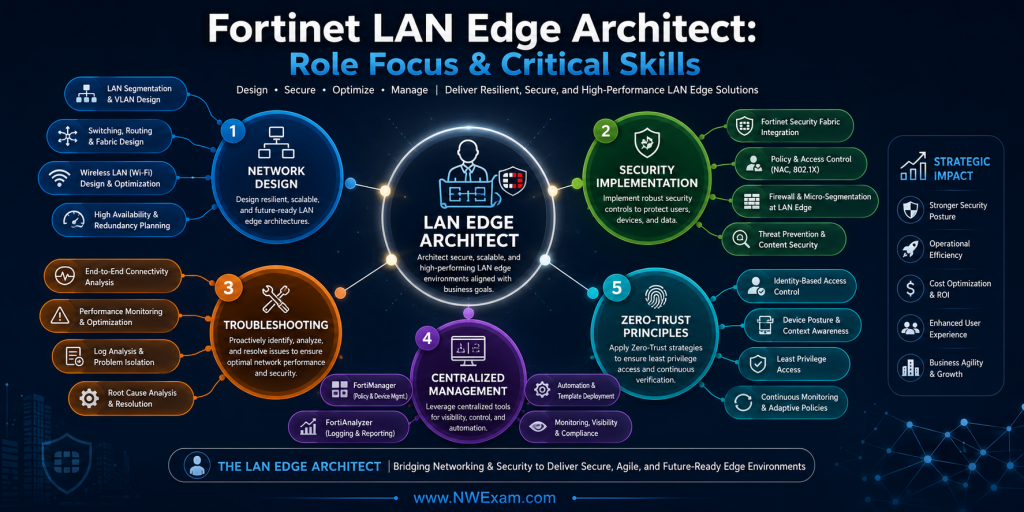
The Fortinet NSE 6 – LAN Edge 7.6 Architect exam assesses knowledge across several key topics:
- Authentication: This domain covers various authentication methods and their integration within Fortinet LAN Edge environments, ensuring secure user and device access.
- Central management: Focuses on leveraging tools like FortiManager and FortiAnalyzer for centralized configuration, monitoring, and policy enforcement across FortiSwitch and FortiAP deployments.
- Zero-trust LAN access: Explores the principles and implementation of Zero-Trust Network Access within the LAN Edge, emphasizing identity-based segmentation and continuous verification.
- Monitoring and troubleshooting: Addresses the skills required to proactively monitor network health, identify performance bottlenecks, and efficiently resolve issues in complex Fortinet LAN Edge infrastructures.
Each topic requires not just theoretical knowledge but also an understanding of how these concepts are applied in real-world Fortinet deployments, forming the backbone of secure and efficient LAN Edge architectures.
Avoiding Surface-Level Study of Foundational Concepts
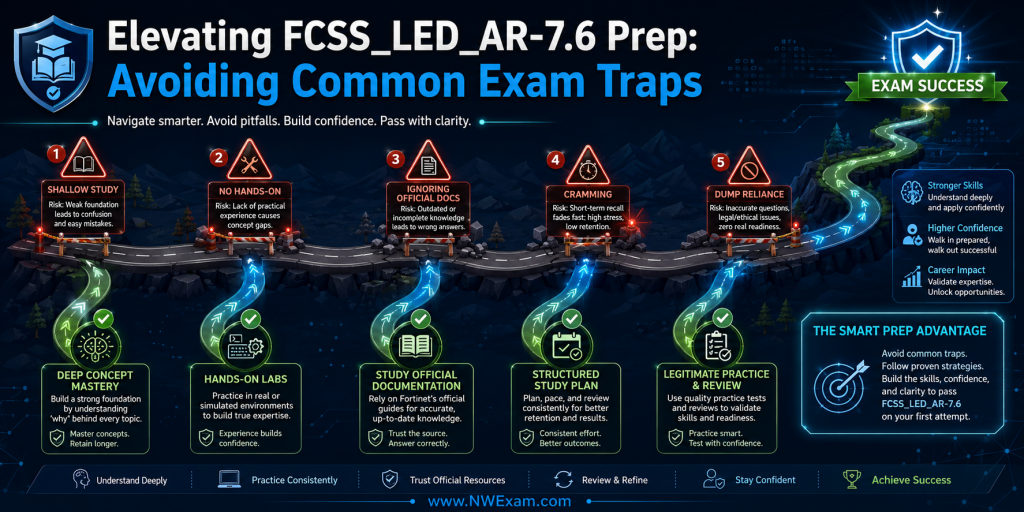
One of the most common mistakes candidates make when preparing for the FCSS_LED_AR-7.6 exam is adopting a shallow approach to foundational topics. Many attempt to memorize configurations or commands without truly grasping the underlying network principles that govern Fortinet LAN Edge solutions. This superficial understanding can be a significant trap, especially when faced with scenario-based questions that require critical thinking and an ability to diagnose complex architectural problems.
Success in the Fortinet NSE 6 – LAN Edge 7.6 Architect exam hinges on a robust comprehension of core networking concepts such as VLANs, link aggregation, DHCP, DNS, and various routing protocols, as they apply to FortiSwitch and FortiAP deployments. Simply knowing “how” to configure a feature is insufficient; an architect must also understand “why” a particular configuration is chosen, its implications on network performance, security, and scalability, and how it integrates into the broader Fortinet Security Fabric. Deepening this foundational knowledge ensures that candidates can adapt their understanding to diverse and challenging exam scenarios, rather than relying on rote memorization.
The Pitfall of Ignoring Interoperability
A significant trap is overlooking how different Fortinet components interoperate. The LAN Edge isn’t just about FortiSwitch and FortiAP; it’s about how these devices seamlessly integrate with FortiGate, FortiManager, FortiAnalyzer, and potentially FortiNAC. Architects must understand the communication flows, API integrations, and policy synchronization mechanisms that bind the entire Fortinet ecosystem together. Without this holistic view, proposed solutions may lack the necessary coherence and security posture.
Bridging Theory with Practical Fortinet Solutions
The FCSS_LED_AR-7.6 certification is an architect-level exam, meaning it demands more than just theoretical knowledge. A critical trap is a lack of practical experience with Fortinet’s LAN Edge components, primarily FortiSwitch and FortiAP. While textbooks and study guides provide essential theory, the nuances of real-world deployment, configuration challenges, and troubleshooting scenarios can only be truly mastered through hands-on practice. Without this practical immersion, even well-studied candidates may struggle to apply their knowledge effectively in the exam’s practical scenarios.
Candidates should actively engage with Fortinet hardware or virtual labs to gain proficiency in:
- FortiLink Configuration: Understanding how FortiSwitch integrates with FortiGate for unified management and policy enforcement.
- FortiAP Deployment: Configuring access points, SSIDs, security profiles, and managing wireless clients.
- Advanced Switching Features: Implementing VLANs, QoS, STP, and port security on FortiSwitch devices.
- Wired and Wireless Security: Applying authentication mechanisms, guest access, and firewall policies across the LAN Edge.
This hands-on experience is invaluable for solidifying theoretical concepts and developing the problem-solving skills necessary for the exam. For further learning and to explore various Fortinet certifications, consider dedicated study tracks and resources that emphasize practical application.
Simulating Real-World Scenarios
Merely configuring devices in isolation is not enough. The key lies in creating and troubleshooting network scenarios that mimic real-world deployments. This includes simulating device failures, network segmentation challenges, and security policy conflicts. Such exercises build critical diagnostic skills and prepare candidates for the complex, multi-layered problems presented in the exam. It transforms passive learning into active problem-solving, a hallmark of an effective architect.
Navigating Complex Scenario-Based Questions
One of the most significant traps candidates fall into during the FCSS_LED_AR-7.6 exam is inadequate preparation for its deeply scenario-based questions. Unlike entry-level certifications that might focus on recall, an architect-level exam presents complex network situations, asking candidates to identify problems, design solutions, or troubleshoot issues within a given Fortinet LAN Edge environment. Simply memorizing facts or command syntax is not enough. Candidates must develop a strategic mindset. They should be able to analyze information effectively. They must also evaluate and synthesize information to solve problems.
To overcome this pitfall, candidates should:
- Deconstruct Scenarios: Learn to break down complex questions into smaller, manageable components. Identify the core problem, the existing infrastructure, and the desired outcome.
- Apply Best Practices: Understand Fortinet’s recommended architectural principles for scalability, security, and performance. Each solution should align with these guidelines.
- Consider Trade-offs: Recognize that real-world architectural decisions often involve compromises. Be prepared to evaluate the pros and cons of different Fortinet solutions based on given constraints.
- Practice with Detailed Cases: Engage with study materials that include comprehensive case studies. Use resources that provide detailed network designs. These materials encourage critical thinking at every decision point.
Engaging with Fortinet FCSS_LED_AR-7.6 sample questions that are heavily scenario-focused can significantly improve your analytical skills and comfort level with these challenging question types. This practice is crucial for developing the architect’s perspective needed for exam success.
Developing an Architectural Mindset
Success in these scenarios relies on adopting an architectural mindset. This involves thinking holistically about network design, not just individual device configurations. It means considering how changes in one part of the network affect others, the implications for future expansion, and how to maintain a consistent security posture. This perspective is built through consistent practice and critical reflection on various Fortinet deployment models and their potential challenges.
Optimizing Time Allocation for the FCSS_LED_AR-7.6 Exam
The 75-minute duration for 35-45 questions in the FCSS_LED_AR-7.6 exam can become a significant trap if not properly managed. Many candidates, armed with extensive knowledge, fail not due to a lack of understanding, but because they run out of time or allocate it inefficiently. Underestimating the time pressure can lead to rushed decisions, overlooked details in scenario questions, or incomplete responses. Effective time management is a skill that must be practiced alongside technical preparation to ensure a fair opportunity at passing.
Strategies for mastering exam time allocation include:
- Pre-Assessment Pacing: Before the actual exam, practice with mock tests under strict timed conditions. This helps establish a realistic pace and identifies areas where you might spend too much time.
- Question Prioritization: Learn to quickly assess questions. If a question appears overly complex or time-consuming, flag it and move on. Return to it only after addressing all other questions you can answer more readily.
- Avoid Overthinking: Trust your initial instincts on multiple-choice questions, especially if you’ve studied thoroughly. Excessive second-guessing can consume valuable minutes.
- Strategic Review: Allocate the last few minutes for a quick review of flagged questions and ensuring all answers are submitted correctly. Focus on questions where you had initial doubts but avoided getting stuck.
Developing a consistent rhythm helps you manage the exam pace effectively. It also builds confidence. This approach reduces anxiety during the exam. It prevents time constraints from affecting your chances of passing.
Beyond Rote Memorization: True Comprehension for FCSS_LED_AR-7.6
A pervasive trap in certification preparation, particularly for a high-level exam like the FCSS_LED_AR-7.6, is the over-reliance on memorizing answers from practice questions or so-called “dumps.” While practice questions are invaluable tools for self-assessment and identifying knowledge gaps, using them as a substitute for genuine understanding is a critical mistake. Fortinet’s architect exams are designed to test deep comprehension of concepts. They also evaluate the practical application of principles. The exams do not focus only on recalling specific solutions to specific problems.
Engaging with practice questions ethically and effectively means:
- Diagnostic Tool: Use practice questions to identify areas where your knowledge is weak. Each incorrect answer should prompt a deeper dive back into the official documentation and study materials.
- Concept Reinforcement: After answering a question, even if correctly, take time to understand *why* that answer is correct and why other options are incorrect. This reinforces the underlying concepts.
- Avoiding “Dumps”: Steer clear of “exam dumps” that promise actual exam questions. These materials are often outdated, inaccurate, and promote a flawed preparation strategy that undermines true learning and ethical standards. Ethical preparation builds real skills, which are far more valuable than a mere credential.
True comprehension for FCSS_LED_AR-7.6 involves understanding Fortinet LAN Edge architecture design best practices, the rationale behind specific configurations, and the implications of various design choices. This approach ensures that you are well prepared for the exam. It also helps you become genuinely competent in the role of a Fortinet LAN Edge Architect.
Leveraging Official Fortinet Resources and Training
A common pitfall is underutilizing or completely ignoring the wealth of official resources provided by Fortinet. In an attempt to find quick fixes or shortcuts, some candidates overlook the most reliable and accurate study materials available. Fortinet designs its certifications based on its official courseware, documentation, and practical guides, making these resources indispensable for FCSS_LED_AR-7.6 preparation. Relying on unofficial or outdated materials can introduce inaccuracies and lead to a skewed understanding of the tested objectives.
To maximize your preparation, consistently consult:
- Fortinet Official Training Courses: These courses are developed by Fortinet experts and align directly with exam objectives, offering structured learning paths.
- FortiDocs and Fortinet Knowledge Base: The official documentation provides comprehensive details on product features, configurations, and deployment best practices. These are critical for understanding the technical nuances.
- Fortinet Whitepapers and Solution Guides: These resources often delve into architectural considerations, design methodologies, and real-world implementation scenarios, which are highly relevant for an architect-level exam.
- Fortinet Community Forums: Engaging with the Fortinet community can provide insights into common challenges and solutions from experienced professionals.
Accessing these authoritative sources ensures that your study is aligned with Fortinet’s current technologies and architectural philosophies, providing the most accurate and up-to-date information for your Fortinet LAN Edge Architect exam details.
Securing Access: Mastering Zero-Trust LAN Principles
The concept of Zero-Trust LAN access is a cornerstone of modern network security, and a significant trap for FCSS_LED_AR-7.6 candidates is a superficial understanding of its implementation within the Fortinet ecosystem. Many candidates grasp the general idea of “never trust, always verify” but fail to delve into the practicalities of how Fortinet integrates this principle into LAN Edge solutions. This includes understanding the role of FortiNAC, identity-based policies, and continuous authentication mechanisms that are crucial for truly securing network access.
To genuinely master Zero-Trust LAN access, candidates must explore:
- Identity and Access Control: How Fortinet leverages user and device identities to enforce granular access policies, moving beyond simple port security or VLAN assignments.
- Micro-segmentation: Designing and implementing micro-segments within the LAN using FortiSwitch capabilities to limit lateral movement of threats.
- Policy Enforcement Points: Understanding how FortiGate, FortiSwitch, and FortiAP act as enforcement points for Zero-Trust policies.
- Continuous Verification: The mechanisms Fortinet uses for ongoing assessment of device posture and user behavior to maintain trust dynamically.
A deep dive into these areas improves your understanding. Practical scenarios provide better real-world knowledge. This approach helps prevent conceptual ambiguity. It also strengthens your ability to architect secure Zero-Trust LAN solutions using Fortinet products.
Integrating FortiNAC for Policy Orchestration
A significant aspect of Fortinet’s Zero-Trust strategy involves FortiNAC. Candidates often overlook the depth required to understand how FortiNAC orchestrates policy enforcement, performs device profiling, and integrates with other Security Fabric components. This is not just about identifying a device; it’s about context-aware policy decisions based on device type, user role, location, and security posture, all dynamically enforced across the LAN Edge. A gap in FortiNAC knowledge can severely impact performance on this exam domain.
Streamlining Operations with Central Management Expertise
Underestimating the importance and complexity of central management for Fortinet LAN Edge solutions is another trap many FCSS_LED_AR-7.6 candidates encounter. In large-scale or distributed environments, manual configuration of individual FortiSwitch and FortiAP devices becomes inefficient and error-prone. The Fortinet NSE 6 – LAN Edge 7.6 Architect exam heavily emphasizes the ability to design solutions that leverage FortiManager for unified configuration and FortiAnalyzer for comprehensive logging and reporting. A superficial understanding of these tools can lead to flawed architectural proposals.
Candidates must therefore focus on:
- FortiManager for Provisioning and Policy: Mastering device registration, template creation, policy packages, and firmware management for FortiSwitch and FortiAP. This includes understanding ADOMs (Administrative Domains) for multi-tenancy or geographical segmentation.
- FortiAnalyzer for Visibility and Compliance: Utilizing FortiAnalyzer for centralized log collection, security event analysis, custom reporting, and compliance auditing specific to LAN Edge traffic and events.
- Automation and Orchestration: Exploring how FortiManager can facilitate automation through scripts and connectors, reducing operational overhead and ensuring consistent deployments across the LAN Edge.
Proficiency in these central management platforms improves operational efficiency. It is also a critical architectural consideration for scalability. Moreover, It helps maintain consistency across the network. It also strengthens the security posture of a Fortinet LAN Edge deployment.
Proactive Monitoring and Troubleshooting in LAN Edge Environments
A significant pitfall for aspiring FCSS_LED_AR-7.6 certified professionals is insufficient preparation in the areas of monitoring and troubleshooting. An architect not only designs and implements a network but must also ensure its ongoing health, performance, and rapid problem resolution. The exam will test your ability to diagnose issues, interpret logs, and apply appropriate tools and methodologies to restore functionality in a Fortinet LAN Edge environment. A purely theoretical understanding of FortiSwitch and FortiAP features without troubleshooting acumen is incomplete.
To avoid this trap, candidates should develop strong skills in:
- FortiAnalyzer Log Analysis: Interpreting logs from FortiSwitch and FortiAP devices, identifying security events, performance issues, and connectivity problems.
- CLI Diagnostics: Utilizing command-line interface (CLI) commands on FortiSwitch and FortiGate (when managing FortiAPs via FortiLink) for real-time status checks, interface statistics, and debugging.
- Network Monitoring Tools: Understanding how to integrate Fortinet devices with SNMP-based NMS (Network Management Systems) or FortiClient EMS for endpoint visibility and control.
- Troubleshooting Methodologies: Applying structured troubleshooting approaches to common LAN Edge issues such as connectivity loss, poor Wi-Fi performance, authentication failures, and policy enforcement discrepancies.
Proficiency in these areas helps you design a robust LAN Edge. It also ensures that you can maintain its integrity and performance after deployment. This is a key responsibility of a Fortinet Architect.
The Discipline of Consistent Study and Avoiding Cramming
The final, yet often underestimated, trap that sabotages success in the FCSS_LED_AR-7.6 exam is the lack of a disciplined and consistent study plan, often replaced by last-minute cramming. The Fortinet NSE 6 – LAN Edge 7.6 Architect exam covers a broad and deep range of topics that require assimilation over time, rather than superficial memorization. Cramming leads to a shallow understanding of concepts. It causes quick forgetting. It also increases anxiety. This makes it very difficult to apply complex concepts in intricate exam scenarios.
To build genuine long-term knowledge and readiness:
- Structured Study Schedule: Develop a realistic study schedule well in advance of the exam date. Break down the syllabus into manageable chunks and allocate dedicated time for each, including review sessions.
- Spaced Repetition: Regularly revisit previously studied topics. This technique helps transfer information from short-term to long-term memory, ensuring concepts are retained and readily accessible during the exam.
- Active Recall: Instead of passively rereading notes, actively test yourself. Create flashcards, practice drawing network diagrams, or try to explain concepts aloud without referring to materials.
- Prioritize Understanding: Focus on truly understanding the “why” and “how” of Fortinet LAN Edge principles rather than just memorizing facts. This depth of knowledge is what allows you to solve complex architectural problems.
Consistent effort over time builds a strong foundation. It reduces stress. It also significantly increases the chances of passing the FCSS_LED_AR-7.6 exam successfully.
Maintaining Mental and Physical Well-being
Consistent study isn’t just about hours at the desk; it’s also about effective learning. Ensuring adequate sleep, taking regular breaks, and maintaining a balanced lifestyle are crucial for cognitive function and information retention. Burnout from excessive cramming can severely impair judgment and focus on exam day. Prioritizing well-being ensures that the mind is sharp and ready to tackle the architectural challenges presented by the exam.
Conclusion
Passing the Fortinet FCSS_LED_AR-7.6 exam is a challenging yet rewarding endeavor, signifying a high level of expertise in Fortinet LAN Edge architecture. By proactively identifying and avoiding the common traps discussed such as surface-level understanding, lack of practical experience, poor time management, and over-reliance on rote memorization candidates can significantly enhance their chances of success. A strategic approach rooted in deep comprehension, hands-on application, and diligent utilization of official Fortinet resources is the most reliable path to earning this distinguished certification.
The journey to becoming a Fortinet NSE 6 – LAN Edge 7.6 Architect demands commitment and smart preparation. Equip yourself with the right knowledge, hone your practical skills, and adopt a systematic study plan. Embrace the challenge, learn from every practice opportunity, and build the expertise that will not only secure your certification but also solidify your standing as a proficient Fortinet LAN Edge professional. Explore comprehensive Fortinet certification resources to begin your strategic preparation today.
Frequently Asked Questions
1. What does the Fortinet FCSS_LED_AR-7.6 certification validate?
The Fortinet FCSS_LED_AR-7.6 certification validates a professional’s advanced architectural skills in designing, implementing, and troubleshooting Fortinet LAN Edge solutions, focusing on FortiSwitch and FortiAP products.
2. What is the recommended approach to study for the Fortinet NSE 6 – LAN Edge 7.6 Architect exam?
A recommended approach involves a combination of deep theoretical study of official Fortinet documentation, extensive hands-on lab practice with FortiSwitch and FortiAP, and consistent engagement with scenario-based practice questions under timed conditions.
3. Are there any specific Fortinet products candidates should focus on for the FCSS_LED_AR-7.6 exam?
Candidates should primarily focus on FortiSwitch and FortiAP integration, along with central management tools like FortiManager and FortiAnalyzer, and security features such as Zero-Trust LAN access and authentication methods.
4. How important is hands-on experience for passing the FCSS_LED_AR-7.6 exam?
Hands-on experience is critically important for the FCSS_LED_AR-7.6 exam. The architect-level questions often require applying theoretical knowledge to practical, real-world deployment and troubleshooting scenarios, which can only be mastered through practical experience.
5. What are the benefits of achieving the Fortinet FCSS_LED_AR-7.6 certification?
Achieving the Fortinet FCSS_LED_AR-7.6 certification demonstrates expert-level competence in Fortinet LAN Edge solutions, enhancing career opportunities, validating advanced technical skills, and recognizing expertise in designing secure and scalable wired and wireless networks.


