The Blue Prism Certified Associate Developer (ADEV01) exam is the credential that turns a Blue Prism trainee into a recognised automation builder. Offered by SS&C Blue Prism, it validates that you can design, build, and deploy software robots on the Blue Prism platform, a leading enterprise robotic process automation tool. This guide breaks down what ADEV01 measures, how the syllabus is weighted, and the exact skills you need to walk in ready.
Passing ADEV01 signals to employers that you understand more than the drag-and-drop surface of Blue Prism. It confirms you can organise reusable objects, structure resilient processes, and push automations into production without breaking them. If you are aiming for an RPA developer role, this is the credential that gets your resume taken seriously.
Table of Contents
- What Does the Blue Prism ADEV01 Certification Prove?
- Who Should Take the Blue Prism Associate Developer Exam?
- What Is the ADEV01 Exam Format and Cost?
- How Is the ADEV01 Syllabus Weighted Across Domains?
- How Do You Master Object Development for ADEV01?
- What Does Process Development Cover on the Exam?
- How Does Process Implementation Test Deployment Skills?
- Object Studio vs Process Studio: What Is the Difference?
- How Should You Prepare for the ADEV01 Exam?
- What Career Paths Open After ADEV01 Certification?
- Frequently Asked Questions
- Conclusion
What Does the Blue Prism ADEV01 Certification Prove?
The Blue Prism Associate Developer certification (ADEV01) proves you can build working automations that follow Blue Prism design standards. It confirms practical fluency in creating reusable objects, structuring processes, and preparing them for deployment. Rather than testing theory alone, ADEV01 checks whether your builds are reliable, well-labelled, and ready to run in a real Control Room environment.
Blue Prism began life in 2001, founded by Alastair Bathgate and David Moss, and became part of SS&C Technologies after a 2022 acquisition valued near 1.6 billion dollars. That heritage matters because the platform is engineered around enterprise-grade governance, and the exam reflects it.
The credential is best understood as a promise to employers: the holder can take a business requirement and produce an automation that other developers can read, reuse, and maintain. As the recognised commercial pioneer of Blue Prism RPA, the vendor sets strict conventions, and ADEV01 measures how closely you follow them.
Who Should Take the Blue Prism Associate Developer Exam?
The ADEV01 exam suits anyone moving into a hands-on Blue Prism development role: new RPA developers, business analysts transitioning into automation, and IT professionals who want a vendor-recognised credential. You do not need years of experience, but you do need real practice building objects and processes inside the platform before you sit it. Developers comparing low-code platforms can also review the Appian Lead Developer exam.
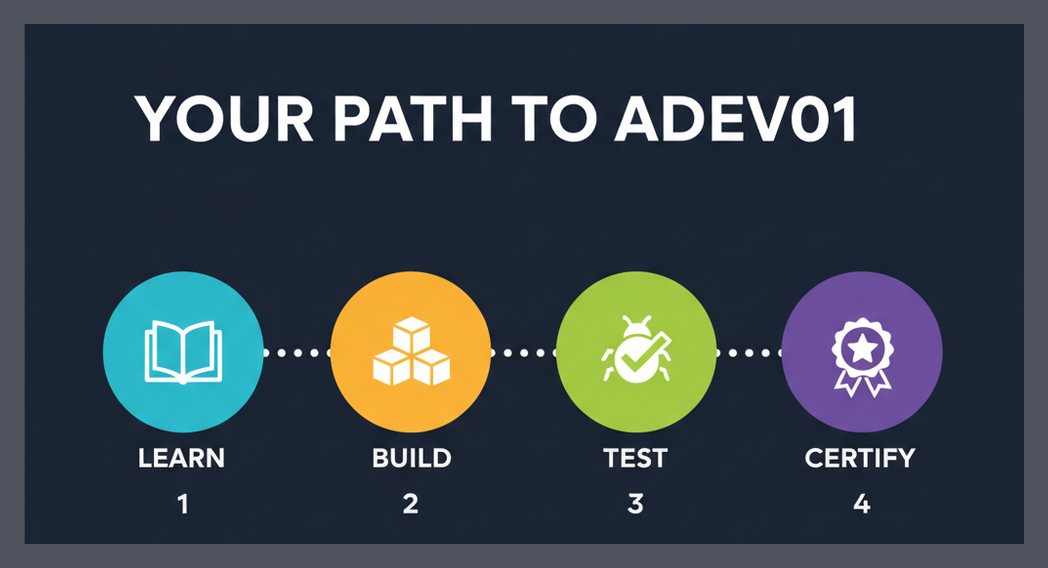
This certification fits several profiles particularly well:
- Aspiring RPA developers who have completed foundational Blue Prism training and want proof of capability.
- Software developers exploring low-code automation who already understand logic, loops, and exception handling.
- Business analysts and process owners who design workflows and want to build them rather than hand them off.
- Support and operations staff aiming to move into delivery teams that maintain a digital workforce.
Coding experience helps but is not mandatory. Blue Prism is visual, so the harder skills to develop are disciplined design and reuse. If you have used other RPA tooling, such as Microsoft Power Automate RPA desktop flows, many concepts will feel familiar, though Blue Prism’s object model is stricter.
What Is the ADEV01 Exam Format and Cost?
The ADEV01 exam is a 50-question assessment that runs for 60 minutes and requires a 70 percent score to pass, with a cost of 140 US dollars. It focuses on practical developer knowledge across object building, process design, and deployment. Understanding the format upfront helps you manage pace, since roughly one minute per question leaves little room for hesitation.
Here are the confirmed exam specifications for the Blue Prism Certified Associate Developer credential:
| Specification | Detail |
|---|---|
| Exam Code | ADEV01 |
| Exam Name | Blue Prism Certified Associate Developer |
| Number of Questions | 50 |
| Duration | 60 minutes |
| Passing Score | 70% |
| Exam Cost | $140 USD |
| Syllabus Domains | 3 (Object, Process, Implementation) |
Because the pass mark is 70 percent, you can afford to miss around 15 questions and still succeed. That margin rewards candidates who practise timed questions before exam day. Working through a realistic ADEV01 practice exam is one of the most effective ways to calibrate your pace and spot weak domains early.
How Is the ADEV01 Syllabus Weighted Across Domains?
The ADEV01 syllabus splits across three official domains: Object Development at 40 percent, Process Development at 40 percent, and Process Implementation at 20 percent. In other words, 80 percent of the exam sits in the two build-focused domains. That weighting tells you exactly where to invest study time if you want the strongest return on effort.
The table below maps each domain to its weight and core focus so you can plan revision around the areas that carry the most marks.
| Domain | Weight | Primary Focus |
|---|---|---|
| Object Development | 40% | Building and labelling reusable objects, Application Modeller, spy modes, wait stages |
| Process Development | 40% | Process templates, work queues, exception handling, loops, utilities, pre-built skills |
| Process Implementation | 20% | Testing, debugging, Control Room execution, logging, release files |
Treat the equal 40 percent weighting of the first two domains as a signal: examiners expect balanced competence in both building objects and assembling them into processes. Neglecting either one puts a pass at genuine risk.
How Do You Master Object Development for ADEV01?
Object Development, worth 40 percent of ADEV01, tests how well you build the reusable components that interact with target applications. You must create standard action types to the best design standard, organise and label objects clearly, and configure Application Modeller elements using consistent naming conventions. Solid object design is the foundation every process later depends on.
Application Modeller and spy modes
The Application Modeller is where Blue Prism captures the elements of a target application. For ADEV01 you need to know the different spy modes used to interact with applications, and when each is appropriate. Choosing the correct spy mode is often the difference between a stable object and one that fails whenever the interface shifts slightly.
Wait stages and standard actions
Reliable objects depend on wait stages that confirm an application is ready before the robot acts. The exam expects you to use wait stages correctly rather than relying on fixed delays. You should also structure standard action types cleanly, so other developers can reuse them without rework.
- Create standard action types that follow Blue Prism design best practice.
- Organise and label objects so they are easy to identify and reuse.
- Apply consistent labelling conventions to Application Modeller elements.
- Select the right spy mode for each application interaction.
- Use wait stages to synchronise the robot with the target application.
What Does Process Development Cover on the Exam?
Process Development, also 40 percent of ADEV01, covers how you assemble objects into complete, resilient automations. It spans process templates, work queues, exception handling, loops, and common utilities. This is the largest practical area of the exam, so expect detailed questions on how a well-structured process should behave when things go wrong.
Work queues and process structure
Work queues are central to how Blue Prism scales work across a digital workforce. You need to build work queues and understand the actions that manage them, from adding items to marking exceptions. Using process templates keeps structure consistent, and knowing when to reuse existing objects, pages, and sub-pages prevents duplicated effort.
Exception handling and control logic
The exam probes your grasp of exception handling types, retry loops, breakpoints, and blocks. You should also be comfortable with loops, process stop controls, and building Decisions, Calculations, Data Items, and Collections accurately. Sound exception handling is what separates a demo automation from a production-ready one.
Additional Process Development skills the syllabus assesses include:
- Applying best-practice standards in Credential Manager and environment variables.
- Using common process utilities such as MS Excel, Collection Manipulation, and File Management.
- Importing and using pre-built skills to accelerate delivery.
- Deciding when to reuse existing objects, pages, and sub-pages.
How Does Process Implementation Test Deployment Skills?
Process Implementation makes up 20 percent of ADEV01 and focuses on getting an automation live and stable. It covers testing actions and processes to reduce errors, debugging steps, and running a process in Control Room. This domain confirms you can move beyond building and actually operate an automation in a managed environment.
Within Control Room, you are expected to configure schedules, identify process errors, and monitor execution. The exam also assesses appropriate use of stage logging, which is critical for diagnosing failures without drowning in noise. Finally, you must know how to create a release file to package an automation for deployment.
Key Process Implementation tasks to practise before exam day:
- Test actions and complete processes to reduce runtime errors.
- Follow structured debugging steps to isolate faults.
- Run a process in Control Room and configure its schedule.
- Identify process errors and apply appropriate stage logging.
- Create a release file to package the automation for deployment.
Object Studio vs Process Studio: What Is the Difference?
Object Studio and Process Studio are the two build environments in Blue Prism, and ADEV01 assumes you know exactly when to use each. Object Studio is where you create business objects that interact with applications, while Process Studio is where you orchestrate those objects into an end-to-end process. Confusing their roles is a common beginner mistake the exam is designed to catch.
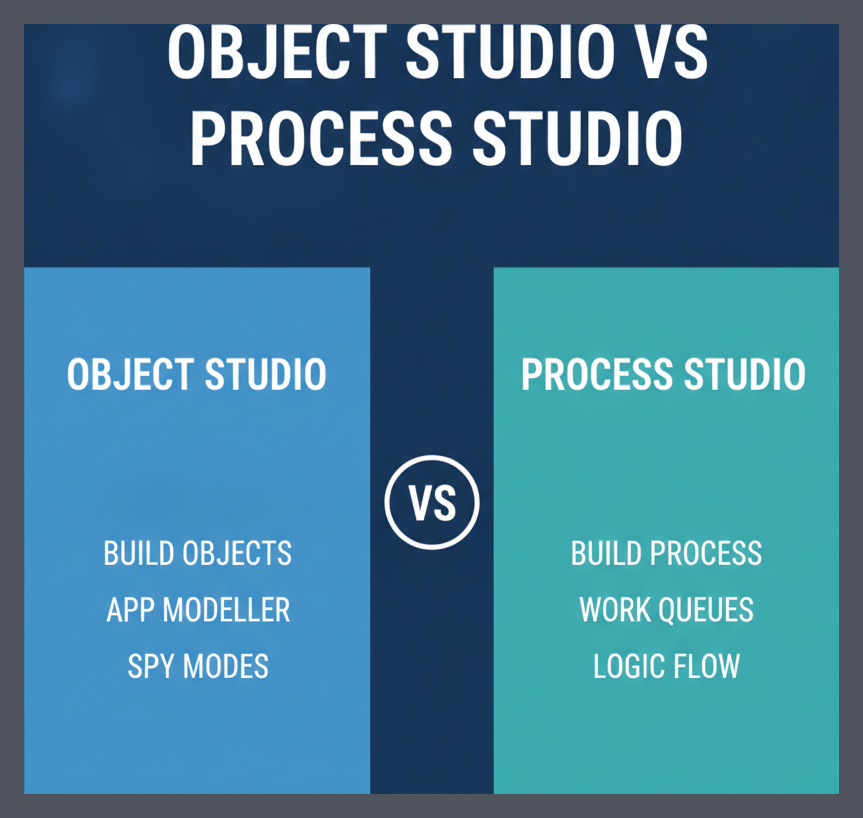
| Aspect | Object Studio | Process Studio |
|---|---|---|
| Primary purpose | Build reusable Visual Business Objects | Orchestrate objects into a full process |
| Interacts with applications | Yes, via Application Modeller | No, only through objects |
| Typical contents | Actions, Application Modeller, wait stages | Work queues, decisions, exception handling |
| Reusability | Designed for reuse across processes | Specific to a business workflow |
The practical rule is simple: application-facing logic belongs in Object Studio, and business logic belongs in Process Studio. Keeping that separation clean is a core Blue Prism design principle, and it recurs throughout the ADEV01 syllabus. For a broader view of the developer pathway, the Blue Prism AD01 certification guide covers the next-level developer credential.
How Should You Prepare for the ADEV01 Exam?
Effective ADEV01 preparation combines hands-on building with focused syllabus review. Because 80 percent of the exam covers Object and Process Development, most study time should go into actually constructing objects, work queues, and exception handling inside Blue Prism. Reading alone rarely passes this exam; muscle memory in the platform does.
A practical study plan looks like this:
- Complete the official Blue Prism foundation training to cover platform basics.
- Build several small objects, practising spy modes, wait stages, and labelling.
- Assemble those objects into a process using a work queue and exception handling.
- Deploy and run your process in Control Room, then create a release file.
- Take timed practice questions to test recall and pace under exam conditions.
Most candidates report that two to four weeks of consistent practice is enough if they already have basic Blue Prism exposure. Focus your final revision on the areas that carry weight: exception handling, work queue actions, spy modes, and Control Room operations. Reviewing sample questions helps you recognise how the exam phrases scenario-based problems.
What Career Paths Open After ADEV01 Certification?
The ADEV01 certification opens the door to roles such as RPA developer, automation engineer, and Blue Prism consultant. It is an entry-level developer credential, so it positions you for hands-on delivery work on automation teams. From there, experienced developers often progress into solution design, technical lead, or RPA architect positions.
Demand for automation skills remains strong across finance, healthcare, insurance, and shared-services operations, all sectors where Blue Prism has a large enterprise footprint. Because Blue Prism sits inside the wider SS&C portfolio, certified developers frequently work alongside broader digital-transformation programmes.
Typical roles and progression for ADEV01 holders include:
- RPA Developer building and maintaining automations against business requirements.
- Automation Engineer supporting a digital workforce and its infrastructure.
- Blue Prism Consultant advising clients on automation delivery and standards.
- RPA Solution Designer or Architect after gaining delivery experience and advanced certifications.
Earning ADEV01 early is a credible first step, and it pairs naturally with higher Blue Prism credentials as your delivery experience grows.
Frequently Asked Questions
What is the Blue Prism ADEV01 certification?
ADEV01 is the Blue Prism Certified Associate Developer exam. It validates that you can build reusable objects, design resilient processes, and deploy automations on the Blue Prism platform following the vendor’s design standards. It is an entry-level developer credential recognised across enterprise RPA teams.
How many questions are on the ADEV01 exam?
The ADEV01 exam contains 50 questions and lasts 60 minutes. That gives you a little over one minute per question, so pacing matters. Practising timed questions beforehand helps you avoid spending too long on any single scenario during the real assessment.
What score do you need to pass ADEV01?
You need 70 percent to pass the Blue Prism Associate Developer exam. On a 50-question paper, that means answering at least 35 questions correctly. The margin lets you miss around 15 questions, which rewards steady preparation across all three syllabus domains rather than last-minute cramming.
How much does the Blue Prism Associate Developer exam cost?
The ADEV01 exam costs 140 US dollars. Budgeting for the exam fee alongside any training you take is worth doing early. Because the exam rewards hands-on practice, most candidates also invest time in building sample automations, which costs effort rather than money.
Do you need coding experience to pass ADEV01?
No, formal coding experience is not required. Blue Prism is a visual, low-code platform, so disciplined design and reuse matter more than writing code. That said, familiarity with logic, loops, and exception handling makes the Process Development domain considerably easier to grasp.
How long does it take to prepare for ADEV01?
Most candidates with basic Blue Prism exposure prepare in two to four weeks of consistent practice. Because Object and Process Development make up 80 percent of the exam, hands-on building of objects, work queues, and exception handling should take priority over passive reading during that time.
What is the difference between Object Studio and Process Studio?
Object Studio is where you build reusable business objects that interact with applications through the Application Modeller. Process Studio is where you orchestrate those objects into a complete workflow using work queues, decisions, and exception handling. Application logic belongs in Object Studio; business logic belongs in Process Studio.
Is the ADEV01 certification worth it for an RPA career?
Yes, for anyone entering RPA delivery. ADEV01 gives you a vendor-recognised credential that confirms practical building skill, which helps when applying for RPA developer roles. It also forms a foundation for higher Blue Prism certifications as you gain real project experience.
Which skills carry the most marks on ADEV01?
Object Development and Process Development each carry 40 percent, so together they account for 80 percent of the exam. Prioritise spy modes, wait stages, work queue actions, and exception handling. Process Implementation, at 20 percent, covers testing, Control Room, logging, and release files.
Conclusion
The Blue Prism Certified Associate Developer (ADEV01) exam is a focused, practical test of whether you can build automations that survive real production use. With 50 questions, a 60-minute limit, and a 70 percent pass mark, it rewards developers who have genuinely practised across Object Development, Process Development, and Process Implementation rather than memorised theory.
Concentrate your effort where the marks are: the two build domains that together carry 80 percent. Build objects, wire them into processes with proper exception handling, and deploy them through Control Room until the workflow feels natural. When you are ready to test your readiness under exam conditions, working through structured ADEV01 practice questions is the logical next step toward earning the credential.


