Storage teams no longer provision capacity by hand, and the Hitachi HQT-6761 exam exists to prove you can run that automation. Formally titled Ops Center Automation Professional, HQT-6761 is a Hitachi Vantara credential that validates practical command of Hitachi Ops Center Automator, the platform that turns repetitive storage tasks into repeatable service workflows. This guide walks through what the certification measures, the official syllabus taken from the exam datacard, and how the Automator engine actually behaves in production. You will see the exam format, the domains you must know, and a preparation plan built around real product features rather than memorised trivia. Whether you administer Hitachi Vantara arrays daily or are moving into storage orchestration, the sections below give you a single, structured path toward passing.
Table of Contents
- What Does the Hitachi HQT-6761 Certification Validate?
- What Are the HQT-6761 Exam Details and Format?
- What Topics Does the Ops Center Automation Professional Syllabus Cover?
- How Does Hitachi Ops Center Automator Work?
- What Are Services, Tasks, and Service Builder in Automator?
- How Does Smart Provisioning Automate Storage?
- How Do the CLI and REST API Extend Automator?
- How Should You Prepare for the HQT-6761 Exam?
- What Career Paths Follow the Automation Certification?
- Frequently Asked Questions About HQT-6761
- Conclusion
What Does the Hitachi HQT-6761 Certification Validate?
The Hitachi HQT-6761 certification, Ops Center Automation Professional, validates that you can design, run, and administer automated storage operations using Hitachi Ops Center Automator. It confirms you understand Automator architecture, service and task management, Smart Provisioning, Service Builder, and both the CLI and REST API. In short, HQT-6761 proves you can operate Hitachi Ops Center Automation at a professional level.
This credential targets the shift from manual array administration to policy-driven service delivery. Instead of measuring hardware trivia, it checks whether you can translate a provisioning request into a repeatable workflow that the platform executes safely. That focus makes it valuable for engineers who already run Hitachi storage and want proof they can scale operations without adding headcount.
The exam sits within the broader Hitachi Vantara storage track. Professionals who hold adjacent credentials often expand into automation next, moving from platform administration toward orchestration. If you are mapping a wider learning route, the HQT-4180 certification path covers Virtual Storage Platform midrange skills that pair naturally with Automator knowledge.
What Are the HQT-6761 Exam Details and Format?
The HQT-6761 exam contains 35 questions and gives you 60 minutes to complete them. You must score 65 percent to pass, and the exam costs $100 USD. These figures come directly from the Hitachi Vantara Ops Center Automation Professional datacard, so plan your pacing around roughly 100 seconds per question, leaving time to review flagged items before you submit.
Because the passing bar sits at 65 percent, you can miss several questions and still qualify, yet the tight question count means every domain carries weight. There is no single throwaway topic. The table below summarises the core specifications you should confirm before booking.
| Exam Attribute | Detail |
|---|---|
| Exam Code | HQT-6761 |
| Exam Name | Ops Center Automation Professional |
| Number of Questions | 35 |
| Duration | 60 minutes |
| Passing Score | 65% |
| Exam Cost | $100 USD |
Treat the clock as your main constraint. With only 60 minutes, reading each scenario carefully on the first pass usually beats rushing and revisiting. Candidates who have taken it report that clear knowledge of Automator terminology removes most of the time pressure.
What Topics Does the Ops Center Automation Professional Syllabus Cover?
The HQT-6761 syllabus spans seven topic areas, moving from Automator fundamentals through administration, service management, Smart Provisioning, Service Builder, the CLI, and the REST API. Each area maps to a real function inside Hitachi Ops Center Automator, so studying the product directly is the most efficient way to cover the blueprint. The table below lists every official section and its objectives.
| Syllabus Section | Objectives Covered |
|---|---|
| Automator Overview | Describe Hitachi Ops Center Automator architecture and functionality; list key features; describe the various use cases for Automator. |
| Automator GUI and Administration | Describe the Automator GUI and the use of the tabs; describe Automator workflows; describe user roles and their functions; describe how to administer Automator. |
| Services and Tasks Management | Describe service creation; describe task management; describe how to identify and customize services; describe how to use and execute services. |
| Smart Provisioning | Describe how Smart Provisioning helps customers provision storage based on their configuration; describe how it helps optimize storage utilization based on resource consumption. |
| Service Builder | Describe Automator Service Builder functionality. |
| Automator Command Line Interface | Describe the use of Automator CLI commands. |
| Automator REST API | Describe the Automator REST API architecture and its usage. |
Notice how the blueprint climbs in complexity. It starts with concepts, moves into daily administration, then reaches programmatic control through the CLI and REST API. To rehearse the question style before exam day, work through a set of HQT-6761 practice questions that mirror how these objectives are tested.
How Does Hitachi Ops Center Automator Work?
Hitachi Ops Center Automator works as an orchestration layer that packages storage operations into reusable services. Administrators define what a task should do once, and Automator repeats it consistently across the environment. The HQT-6761 exam expects you to describe its architecture, navigate the GUI tabs, follow workflows, and understand how user roles control who can build, run, or approve automation.
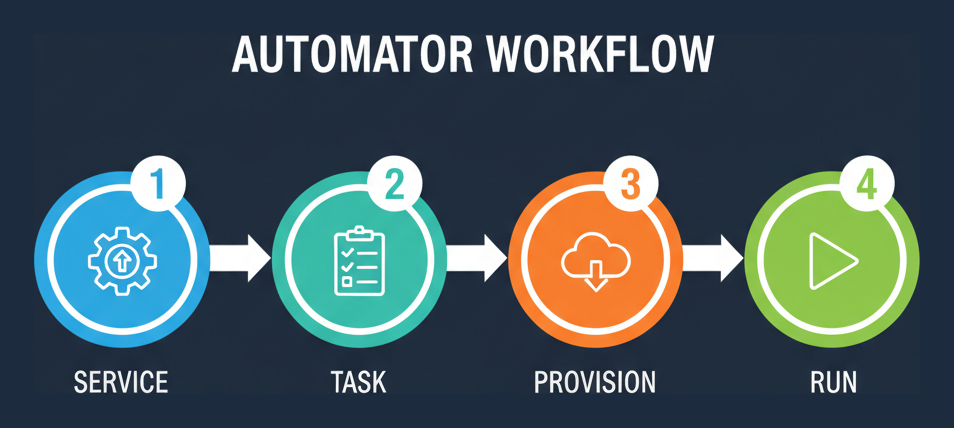
The Automator GUI and workflows
The graphical interface is organised into tabs that separate day-to-day activity from configuration. Operators typically request and monitor services, while administrators manage templates, connections, and permissions. Workflows tie these pieces together, moving a request through submission, task execution, and completion with a clear audit trail.
User roles and administration
Automator uses role-based access so that responsibilities stay separated. A submit-only user can run approved services without altering them, whereas an administrator maintains templates and system settings. For exam purposes, know which role performs which action, since several objectives target this distinction. Teams running Hitachi arrays often deploy Automator alongside VSP platforms covered in the VSP 360 storage guide, so understanding both layers helps in real deployments.
What Are Services, Tasks, and Service Builder in Automator?
In Hitachi Ops Center Automator, a service is a published, reusable automation that a user can run, and a task is the individual execution of that service. Service Builder is the development environment where you create and customise the templates behind those services. The HQT-6761 exam tests how you create services, manage tasks, and extend functionality through Service Builder.
Services and task management
A service turns a storage procedure, such as allocating a volume, into a form-driven request. When a user submits it, Automator generates a task and tracks its progress to completion. Managing tasks means monitoring status, handling failures, and confirming that each execution produced the intended result. Because the exam covers identifying and customising services, you should know how to adapt an existing template to a new requirement.
Building with Service Builder
Service Builder lets you assemble workflows from plug-ins and existing building blocks rather than scripting everything from scratch. It supports customisation for site-specific processes, which is where automation delivers the most value. The official Ops Center Automator User Guide details the service catalog and template structure that these objectives draw from.
- Create a service from an existing template and publish it for users.
- Monitor tasks and interpret status to confirm successful execution.
- Customise service properties to match local naming and configuration rules.
- Use Service Builder to combine steps into a repeatable workflow.
How Does Smart Provisioning Automate Storage?
Smart Provisioning is the Hitachi Ops Center Automator capability that provisions storage based on a customer’s configuration and then optimises utilisation according to actual resource consumption. Rather than manually selecting pools and volumes, an administrator relies on Automator to place capacity intelligently. HQT-6761 asks you to describe both the provisioning and optimisation sides of this feature.
On the provisioning side, Smart Provisioning reads the existing configuration and allocates capacity that fits the requested profile. This reduces guesswork and enforces consistency across requests. On the optimisation side, it evaluates how resources are being consumed and helps keep utilisation efficient over time, which matters as data volumes grow.
This aligns with the wider discipline of storage resource management, where the goal is to match capacity to demand without stranding expensive space. For the exam, focus on the two outcomes the objectives name directly: provisioning by configuration and optimisation by consumption.
How Do the CLI and REST API Extend Automator?
The Hitachi Ops Center Automator CLI and REST API let you drive automation without the graphical interface. The CLI runs Automator commands from a terminal or script, while the REST API exposes Automator functions to external systems and integrations. HQT-6761 expects you to describe CLI command usage and the REST API architecture and its purpose.
When the CLI helps
Command line access suits repeatable, scriptable operations and integration with existing job schedulers. Knowing the general purpose of Automator CLI commands, rather than memorising every switch, matches what the objective requires.
Why the REST API matters
The REST API is how Automator participates in larger automation ecosystems. External tools can submit services, query tasks, and retrieve results programmatically, which lets storage provisioning slot into broader IT service management pipelines. For the exam, understand the architecture at a conceptual level: resources are addressed over HTTP, and the API returns structured responses that other systems consume.
How Should You Prepare for the HQT-6761 Exam?
Preparing for HQT-6761 works best when you combine hands-on Automator practice with structured review of the seven syllabus areas. Because the exam has only 35 questions, coverage matters more than depth in any single topic. A short, consistent study routine that touches every domain will serve you better than long sessions on one feature.
- Map your study plan to the seven official syllabus sections and rate your confidence in each.
- Spend hands-on time in the Automator GUI, running services and reviewing tasks to reinforce workflows.
- Read the official documentation for Service Builder, Smart Provisioning, the CLI, and the REST API.
- Rehearse with sample questions to learn the phrasing and pacing before exam day.
- Review vendor learning paths through Hitachi Vantara training to fill any gaps.
Avoid relying on unofficial dumps, which rarely reflect the current blueprint. Instead, anchor your revision in the product and its guides. If you can explain each objective aloud in plain language, you are ready to sit the exam with confidence.
What Career Paths Follow the Automation Certification?
HQT-6761 supports careers in storage administration, infrastructure automation, and IT operations engineering. As enterprises push toward self-service infrastructure, professionals who can automate provisioning become harder to replace. The certification signals that you can reduce manual effort and enforce consistency, which are qualities hiring managers value in senior storage and platform roles.
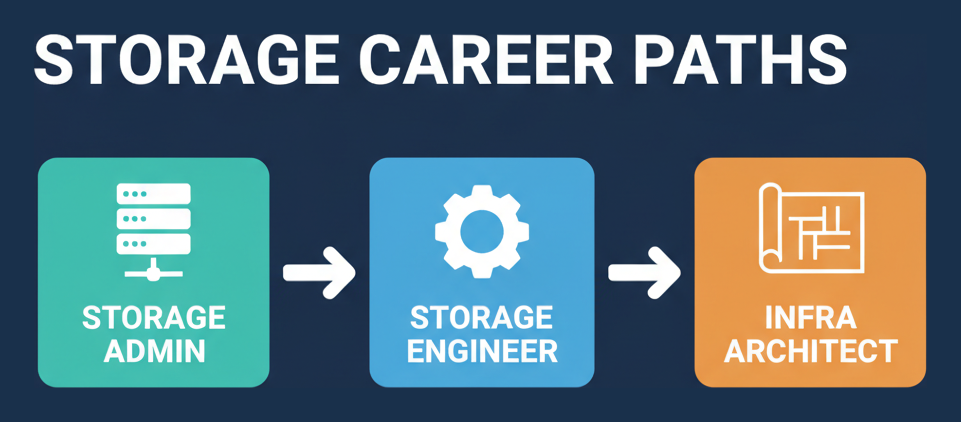
Common roles that benefit from Automator skills include:
- Storage administrator moving toward orchestration responsibilities.
- Infrastructure automation engineer building self-service provisioning.
- IT operations specialist integrating storage into service catalogs.
- Data center engineer standardising repeatable workflows.
Automation expertise also compounds. Once you can express storage operations as services and expose them through the REST API, you become the bridge between storage teams and wider DevOps or ITSM initiatives. That positioning often leads to architecture and lead engineering tracks over time.
Demand for these skills tracks the growth of enterprise data. As organisations manage more capacity across hybrid environments, the ability to standardise provisioning and cut manual toil directly protects service levels. A professional credential such as HQT-6761 gives hiring teams a clear signal that you can deliver that consistency, which strengthens your case for storage engineering and platform automation roles.
Frequently Asked Questions About HQT-6761
What is the HQT-6761 certification?
HQT-6761 is the Hitachi Vantara Ops Center Automation Professional certification. It validates your ability to administer and automate storage operations using Hitachi Ops Center Automator, including services, tasks, Smart Provisioning, Service Builder, the CLI, and the REST API.
How many questions are on the HQT-6761 exam?
The exam has 35 questions. You have 60 minutes to answer them, which averages to roughly 100 seconds per question. Careful first-pass reading usually leaves enough time to review any flagged items before submitting.
What score do you need to pass HQT-6761?
You need 65 percent to pass. With 35 questions, that means answering enough items correctly across all seven syllabus areas. Because coverage is broad and the count is small, no single domain can be safely ignored.
How much does the HQT-6761 exam cost?
The HQT-6761 exam costs $100 USD. Confirm current pricing and scheduling details when you register, since delivery arrangements and regional taxes can affect the final amount you pay.
What is Hitachi Ops Center Automator?
Hitachi Ops Center Automator is a software platform that turns storage operations into reusable, form-driven services. Administrators define a task once, and the platform executes it consistently, reducing manual effort and enforcing standard configurations across the environment.
Is Ops Center Automation Professional suitable for beginners?
The credential is aimed at practitioners rather than newcomers. Some familiarity with Hitachi storage administration helps you connect Automator features to real provisioning tasks. Beginners can still pass with focused hands-on practice against the seven syllabus areas.
What is Smart Provisioning in Automator?
Smart Provisioning allocates storage based on the existing configuration and then optimises utilisation according to actual resource consumption. It removes much of the manual pool and volume selection, helping teams keep capacity efficient as demand grows.
How do the CLI and REST API differ in Automator?
The CLI runs Automator commands from a terminal or script for repeatable local operations. The REST API exposes Automator functions to external systems over HTTP, letting other tools submit services and retrieve results as part of larger automation pipelines.
How long does it take to prepare for HQT-6761?
Preparation time varies with experience. Practitioners who already run Hitachi storage often need two to four weeks of steady study, while those new to Automator should plan longer to build hands-on familiarity with each syllabus area.
Conclusion
HQT-6761 rewards genuine command of Hitachi Ops Center Automation rather than rote memorisation. The exam is compact, 35 questions in 60 minutes at a 65 percent pass mark, yet it spans the full Automator stack from architecture and administration to Smart Provisioning, Service Builder, the CLI, and the REST API. Ground your study in the seven official syllabus areas, spend real time inside the product, and rehearse the question style until the terminology feels natural. When you are ready to test your readiness, working through a focused set of sample questions is the logical next step toward passing with confidence and moving your storage career into automation.


