
This article explains what the role demands, what the CPSA exam actually tests, and how the eight official syllabus domains map to real skills you will use on the job. You will also find a practical preparation plan, the certification’s career payoff, and answers to the questions candidates ask most before they register. Everything here focuses on one outcome: helping you pass the exam and step confidently into Pega delivery work.
Table of Contents
- What Does a Pega System Architect Actually Do?
- What Is on the CPSA Exam?
- Which Domains Does the CPSA Syllabus Cover?
- How Does Case Management Shape the Pega Platform?
- How Do Data Models and Integration Work in Pega?
- What UX and Decisioning Skills Does the Exam Test?
- How Should You Prepare for the CPSA Exam?
- What Career Paths Open After Becoming a Pega System Architect?
- Frequently Asked Questions
- Conclusion
What Does a Pega System Architect Actually Do?
A Pega system architect configures applications on the Pega Platform using its model-driven, low-code tooling rather than hand-coding every feature. The CPSA certification confirms you can build case types, design data models, wire up integrations, and shape user interfaces that meet business needs. In practice, the role blends software design thinking with a strong grasp of how Pega’s rule-based engine assembles applications.
The work is less about typing code and more about assembling reusable rules. You spend your day translating requirements into case life cycles, defining how data flows between systems, and making sure the application behaves correctly for different user roles. Because Pega is a leader among low-code development platforms, the skills transfer across banking, insurance, healthcare, and government projects.
Typical responsibilities include:
- Designing case types and their stages, steps, and processes
- Building data models and connecting external systems through integrations
- Creating views, forms, and portals for end users
- Applying security roles and access controls
- Supporting deployment and application health monitoring
The credential targets developers and technical staff who want a verified baseline before moving into senior design work. You can review the full track through the official Pega certification programs to see where the CPSA fits.
What Is on the CPSA Exam?
The CPSA exam, version PEGACPSA25V1, contains 60 multiple-choice questions and gives you 90 minutes to complete them. You need a score of 65% to pass, and the exam fee is USD $190. It is delivered through Pearson VUE, so you can sit it at a test centre or online under proctored conditions. The format rewards candidates who have built applications, not just read about them.
Here are the core exam specifications at a glance:
| Specification | Detail |
|---|---|
| Exam name | Certified Pega System Architect (CPSA) |
| Exam version | PEGACPSA25V1 |
| Number of questions | 60 |
| Duration | 90 minutes |
| Passing score | 65% |
| Question format | Multiple choice |
| Exam fee | USD $190 |
| Delivery | Pearson VUE |
Because the pass mark sits at 65%, you can afford to miss a fair share of questions, yet the breadth of the syllabus means weak areas add up quickly. Working through a realistic set of CPSA practice questions is the fastest way to find those gaps before exam day. When you are ready to book, schedule the test through Pearson VUE exam scheduling.
“The Certified Pega System Architect certification provides a baseline measurement on your knowledge of Pega Platform.”
Which Domains Does the CPSA Syllabus Cover?
The CPSA syllabus is divided into eight weighted domains, and each one reflects a distinct part of building a Pega application. Case Management carries the most weight at 25%, followed by Data and Integration at 20%. Together these two domains account for nearly half the exam, so they deserve the largest share of your study time. The remaining domains cover development, security, experience, and newer platform capabilities.
The official domain breakdown and weightings are shown below:
| Domain | Weight |
|---|---|
| Case Management | 25% |
| Data and Integration | 20% |
| Application Development | 15% |
| Security | 10% |
| User Experience | 10% |
| Pega GenAI | 10% |
| DevOps | 5% |
| Insights | 5% |
Notice that Pega GenAI now carries the same 10% weight as Security and User Experience. That change reflects how generative AI features have moved into mainstream Pega delivery. DevOps and Insights round out the syllabus at 5% each, so while they matter, they should not consume the bulk of your revision.
How Does Case Management Shape the Pega Platform?
Case management is the heart of the Pega Platform and the largest CPSA domain at 25%. A case represents a unit of work, such as a loan application or a service request, that moves through defined stages until it reaches resolution. As a Pega system architect, you design these case types so the application guides users and automated steps toward the right outcome every time.
Stages, Steps, and Processes
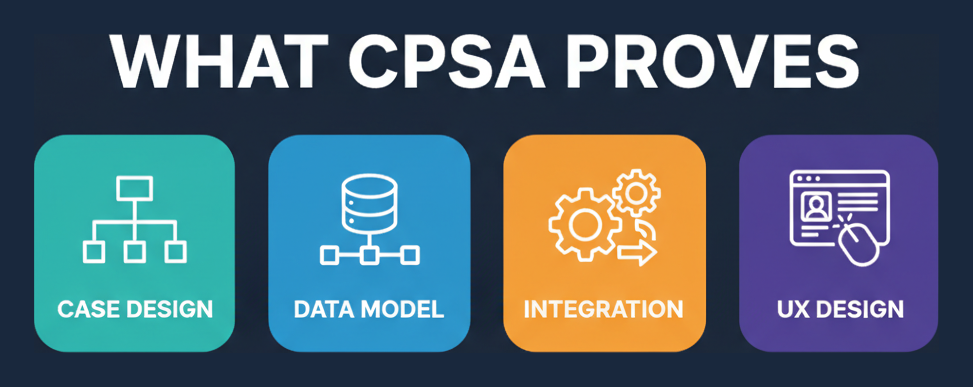
Pega uses a stage-based life cycle to model how work progresses. You break a case into stages, then add steps and processes inside each one. This visual structure is what lets business stakeholders read the design without seeing code.
- Stages define the major phases of the work
- Steps represent individual actions or approvals
- Processes group steps into repeatable flows
- Service level agreements set deadlines and escalation
Automation and Routing
Beyond the life cycle, you configure how cases route to the correct users or work queues. Assignments, decision logic, and automated steps keep work moving without manual handoffs. Mastering this domain means understanding how a case gathers data, triggers actions, and closes cleanly, because every other domain plugs into the case at some point.
How Do Data Models and Integration Work in Pega?
Data and Integration is the second-largest CPSA domain at 20%, and it governs how a Pega application stores information and talks to other systems. You design data models using data types, fields, and relationships, then connect them to external sources through connectors and data pages. Strong data design keeps an application accurate, fast, and easy to maintain as requirements grow. Integration design carries across platforms, and the blockchain architect credential covers the same concerns where the system of record is a distributed ledger.
In Pega, data does not live in isolation. A well-built application pulls customer records, pricing, or inventory from systems of record rather than duplicating them. Key concepts in this domain include:
- Data types and field definitions that model business entities
- Data pages that load and cache information on demand
- Connectors and integrations to REST, SOAP, and database sources
- Data transforms that map and reshape values between structures
Because integrations often decide whether a project succeeds, the exam expects you to know when to source data live versus store it locally, and how to keep those calls efficient. Practising with real data pages and simple REST connections during study will make these questions far easier to answer under time pressure.
What UX and Decisioning Skills Does the Exam Test?
The CPSA exam blends front-end experience with newer intelligent capabilities across three domains: User Experience at 10%, Pega GenAI at 10%, and Insights at 5%. Together they test whether you can present work clearly to users, apply generative AI features responsibly, and surface data that helps teams act. These areas show how modern Pega applications go beyond simple forms.
User Experience
User Experience covers how you build views, forms, and portals so end users can complete work smoothly. You configure UI elements, control what each role sees, and design layouts that adapt across devices. Clean experience design reduces training time and errors in production.
Pega GenAI and Insights
Pega GenAI introduces generative AI features that assist users and speed up development, and its 10% weighting signals how central it has become. Insights, at 5%, focuses on dashboards and reports that turn case data into visible metrics. Application Development, weighted at 15%, ties these threads together by testing how you assemble, reuse, and organise rules across the whole application.
How Should You Prepare for the CPSA Exam?
Effective CPSA preparation combines hands-on platform practice with structured revision of all eight domains. Because the exam rewards real building experience, the strongest candidates spend far more time inside Pega than reading about it. A focused plan of four to six weeks is realistic for someone already working with the platform, and longer for complete beginners.
Follow this preparation sequence:
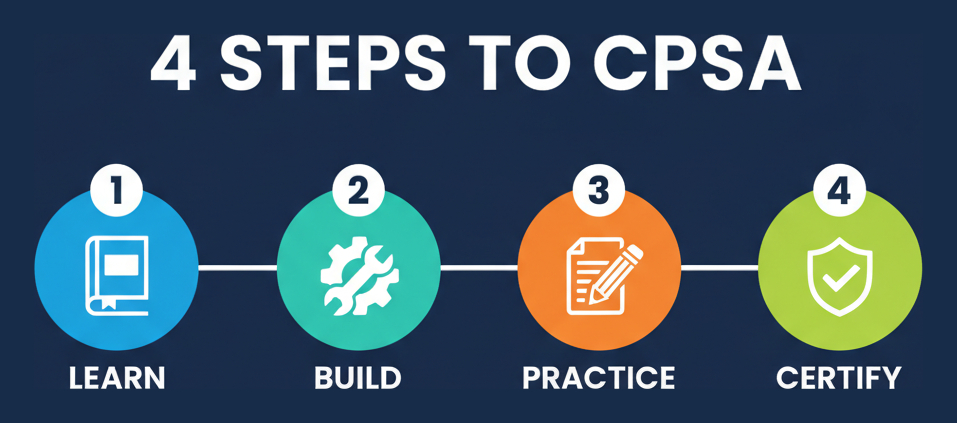
- Complete the System Architect learning path on Pega Academy training and build the mission exercises yourself
- Weight your study time by domain, starting with Case Management and Data and Integration
- Build a small end-to-end application so concepts connect rather than sit in isolation
- Take timed practice tests and review every wrong answer against the syllabus
- Revisit weak domains in the final week before your exam date
Candidates who have passed often note that the questions feel practical rather than theoretical, so memorising definitions alone rarely works. For extra revision structure, these CPSA study tips offer a proven routine you can adapt to your own schedule. Consistency across the full syllabus matters more than deep expertise in any single area.
What Career Paths Open After Becoming a Pega System Architect?
Earning the CPSA opens the door to hands-on Pega delivery roles and sets up a clear route toward senior design positions. Employers across banking, insurance, telecom, and public services hire certified system architects to build and maintain their Pega applications. The credential signals that you can contribute to a project team from day one, which shortens onboarding and boosts your hiring appeal.
Common roles and progression include:
- Pega System Architect building and configuring applications
- Pega Developer focused on rule design and integration
- Application delivery consultant working with client teams
- Senior architect roles that own solution design and standards
The natural next step after CPSA is the senior credential, which deepens your design and architecture responsibility. If you plan to grow into that level, this overview of the Senior System Architect path shows how the roles and rewards expand. Many professionals treat CPSA as the foundation of a multi-year Pega career rather than a one-off certificate.
Frequently Asked Questions
What is the Certified Pega System Architect certification?
The CPSA is an entry-level Pegasystems credential that verifies you can build applications on the Pega Platform using its low-code tools. It confirms baseline skills in case design, data modelling, integration, security, and user experience, making it the starting point of the Pega technical career track.
How many questions are on the CPSA exam?
The CPSA exam contains 60 multiple-choice questions. You have 90 minutes to answer them, which averages about 90 seconds per question. The pace is comfortable if you know the material, but unfamiliar domains can slow you down, so broad preparation matters.
What is the passing score for the CPSA exam?
You need to score 65% or higher to pass the CPSA exam. Because the questions span eight weighted domains, missing an entire topic area can pull you below the line even if you are strong elsewhere. Balanced study across all domains is the safest strategy.
How much does the CPSA exam cost?
The CPSA exam fee is USD $190. You register and schedule the exam through Pearson VUE, either at a physical test centre or online with remote proctoring. Check current regional pricing at registration, as taxes and local charges may apply.
Which domain carries the most weight on the CPSA exam?
Case Management is the heaviest domain at 25%, followed by Data and Integration at 20%. These two areas together make up 45% of the exam, so most candidates dedicate the largest share of their preparation time to mastering case design and data handling.
Do I need coding experience to become a Pega system architect?
No, deep coding experience is not required, because Pega is a low-code platform built around visual, model-driven configuration. That said, general software design awareness helps. The exam focuses on how you assemble rules, cases, and data rather than on writing traditional program code.
How long does it take to prepare for the CPSA exam?
Most candidates who already use Pega need about four to six weeks of focused study. Complete beginners should plan for longer and build a sample application to gain hands-on practice. Time spent inside the platform matters more than passive reading for this exam.
Is the CPSA certification worth it for my career?
Yes, the CPSA is widely recognised by employers who run Pega applications across finance, insurance, and government. It shortens onboarding, supports higher earning potential, and provides the foundation for senior Pega roles, making it a strong return on a modest investment of time and fee.
Conclusion
Becoming a Pega system architect starts with understanding what the CPSA measures and building the hands-on skills behind each of its eight domains. Case Management and Data and Integration lead the syllabus, but a balanced grasp of development, security, experience, GenAI, DevOps, and Insights is what carries you past the 65% pass mark. Treat the exam as proof of what you can build, not just what you can recall.
With a focused study plan, real platform practice, and steady revision across every domain, the CPSA is well within reach. When you are ready to test your readiness, work through a full set of CPSA practice questions and use your results to guide the final week of preparation before you book the exam.


