Rather than treating the credential as a checkbox, we focus on the outcome you are working toward: becoming the person a team trusts to manage identities, storage, compute, networking, and monitoring across a live Azure subscription. You will find the official skills-measured breakdown, practical preparation tactics, and an honest look at where the certification can take your career. If you already work with the Azure portal, PowerShell, or the Azure CLI, most of this will feel like naming skills you are building anyway.
Table of Contents
- What Does a Microsoft Azure Administrator Do?
- What Is the AZ-104 Exam Format?
- What Skills Does the AZ-104 Exam Measure?
- How Do You Manage Azure Identities and Governance?
- How Do You Implement and Manage Azure Storage?
- Deploying and Managing Azure Compute Resources
- How Do You Configure Azure Virtual Networking?
- Monitoring and Maintaining Azure Resources
- How Should You Prepare for the AZ-104 Exam?
- What Career Paths Open After You Certify?
- Frequently Asked Questions
- Conclusion
What Does a Microsoft Azure Administrator Do?
A Microsoft Azure administrator implements, manages, and monitors an organization’s Azure environment, covering virtual networks, storage, compute, identity, security, and governance. The AZ-104 certification validates exactly this scope. Administrators rarely work alone; they coordinate with security, database, DevOps, and application teams to keep cloud infrastructure reliable, cost-aware, and compliant.
In practice, the role is hands-on. You provision resources, tune access with role assignments, respond to alerts, and troubleshoot connectivity when something breaks. Microsoft positions this as an intermediate credential, so it expects real familiarity rather than beginner theory.
Before attempting the exam, candidates are expected to be comfortable with several foundations:
- Operating systems, networking, servers, and virtualization concepts
- PowerShell and the Azure CLI for scripted administration
- The Azure portal for daily management tasks
- Azure Resource Manager (ARM) templates or Bicep files
- Microsoft Entra ID for identity and access
If those tools are already part of your week, the certification mostly formalizes skills you use. If they are new, treat that list as your starting syllabus before diving into exam-specific study.
What Is the AZ-104 Exam Format?
The AZ-104 exam runs for 120 minutes and presents between 40 and 60 questions drawn from five skill areas. It is delivered through Pearson VUE, costs $165 USD, and requires a scaled score of 700 out of 1000 to pass. Questions mix multiple choice, case studies, and hands-on style scenarios, so rote memorization alone will not carry you through.
The table below summarizes the core exam specifications candidates ask about most:
| Specification | Detail |
|---|---|
| Exam code | AZ-104 |
| Certification | Microsoft Certified – Azure Administrator Associate |
| Number of questions | 40-60 |
| Duration | 120 minutes |
| Passing score | 700 / 1000 |
| Exam cost | $165 USD |
| Registration provider | Pearson VUE |
Because scoring is scaled rather than a flat percentage, individual questions carry different weights. Working through a realistic set of AZ-104 practice questions helps you gauge readiness against the actual style and difficulty before you book a seat. Aim to consistently clear the equivalent of the passing bar under timed conditions.
What Skills Does the AZ-104 Exam Measure?
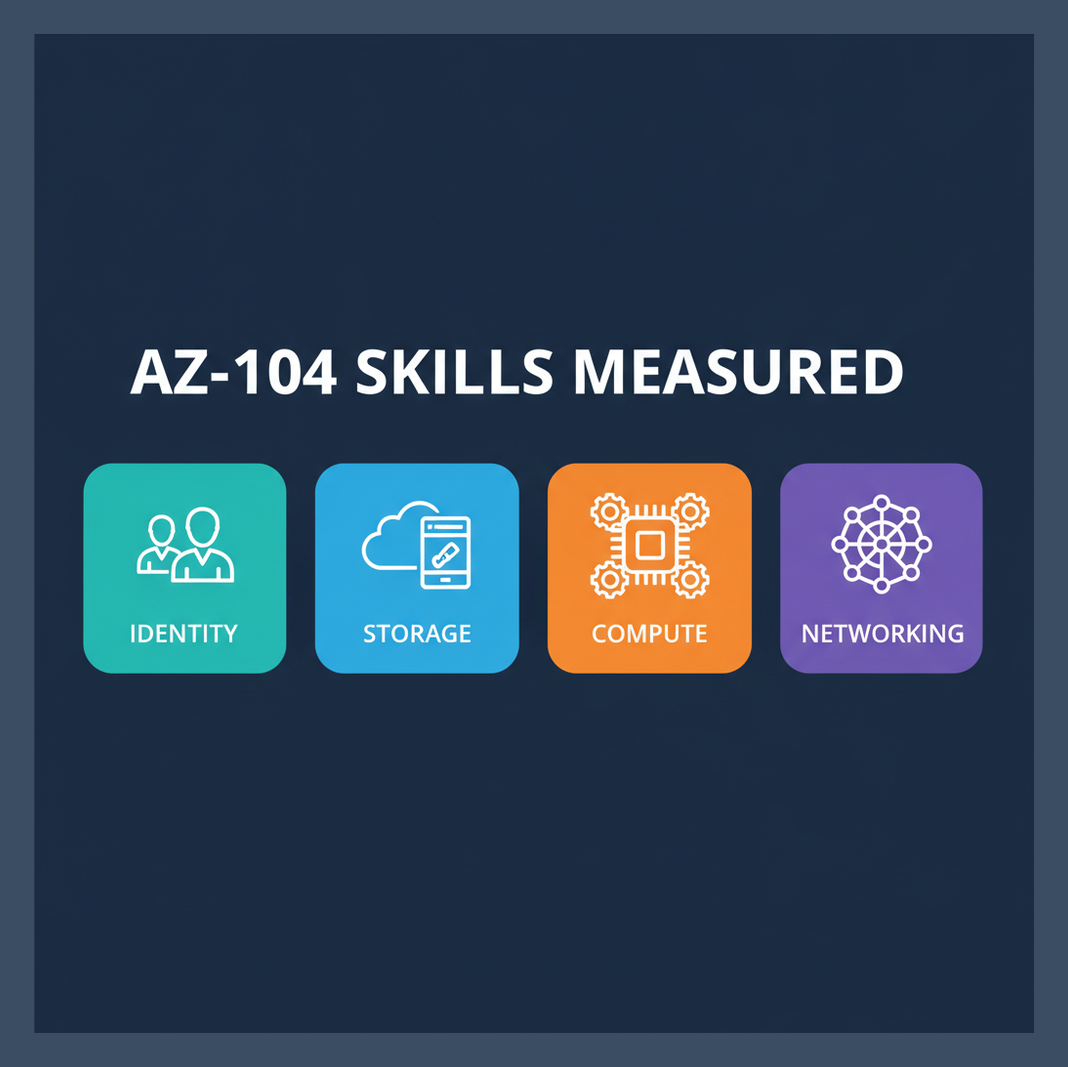
The AZ-104 exam measures five skill areas, each carrying a published weighting that tells you where to concentrate study time. Identity, governance, and compute together account for the largest share, while monitoring sits at the lighter end. Knowing these percentages lets you allocate preparation hours in proportion to how heavily each area is assessed.
| Skill area | Weighting |
|---|---|
| Manage Azure identities and governance | 20-25% |
| Implement and manage storage | 15-20% |
| Deploy and manage Azure compute resources | 20-25% |
| Implement and manage virtual networking | 15-20% |
| Monitor and maintain Azure resources | 10-15% |
Two takeaways follow from this split. First, identity and compute reward the most study because they carry the highest combined weight. Second, no area is small enough to skip, since even the lightest band can decide a borderline result. Treat all five as required, then invest extra hours where the percentages are highest.
How Do You Manage Azure Identities and Governance?
Managing Azure identities and governance is the heaviest-weighted skill area on AZ-104, at 20 to 25 percent. It covers Microsoft Entra users and groups, access control across Azure resources, and subscription-level governance. Administrators must control who can do what, and set guardrails that keep an environment compliant and cost-aware as it grows.
Microsoft Entra users and groups
You are expected to create users and groups, manage their properties, handle licenses, bring in external users, and configure self-service password reset. These tasks form the identity backbone of any tenant. Microsoft’s own Microsoft Entra ID documentation is the reference point for how these pieces fit together.
Access and governance controls
Beyond identity, this domain tests practical governance skills:
- Managing built-in Azure roles and assigning them at different scopes
- Interpreting existing access assignments to audit permissions
- Implementing Azure Policy and configuring resource locks
- Applying tags, managing resource groups, subscriptions, and management groups
- Controlling spend with alerts, budgets, and Azure Advisor recommendations
Expect scenario questions that ask you to grant the least privilege necessary, or to enforce a policy across a management group rather than a single subscription.
How Do You Implement and Manage Azure Storage?
Implementing and managing storage accounts for 15 to 20 percent of AZ-104. This area assesses how you secure access to storage, configure storage accounts and redundancy, and work with Azure Files and Azure Blob Storage. The recurring theme is protecting data while keeping it available to the right services and users.
Access control questions cover storage firewalls, shared access signature (SAS) tokens, stored access policies, access keys, and identity-based access for Azure Files. On the account side, you configure redundancy options, object replication, and encryption, and move data using tools like Azure Storage Explorer and AzCopy.
Blob and file features round out the domain. You should be confident creating file shares and blob containers, setting storage tiers, and configuring data-protection features such as:
- Soft delete for blobs, containers, and Azure Files
- Snapshots for file shares
- Blob lifecycle management to move data between tiers automatically
- Blob versioning to preserve earlier states
These features come up often because they map directly to real cost and recovery decisions administrators make.
Deploying and Managing Azure Compute Resources
Deploying and managing Azure compute resources shares top billing with identity at 20 to 25 percent of AZ-104. It spans automated deployment, virtual machines, containers, and Azure App Service. This is where administrators turn templates and portal actions into running workloads, so the domain leans heavily on practical, repeatable configuration.
Automated deployment with ARM and Bicep
You need to read and modify Azure Resource Manager templates and Bicep files, deploy resources from them, and export or convert between the two formats. Infrastructure as code is treated as a core administrator skill, not an optional extra.
Virtual machines and containers
Virtual machine tasks include creating VMs, configuring encryption at host, moving VMs between resource groups or regions, managing sizes and disks, and deploying to availability zones, availability sets, and scale sets. On the container side, you provision and scale workloads using Azure Container Registry, Azure Container Instances, and Azure Container Apps.
Azure App Service
App Service questions test provisioning plans, configuring scaling, adding certificates and TLS, mapping custom DNS names, setting up backups, and using deployment slots. Practicing these end to end pays off more than reading about them.
How Do You Configure Azure Virtual Networking?
Configuring virtual networking makes up 15 to 20 percent of AZ-104 and tests how you connect and secure Azure resources. It covers virtual networks and subnets, secure access controls, and name resolution and load balancing. Networking questions frequently appear as troubleshooting scenarios, so understanding how the pieces interact matters as much as knowing each setting.
Core virtual network skills include creating and configuring virtual networks, subnets, and peering, plus public IP addresses and user-defined routes. You also need to diagnose connectivity problems when traffic does not flow as expected.
Security and delivery form the rest of the domain:
- Network security groups (NSGs) and application security groups, including evaluating effective rules
- Azure Bastion for secure remote access
- Service endpoints and private endpoints for Azure PaaS
- Azure DNS for name resolution
- Internal and public load balancers, plus troubleshooting load balancing
Because networking touches every other domain, weak spots here often surface as failures elsewhere. Practicing connectivity troubleshooting builds intuition that transfers directly to the exam.
Monitoring and Maintaining Azure Resources
Monitoring and maintaining Azure resources is the lightest domain at 10 to 15 percent, yet it protects everything you build in the other four. It covers monitoring with Azure Monitor and implementing backup and recovery. Administrators use these skills to catch problems early and to restore service quickly when something fails.
On the monitoring side, you interpret metrics, configure and query logs, and set up alert rules, action groups, and alert processing rules. You also use Azure Monitor Insights for virtual machines, storage accounts, and networks, and Network Watcher with Connection monitor for network health. The Azure Monitor overview is a useful map of how metrics, logs, and alerts fit together.
Backup and recovery complete the domain. You should be able to create Recovery Services and Azure Backup vaults, configure backup policies, run backup and restore operations, and set up Azure Site Recovery, including performing a failover to a secondary region. These tasks turn a monitoring alert into a recovery plan that actually works.
How Should You Prepare for the AZ-104 Exam?
The most reliable way to prepare for AZ-104 is to combine hands-on practice in a live Azure subscription with structured study aligned to the five skill areas. Because the exam rewards practical ability, reading alone leaves gaps. A free Azure trial or a pay-as-you-go subscription gives you a safe place to build, break, and fix real resources.
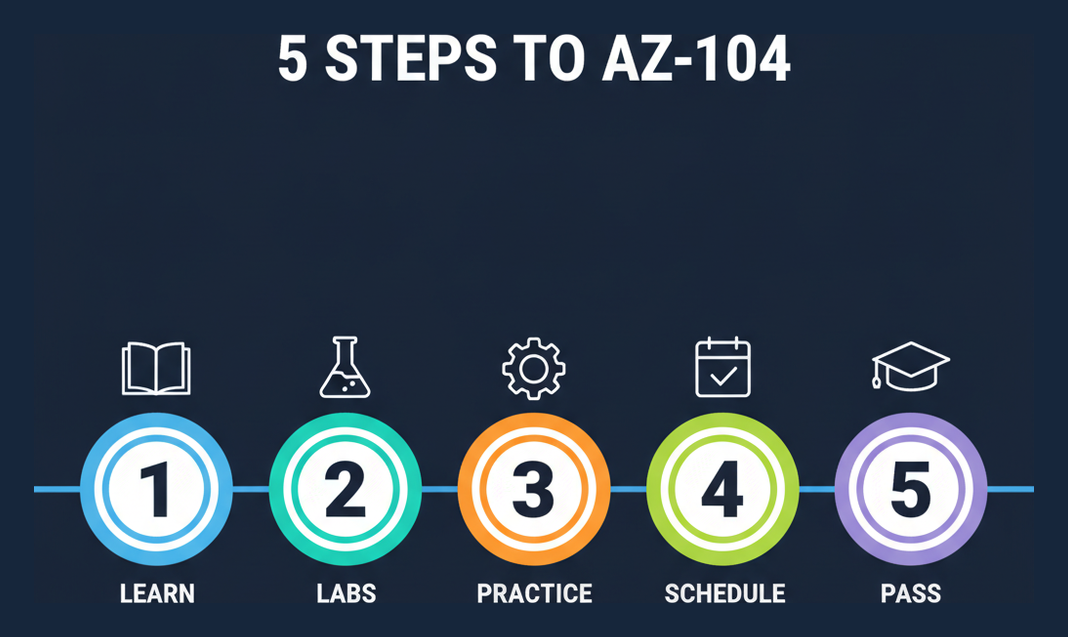
A workable study sequence looks like this:
- Map your current experience against the five weighted domains and rank your weak areas.
- Work through Microsoft Learn paths for each domain, doing every exercise in a real subscription.
- Script routine tasks with PowerShell and the Azure CLI so portal outages never block you.
- Take a full practice assessment under timed conditions to expose blind spots.
- Review incorrect answers, return to the relevant domain, and retest until scores stabilize.
Two references keep your plan on track. The official AZ-104 study guide lists every objective in detail, and a focused AZ-104 preparation walkthrough shows how other candidates sequenced their study. Prioritize the highest-weighted domains, but never leave monitoring untouched.
What Career Paths Open After You Certify?
Earning the Azure Administrator Associate credential positions you for cloud operations roles and creates a springboard toward architecture, security, and DevOps specializations. Employers read AZ-104 as proof you can run production Azure workloads, which makes it one of the more marketable associate-level certifications. It also acts as a prerequisite mindset for several advanced Microsoft credentials.
Common roles and next steps include:
- Azure administrator and cloud operations engineer positions
- Cloud systems administrator and infrastructure engineer roles
- A path toward the Azure Solutions Architect Expert credential
- A move into Azure security or DevOps engineering specializations
Many professionals weigh the time investment before committing, and it helps to read a candid take on whether AZ-104 is worth it alongside current job listings. You can also confirm the credential scope on Microsoft’s Azure Administrator certification page. Remember that role-based Microsoft certifications require annual renewal through a free online assessment, so staying current is part of the commitment.
Frequently Asked Questions
What is the passing score for the AZ-104 exam?
The AZ-104 exam uses a scaled scoring model, and you need 700 out of 1000 to pass. Because scoring is scaled, questions carry different weights, so the figure does not translate to a flat 70 percent of questions answered correctly.
How many questions are on the AZ-104 exam?
The AZ-104 exam includes between 40 and 60 questions, delivered in 120 minutes through Pearson VUE. The mix spans multiple choice, case studies, and hands-on style items across all five skill areas, so pacing yourself across question types matters.
How much does the AZ-104 exam cost?
The AZ-104 exam costs $165 USD, though the exact price can vary by the country or region where you take it. Payment is handled when you schedule through Pearson VUE, and retake fees apply if you need another attempt.
Do I need experience before taking AZ-104?
Yes, Microsoft positions AZ-104 as an intermediate credential. Candidates should be comfortable with operating systems, networking, PowerShell, the Azure CLI, the Azure portal, ARM templates or Bicep, and Microsoft Entra ID before sitting the exam. Microsoft runs a separate credential for the automation platform itself, and the GitHub Actions administration exam leans heavily on administration.
Which AZ-104 domain carries the most weight?
Two domains tie for the highest weighting at 20 to 25 percent each: managing Azure identities and governance, and deploying and managing Azure compute resources. Concentrate extra study time on these two areas while still covering the remaining three. Cost governance sits outside that syllabus entirely, and FinOps certification domains is where it is examined.
Can I retake the AZ-104 exam if I fail?
Yes. If you do not pass, you can retake AZ-104 after waiting 24 hours from your first attempt. Later retakes require longer waiting periods, and a separate exam fee applies to each attempt you schedule.
Does the AZ-104 certification expire?
The Azure Administrator Associate certification remains valid for 12 months. You renew it at no cost by passing a free online assessment on Microsoft Learn, which keeps the credential aligned with current Azure features.
Is AZ-900 required before AZ-104?
No, AZ-900 is not a prerequisite for AZ-104. Many candidates take the AZ-900 fundamentals exam first to build confidence, but you can register for AZ-104 directly if you already have hands-on Azure administration experience.
How long does it take to prepare for AZ-104?
Preparation time varies with experience, but candidates with existing Azure exposure often need six to eight weeks of consistent study. Those newer to cloud administration should plan for more, focusing on hands-on labs across all five skill areas.
Conclusion
The Microsoft Azure administrator role rewards people who can manage identity, storage, compute, networking, and monitoring with equal confidence, and AZ-104 is the exam that proves it. By studying in proportion to the published domain weightings and practicing every task in a live subscription, you turn the certification into genuine job readiness rather than memorized facts. Identity and compute deserve the most attention, but a passing result depends on covering all five areas.
When you are ready to test your readiness, work through a full set of AZ-104 practice questions under timed conditions and revisit any domain where your scores dip. That feedback loop is the shortest path from studying to certified and, more importantly, to doing the work well.


