
The AWS Certified Solutions Architect – Associate (SAA-C03) credential from Amazon Web Services measures one thing above all: can you design cloud systems that stay secure, survive failure, perform under load, and still respect a budget. It is the role-defining certification for anyone stepping into an AWS solutions architect associate position, and it rewards design judgement far more than memorised trivia.
This guide treats the exam as what it really is, a test of architectural decisions. You will see exactly what SAA-C03 asks, how its four scoring domains are weighted, and how each domain maps to the daily work of shaping AWS environments. By the end you will have a clear, hands-on route from where you are now to a passing score and a stronger architecture practice.
Table of Contents
- What Does an AWS Solutions Architect Associate Actually Do?
- What Is on the SAA-C03 Exam?
- How Are the Four SAA-C03 Domains Weighted?
- How Do You Design Secure Architectures on AWS?
- What Makes an AWS Architecture Resilient?
- How Do You Build High-Performing Architectures?
- How Do You Keep AWS Costs Under Control?
- Who Should Earn This Credential and Why?
- How Should You Prepare for SAA-C03?
- Frequently Asked Questions
- Conclusion
What Does an AWS Solutions Architect Associate Actually Do?
An AWS solutions architect associate translates business requirements into cloud designs that run on Amazon Web Services. The SAA-C03 credential validates that skill directly. The role involves choosing services, sizing compute and storage, wiring up networking and identity, and balancing security, resilience, performance, and cost so a workload behaves predictably in production.
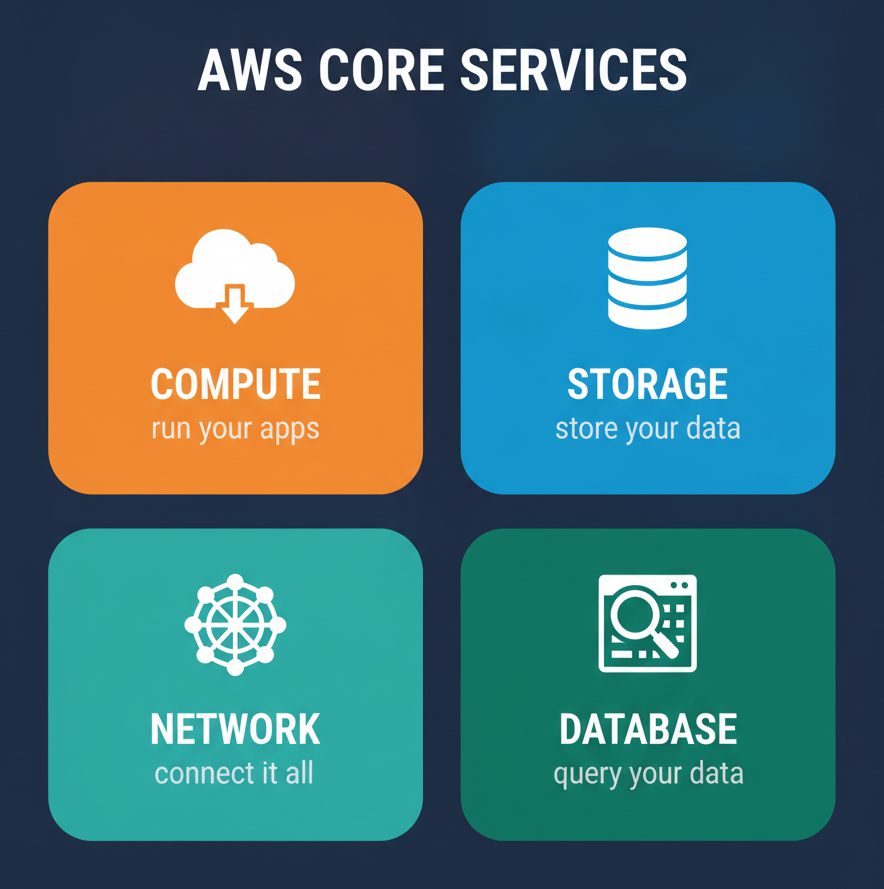
In practice, that means the architect sits between stakeholders and engineers. Product owners describe what a system must do; the architect decides how it should be built on AWS. The choices are rarely about a single service in isolation. They are about trade-offs, such as whether to use a managed database or self-host, whether to scale horizontally or vertically, and where encryption and access boundaries belong.
The SAA-C03 questions mirror this. Most are scenario based, describing a company, a constraint, and a goal, then asking which design best fits. Success depends on recognising patterns rather than reciting facts, which is why real hands-on exposure to the AWS console and services matters so much.
What Is on the SAA-C03 Exam?
The AWS Certified Solutions Architect – Associate (SAA-C03) exam contains 65 questions and runs for 130 minutes. It uses a scaled scoring model from 100 to 1000, with 720 required to pass, and the registration cost is 150 USD. Questions are multiple choice and multiple response, delivered at a test centre or through online proctoring via Pearson VUE.
Because the pass mark is scaled rather than a simple percentage, a handful of harder questions can be offset by strong performance elsewhere. That makes broad, even coverage of every domain more valuable than deep mastery of one. Working through a realistic set of SAA-C03 practice questions is the fastest way to calibrate to the scenario style before test day.
| Exam Attribute | Detail |
|---|---|
| Exam code | SAA-C03 |
| Certification | AWS Certified Solutions Architect – Associate |
| Number of questions | 65 |
| Duration | 130 minutes |
| Passing score | 720 on a scale of 100 to 1000 |
| Exam price | 150 USD |
| Format | Multiple choice and multiple response |
How Are the Four SAA-C03 Domains Weighted?
The SAA-C03 blueprint is built on four scoring domains, each weighted by how many questions it contributes. Design Secure Architectures leads at 30 percent, followed by Design Resilient Architectures at 26 percent, Design High-Performing Architectures at 24 percent, and Design Cost-Optimized Architectures at 20 percent. Security carries the most weight, so it deserves the most study time.
These weightings shape a sensible study order. Since security and resilience together account for well over half the exam, they should anchor your preparation. The table below shows the official split, which maps closely to the pillars of the AWS Well-Architected Framework that the credential draws from.
| Domain | Focus | Weight |
|---|---|---|
| Design Secure Architectures | Identity, network security, data protection | 30% |
| Design Resilient Architectures | Decoupling, high availability, fault tolerance | 26% |
| Design High-Performing Architectures | Scalable compute, storage, database, network | 24% |
| Design Cost-Optimized Architectures | Right-sizing, storage tiers, cost tooling | 20% |
How Do You Design Secure Architectures on AWS?
Designing secure architectures is the largest SAA-C03 domain at 30 percent, and it covers secure access, secure workloads, and data protection. You need to apply least privilege through AWS Identity and Access Management, segment networks with security groups and subnets, and encrypt data both at rest and in transit. The shared responsibility model underpins every decision here.
Identity and access design
Secure access starts with IAM users, groups, roles, and policies arranged around least privilege. The exam expects you to design a flexible authorization model, use AWS Security Token Service for role switching and cross-account access, and enforce multi-factor authentication on privileged accounts. For many-account estates, AWS Control Tower and service control policies set guardrails centrally.
Network and data protection
On the network side, you build VPC architectures with security groups, route tables, network ACLs, and NAT gateways, then separate public and private subnets. Services such as AWS WAF, AWS Shield, and Secrets Manager protect applications and credentials. For data, AWS Key Management Service handles encryption keys, ACM manages TLS certificates, and lifecycle policies govern retention, backup, and replication.
- Apply least privilege and MFA to IAM users and root accounts
- Use STS role switching for cross-account access
- Encrypt at rest with KMS and in transit with ACM and TLS
- Segment traffic with public and private subnets
What Makes an AWS Architecture Resilient?
Resilient architectures make up 26 percent of SAA-C03 and test whether you can design scalable, loosely coupled systems that keep running when components fail. This means decoupling workloads with queues and events, spreading resources across Availability Zones, and choosing highly available, fault-tolerant storage and database options that meet stated recovery requirements.
Loose coupling is the recurring theme. Instead of tightly linked components, resilient designs use Amazon SQS for buffering, API Gateway for managed interfaces, and event-driven patterns so parts can scale and fail independently. Multi-AZ deployments, read replicas, and automated failover turn a single point of failure into a recoverable event.
“Everything fails, all the time.”
That mindset is exactly what the domain rewards. When a scenario describes an outage risk, the strongest answer usually distributes the workload, removes shared state, and lets automation restore capacity rather than relying on any single healthy instance.
How Do You Build High-Performing Architectures?
High-performing architectures account for 24 percent of the SAA-C03 exam and span storage, compute, database, network, and data ingestion. The goal is selecting services and configurations that meet performance demands now and scale for future needs, from Amazon S3 and EBS storage classes to elastic compute with EC2 Auto Scaling, Lambda, and Fargate.
Compute and storage choices
Performance questions often hinge on matching a workload to the right resource. Serverless options like Lambda suit spiky, event-driven tasks, while containers on ECS or EKS handle sustained services. On storage, you weigh object, file, and block characteristics, then pick S3, EFS, or EBS with configurations that sustain throughput and scale on demand.
Database and network performance
For data, the exam covers read replicas, caching with Amazon ElastiCache, and choosing between relational engines like Aurora and non-relational stores like DynamoDB based on access patterns. Networking performance leans on CloudFront and Global Accelerator at the edge, Application Load Balancers for distribution, and Kinesis for streaming ingestion. Each choice ties back to a measurable requirement.
How Do You Keep AWS Costs Under Control?
Cost-optimized architectures form the final 20 percent of SAA-C03 and test whether your designs deliver value without waste. This domain covers cost-effective storage and compute choices, plus the tooling to measure spend, including AWS Cost Explorer, AWS Budgets, and the Cost and Usage Report. Right-sizing and lifecycle management are the core skills.
Storage is where many savings live. Moving infrequently accessed objects to colder S3 tiers, matching EBS volume types to real IO needs, and automating lifecycle transitions all reduce cost without hurting the workload. On compute, selecting the right instance type, using auto scaling to avoid idle capacity, and choosing managed services thoughtfully keeps bills predictable.
- Tier S3 objects and manage their lifecycle automatically
- Match EBS volume types to actual IO requirements
- Track spend with Cost Explorer, Budgets, and cost allocation tags
- Right-size compute and enable auto scaling to cut idle capacity
Who Should Earn This Credential and Why?
The AWS solutions architect associate credential suits cloud engineers, system administrators, developers, and IT professionals who design or influence AWS deployments. Amazon Web Services recommends around one year of hands-on experience with AWS before attempting SAA-C03, though motivated newcomers with steady lab practice also pass. It is widely treated as a baseline credential for cloud architecture roles.
The career case is strong. Solutions architect roles consistently rank among the better-paid cloud positions, and SAA-C03 appears frequently in job descriptions as a preferred or required qualification. Because the exam validates broad, service-spanning design skill rather than one narrow tool, it transfers well across industries and team structures. Architect credentials exist for other technology stacks too, and the blockchain solutions architect exam applies the same design reasoning to distributed ledgers.
If your background sits closer to platform engineering, pairing this credential with adjacent cloud study helps. Professionals exploring a broader cloud engineer path or a vendor-neutral cloud architect certification often find the design principles reinforce each other.
How Should You Prepare for SAA-C03?
Preparing for SAA-C03 works best as a domain-weighted, hands-on plan rather than passive reading. Since secure and resilient architectures together carry 56 percent of the score, they should take the largest share of your study time. Build in the AWS console constantly, because the exam rewards recognising real design patterns over recalling definitions.
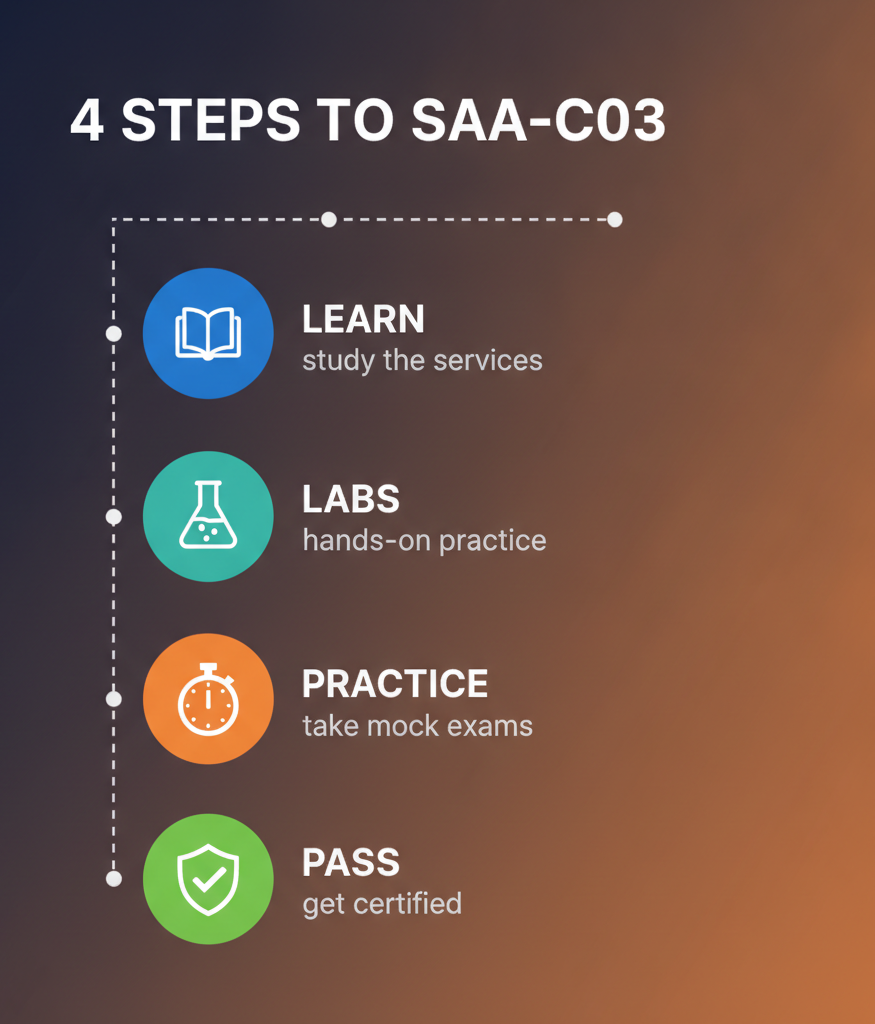
A structured sequence keeps preparation focused and measurable:
- Read the official exam guide and note every domain objective
- Build a small multi-tier workload with a VPC, IAM roles, and encryption
- Practise resilience by adding multi-AZ, auto scaling, and a queue
- Layer in performance and cost tuning, then compare configurations
- Take timed practice questions and review every incorrect answer
- Revisit weak domains until your practice scores stay above target
Anchor your study to primary sources. The AWS official certification page and the detailed SAA-C03 exam guide define the blueprint precisely. When you are ready, you can schedule through Pearson VUE at a centre or online.
Frequently Asked Questions
What is the AWS Certified Solutions Architect – Associate exam?
It is an associate-level AWS credential, coded SAA-C03, that validates your ability to design secure, resilient, high-performing, and cost-optimized systems on Amazon Web Services. The exam uses scenario-based questions to test practical architectural judgement rather than isolated facts.
How many questions are on the SAA-C03 exam?
The SAA-C03 exam has 65 questions delivered as multiple choice and multiple response. You have 130 minutes to complete it, which leaves roughly two minutes per question, enough time to read each scenario carefully and reason through the options.
What score do you need to pass SAA-C03?
You need 720 on a scaled range of 100 to 1000. Because scoring is scaled rather than a flat percentage, a few difficult questions can be balanced by strong performance across the other domains, so even coverage matters more than perfection in one area.
How much does the AWS solutions architect associate exam cost?
The SAA-C03 registration fee is 150 USD. AWS occasionally offers practice or retake benefits through its training programs, but the standard exam price for the associate-level solutions architect credential is 150 USD at the time of scheduling.
Which SAA-C03 domain is the most important?
Design Secure Architectures carries the highest weight at 30 percent, so security is the single most important domain. Combined with Design Resilient Architectures at 26 percent, these two areas account for the majority of the exam and deserve the largest share of study time.
How long does it take to prepare for SAA-C03?
Most candidates prepare in eight to twelve weeks of consistent study, though the timeline depends on prior AWS experience. Those with around a year of hands-on practice often need less, while newcomers should plan extra lab time to build familiarity with core AWS services.
Do you need experience before taking this exam?
AWS recommends approximately one year of hands-on experience designing on AWS, but it is a recommendation rather than a requirement. Candidates without that background can still succeed by combining structured study with regular practice in the AWS console to reinforce design patterns.
Is the AWS solutions architect associate certification worth it?
For most cloud professionals, yes. The credential is widely recognised, appears often in solutions architect job listings, and validates transferable design skills across industries. It also provides a solid foundation for pursuing the professional-level architect certification later.
What is the difference between the associate and professional architect exams?
The associate SAA-C03 exam validates core design skills across four domains, while the professional exam covers more complex, enterprise-scale, and multi-account scenarios in greater depth. Many candidates earn the associate credential first, then build experience before attempting the professional level.
Conclusion
The AWS Certified Solutions Architect – Associate credential is earned through design judgement, not rote recall. Its four domains, led by security at 30 percent and resilience at 26 percent, map directly to the daily choices that keep cloud systems safe, available, fast, and affordable. Master those trade-offs in the console and the exam scenarios become familiar rather than intimidating.
Build your study around the official blueprint, practise each domain with real hands-on labs, and calibrate your readiness with realistic scenario questions before you book. When your practice scores hold steady above the target, work through a full set of SAA-C03 sample questions and schedule the exam with confidence.


