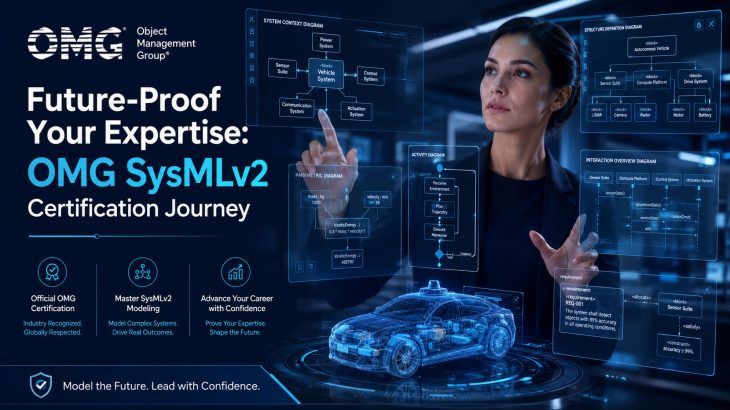
The OMG Certified Systems Modeling Language v2 – Model User (OMG-SYSML2-MU100) certification offers a strategic validation of essential skills in modern systems engineering. This credential, provided by the Object Management Group (OMG), is designed for professionals who utilize SysML v2 to articulate system structures, behaviors, requirements, and constraints effectively. Earning this SysMLv2 Certification demonstrates a foundational understanding of the latest standard in model-based systems engineering (MBSE), proving competency in a rapidly evolving technical landscape. This comprehensive article delves into the exam’s structure, syllabus, benefits, and provides a robust roadmap to help you achieve certification and advance your career.
Assessing the SysMLv2 Certification Examination
The OMG Certified Systems Modeling Language v2 – Model User certification is a critical benchmark for professionals aiming to solidify their expertise in SysML v2. Understanding the specific details of the **OMG-SYSML2-MU100** exam is the first step toward successful preparation. This examination evaluates a candidate’s practical ability to interpret and apply SysML v2 modeling concepts, ensuring they can contribute effectively to complex systems development projects. For official exam registration and further details, candidates can visit the Pearson VUE OMG page, which serves as the primary testing partner.
Key information regarding the exam structure includes:
- Exam Name: OMG Certified Systems Modeling Language v2 – Model User
- Exam Code: OMG-SYSML2-MU100
- Exam Price: USD $400
- Duration:
- Residents of English-speaking Countries: 150 Minutes
- All others: 180 Minutes
- Number of Questions: 90
- Passing Score: 63 / 90 (70%)
Familiarity with these parameters will help candidates gauge the commitment required and plan their study schedule effectively. Comprehensive details on the exam and certification program are also available on the official SysML v2 certification page.
Charting Core Concepts: The SysMLv2 Model User Syllabus
A deep understanding of the syllabus for the OMG-SYSML2-MU100 exam is paramount for any aspiring SysML v2 Model User. The curriculum is meticulously structured to cover the foundational and advanced aspects of systems modeling with SysML v2, ensuring candidates possess a holistic view of the language’s application. Each domain carries a specific weight, reflecting its importance in real-world MBSE scenarios and guiding candidates on where to allocate their study efforts most effectively. For an in-depth review of the syllabus, including specific topics, candidates can refer to the official SysML v2 Model User PDF documentation.
The syllabus domains and their respective weightages are:
- FOUNDATIONS (39%): This significant portion covers the core principles, terminology, and fundamental constructs of SysML v2. Candidates must grasp the underlying concepts that form the basis of all SysML v2 modeling activities, including the basic elements, relationships, and the overall metamodel.
- BEHAVIOR (33%): Focusing on how systems operate and interact, this domain emphasizes modeling the dynamic aspects of a system. It includes concepts like actions, activities, interactions, and state machines, enabling users to represent system functionality and control flow.
- STRUCTURE (18%): This section addresses the static composition of systems, detailing how components are organized and connected. It involves understanding parts, ports, items, and connections, which are crucial for defining system architecture and interfaces.
- REQUIREMENTS & CONSTRAINTS (5%): Acknowledging the importance of defining system expectations, this domain covers the representation of requirements and design constraints within the SysML v2 framework. It focuses on linking models to specific stakeholder needs and operational limitations.
- CASES (3%): This smaller yet essential section introduces the concept of modeling usage scenarios and operational contexts for a system. It helps in understanding how a system interacts with its environment and external actors.
- SUPPORTING CONCEPTS (2%): This category encompasses various auxiliary topics that complement the main domains, such as general-purpose modeling elements and utility constructs that enhance the expressiveness and completeness of SysML v2 models.
By systematically addressing each of these domains, candidates can build a robust understanding of SysML v2, preparing them not just for the exam, but for practical application in sophisticated engineering projects. Those who model business processes rather than engineered systems have a separate OMG BPM credential from the same organisation.
Realizing Professional Advantages: SysMLv2 Model User Certification Benefits
Attaining the OMG SysMLv2 Model User certification offers a distinct competitive edge in the rapidly evolving landscape of systems engineering. This credential serves as a powerful testament to an individual’s proficiency in the latest iteration of the Systems Modeling Language, widely regarded as the future standard for model-based systems engineering (MBSE). It extends beyond mere theoretical knowledge, validating the practical skills required to navigate and contribute to complex, model-driven projects. Professionals holding this certification are recognized for their ability to interpret and utilize SysML v2 models, thereby streamlining communication and reducing ambiguities within development teams.
Key advantages of earning this certification include:
- Enhanced Career Opportunities: The demand for skilled MBSE practitioners, particularly those fluent in SysML v2, is on the rise. Certification opens doors to advanced roles in aerospace, defense, automotive, and other high-tech industries.
- Validation of Expertise: The OMG credential formally recognizes your foundational skills in SysML v2, distinguishing you as a proficient model user. This is particularly valuable as organizations increasingly adopt MBSE methodologies for efficiency and accuracy.
- Improved Project Contributions: With a standardized understanding of SysML v2, you can more effectively participate in model reviews, contribute to model development, and ensure consistency across system representations. This leads to fewer errors and more successful project outcomes.
- Credibility and Recognition: An OMG certification carries significant weight within the industry. It demonstrates a commitment to professional development and adherence to best practices in systems modeling. Your achievement can be showcased through digital badges, such as those verified on Credly digital credentials, enhancing your professional profile.
- Future-Proofing Your Skills: SysML v2 represents a significant leap forward in modeling capabilities, designed to meet the demands of future complex systems. By certifying, you align your skillset with the technological trajectory of the industry, safeguarding your professional relevance for years to come.
This certification is not merely an achievement; it’s an investment in a robust and adaptable career path within the critical domain of systems engineering. Explore other valuable OMG certifications to further broaden your professional horizons.
Identifying Ideal Candidates for SysMLv2 Credentialing
The OMG SysMLv2 Model User certification is specifically tailored for a diverse group of professionals whose roles intersect with the design, analysis, and implementation of complex systems. This credential is most beneficial for individuals who regularly interact with or are expected to interpret system models, ensuring they possess a common understanding of the SysML v2 standard. It clarifies model semantics and enhances team collaboration by establishing a unified language for system representation. The certification provides a structured learning path that validates competence in navigating and extracting critical information from SysML v2 models.
Key roles and individuals who would significantly benefit from pursuing this certification include:
- Systems Engineers: Those involved in specifying, designing, analyzing, and validating complex systems, who will directly use SysML v2 for model-based definition.
- Software Engineers: Professionals who need to understand the system context provided by SysML models to effectively design and integrate software components.
- Hardware Engineers: Engineers who require a clear understanding of system architecture and interfaces documented in SysML v2 to develop hardware components.Requirements Analysts: Individuals responsible for capturing, analyzing, and managing system requirements, who can leverage SysML v2 to link requirements directly to system models.
- Modelers and Architects: Experienced modelers transitioning from SysML v1 or other modeling languages, seeking formal validation in the latest SysML standard.
- Project Managers: Managers overseeing systems engineering projects who need to interpret models to assess project progress, risks, and ensure alignment with system specifications.
- Quality Assurance and Test Engineers: Professionals who develop test cases and validate system behavior based on detailed system models.
Essentially, anyone involved in a project that aims to adopt or is already leveraging SysML v2 for efficient and precise system development will find the Model User certification invaluable. It bridges communication gaps and fosters a more integrated approach to systems development.
Crafting an Effective Study Pathway for SysMLv2 Certification
Embarking on the journey to earn your SysMLv2 certification requires a strategic and well-organized study plan. Simply reviewing materials without a structured approach can be inefficient. A successful pathway focuses on understanding the core principles of SysML v2, practicing its application, and familiarizing yourself with the exam format. This structured approach helps in building a deep comprehension of the modeling language, rather than just memorizing facts, ensuring that your skills are future-proofed and applicable in real-world scenarios. Begin by acquiring all necessary resources and setting realistic milestones.
Understanding Fundamental Domains: Key for SysMLv2 Users
The success of your preparation hinges on systematically breaking down the syllabus and mastering each domain. Since the OMG-SYSML2-MU100 exam emphasizes foundational knowledge, a deep dive into each topic area is critical. Focus on not just what each concept means, but how it’s applied within the SysML v2 framework to represent different aspects of a system. Dedicate more study time to the higher-weighted sections to maximize your learning efficiency and ensure comprehensive coverage of the most critical areas. This approach helps in building a layered understanding, starting from basic constructs and progressing to more complex modeling scenarios.
Exploring SysMLv2 Foundations
The Foundations domain, representing the largest portion of the exam, covers the bedrock principles of SysML v2. It includes the fundamental elements of the language, such as various types of definitions, usages, and relationships. Candidates should spend considerable time understanding the core metamodel, the distinction between different kinds of elements (e.g., blocks, parts, actions), and how they are related through composition, generalization, and dependency. Mastering the basic syntax and semantics is crucial, as this knowledge underpins all other modeling activities. It is essential to internalize the conceptual model that SysML v2 presents, which allows for a more rigorous and unambiguous specification of systems.
Modeling System Behavior with SysMLv2
Behavioral modeling in SysML v2 focuses on defining how a system performs its functions and interacts with its environment over time. This section requires an understanding of activities, actions, interactions, and state machines. Candidates should learn how to sequence operations, represent concurrency, and model responses to events. Pay attention to how different behavioral constructs are used to specify functional requirements and dynamic properties of a system. Practice creating various behavioral diagrams or textual descriptions to articulate complex system operations, ensuring you can clearly represent the flow of control and data.
Defining System Structure in SysMLv2
The Structure domain dictates how a system is composed of its constituent parts and how these parts are interconnected. This involves understanding blocks, parts, ports, and items, and how they form a coherent system architecture. Candidates must be proficient in defining interfaces between system components and specifying their composition hierarchies. Focus on accurately representing the internal structure of system elements, their connections, and the flow of items across interfaces. This knowledge is vital for designing robust and maintainable systems, as it provides a clear blueprint for implementation.
Integrating Requirements and Constraints
Requirements and constraints are central to any systems engineering effort, and SysML v2 provides mechanisms to formally integrate them into models. This domain requires understanding how to define requirements, allocate them to system elements, and manage their traceability throughout the development lifecycle. Additionally, learn how to express design constraints that impose limitations on system behavior or structure. The ability to link requirements directly to the model ensures that the system being designed truly meets stakeholder needs and complies with all specified criteria, making this a critical area for practical application.
Applying Cases and Supporting Concepts
While smaller in weight, the Cases and Supporting Concepts domains provide valuable context and expressive power to SysML v2 models. Cases involve defining specific scenarios of system use or operation, which helps in validating requirements and testing system behavior. Supporting concepts cover various auxiliary elements that enhance the clarity and completeness of models, such as comments, annotations, and various utility constructs. Understand how these elements are used to provide additional information, clarify design intent, and improve the overall readability and maintainability of SysML v2 models.
Optimizing Resource Selection for SysMLv2 Learning
Selecting the right study materials is crucial for effective preparation for the OMG-SYSML2-MU100 certification. Given the strategic and future-oriented nature of SysML v2, relying on up-to-date and authoritative resources is key to grasping the nuances of the language. While there are many resources available, prioritizing official documentation and vendor-approved training ensures accuracy and alignment with the exam objectives. Avoid outdated materials, as SysML v2 introduces significant advancements over its predecessor, SysML v1. The integrity of your learning process directly impacts your ability to apply these concepts in real-world scenarios.
Consider the following types of resources:
- Official OMG Documentation: The SysML v2 specification itself is the ultimate source of truth. While dense, it provides the most precise definitions and explanations of the language constructs. Complementing this with the official SysML v2 Model User Guide (if available) can provide practical examples and interpretation.
- Vendor-Approved Training Courses: Reputable training providers offer structured courses specifically designed for SysML v2. These courses often include hands-on exercises, expert instructors, and tailored content that aligns with the exam syllabus, making them highly effective for guided learning.
- Specialized Books and Online Tutorials: As SysML v2 matures, more books and online tutorials will become available. Look for resources authored by recognized experts in MBSE and SysML. These can offer different perspectives and simplified explanations of complex topics.
- Community Forums and Discussions: Engaging with the SysML v2 community can provide valuable insights, clarify difficult concepts, and offer practical tips. Platforms where experts and practitioners discuss the language can be a rich source of learning.
Always cross-reference information and prioritize official sources to ensure your understanding is accurate and comprehensive, laying a strong foundation for your certification success.
Simulating Exam Conditions with Practice Tests
A crucial phase in preparing for the OMG-SYSML2-MU100 exam involves engaging with high-quality practice tests. This step is not just about identifying knowledge gaps, but also about building confidence, refining your test-taking strategy, and managing time effectively under simulated exam conditions. Practice exams allow you to experience the question styles and difficulty levels you can expect on the actual certification test, helping to reduce anxiety and improve performance on exam day. Regularly attempting these simulations is a strategic move to assess your readiness and fine-tune your preparation plan.
The benefits of incorporating practice tests into your study regimen include:
- Identifying Weak Areas: Practice exams highlight specific syllabus topics where your understanding may be lacking, allowing you to refocus your study efforts more precisely.
- Familiarity with Question Format: You become accustomed to the types of questions asked, including scenario-based queries and those testing conceptual understanding, which is vital for the SysMLv2 certification.
- Time Management Skills: Working through practice tests under timed conditions helps you learn to pace yourself, ensuring you can answer all questions within the allocated duration.
- Confidence Building: Consistent performance in practice exams boosts your confidence, making you more relaxed and focused when you sit for the actual OMG-SYSML2-MU100 test.
- Reinforcing Knowledge: The act of recalling and applying information during practice tests helps to solidify your learning and improve retention.
For those seeking comprehensive practice questions and a simulated exam environment, resources such as ProcessExam’s SysMLv2 practice exam can be invaluable. These platforms are designed to mirror the actual exam experience, providing detailed insights into your performance. Remember, ethical study practices are key; focus on understanding the concepts rather than memorizing answers.
Sustaining Expertise in the Evolving MBSE Landscape
Earning the OMG SysMLv2 Model User certification is a significant milestone, but it also marks the beginning of an ongoing commitment to professional development. The field of Model-Based Systems Engineering (MBSE) is continuously evolving, with new tools, methodologies, and best practices emerging regularly. To maintain the value and relevance of your certification, it is crucial to stay abreast of these advancements. A future-proof career path in MBSE involves not just acquiring credentials but actively engaging with the community and continuously enhancing your skillset beyond the initial certification requirements. This proactive approach ensures that your expertise remains cutting-edge and adaptable to future industry demands.
Strategies for sustaining your SysML v2 expertise include:
- Continuous Learning: Regularly engage with new publications, articles, and research papers related to SysML v2 and MBSE. The OMG itself is a great source for updates and new specifications.
- Practical Application: Actively seek opportunities to apply SysML v2 in your projects. Practical experience reinforces theoretical knowledge and exposes you to real-world challenges and solutions.
- Community Engagement: Participate in SysML v2 user groups, online forums, and industry conferences. Networking with peers and experts can provide valuable insights and keep you informed about emerging trends.
- Explore Advanced Topics: Once proficient as a Model User, consider delving into more advanced aspects of SysML v2, such as tool customization, model transformation, or integration with other engineering disciplines.
- Mentorship and Knowledge Sharing: Share your knowledge and mentor others who are new to SysML v2. Teaching reinforces your own understanding and contributes to the growth of the MBSE community.
By actively pursuing these avenues, your SysMLv2 Certification will not just be a static achievement, but a dynamic foundation for sustained excellence in systems engineering.
The OMG Certified Systems Modeling Language v2 – Model User (OMG-SYSML2-MU100) certification stands as a pivotal achievement for any professional navigating the complexities of modern systems engineering. It not only validates a robust understanding of the latest MBSE standard but also positions you at the forefront of an industry increasingly reliant on model-driven development. By strategically preparing for and earning this credential, you are not merely acquiring a certificate; you are investing in a future-proof skillset that enhances your career trajectory, improves project outcomes, and solidifies your expertise in a globally recognized language for system specification.
Embrace this opportunity to define your mastery in SysML v2 and contribute to the next generation of complex systems. Begin your structured preparation today to unlock new professional possibilities and ensure your knowledge remains relevant and impactful in the dynamic world of systems modeling. For a comprehensive overview of certification options, visit the main OMG certification roadmap on our platform.
Frequently Asked Questions
1. What does the SysMLv2 Model User certification validate?
The OMG Certified Systems Modeling Language v2 – Model User (OMG-SYSML2-MU100) certification validates an individual’s foundational understanding and practical ability to interpret, navigate, and utilize SysML v2 models effectively in systems engineering contexts. It confirms proficiency in the core concepts and application of the latest SysML standard.
2. Who is the target audience for the OMG-SYSML2-MU100 exam?
The target audience includes systems engineers, software engineers, hardware engineers, requirements analysts, modelers, architects, project managers, and quality assurance professionals who need to understand or work with SysML v2 models in complex systems development projects.
3. How does SysMLv2 certification benefit my career?
Earning SysMLv2 certification enhances career opportunities in MBSE, validates your expertise with a globally recognized standard, improves your ability to contribute to complex projects, and demonstrates a commitment to staying current with leading-edge systems engineering practices, making your skills highly valuable.
4. What is the passing score for the OMG-SYSML2-MU100 exam?
To pass the OMG-SYSML2-MU100 exam, candidates must achieve a score of 63 out of 90 questions, which equates to 70% accuracy.
5. Are there any prerequisites for taking the SysMLv2 Model User exam?
While the OMG typically does not enforce strict prerequisites for its associate-level certifications, a strong foundational understanding of systems engineering principles and prior exposure to modeling concepts are highly recommended to succeed in the OMG-SYSML2-MU100 exam.


