Five and a half hours is a long time to sit an exam. The ASQ Certified Quality Engineer credential asks for exactly that: 175 questions across 318 minutes of testing time, spread over seven domains that run from boardroom leadership to control chart arithmetic. It is one of the widest single exams in the quality profession, and the breadth is the difficulty. Very few candidates are weak on all of it. Almost every candidate is weak on some of it.
That shape should drive your preparation. This guide covers what the CQE actually certifies, how the seven domains divide the question paper, why quantitative methods carry the heaviest load, and how the credential compares with a Six Sigma belt when you are choosing where to spend your study time.
Table of Contents
- What Does the CQE Actually Certify?
- How Long Is the CQE Exam and What Does It Cost?
- How Are the Seven CQE Domains Divided?
- Why Do Quantitative Methods Carry the Most Questions?
- What Does Product and Process Control Expect You to Do?
- How Does the Design Domain Differ From Control?
- Where Does Risk Management Fit in a Quality Exam?
- How Should You Study for a Five-Hour Exam?
- Should You Take the CQE or a Six Sigma Belt?
- What Does the CQE Change About Your Career?
- Frequently Asked Questions About the CQE
- Conclusion
What Does the CQE Actually Certify?
The CQE certifies that you can understand and apply the full body of quality engineering practice: designing quality into products and processes, controlling them once running, measuring them honestly, and improving them with evidence. It is a generalist credential in a field that rewards generalists, which is why its question paper refuses to stay in one place.
The role it describes is older than most technology certifications and considerably more stable. Quality engineering has been building on the same foundations for decades, and the exam still expects familiarity with how the discipline arrived where it is.
“The popular term for fitness for use is Quality, and our basic definition becomes: quality means fitness for use.”
Applied Knowledge, Not Recall
The published body of knowledge tags its objectives with cognitive levels that run from Remember through Understand, Apply, Analyze, and Evaluate. Very little of the CQE sits at the Remember end. Most of it asks you to apply a tool or analyse a result, which is why memorising definitions alone leaves candidates stranded.
How Long Is the CQE Exam and What Does It Cost?
The CQE presents 175 questions with 318 minutes of exam time inside a 330 minute appointment, and it is scored on a 750 point scale with 550 required to pass. Pricing depends on ASQ membership, which is unusual among certification bodies and worth calculating before you book.
| Specification | Detail |
|---|---|
| Exam name | ASQ Certified Quality Engineer |
| Exam code | CQE |
| Number of questions | 175 |
| Exam time | 318 minutes |
| Total appointment time | 330 minutes |
| Passing score | 550 out of 750 |
| Question format | Multiple choice |
| Fee, ASQ members | USD $450 |
| Fee, non-members | USD $550 |
| Retake fee | USD $350 |
The Membership Arithmetic
The gap between the member and non-member fee is USD $100 on a single sitting. Candidates who expect to take more than one ASQ exam, or who want the handbook and section access anyway, usually find the membership pays for itself on the first booking. Retakes at USD $350 also soften the cost of a near miss.
Reviewing the full Certified Quality Engineer exam outline before you commit is worthwhile, because the breadth surprises people who arrived from a narrow specialism.
How Are the Seven CQE Domains Divided?
The CQE body of knowledge publishes seven domains with an explicit question count against each, which is more transparent than the percentage bands most exams give you. The counts total 160, so a further 15 of the 175 questions presented are unscored and cannot be identified while you sit.
| Domain | Questions |
|---|---|
| I. Management and Leadership | 17 |
| II. The Quality System | 18 |
| III. Product, Process, and Service Design | 21 |
| IV. Product and Process Control | 23 |
| V. Continuous Improvement | 26 |
| VI. Quantitative Methods and Tools | 34 |
| VII. Risk Management | 21 |
Read that table as a study budget rather than a contents list. Quantitative Methods and Continuous Improvement together account for 60 scored questions, well over a third of the paper, and they are also the two domains that reward practice most directly.
Why Do Quantitative Methods Carry the Most Questions?
Quantitative Methods and Tools is the largest CQE domain at 34 questions because it supplies the evidence every other domain depends on. A control decision, a design verification, an improvement claim, and a risk estimate are all statistical statements. The exam concentrates the mathematics in one domain and then assumes it everywhere else.
What Sits Inside the Domain
- Descriptive statistics and the distributions that model process behaviour
- Statistical inference, including hypothesis testing and confidence intervals
- Process capability indices and what they do and do not promise
- Measurement systems analysis covering repeatability and reproducibility
- Design of experiments for isolating factors that actually matter
- Regression and correlation for relationships between variables
- Reliability modelling and life data concepts
The depth required is applied rather than theoretical. You are not asked to derive results, but you are expected to choose the right technique, run it, and read the output correctly under time pressure.
What Does Product and Process Control Expect You to Do?
Product and Process Control carries 23 CQE questions and covers the machinery of keeping a running process inside its limits. This is the domain where control charts, sampling plans, and measurement systems stop being theory and become decisions about whether to release a batch.

Control Charts and Their Rules
You should be able to select the correct chart for the data type, interpret out of control signals, and explain why a process can be in statistical control and still incapable of meeting specification. Confusing control limits with specification limits is one of the most reliably penalised errors in the whole exam. The statistical process control fundamentals published by the certifying body are a sensible reference point for this material.
Sampling and Inspection
Acceptance sampling, sampling plan selection, and the risks carried by both producer and consumer appear regularly. So does measurement system capability, because a control decision made with an unreliable gauge is not a control decision at all.
How Does the Design Domain Differ From Control?
Product, Process, and Service Design carries 21 CQE questions and sits earlier in the lifecycle than the control domain. Where control asks whether a running process is behaving, design asks whether the thing was capable of behaving in the first place. The distinction matters because the exam tests them separately.
Expect requirements translation, design review and verification, reliability and maintainability considerations, and the techniques that push quality decisions upstream. Candidates from inspection backgrounds often underestimate this domain because their working experience begins after design has finished.
Anyone weighing the CQE against a narrower audit focused credential will find the comparison in this quality auditor certification overview a useful contrast, since the two exams share a vocabulary but not a centre of gravity.
Where Does Risk Management Fit in a Quality Exam?
Risk Management is a full CQE domain worth 21 questions, which surprises candidates who learned quality before risk based thinking became central to modern quality systems. It is not a bolt on. It reflects how quality standards now expect organisations to reason about what could go wrong before it does.
The material covers risk identification and assessment, the tools used to structure that assessment, and how risk feeds into decisions about controls and priorities. Failure mode analysis appears here as a working technique rather than a documentation exercise, and questions tend to reward candidates who have actually used it.
How Should You Study for a Five-Hour Exam?
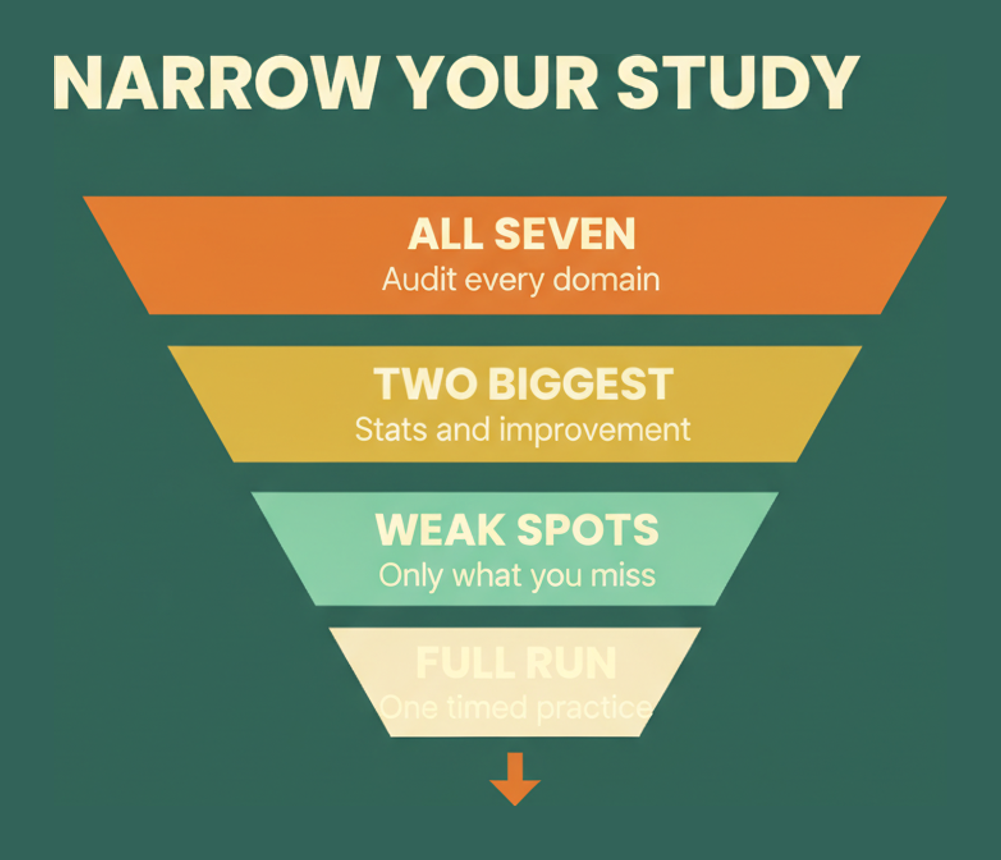
Preparation for the CQE has two halves: covering an unusually broad body of knowledge, and building the stamina to apply it for over five hours. Most successful candidates report a plan measured in months rather than weeks, structured around the published question counts rather than around personal interest.
A Sequence That Fits the Weighting
- Audit yourself against the seven domains first. Score your confidence in each before opening a single book.
- Start with Quantitative Methods. It is the largest domain and it underpins the others, so early investment compounds.
- Work problems, not chapters. Statistics knowledge that has only been read does not survive exam conditions.
- Learn your reference material physically. If the sitting permits references, knowing where a table lives matters as much as knowing it exists.
- Rehearse the confusable pairs. Control against specification limits, accuracy against precision, common against special cause.
- Build endurance deliberately. Sit at least one full length timed practice run before exam day.
Candidates who want a second perspective on structuring that plan will find this walkthrough of the quality engineer test breakdown a helpful companion to the domain audit above.
Should You Take the CQE or a Six Sigma Belt?
This is the most common CQE decision, and the honest answer is that the two credentials describe different jobs. A Six Sigma Black Belt certifies that you can run improvement projects using a defined methodology. The CQE certifies that you can hold responsibility for quality engineering across a product lifecycle.
| Consideration | CQE | Six Sigma Black Belt |
|---|---|---|
| Centre of gravity | Quality engineering as an ongoing discipline | Improvement projects with a defined lifecycle |
| Statistical depth | Broad and applied across the lifecycle | Deep within the improvement methodology |
| Typical employer signal | Ready to own quality for a product or line | Ready to lead structured improvement work |
| Best when | Your role spans design, control, and compliance | Your role is project based improvement |
If your work already spans design reviews, control plans, supplier issues, and audits, the CQE describes what you do. If your work is a sequence of improvement projects, a belt describes it better. Many quality professionals eventually hold both, and the statistical preparation transfers in either direction. If you are earlier in a quality career and join improvement teams without owning a full engineering remit, the ASQ Quality Improvement Associate exam is a gentler place to start.
What Does the CQE Change About Your Career?
The CQE is one of the most widely recognised credentials in manufacturing and regulated industries, and it functions as a competence filter in hiring. Because it is issued by the profession’s own body rather than a product vendor, it does not decay when a tool or platform falls out of favour.
- Quality engineers formalising experience already gained on the job
- Manufacturing and process engineers moving toward quality ownership
- Supplier quality specialists who need credibility across organisational boundaries
- Reliability and test engineers broadening beyond a single discipline
- Quality managers who want technical depth behind a leadership title
Compensation varies widely by industry and region, and current quality engineer salary benchmarks give a more useful picture than any single figure. The official CQE certification requirements set out the education and experience thresholds, and exams are delivered through Prometric test centres.
Frequently Asked Questions About the CQE
How many questions are on the CQE exam?
The CQE presents 175 questions. The published body of knowledge assigns question counts to seven domains totalling 160, which means 15 questions are unscored and cannot be identified during the sitting.
How long is the CQE exam?
Exam time is 318 minutes inside a total appointment of 330 minutes. That is more than five hours of testing, so physical and mental endurance is a genuine part of preparation rather than an afterthought.
What score do you need to pass the CQE?
The passing score is 550 out of 750. Because scoring is scaled rather than a simple percentage of questions answered correctly, treat the domain question counts as your study guide rather than trying to calculate a raw target.
How much does the CQE cost?
The fee is USD $450 for ASQ members and USD $550 for non-members, with retakes at USD $350. The membership difference of USD $100 often makes joining worthwhile if you plan more than one exam.
Which CQE domain is the largest?
Quantitative Methods and Tools is the largest domain with 34 questions. Continuous Improvement follows with 26. Together they account for 60 of the 160 scored questions, so both deserve disproportionate study time.
Is the CQE harder than a Six Sigma Black Belt?
They are difficult in different ways. The CQE is harder in breadth, covering design, control, statistics, and risk across a full lifecycle. A Black Belt is typically harder in depth within the improvement methodology itself.
Do I need a statistics background to pass the CQE?
Not formally, but you need working statistical competence. The exam asks you to select techniques, apply them, and interpret results rather than derive them, so applied practice matters more than theoretical training.
How long should I prepare for the CQE?
Most candidates plan in months rather than weeks because of the breadth involved. A domain by domain confidence audit at the start makes the timeline realistic and stops strong areas from absorbing time they do not need.
What is the difference between control limits and specification limits?
Control limits describe what a process actually does and come from process data. Specification limits describe what the customer requires. A process can be perfectly in control and still fail specification, and the exam tests this distinction repeatedly.
Does the CQE expire?
ASQ certifications operate on a recertification cycle that requires evidence of continuing professional development or a retake. Check the current recertification terms when you certify, since the requirements are maintained by the certification body.
Conclusion
The CQE is a breadth exam wearing a depth exam’s clothing. Seven domains, 175 questions, and over five hours of testing reward candidates who planned against the published question counts instead of studying what they already enjoyed. Quantitative Methods and Continuous Improvement carry the heaviest load, Product and Process Control punishes the control versus specification confusion, and Risk Management is a full domain rather than a footnote.
Start with an honest audit of the seven domains, put your first weeks into the statistics that underpin everything else, work problems rather than chapters, and sit at least one full length timed rehearsal before you book. The credential lasts because the discipline does.


