
Analytics-Arch-201 is the Salesforce Tableau Architect exam, and it is not the credential most people expect it to be. The name suggests whiteboards and reference diagrams. The blueprint says something blunter: designing infrastructure is worth 22% of the paper, while deploying Tableau Server and then monitoring the result take 78% between them. Knowing how to become a Tableau architect therefore has less to do with drawing topologies than with standing a production deployment up, wiring it into an enterprise identity provider, and proving months later that it still performs. This article walks through all three exam domains in the order the blueprint weights them, sets out the format, cost, and pass mark, and looks at what kind of hands-on experience the questions quietly assume you already have. It also covers where Tableau Cloud fits, and which roles the credential tends to open once you hold it.
Why Is Analytics-Arch-201 Weighted Towards Operations?
Because Salesforce weights the Tableau Architect exam by where deployments actually fail. Design work carries 22%, but deploying Tableau Server accounts for 37% and monitoring and maintaining it accounts for 41%. Together those two operational domains make up 78% of Analytics-Arch-201, which tells you exactly where to spend your study time.Independent salary data for Tableau specialist roles shows why the architect tier is worth the preparation.
That split is unusual for an architect-level credential, and it is deliberate. An elegant topology that nobody can authenticate against is worthless. So is a correctly sized cluster that slows to a crawl six months in because nobody baselined it. The exam is written by people who have watched both happen.
The practical consequence is that reading architecture guides will not carry you. Roughly four questions in five are about work you do after the design is signed off, and those questions tend to be scenario-shaped rather than definitional.
What Does the Tableau Architect Exam Cover?
Analytics-Arch-201 is a 59 question exam with 105 minutes on the clock and a 63% pass mark, which works out at roughly 37 correct answers. Registration costs $400 USD and a retake costs $200. It is delivered through Pearson VUE test centres, and the syllabus is organised into three weighted domains rather than a long list of objectives.
Format, cost, and scoring
| Attribute | Detail |
|---|---|
| Exam code | Analytics-Arch-201 |
| Credential | Salesforce Tableau Architect |
| Questions | 59 |
| Duration | 105 minutes |
| Passing score | 63% |
| Registration fee | $400 USD |
| Retake fee | $200 USD |
| Delivery | Pearson VUE |
How the three domains are weighted
| Domain | Weight |
|---|---|
| Monitor and Maintain a Tableau Deployment | 41% |
| Deploy Tableau Server | 37% |
| Design a Tableau Infrastructure | 22% |
With 105 minutes for 59 questions you get a shade under two minutes each. That is comfortable for a definition and tight for a multi-part scenario, so the usual advice applies: answer what you know quickly and bank the time for the long ones.
How Do You Design a Tableau Infrastructure?
The design domain is worth 22% and covers five activities: gathering requirements for complex deployments, planning a Tableau Cloud implementation, planning migrations across platforms and environments, designing process topology, and recommending server configurations. It is the smallest domain, but it sets up the vocabulary the other two rely on. At the other end of the ladder the entry exam is far gentler, and the Analytics 101 pass mark explains how gentle.
Process topology is the concept that repays study most. Tableau Server is not one program but a set of processes, and deciding which node runs which process is the difference between a cluster that survives a failure and one that merely looks redundant. Questions here usually give you a requirement, such as tolerating the loss of a node, and ask what the topology has to look like.
Migration planning is the second recurring theme. Moving between environments, between operating systems, or from Server to Cloud each carries its own constraints, and the exam expects you to know which parts of a deployment travel and which have to be rebuilt.
What Does Deploying Tableau Server Involve?
Deployment is worth 37% of Analytics-Arch-201 and covers implementing production-ready deployments, configuring authentication, implementing encryption, and installing on both Linux and Windows. Authentication is the densest part of it, because Tableau Server supports a long list of methods and the exam expects you to match the right one to an organisation’s existing identity estate.
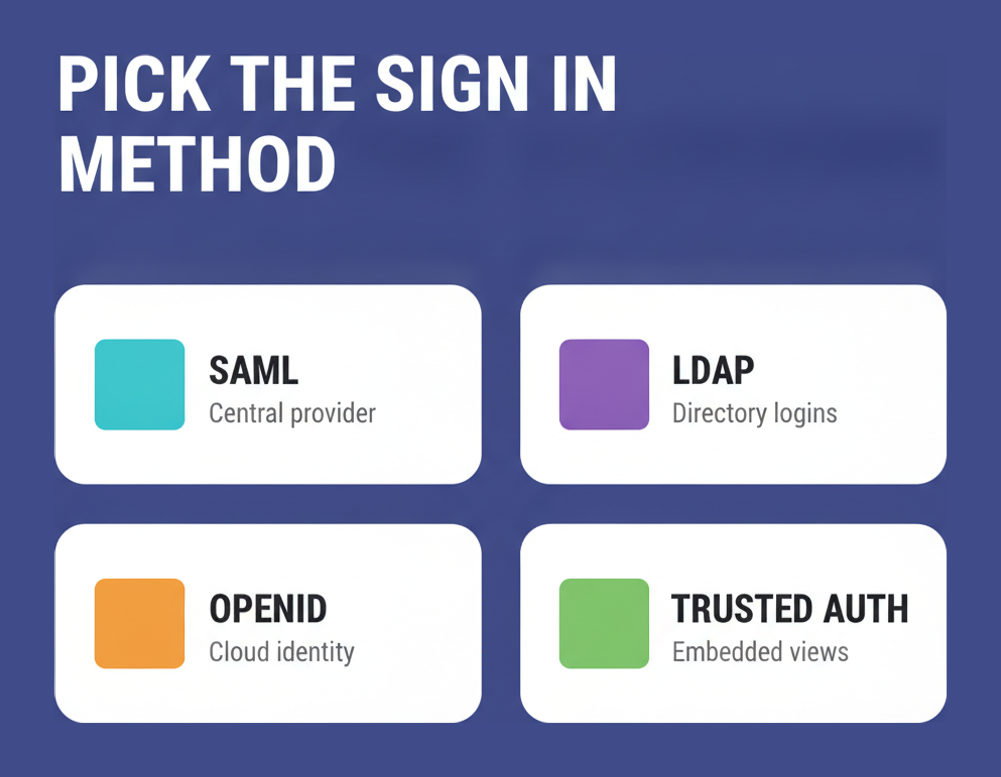
Authentication is the heart of this domain
The syllabus names SAML, Kerberos, OpenID Connect, LDAP, and Azure AD directly. The Tableau authentication documentation sets out how each fits together, including local authentication, mutual SSL, and trusted authentication for embedding scenarios.
A useful way to revise it is by the question the organisation is really asking:
- We already run Active Directory and want silent sign-on, so Kerberos or Active Directory integration
- We have a central identity provider and want assertions, so SAML
- We use a modern cloud identity service, so OpenID Connect or Azure AD
- We need to embed views in another application on the user’s behalf, so trusted authentication or connected apps
Encryption and platform choice
Encryption questions separate data at rest from data in transit, and expect you to know which is configured where. Installation questions cover both Linux and Windows, so a candidate who has only ever installed on one platform should spend time reading about the other before exam day.
How Do You Monitor and Maintain a Tableau Deployment?
At 41%, monitoring and maintenance is the single largest domain in the Tableau Architect exam. It covers building administrative views and dashboards, running load tests, diagnosing and fixing performance problems, using observability data to keep an environment healthy, automating routine server maintenance, and managing server extensions.
Administrative views are where most candidates should start. They are the built-in workbooks that report server and site activity, and the administrative views documentation covers both what they show and the PostgreSQL driver requirement that trips people up on newer versions.
Performance questions want a method, not a rule
Tableau’s own performance tuning guidance frames server tuning around three different optimisation goals: responding to user traffic, refreshing extracts, and serving extract-heavy query loads. Tuning for one can work against another, which is precisely the trade-off the exam likes to test.
Load testing is the other half. The exam distinguishes between measuring what an environment can take and reacting to what it is currently doing, and those are different tools answering different questions.
Cloud or Server: Which Path Does the Exam Assume?
Both, and the balance is worth understanding before you study. Two of the three domains name Tableau Server explicitly, and the deployment domain is entirely Server-focused. Tableau Cloud appears inside the design domain, through planning a Cloud implementation and planning migrations between platforms.
| Question type | Tableau Server | Tableau Cloud |
|---|---|---|
| Where it appears | Deploy and Monitor domains | Design domain |
| Installation and topology | Yours to plan and run | Managed for you |
| Identity integration | Full range of methods to configure | Planned as part of the implementation |
| Study emphasis | The large majority of the exam | Planning and migration decisions |
So a candidate whose entire experience is on Tableau Cloud has real work to do. The reverse is less painful, because a Server administrator still meets Cloud through migration planning rather than through day-to-day operations.
How Do You Build the Experience This Exam Assumes?
Analytics-Arch-201 assumes you have run a Tableau deployment, not merely read about one. There are no published prerequisites, so nothing stops you registering, but the 63% pass mark across 59 scenario-heavy questions is difficult to reach on theory alone. The most reliable preparation is deliberately closing the gaps your own environment never forced you to touch.
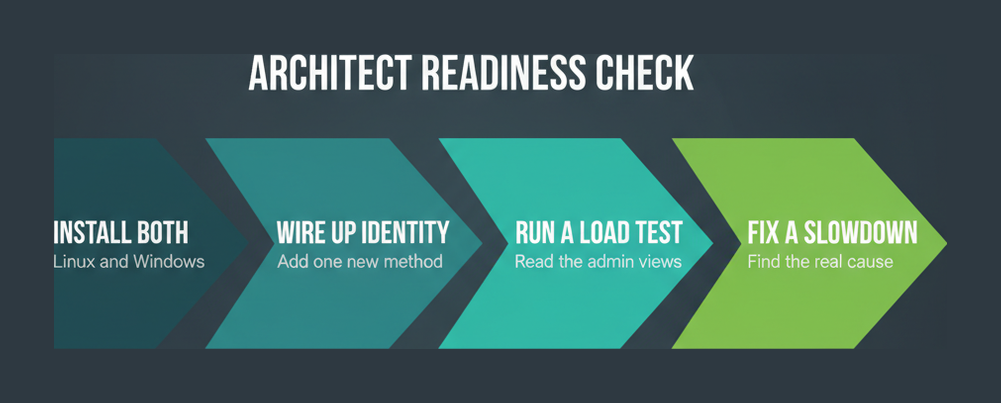
A sequence that works:
- Audit yourself against the three domains and mark every objective you have never actually performed
- Start with monitoring and maintenance, since it is the largest domain and the easiest to practise on a live environment
- Work through the authentication methods you have not configured, at least to the point of understanding what each requires
- Install Tableau Server on whichever operating system you normally avoid
- Run a load test and read the administrative views afterwards, so the numbers mean something
- Move to timed questions and treat each miss as a pointer back to a specific objective
Working through Tableau architect sample questions is a fast way to find those gaps, because the scenario phrasing exposes assumptions that reading documentation does not.
Which Roles Open Up After the Architect Credential?
The Tableau Architect credential maps to platform ownership roles: Tableau platform architect, analytics platform engineer, BI infrastructure lead, and the senior server administrator who owns an enterprise deployment end to end. It sits above the analyst and consultant credentials because it certifies running the platform rather than building content on it. Architects working on distributed ledgers have a parallel route, set out in these CBSA exam objectives.
The distinction matters when you are choosing between Tableau certifications. If your work is building and interpreting content, the Tableau data analyst path is the better fit. If you want the wider view of how the architect role has developed, the earlier architect career walkthrough covers the same credential under its previous exam code.
One practical note on registration: at $400 with a $200 retake, this is one of the more expensive analytics exams, which is a further argument for closing your gaps before booking rather than after.
Frequently Asked Questions
How many questions are on the Analytics-Arch-201 exam?
The exam has 59 questions and a 105 minute time limit. That gives you a little under two minutes per question, which is generous for straightforward items and tight for the longer deployment scenarios, so pace accordingly.
What is the passing score for the Tableau Architect exam?
You need 63% to pass, which is roughly 37 correct answers out of 59. Because the two operational domains carry 78% of the paper, a weak showing in either one is very hard to recover from elsewhere.
How much does the Tableau Architect certification cost?
Registration is $400 USD and a retake is $200 USD. Given that pricing, most candidates are better served closing their weakest domain before booking rather than treating a first attempt as a practice run.
Are there prerequisites for Analytics-Arch-201?
No prerequisites are published, so you can register directly. The exam nonetheless assumes genuine hands-on experience running a Tableau deployment, which is a far more demanding constraint than any formal requirement would be.
Which domain carries the most weight?
Monitor and Maintain a Tableau Deployment, at 41%. It covers administrative views, load testing, performance troubleshooting, observability data, maintenance automation, and server extensions, making it the largest single block of the exam.
Does the exam cover Tableau Cloud as well as Tableau Server?
Yes, though unevenly. Tableau Cloud appears mainly in the design domain through implementation planning and migration decisions, while the deploy and monitor domains focus on Tableau Server, which is where most of the marks sit.
Which authentication methods should you know?
The syllabus names SAML, Kerberos, OpenID Connect, LDAP, and Azure AD. Understanding which method suits a given identity estate matters more than memorising configuration steps, because the questions are framed around organisational requirements.
Do you need to know both Linux and Windows?
Yes. The deployment domain explicitly covers installing Tableau Server on Linux and on Windows, so candidates who have only ever installed on one platform should spend study time on the other before sitting the exam.
How long does preparation usually take?
Experienced server administrators often need six to eight weeks of part-time study, mostly to cover objectives their own environment never required. Candidates without production experience should expect considerably longer and should get hands-on access first.
How does this differ from the Tableau data analyst certification?
The analyst credential tests building and interpreting content in Tableau. The architect credential tests designing, deploying, and operating the platform that content runs on, so they suit different roles and are usually taken by different people.
Conclusion
The route to becoming a Tableau architect runs through operations. Analytics-Arch-201 puts 78% of its marks on deploying Tableau Server and then keeping it healthy, which means the credential rewards people who have configured authentication against a real identity provider, watched a deployment slow down, and worked out why.
Plan your study in the order the blueprint weights it: monitoring and maintenance first, deployment second, design last. Fill in the platform you have not installed and the authentication method you have not configured, then move to timed scenario questions to find the objectives your own environment never made you learn.


