1Z0-830 is the Oracle Java SE 21 Developer Professional exam, and the clearest signal of what it expects is the clock. Oracle allows 120 minutes for 50 questions, which is well over two minutes each and far more generous than most multiple choice papers. That is not kindness. A Java SE 21 certification tests your ability to read code, and the questions carry listings long enough that you will need the time. The syllabus spans ten topic areas from date and time handling through to localisation, with concurrency, streams, and object-oriented design in between, and Oracle publishes no weightings for any of them. This article covers what each area involves, which modern language features the questions assume you already use, and how a developer whose habits were formed on Java 8 should close the gap.
What Does the Java SE 21 Developer Certification Cover?
1Z0-830 is a 50 question multiple choice exam with 120 minutes allowed and a 68% pass mark, meaning 34 correct answers. It costs $245 USD, with pricing varying by country and local currency. Oracle publishes ten topic areas for the exam and attaches no percentage weighting to any of them. The Stack Overflow developer survey still places Java among the most widely used languages, which is why the version gap matters commercially and not just academically.
Format, cost, and scoring
| Attribute | Detail |
|---|---|
| Exam code | 1Z0-830 |
| Certification | Oracle Java SE 21 Developer Professional |
| Questions | 50, multiple choice |
| Duration | 120 minutes |
| Passing score | 68% |
| Cost | $245 USD, varying by country |
| Published weightings | None |
The ten topic areas
- Handling date, time, text, numeric, and boolean values
- Controlling program flow
- Using object-oriented concepts in Java
- Handling exceptions
- Working with arrays and collections
- Working with streams and lambda expressions
- Packaging and deploying Java code
- Managing concurrent code execution
- Using the Java I/O API
- Implementing localisation
Oracle also names annotations, generics, and the basics of the Java Logging API as expected competencies, so they can surface inside any of the ten areas rather than appearing as a section of their own.
Why Does 1Z0-830 Allow 120 Minutes for 50 Questions?
Because reading is most of the work. At 2.4 minutes per question, 1Z0-830 is far more generous than a typical certification paper, and Oracle extended the allowance from the 90 minutes used on earlier Java exams. The reason is the format: many questions present a code listing and ask what it prints, whether it compiles, or which line fails.
That changes how you should practise. Recognising a definition takes seconds; tracing a stream pipeline through three intermediate operations, or spotting that a switch expression does not cover every permitted subtype of a sealed interface, takes minutes. If your revision consists of reading about features rather than reading code, you will be slower on the day than your knowledge deserves.
Two habits pay off. The first is compiling and running short snippets yourself rather than trusting what you expect them to do. The second is learning to spot the deliberate trap early, since most code questions turn on one line, and finding that line quickly is what the extra time is really for.
Which Modern Java Features Does the Exam Assume?
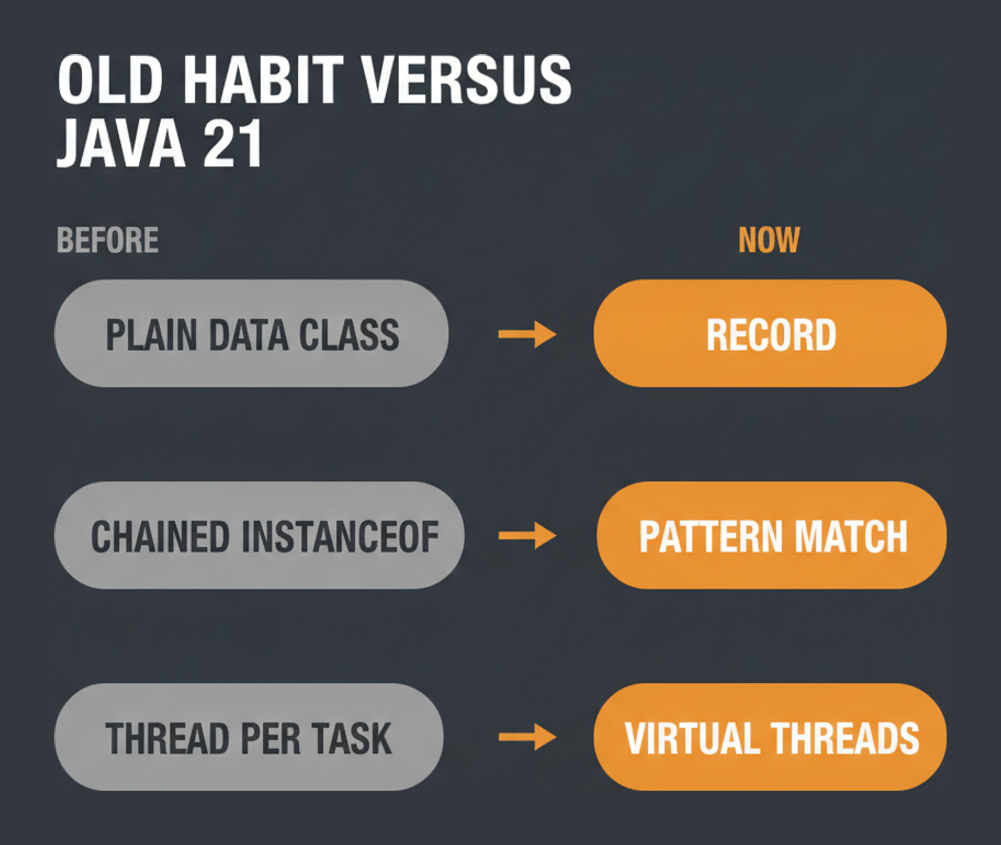
The ones that became permanent between Java 14 and Java 21, and the exam treats them as ordinary Java rather than as novelties. Records, sealed classes, pattern matching, text blocks, and switch expressions all sit inside the object-oriented concepts and program flow topic areas, so there is no way to avoid them.
What arrived when
Oracle’s Java language changes documentation tracks the progression precisely, and knowing it helps you reason about what a given release supports.
| Feature | Became permanent in |
|---|---|
| Switch expressions | Java SE 14 |
| Text blocks | Java SE 15 |
| Records and pattern matching for instanceof | Java SE 16 |
| Sealed classes | Java SE 17 |
| Record patterns and pattern matching for switch | Java SE 21 |
Where the questions bite
Record patterns and pattern matching for switch were finalised in Java 21 itself, which makes them the features most likely to appear in a form you have not met before. The recurring theme is exhaustiveness: when a switch works over a sealed type, the compiler expects every permitted subtype to be handled, and questions are built around what happens when one is missing.
How Much Concurrency Do You Need to Know?
Enough to reason about virtual threads, not just the executor framework. Managing concurrent code execution is one of the ten published topic areas, and Java 21 is the release where virtual threads became a standard part of the platform, so the topic carries material that did not exist on earlier Java exams.
A virtual thread is still an instance of java.lang.Thread, but it is not tied to a specific operating system thread. When code running in one performs a blocking I/O operation, the runtime suspends it and frees the underlying OS thread for other work. That single mechanism explains most of what the exam asks.
Oracle is unusually direct about what virtual threads are not for, and it is worth taking literally: they are not faster threads and do not run code any faster than platform threads. They exist to provide scale through higher throughput, not speed through lower latency. Exam questions lean on that distinction.
The virtual threads documentation is the reference to work from here. A question that describes a CPU-bound workload and asks whether virtual threads will help is testing exactly the distinction in that quotation, and the answer is usually no.
What Do Streams and Lambdas Look Like on the Exam?
They look like code you have to execute in your head. Working with streams and lambda expressions is its own topic area, and the questions typically show a pipeline and ask for the output, the type, or whether it compiles at all. Familiarity with the syntax is not enough; you need to be able to trace the data.
The recurring themes are consistent:
- Which operations are lazy and which trigger the pipeline to run
- What a terminal operation actually returns, particularly the Optional-returning ones
- How collectors group, partition, and join, and what type comes back
- What happens to a stream after it has already been consumed
- Which functional interface a given lambda satisfies, and why another one does not compile
Arrays and collections sit alongside this as a separate area, and Java 21’s sequenced collections gave the framework a defined notion of first and last elements with a reversed view. It is a small addition that is easy to overlook precisely because it is new.
How Are Packaging and Deployment Tested?
Mostly through the module system and the mechanics of turning source into something runnable. Packaging and deploying Java code is one of the ten areas, and it covers modules, the command line tooling, and how a program is assembled and launched rather than how it behaves once running.
Modules tend to be the weak point, because a great many working developers have never declared one. Expect questions on what a module declaration exports, what it requires, and what happens to code on the class path as opposed to the module path.
The Java I/O API and localisation round out the practical end of the syllabus. Localisation is easy to skip and easy to score in: locales, resource bundles, and formatting numbers, currencies, and dates for a given region are a compact, well defined body of knowledge.
How Should a Java 8 Developer Prepare for Java 21?
By treating the gap as language change rather than revision. A developer whose daily work is Java 8 already knows streams, lambdas, collections, and exceptions well. What they have missed is thirteen years of syntax that the exam treats as routine, plus virtual threads and the module system.
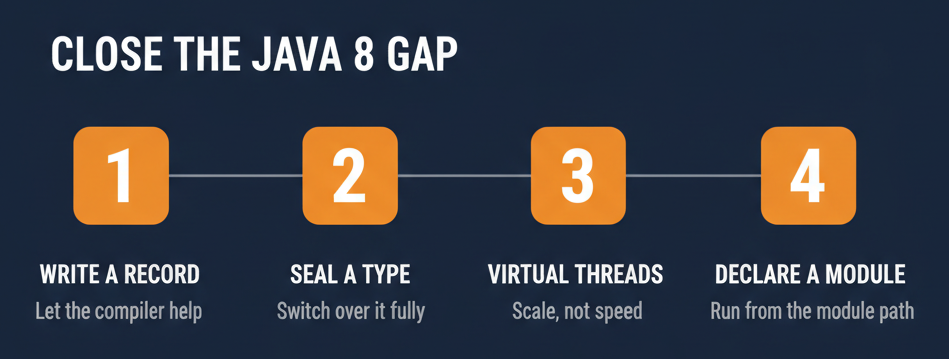
A sequence that closes that gap efficiently:
- Rewrite a small existing class as a record and see what the compiler generates for you
- Model a small type hierarchy with a sealed interface, then switch over it exhaustively
- Replace a nested chain of instanceof checks with pattern matching, including a record pattern
- Run the same workload on platform threads and on virtual threads to see where each helps
- Declare one module, export one package, and run the result from the module path
- Spend a session purely on localisation, since it is compact and reliably examinable
Throughout, compile and run every experiment rather than reading about it. Working through the full 1Z0-830 syllabus topic by topic is the most reliable way to find which of the ten areas your own codebase never forced you to learn.
How Does 1Z0-830 Compare With the Java SE 17 Exam?
They are the same credential at different language levels, and both target long-term support releases. Java SE 21 is an LTS release, as Java SE 17 was before it, which is why Oracle builds a professional exam around each. The structural difference is what has become permanent in the language since.
| Consideration | Java SE 17 exam | Java SE 21 exam |
|---|---|---|
| Exam code | 1Z0-829 | 1Z0-830 |
| Sealed classes | Permanent, examinable | Permanent, examinable |
| Pattern matching for switch | Preview at that release | Finalised and examinable |
| Record patterns | Not yet available | Finalised and examinable |
| Virtual threads | Not part of the platform | Standard, and in the concurrency area |
For most candidates the current release is the better target, since employers tend to care about the newest LTS. If you want a sense of how Oracle structures these developer papers, the earlier Java SE 17 exam walkthrough covers the predecessor in detail. For a look at how Oracle shapes its other professional-level credentials, the Oracle database administration route is a useful contrast.
One practical note on booking: although Oracle exams appear in the Pearson VUE catalogue, Oracle exams delivered in English are managed directly by Oracle, so scheduling happens through Oracle rather than the Pearson VUE portal.
Frequently Asked Questions
How many questions are on the 1Z0-830 exam?
The exam has 50 multiple choice questions with 120 minutes allowed, which works out at about 2.4 minutes each. The generous allowance reflects how much code you have to read rather than any unusual difficulty in the concepts.
What is the passing score for the Java SE 21 exam?
You need 68%, which is 34 correct answers out of 50. Since Oracle publishes no weightings for the ten topic areas, there is no large section to lean on, so broad coverage matters more than depth in a favourite topic.
How much does the Oracle Java SE 21 certification cost?
The exam costs $245 USD, and Oracle notes that pricing may vary by country or in localised currency. Check the price for your own region when booking rather than assuming the dollar figure applies everywhere.
Are the exam topics weighted?
No. Oracle lists ten topic areas without percentages, so every area is examinable and none can be safely ignored. Annotations, generics, and Java Logging API basics are also named as expected competencies across those areas.
Do you need to know virtual threads?
Yes. Managing concurrent code execution is a published topic area, and virtual threads became a standard platform feature in Java 21. Understanding that they provide throughput rather than raw speed is the distinction most questions turn on.
Which language features are new since Java 17?
Record patterns and pattern matching for switch were finalised in Java SE 21, having previously been preview features. Sealed classes, records, text blocks, and switch expressions all became permanent in earlier releases and remain examinable.
Is Java SE 21 a long-term support release?
Yes. Java SE 21 was released in September 2023 as a long-term support version, which is why Oracle built a professional developer certification around it, as it did for Java SE 17 and Java SE 11 before.
Do you need to know the module system?
Yes. Packaging and deploying Java code is a published topic area and covers modules directly. This is often the weakest area for working developers, since many production codebases still run entirely from the class path.
Are there prerequisites for 1Z0-830?
No prerequisites are published, so any candidate may register. The exam does assume genuine day-to-day Java development experience, particularly the ability to read unfamiliar code accurately under time pressure.
Should a Java 8 developer take this exam directly?
They can, but the gap is real. Records, sealed classes, pattern matching, text blocks, virtual threads, and modules all postdate Java 8, so plan deliberate hands-on time with each rather than treating preparation as revision.
Conclusion
1Z0-830 measures whether you can read modern Java accurately, which is why Oracle gives you 120 minutes for 50 questions. Ten topic areas, no published weightings, and a 68% pass mark together mean the winning strategy is breadth: cover localisation and modules as seriously as you cover streams.
If your habits were formed before Java 17, the real work is language change rather than revision. Write records, seal a hierarchy, switch over it exhaustively, run something on virtual threads, and declare one module. Then work timed code-reading questions across all ten areas until tracing a listing feels quick rather than laborious.


