NCP-MCI, the Nutanix Certified Professional exam for Multicloud Infrastructure, is the credential Nutanix positions at the advanced end of its programme, and the Nutanix multicloud infrastructure certification it awards is the one most working administrators are actually aiming at. It is a 75 question paper with a 120 minute limit and a $200 fee, and it carries one detail that trips people up before they even sit down: it is not scored as a percentage. The result comes back on a scale running from 1000 to 6000, and you need 3000. That is the midpoint of the reportable range, which is a different thing from getting half the questions right. This article covers what the four domains actually ask, why the version you study against matters more here than on most exams, whether the associate credential is worth taking first, and which roles the professional credential genuinely serves.
What Is the Nutanix Multicloud Infrastructure Certification?
NCP-MCI validates that an administrator can deploy, manage, protect and monitor a Nutanix environment that spans more than one cloud. It runs 75 questions in 120 minutes, costs $200 USD, and is scheduled through Nutanix directly rather than a third-party test provider. Nutanix classifies it at the advanced level of its certification programme.
The word multicloud in the name is not decoration. Every one of the four domains is phrased around a multicloud environment, and the objectives reflect that: cloud integration, cross-cluster VM migration, replication between sites, and capacity planning that has to hold up when one location fails. An administrator who only ever touches a single on-premises cluster will find parts of this exam describe work they have never done.
| Exam detail | Value |
|---|---|
| Exam name | Nutanix Certified Professional – Multicloud Infrastructure |
| Exam code | NCP-MCI |
| Questions | 75 |
| Duration | 120 minutes |
| Passing score | 3000 on a scale of 1000 to 6000 |
| Price | $200 USD |
| Scheduling | Nutanix |
| Recommended training | Nutanix Enterprise Cloud Administration |
Registration and the current course catalogue both live behind the Nutanix University portal, which requires a sign-in, so plan on creating an account before you try to book anything. A consolidated view of the credential and its objectives sits on the NCP-MCI certification page.
Why Is NCP-MCI Scored Out of 6000?
NCP-MCI reports a scaled score between 1000 and 6000, with 3000 required to pass. Scaled scoring exists so that different forms of the same exam can be compared fairly: a harder set of questions is worth slightly more per correct answer than an easier one, and the reported number accounts for that before you ever see it.
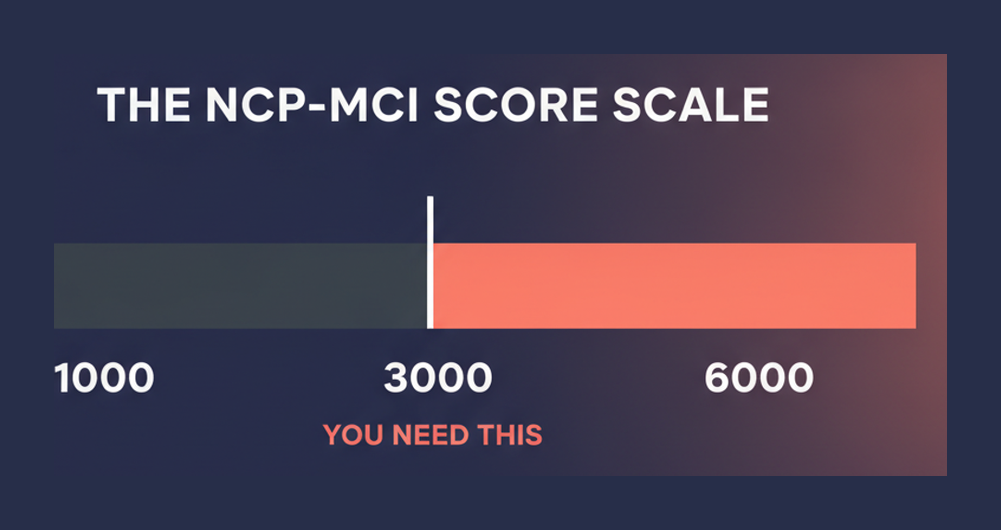
The practical consequence is that you cannot convert 3000 into a number of correct answers, and you should not try. Candidates who go in planning to “get sixty out of seventy-five” are working from a model the exam does not use. What you can rely on is that every question contributes, and that no domain is discounted.
What this changes about preparation
With no published percentage weights across the four domains and a scaled result at the end, triage is not available. The usual tactic of writing off the smallest domain has nothing to aim at here. The efficient approach is breadth: make sure you can answer something sensible in all four areas rather than mastering two and hoping.
Should You Take NCA First, or Go Straight to NCP-MCI?
There is no formal requirement to hold the Nutanix Certified Associate credential before sitting NCP-MCI, so the decision is purely practical. If you already administer a Nutanix cluster day to day, go straight to the professional exam. If your exposure is limited to demos, evaluations or a lab you built once, the associate credential builds the vocabulary far more cheaply than a failed professional attempt does. The automation track sits alongside it, and the NCP-MCA certification guide covers what Self-Service and X-Play add on top.
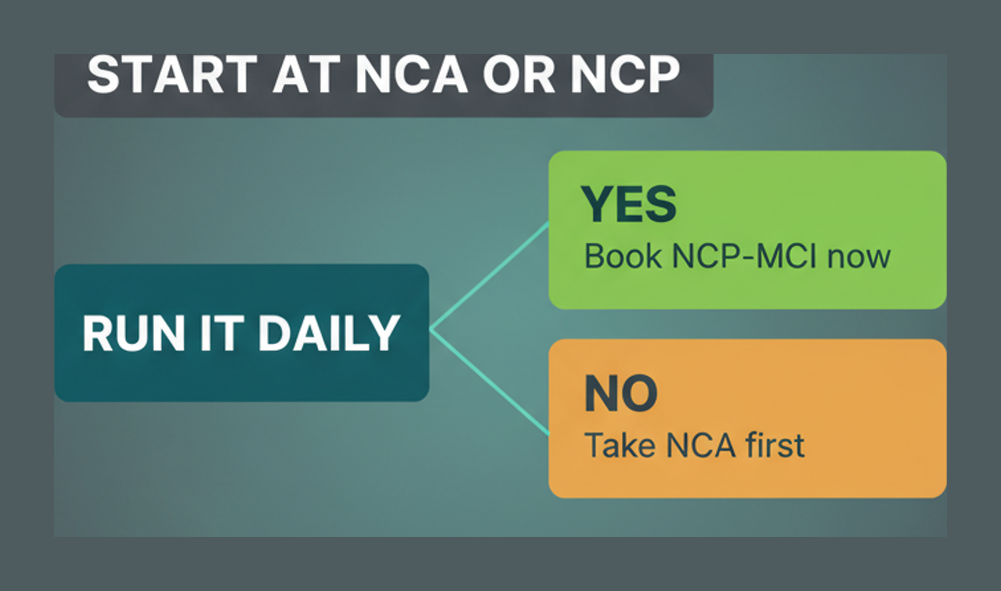
The honest test is whether the following sound like descriptions of your week or like unfamiliar phrases: Prism Central deployment sizing, protection domains, LCM upgrades, vDisk live migration, and Cluster Lockdown Mode. If four of the five are familiar, book NCP-MCI.
Where each credential lands
NCA proves you understand the platform. NCP-MCI proves you can run it, including when a site fails. Employers reading a CV treat them very differently, and the professional credential is the one attached to Nutanix’s advanced tier. For candidates starting further back, this Nutanix Certified Associate walkthrough covers what the entry exam involves.
Whichever route you take, the full programme structure is published on the Nutanix certifications page.
Which Version of NCP-MCI Should You Study?
Version confusion is the single biggest avoidable risk on this exam. NCP-MCI has been revised repeatedly as the platform has moved, and material for retired versions is still widely circulated and still ranks in search results. Studying the wrong one produces confident answers that are wrong for the current form.
The blueprint has moved with the product in ways that are easy to spot once you know to look. Prism Central has taken on far more of the management surface, which is why Prism Central deployment, sizing, scaling and its Policy Engine now appear as first-class objectives rather than as an afterthought. Prism Central based disaster recovery sits alongside the older Prism Element based approach rather than replacing it, and the exam expects you to know when each applies.
How to avoid the trap
- Check the version listed on the current objective set before buying or trusting any study material.
- Treat anything that only mentions protection domains, and never mentions Prism Central based DR, as out of date.
- Verify version-sensitive behaviour against your own deployment, and note where your cluster is older than the exam expects.
- Prefer resources that name the current version explicitly over those that just say “NCP-MCI”.
A current list of preparation material for this exam is collected in this NCP-MCI preparation resource guide.
What Does the Cluster Management Domain Cover?
The cluster domain is the foundation of the exam and the broadest of the four. It spans deploying and configuring clusters, standing up and sizing Prism Central, network management, cluster storage, and cluster security, and it expects configuration-level knowledge rather than concepts.
Deployment questions get specific quickly. You are expected to gather the required configuration details, tell deployment methods apart, size the controller VM according to which features are enabled, configure the required services, and perform node imaging. Prism Central is treated as its own deployment exercise, with sizing driven by which features you intend to switch on and a scaling path when the estate grows.
Networking and storage inside the domain
Networking covers virtual switches, virtual subnets, VPC configuration, and Flow load balancing and traffic mirroring. Storage covers what to do when a cluster runs short, when to apply which resiliency model, when reserved capacity or reserved space is appropriate, and how external storage integrates.
Security is heavier than most candidates expect
Cluster security is a substantial sub-area in its own right: hardening through nCLI, disabling SSH and Bash access, filesystem whitelists, SSL certificate implementation, firewall requirements, Cluster Lockdown Mode, encryption options, network segmentation, and identity and access management with role-based access control in Prism Central. Anyone treating this exam as purely a virtualisation paper will be surprised here.
How Deep Does the Workload Management Domain Go?
The workload domain moves from the platform to what runs on it, and it goes deeper into day-to-day operations than the cluster domain does into architecture. Virtual machine management, storage containers, workload storage, VM conversion and workload security all sit here, and all are examined as tasks.
Migration is the recurring theme. The objectives call out moving VMs both within a cluster and between clusters, live migration of vDisks, and full conversion of workloads from other platforms, including installing VirtIO, identifying supported source and target platforms, and choosing the right Nutanix tool for the job. Anyone who has run a real migration will recognise the shape of these questions immediately.
Workload security
Security appears again, this time at the workload level: enabling vTPM and Secure Boot on a VM, applying VM level encryption through a storage policy, applying microsegmentation policy, analysing an environment with Security Central, and creating approval policies. Microsegmentation in particular rewards hands-on time, because the mental model of policy applied per workload rather than per network segment takes a while to settle.
The underlying architecture that makes all of this possible is standard hyperconverged infrastructure, and candidates coming from traditional three-tier environments benefit from getting that model straight before anything else.
What Do the DR and Operations Domains Ask For?
These two domains together cover what happens when the environment is under stress. Disaster recovery and data protection asks how you protect and recover Prism Central itself, how you configure Prism Central based DR for VMs and volumes, and how the older Prism Element based approach still works. Operations and monitoring covers capacity, performance and maintenance.
Disaster recovery
Protecting Prism Central is listed first, which is telling: if the management plane is gone, recovering the workloads becomes much harder. The objectives name continuous and point-in-time backup, instance migration, the recovery process itself, and what has to happen after a restore. Replication choices then follow, spanning asynchronous and near-sync, synchronous replication and Metro, and container-level disaster recovery.
The Prism Element side has not gone away. Protection domains across multiple clusters, network mapping for failover, remote site configuration, planned and unplanned failover, and Metro with ESXi are all still examinable, which is why studying only the newer approach leaves a gap.
Operations and monitoring
Capacity management is the standout here because it is forward looking: predicting growth, understanding limits and risks, configuring proactive alerting, optimising resources, and validating that capacity still holds under a failure or DR scenario. Performance work covers Storage QoS, automated resolution of performance alerts, VM performance analysis, and reading audit and system logs. Maintenance covers expanding a cluster, ejecting nodes, diagnosing NCC errors, and planning and executing LCM upgrades.
Which Roles Does This Certification Serve?
NCP-MCI serves infrastructure roles where someone is accountable for uptime rather than for a project. Virtualisation administrators, systems administrators running Nutanix estates, infrastructure engineers, and the operations side of platform teams all draw on what the credential proves, and it maps closely onto a job description rather than onto a technology list.
The credential also carries unusually strong salary signalling. Nutanix records that Skillsoft ranked NCP-MCI the third highest paying IT certification in its published list, dated November 2024. That is a vendor-reported figure rather than an independent one, so treat it as a signal rather than a promise, and check it against real market data such as independent systems administrator pay data for your own region.
Where it does not help
It is not a design credential and it is not an automation credential. Nutanix runs separate professional exams for multicloud automation, database automation, unified storage, end-user computing, cloud native and network security, and an expert-level track above them. If your work is mostly building automation on top of Nutanix rather than running the platform, one of those is the better fit.
Frequently Asked Questions
How many questions are on the NCP-MCI exam?
The exam has 75 questions and a 120 minute limit, which allows roughly 96 seconds per question. That is comfortable for recall items but tighter than it looks once scenario questions with several plausible answers appear.
What score do you need to pass NCP-MCI?
You need 3000 on a scale that runs from 1000 to 6000. Because the score is scaled rather than a raw percentage, it cannot be converted into a fixed number of correct answers.
How much does the Nutanix multicloud infrastructure certification cost?
The exam fee is $200 USD. Training such as the Enterprise Cloud Administration course is priced separately, so budget for that on top if you plan to take the recommended path.
Do you need NCA before taking NCP-MCI?
No formal prerequisite exists, so you may register directly. In practice the associate credential is worth taking first if your Nutanix exposure is limited to labs and evaluations rather than daily administration.
Where do you book the NCP-MCI exam?
Through Nutanix rather than a third-party test provider, using the Nutanix University portal. You will need to create an account there before you can schedule, so allow time for that step.
How many domains does NCP-MCI have?
Four: managing clusters, managing workloads, disaster recovery and data protection, and operations and monitoring. No percentage weights are published for them, so none can safely be skipped.
Does the exam cover security?
Substantially. Cluster security covers hardening, lockdown mode, certificates, encryption and network segmentation, while workload security adds vTPM, Secure Boot, VM level encryption and microsegmentation policy.
Is Prism Central heavily tested?
Yes. Prism Central deployment, sizing, scaling and its Policy Engine are named objectives, and protecting and recovering Prism Central itself opens the disaster recovery domain, which is a strong signal of its importance.
How long does preparation usually take?
Two to three months is realistic for an administrator already running Nutanix, and considerably longer without daily exposure. The disaster recovery material is the usual bottleneck because it is hardest to practise safely.
What comes after NCP-MCI?
Nutanix runs further professional exams in multicloud automation, database automation, unified storage, end-user computing, cloud native and network security, plus an expert-level multicloud infrastructure credential above them.
Conclusion
NCP-MCI rewards administrators who run Nutanix rather than those who have read about it. Four unweighted domains, a scaled result at the midpoint of a 1000 to 6000 range, and objectives that reach from node imaging through microsegmentation to Metro failover leave very little room to specialise your way through the paper.
The two decisions worth getting right before you book are both outside the blueprint. Confirm which version the current objective set describes, because material for retired versions still circulates freely and reads perfectly plausibly. And be honest about whether the associate credential should come first, using daily familiarity with Prism Central, protection domains and LCM upgrades as the test rather than ambition.


