The AgilePM Foundation exam gives you 40 minutes to answer 50 multiple choice questions, and you need 60% to pass. That works out at 48 seconds a question, which is the number worth holding onto, because it shapes everything about how you should prepare. AgilePM is APMG International’s Agile Project Management certification, now at version 3, and it is built on the DSDM Agile Project Framework rather than on Scrum. That distinction matters more than most candidates expect. This is not an exam you can pass by knowing agile in general; it tests one specific framework with its own lifecycle, its own roles and its own vocabulary. This article covers the exam format and pass mark, the ten syllabus topics, how AgilePM relates to DSDM, what version 3 added, whether Foundation is enough on its own, and how to prepare for a paper this short.
What Is the AgilePM Foundation Certification?
AgilePM Foundation is the entry-level credential in APMG International’s Agile Project Management scheme. It certifies that you understand the AgilePM framework: its lifecycle, its roles and responsibilities, how requirements are prioritised, and how planning, control and governance work inside an agile project. It is a knowledge-level exam rather than an applied one.
The scheme exists to solve a specific problem. Agile practice grew up in software teams, and much of it assumes a product context with no fixed end date. Project organisations, particularly in the public sector and in regulated industries, still work to defined projects with governance, budgets and reporting obligations. AgilePM is the attempt to make agile delivery work inside that structure rather than around it.
What Foundation does not do
It does not certify that you can run an agile project. That is the Practitioner level. Foundation confirms you know the framework well enough to work in a team using it, which is genuinely useful for business analysts, team members and stakeholders as well as for project managers. There is no prerequisite: you can sit Foundation with no prior certification and no stated experience requirement. Frameworks differ on how they test that step up, and the PSM II assessment shows how Scrum.org handles the same jump from knowing to applying.
What Is the Exam Format and Pass Mark?
The AgilePM Foundation exam is 50 multiple choice questions in 40 minutes, with a pass mark of 60%, which means 30 correct answers. The listed fee is USD $386, though in practice most candidates sit it bundled with an accredited three day course rather than buying it separately.
| Exam detail | Value |
|---|---|
| Certification | APMG International Agile Project Management Foundation |
| Questions | 50 |
| Duration | 40 minutes |
| Passing score | 60%, which is 30 of 50 |
| Format | Multiple choice |
| Fee | USD $386 |
| Framework version | AgilePM version 3 |
| Prerequisites | None |
| Certificate validity | Does not expire |
| Languages | English, Polish, German, Italian, French |
Forty-eight seconds a question is the tightest timing you will meet at Foundation level in any comparable scheme. It is achievable because the questions are recall-based rather than scenario-based, but it leaves no room for working things out from first principles. If you have to reason your way to an answer, you have already lost the time you needed for two other questions.
The practical implication is that AgilePM Foundation rewards rote familiarity in a way that scenario exams do not. Knowing which role owns which decision, and what each lifecycle phase is called, has to be automatic rather than derived. A scenario-driven contrast is the CPMAI methodology certification, which tests a six-phase delivery method rather than recall.
Which Ten Topics Does the Syllabus Cover?
The syllabus lists ten topics and publishes no weightings for any of them, and no sub-objectives either. That is unusually sparse, and it means the only honest planning approach is to treat all ten as equally examinable and cover each one properly rather than trying to guess where the questions concentrate.
| Topic | What sits under it |
|---|---|
| Key Concepts | The vocabulary the rest of the syllabus assumes |
| Scrum Overview | Scrum’s roles, events and artefacts, for context and contrast |
| AgilePM Fundamentals | The philosophy and principles underpinning the framework |
| Individuals and Interactions | The AgilePM roles and who is accountable for what |
| Collaboration and Communication | Facilitated workshops, modelling, daily stand-ups |
| Project Lifecycle Framework | The phases and how a project moves through them |
| Requirements, Estimating and Prioritisation | Requirement types and the prioritisation scheme |
| Planning and Control | Timeboxing, planning levels, tracking progress |
| Risk Management and the Project Approach | Risk in an agile project and how the approach is assessed |
| Governance, Compliance and the AgilePM Products | The products the framework produces and when |
Where the marks concentrate in practice
Three of these carry disproportionate weight for a recall exam. Individuals and Interactions, because role questions are easy to write and easy to get wrong. Project Lifecycle Framework, because phase names and their order are exactly the sort of thing a 48 second question tests. And Governance, Compliance and the AgilePM Products, because the products list is long and each product belongs to a specific point in the lifecycle.
Requirements, Estimating and Prioritisation deserves separate mention. The prioritisation scheme is central to how AgilePM protects a deadline, and understanding that it is a way of flexing scope rather than a way of labelling wishes is the single conceptual leap the framework asks you to make.
Is AgilePM the Same Thing as DSDM?
Effectively yes. AgilePM is APMG International’s certification scheme built on the DSDM Agile Project Framework, which is owned and maintained by the Agile Business Consortium. The exam tests DSDM’s lifecycle, roles, principles and products. If you have studied DSDM, you have studied the substance of AgilePM.
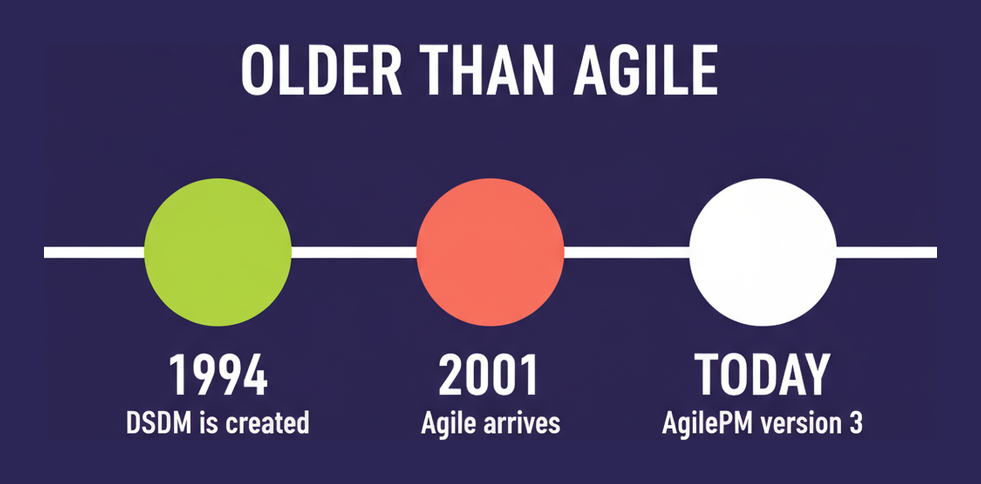
The framework is considerably older than most agile methods people encounter today.
“DSDM was initially created in 1994 through collaboration of a large number of project practitioners across many companies who were seeking to build quality into Rapid Application Development (RAD) processes”
That 1994 date predates the Agile Manifesto by seven years, which explains a lot about the framework’s character. DSDM was built by people who already had project disciplines and wanted to add speed, rather than by people who had speed and later had to add discipline. The result is a framework that treats governance and documentation as normal rather than as overhead to be minimised, which is exactly why it fits organisations that Scrum alone does not.
Why the distinction matters for the exam
Because a question about the lifecycle expects DSDM’s phases, not a generic agile answer. Candidates who arrive with Scrum experience and no framework study often assume the vocabulary transfers, and it does not. The DSDM framework reference is the underlying material, and the broader principles it builds on are set out in the Agile Manifesto explained.
What Changed in AgilePM Version 3?
The current scheme is AgilePM version 3, and the most visible change for exam candidates is the arrival of a dedicated Scrum Overview topic in the syllabus. Earlier versions treated Scrum as background context; version 3 makes it examinable material in its own right, sitting alongside the AgilePM Fundamentals topic.
That is a pragmatic response to how organisations actually work. Most teams sitting an AgilePM exam already run Scrum at team level, and the framework increasingly has to explain how it sits above and around that rather than instead of it. Expect questions that require you to know Scrum’s roles, events and artefacts by name, and to be clear about which vocabulary belongs to which framework.
What this means for study material
Check the version before you buy anything. Study notes written for the previous version will not contain the Scrum Overview material, and the search data shows candidates actively looking for version 3 content specifically, which suggests plenty of older material is still circulating. APMG confirms the current version on its official AgilePM page, which is the place to check before committing to a course or a book.
Should You Stop at Foundation or Go On to Practitioner?
It depends on whether you will run projects or work in them. Foundation is a knowledge credential and it does not expire, which makes it a low-maintenance addition to a profile. Practitioner is the applied level and it requires re-registration every five years, so it carries an ongoing commitment as well as a higher bar.
| Question | Foundation | Practitioner |
|---|---|---|
| What it certifies | Knowledge of the framework | Ability to apply it to a project |
| Expiry | Does not expire | Re-registration every five years |
| Prerequisite | None | AgilePM Foundation |
| Best suited to | Team members, analysts, stakeholders | Project managers running delivery |
For most people the honest answer is that Foundation is enough unless the job title says project manager. If you contribute to agile projects rather than leading them, the Foundation vocabulary is what makes you useful in planning conversations, and nobody is going to ask you to justify a project approach.
If you are leading delivery, Foundation on its own tends to feel incomplete, because the questions that come up in real projects are exactly the applied ones Practitioner tests. Detail on both levels sits in the wider APMG certification catalogue.
Who Actually Benefits From This Certification?
AgilePM lands hardest where agile delivery has to coexist with formal project governance. That means UK and European organisations more than US ones, public sector more than startups, and any environment where a project has a business case, a budget line and a reporting obligation that will not go away because the team adopted an agile method.
- Project managers moving from waterfall into agile delivery without abandoning governance
- Business analysts who need shared vocabulary with a delivery team
- Delivery leads in organisations where AgilePM is the mandated house framework
- PMO staff assessing whether an agile project approach is sound
Where it is worth less
In a US-centric job market, AgilePM has noticeably lower recognition than PMI-ACP, and search demand reflects that. If your career is US-based and you are choosing one agile credential on recognition alone, that is a real consideration rather than a marketing quibble. If your organisation already uses AgilePM, none of that applies and the framework credential is the right one.
On compensation, the certification is rarely the variable that moves pay; the role is. Current benchmarks for the agile project manager role are tracked on PayScale project manager data, which is a better reference than any single figure quoted in an article.
How Do You Prepare for a Forty Minute Exam?
Prepare for recall speed, not for depth. Fifty questions in 40 minutes means every answer has to come from memory rather than from reasoning, so the goal is to make the framework’s names, roles, phases and products automatic. Depth of understanding helps, but it is not what this particular paper measures.
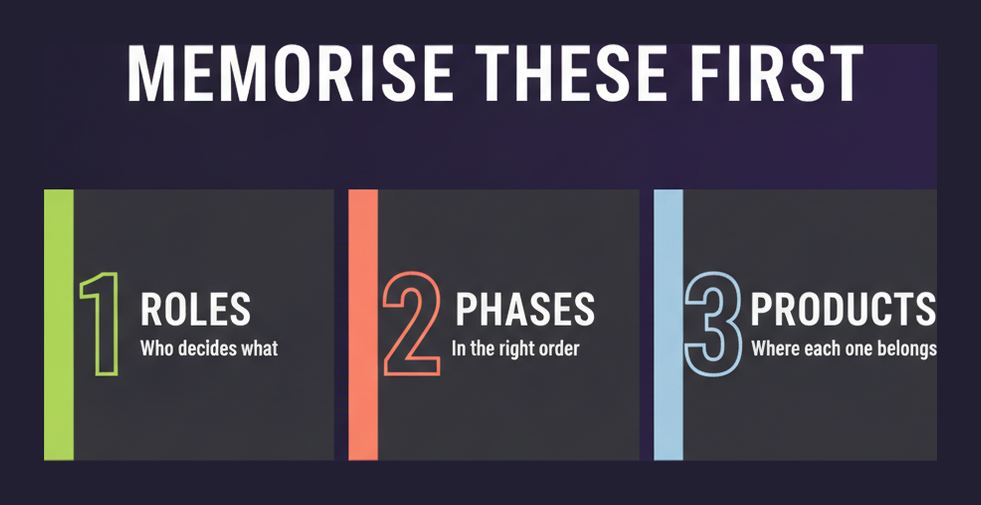
- Confirm your study material is written for AgilePM version 3, because anything older will be missing the Scrum Overview topic that version 3 made examinable.
- Learn the roles and who is accountable for what first, since role questions are the easiest for an examiner to write and the easiest for a candidate to get wrong.
- Memorise the lifecycle phases in order, along with which products belong to which phase, because phase and product questions suit a 48 second format perfectly.
- Drill the prioritisation scheme until you can apply it without hesitating, and make sure you can explain it as a way of flexing scope rather than as a way of ranking wishes.
- Learn the Scrum roles, events and artefacts by name, keeping them clearly separate in your head from the AgilePM equivalents so the two vocabularies do not blur under time pressure.
- Read the governance and compliance material last, since it is the most list-like part of the syllabus and benefits most from being fresh on the day.
- Sit full timed practice papers at 40 minutes rather than untimed question sets, because on this exam the clock is the difficulty and untimed practice will not reveal that.
Working AgilePM practice questions in the exam’s own format is the most useful final step, and the existing AgilePM Foundation resource page collects the preparation material in one place.
Frequently Asked Questions
How long is the AgilePM Foundation exam?
Forty minutes for 50 multiple choice questions, which is 48 seconds each. That is tight enough that the exam effectively tests recall speed rather than reasoning, so preparation should aim at automatic recall.
What is the AgilePM Foundation pass mark?
Sixty per cent, which means 30 correct answers out of 50. There is no separate requirement to pass individual topics, so a strong showing in one area can offset a weaker one elsewhere.
Does the AgilePM Foundation certificate expire?
No. APMG states the Foundation examination is not valid for a defined period and will not expire. Practitioner is different and requires re-registration every five years to stay current.
Are there prerequisites for AgilePM Foundation?
None. You can sit Foundation with no prior certification and no stated experience requirement. Practitioner does require Foundation first, so this is the entry point to the scheme either way.
Is AgilePM the same as DSDM?
AgilePM is APMG’s certification scheme built on the DSDM Agile Project Framework, which the Agile Business Consortium owns. The exam tests DSDM’s lifecycle, roles and products, so the two are the same body of knowledge under different names.
How much does the AgilePM Foundation exam cost?
The listed fee is USD $386. In practice most candidates sit it as part of an accredited course, typically three days, and the exam is bundled into the course price rather than bought separately.
What is new in AgilePM version 3?
The most visible change for candidates is a dedicated Scrum Overview topic in the syllabus. Earlier versions treated Scrum as background; version 3 makes its roles, events and artefacts examinable in their own right.
Which languages is the exam available in?
APMG lists Foundation examinations in English, Polish, German, Italian and French. That reflects where the framework is most used, which is predominantly the UK and continental Europe.
Is AgilePM better than PMI-ACP?
Neither is better in the abstract. AgilePM certifies one specific framework and is stronger in UK and European organisations; PMI-ACP is broader across agile approaches and carries more recognition in the US market.
Do the syllabus topics carry weightings?
No. The syllabus lists ten topics with no percentages and no sub-objectives, so there is no basis for prioritising one over another. Even coverage of all ten is the only defensible study plan.
Conclusion
Two numbers decide how you should approach this exam: 48 seconds per question, and ten topics with no weightings between them. Together they point to the same conclusion, which is that AgilePM Foundation rewards even, automatic recall rather than deep understanding of any one area. Get the roles, the lifecycle phases and the products to the point where you do not have to think, keep the Scrum vocabulary cleanly separate from the AgilePM vocabulary, and check that whatever you study from is written for version 3. Foundation not expiring makes it a genuinely low-maintenance credential once earned. When the framework names come without hesitation, move to full timed papers and let the clock, rather than the content, tell you whether you are ready.


