Spark alone is weighted at 48 percent of CDP-3002. The Cloudera Data Engineer exam runs 50 questions in 90 minutes, asks for 55 percent to pass, and costs $330 booked through Cloudera rather than through Pearson VUE. Five topics share the paper, and they do not share it evenly.
Spark alone is weighted at 48 percent. Add performance tuning at 22 percent and seven questions in every ten are about writing Spark that works and then making it fast. Airflow, deployment, and Iceberg split the remaining 30 percent between them, ten points each. That distribution should decide how you study, and it rarely does, because most summaries present the five topics as a flat list. This article walks each one in weight order, explains what the objectives actually mean in a Cloudera Data Engineering context, and ends with a study plan built around the numbers.
What Does the Cloudera Data Engineer Credential Test?
It tests whether you can build and run a data pipeline on the Cloudera Data Platform. The five topics trace one workflow: process data with Spark, tune it so it finishes in acceptable time, schedule it with Airflow, persist it in Iceberg tables, and deploy the whole thing through the Data Engineering service using its API and command line.
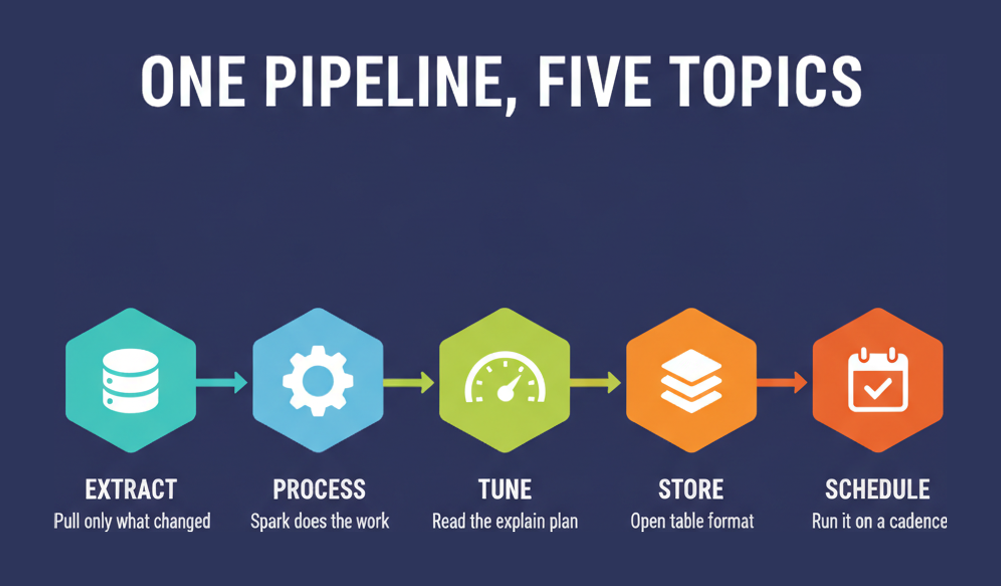
That is a narrower scope than a general data engineering credential. There is nothing here about data modelling theory, nothing about streaming architecture, and nothing about warehouse design. The exam assumes you already know why you are building the pipeline and asks whether you can build it on this platform.
Who the exam suits
Engineers who already write Spark jobs will recognise most of the syllabus immediately. Analysts moving into engineering will find the performance tuning topic the steepest climb, because it assumes you can read an explain plan and reason about join strategy rather than simply write correct code.
Why Does Spark Carry Almost Half the Marks?
Because on the Cloudera Data Platform, Spark is the processing engine and almost everything else is scaffolding around it. Airflow schedules Spark jobs. Performance tuning is Spark tuning. The Data Engineering service exists to run Spark workloads. At 48 percent, roughly 24 of the 50 questions come from this single topic.
The syllabus lists five Spark objectives, and the first one signals how current the exam is: fundamentals of Spark over Kubernetes. This is not a YARN-era paper. Cloudera Data Engineering runs Spark on Kubernetes, and the exam expects you to understand what that implies for resource allocation and job isolation.
The other four Spark objectives
- Working with DataFrames, which is the API the rest of the syllabus assumes throughout
- Understanding distributed processing, meaning partitions, shuffles, and where work actually happens
- Implementing Hive and Spark integration, which is where the platform’s metadata layer enters
- Understanding distributed persistence, which connects directly to the Iceberg topic later
Notice that none of these is a coding exercise. The exam is multiple choice, so it tests whether you understand what a piece of Spark does and why, rather than whether you can type it from memory. The Spark SQL and DataFrames guide is the reference that maps most directly onto these objectives.
How Are the 50 Questions Split Across Five Topics?
Spark takes 48 percent, performance tuning 22 percent, and Airflow, deployment, and Iceberg take 10 percent each. On a 50 question paper that is roughly 24 questions on Spark, 11 on tuning, and 5 apiece on the remaining three. Passing needs 55 percent, or 28 questions.
| Topic | Weight | Approximate questions | Core objectives |
|---|---|---|---|
| Spark | 48% | 24 | Spark on Kubernetes, DataFrames, distributed processing, Hive integration, distributed persistence |
| Performance Tuning | 22% | 11 | Tuning tools, optimization framework and explain plans, schema inference, join performance, caching, partitioned and bucketed tables |
| Airflow | 10% | 5 | Incremental extraction, scheduling ETL pipelines, scheduling quality checks, working with DAGs |
| Deployment | 10% | 5 | Using the API and CLI, working in the Data Engineering service |
| Iceberg | 10% | 5 | Understanding Iceberg |
Run the arithmetic and something useful falls out. A candidate who answers every Spark and tuning question correctly has 35 marks against a 28 mark pass. In other words, the two heavy topics alone can carry the exam, while the three light ones alone cannot.
What Spark Knowledge Does CDP-3002 Expect?
It expects working fluency rather than academic depth. You should be able to explain what a DataFrame operation does to the underlying partitions, predict when a shuffle occurs, describe how Spark reads and writes through the Hive metastore, and reason about persistence across a distributed cluster. Spark on Kubernetes is assumed as the runtime throughout.
Hive and Spark integration is worth calling out because candidates from a pure Databricks background often skip it. On the Cloudera platform, table metadata lives in the metastore, and how Spark resolves a table reference through that layer affects both correctness and performance.
What distributed persistence means here
The objective sounds abstract and is not. It covers where data lands when a job writes it, what format it lands in, how partitioning affects later reads, and how that interacts with the table format. This objective is the bridge into the Iceberg topic, and the two are easier to learn together than apart.
If you want a sense of the question style before committing to a study plan, the full Cloudera Data Engineer exam overview sets out the format alongside the topic breakdown.
Where Does Performance Tuning Earn Its 22 Percent?
In five named areas: the basic tuning tools, the optimization framework and explain plans, schema inference, join performance and caching, and partitioned and bucketed tables. Eleven questions is a substantial share for what many teams treat as an afterthought, and it is the topic that separates candidates who write Spark from candidates who operate it.
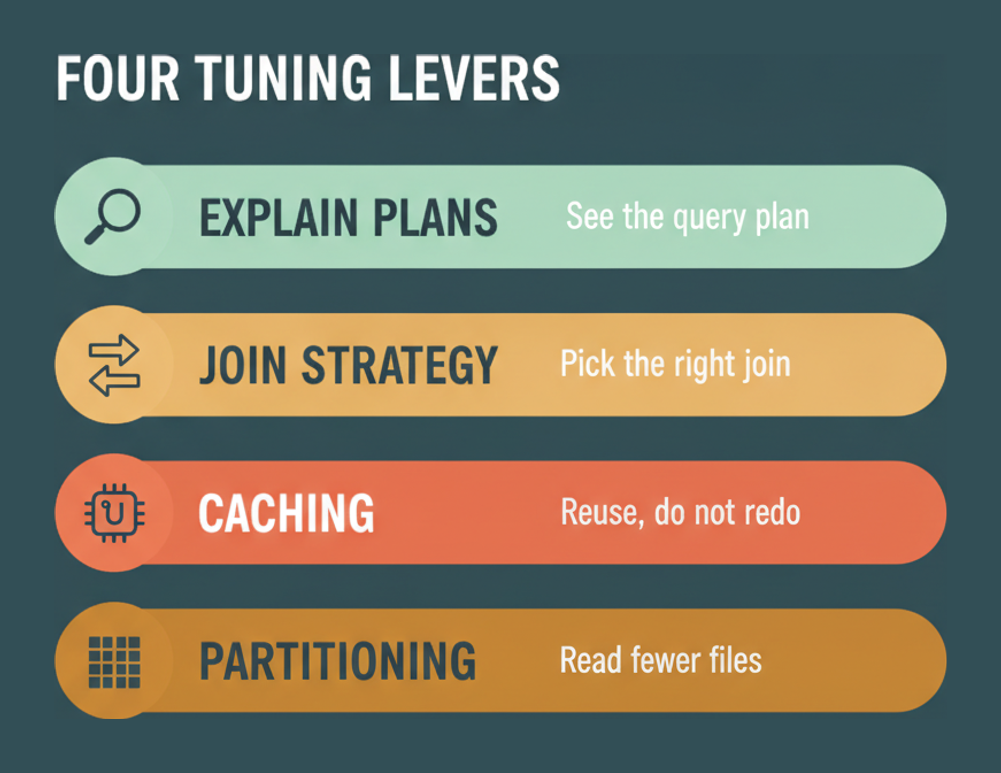
Explain plans are the centre of gravity. If you cannot read one, you cannot answer questions about why a join is slow or what the optimizer chose to do. Everything else in the topic is a lever you pull after reading one.
Inferring schemas is a performance question, not a convenience one
Letting Spark infer a schema means scanning data before processing it. On a large dataset that is a real cost, and on a changing dataset it is a correctness risk. The exam treats schema inference as a trade-off to be reasoned about rather than a default to be accepted.
Joins, caching, partitioning and bucketing
These four sit together because they are the levers that matter most in practice. Improving join performance means understanding broadcast versus shuffle joins and what makes each appropriate. Caching means knowing when reuse justifies the memory. Partitioning and bucketing mean shaping the data on write so that later reads skip what they do not need.
Cloudera’s own recommended preparation includes an advanced Spark application performance tuning course, which tells you plainly how seriously the vendor takes this topic.
How Much Airflow Do You Actually Need?
Enough to build and schedule pipelines, not enough to administer a cluster. The four objectives are implementing incremental extraction from a source system, scheduling ETL pipelines, scheduling quality checks, and working with DAGs. That is five questions, and all four objectives are things a working data engineer does weekly.
Incremental extraction is the one that carries most weight per word. It means pulling only what has changed since the last run, which requires a watermark, a reliable ordering, and a plan for late arriving data. Expect scenario questions rather than syntax questions.
Scheduling quality checks appearing as its own objective is a small signal worth reading. It says the exam treats data quality as part of the pipeline rather than something bolted on afterwards. The Apache Airflow documentation covers the DAG concepts the objectives assume.
Why Is Iceberg on a Data Engineering Exam?
Because the table format has become part of the platform rather than an optional add on. The syllabus gives Iceberg a single objective, “Understand Iceberg”, weighted at 10 percent, and Cloudera lists a free on demand Iceberg fundamentals course among the recommended preparation. Five questions on one objective means the questions will be conceptual.
Expect to be asked what an open table format gives you that a directory of files does not: schema evolution without rewriting data, snapshot isolation so readers are not disturbed by writers, time travel to an earlier snapshot, and partition evolution without reorganising history.
How it connects to the Spark topic
The distributed persistence objective under Spark and the Iceberg topic are two views of the same thing. One asks how a job writes data, the other asks what the resulting table can then do. Studying them as a pair is more efficient than treating Iceberg as a separate five question island. The Apache Iceberg project site is the authoritative reference for the concepts involved.
Readers weighing this credential against the rest of the Cloudera ladder will find the family mapped out across CertificationBox’s Cloudera certification hub, which covers the generalist, administrator, analyst, and machine learning tracks alongside this one.
What Does the Deployment Topic Cover?
Two objectives, both platform specific: using the API and the CLI, and working in the Data Engineering service. This is the topic where CDP-3002 stops being a Spark exam and becomes a Cloudera exam, because none of it transfers to another vendor’s platform.
Cloudera Data Engineering is a managed service for running Spark workloads, and it exposes both a REST API and a command line client. Questions here are likely to be about which interface suits which task, how a job definition differs from a job run, and how resources are requested.
Why five questions deserve more than five minutes
This is the easiest topic to score on and the easiest to neglect. It is entirely learnable from the service documentation in an evening, whereas a single percentage point of the Spark topic may take a week. On a paper where the pass mark is 28 marks, five cheap ones are worth collecting.
Cloudera publishes the interface reference in the Data Engineering service documentation, which is the fastest route through this topic.
What Is the Exam Format, Cost and Booking Route?
CDP-3002 runs 50 questions in 90 minutes, needs 55 percent to pass, and costs $330 USD. Registration goes through Cloudera itself rather than a third party test delivery partner, which is unusual and catches out candidates who go looking for it on a booking platform.
| Specification | Detail |
|---|---|
| Exam name | Cloudera Data Engineer |
| Exam code | CDP-3002 |
| Questions | 50 |
| Duration | 90 minutes |
| Passing score | 55% |
| Price | $330 USD |
| Registration | Cloudera |
Ninety minutes across 50 questions gives you 108 seconds each, which is generous for conceptual items and adequate for a scenario. The 55 percent pass mark is lower than most vendor exams, and that is worth reading as a signal about difficulty rather than as a gift. Cloudera’s wider programme is set out on the Cloudera certification page.
How Should You Plan Your Study Time?
Weight your time the way the exam weights its marks. Spark and performance tuning are 70 percent of the paper and should take roughly 70 percent of your preparation. The three ten point topics are small, self contained, and best used as momentum at the start and revision at the end.
- Open with the deployment topic, because the API, the CLI, and the Data Engineering service can be learned from documentation in a single session and give you five reliable marks early.
- Move to Spark and spend the largest block of your schedule there, treating Spark on Kubernetes, DataFrames, distributed processing, Hive integration, and distributed persistence as one connected picture rather than five separate facts.
- Take performance tuning next and start with explain plans, since every other lever in the topic only makes sense once you can read what the optimizer decided.
- Study Iceberg immediately after distributed persistence, because the two objectives describe the same write path from different ends and reinforce each other.
- Finish with Airflow, concentrating on incremental extraction and on scheduling quality checks, which are the two objectives most likely to appear as scenarios rather than definitions.
Build in time for the arithmetic too. Knowing that Spark and tuning together can carry a pass changes how you triage a difficult question on exam day: an unfamiliar Iceberg item is worth one mark and is not worth five minutes.
Candidates comparing this exam with the machine learning track will find a parallel breakdown in the CDP-6001 exam guide, which shares the platform context but weights an entirely different skill set.
Frequently Asked Questions
How many questions are on the CDP-3002 exam?
50 questions in 90 minutes. That works out at roughly 108 seconds per question, which is comfortable for the conceptual items and adequate for the scenario-style ones in the tuning topic.
What is the passing score for the Cloudera Data Engineer exam?
55 percent, which is 28 of the 50 questions. There is no published per topic minimum, so strength in Spark can offset a weak showing in one of the smaller topics.
How much does CDP-3002 cost?
$330 USD. That is the exam fee alone and does not include any of the recommended training, although Cloudera’s Iceberg fundamentals course is listed as free on demand.
Where do you register for the exam?
Through Cloudera directly rather than through Pearson VUE or PSI. This differs from most vendor certifications and is a common source of confusion when candidates go looking for it on a test delivery platform.
Which topic carries the most marks?
Spark, at 48 percent, or roughly 24 of the 50 questions. Performance tuning is second at 22 percent. Together the two account for around 70 percent of the paper.
Does the exam cover Spark on Kubernetes or on YARN?
Kubernetes. The first Spark objective names it explicitly, reflecting how Cloudera Data Engineering runs workloads. Preparation built around YARN-era material will miss the runtime the exam assumes.
How much Airflow does CDP-3002 test?
Ten percent, about five questions, covering incremental extraction, scheduling ETL pipelines, scheduling quality checks, and working with DAGs. It is pipeline authoring rather than Airflow administration.
Why is Iceberg included, and how deep does it go?
Iceberg is the platform’s open table format and carries a single objective at 10 percent. Expect conceptual questions on schema evolution, snapshots, time travel, and partition evolution rather than implementation detail.
Is there a prerequisite for the Cloudera Data Engineer certification?
No prerequisite certification is published on the syllabus. Practical Spark experience is effectively assumed, though, because half the paper depends on it and the exam does not teach fundamentals.
What training does Cloudera recommend?
Three courses are named: Preparing with Cloudera Data Engineering, Advanced Spark Application Performance Tuning, and DENG-152 Cloudera Iceberg Fundamentals, the last of which is offered free on demand.
Conclusion
CDP-3002 is a Spark exam with a Cloudera wrapper. Seven questions in ten come from Spark and performance tuning, which means a candidate who genuinely understands DataFrames, shuffles, explain plans, and join strategy is most of the way to a pass before touching the other three topics.
The efficient path is to collect the cheap marks first, invest the bulk of your time in the two heavy topics, and treat Iceberg as an extension of distributed persistence rather than a separate subject. Check the current topic breakdown and question format on the money site before you book, and let the weightings, not the syllabus order, set your schedule.


