The UiAAA syllabus uses the word “differentiate” four times, and that is the clearest signal of what the exam is. UiPath Certified Professional Agentic Automation Associate asks you to separate an agent from a robot, agentic AI from generative AI, a system prompt from a user prompt, and a deterministic evaluation from a model-graded one. Get those four apart and most of the paper follows.
It is a 60-question exam, 90 minutes, $150 through Pearson VUE, with a 70 percent pass mark and ten topics carrying no published weightings. What makes it unusual is who it is for: UiPath positions it for technical and non-technical roles alike, which means an RPA developer and a process owner can sit the same paper. This article walks all ten topics, states each of the four distinctions plainly, and sets out what to build before you book.
What Does the Agentic Automation Certification Actually Test?
It tests whether you can design work for AI agents rather than build them. UiAAA covers agentic concepts, discovering where agents belong in a business process, designing an agent blueprint, grounding it in real context, escalating to humans, evaluating reliability, prompt engineering, the UiPath components involved, orchestration with Maestro, and when to reach for Autopilot instead.
UiPath describes the credential as validating foundational skills for collaborating with AI agents in process automation, and says it suits both technical and non-technical roles. That is not marketing softness. Read the objectives and you will find design, judgement and vocabulary throughout, with very little that requires code.
Where it sits in the platform story
The company reported full year fiscal 2026 results built on that same argument. Its framing is that automation is no longer one thing. Deterministic robots do what they are told. Agents decide. Humans stay in the loop where the decision matters. Holding all three in one process is the whole point of the credential, and the UiPath certification programme is explicitly role-based rather than product-based.
“By bringing deterministic automation, agentic AI, and enterprise-grade orchestration together on a single platform, UiPath provides the execution layer enterprises trust to run mission-critical processes in the agentic era.”
How Are the Ten UiAAA Topics Arranged?
Ten topics, no percentage weightings, and a very uneven distribution of objectives underneath them. Agentic AI concepts carries six, agentic discovery and blueprint design carry three and five, while Autopilot for everyone carries exactly one. Objective count is the only signal available and it should be read as surface area rather than as marks.
| Topic | Objectives | What it is really asking |
|---|---|---|
| Agentic AI and agentic automation concepts | 6 | Vocabulary, the agent against robot distinction, and why traditional automation stalls |
| Agentic discovery | 3 | Assessing a process for agent potential and writing an agent story |
| Agent blueprint design | 5 | Tasks, goals, evaluation criteria, prompts, context sources and tool selection |
| Context grounding | 2 | What grounding is, its sources and its configuration |
| Escalations | 2 | Human in the loop and the logic that raises an escalation |
| Agentic evaluations | 2 | Reliability, and deterministic against model-graded evaluation |
| Prompt engineering | 4 | Zero-shot, few-shot, and the four elements of a structured prompt |
| UiPath platform components and integrations | 4 | Studio Web tools, input and output schema, Integration Service connections |
| Agentic orchestration with UiPath Maestro | 3 | BPMN modelling and Service Tasks that invoke agents and workflows |
| Autopilot for everyone | 1 | Knowing when it is the right answer |
Thirty two objectives across 60 questions means roughly two questions per objective if they were evenly spread, which they will not be. The concentration is clearly in the first three topics, and rehearsing against the UiAAA practice exam is the quickest way to find out whether the concepts topic is carrying its apparent weight for you.
What Is the Difference Between an Agent and a Robot?
A robot executes a defined sequence. An agent pursues a goal. The robot follows steps somebody specified in advance and fails when reality does not match them. The agent is given an objective, a set of tools and some context, and works out its own route, which is why the exam gives it evaluation criteria and an escalation path.
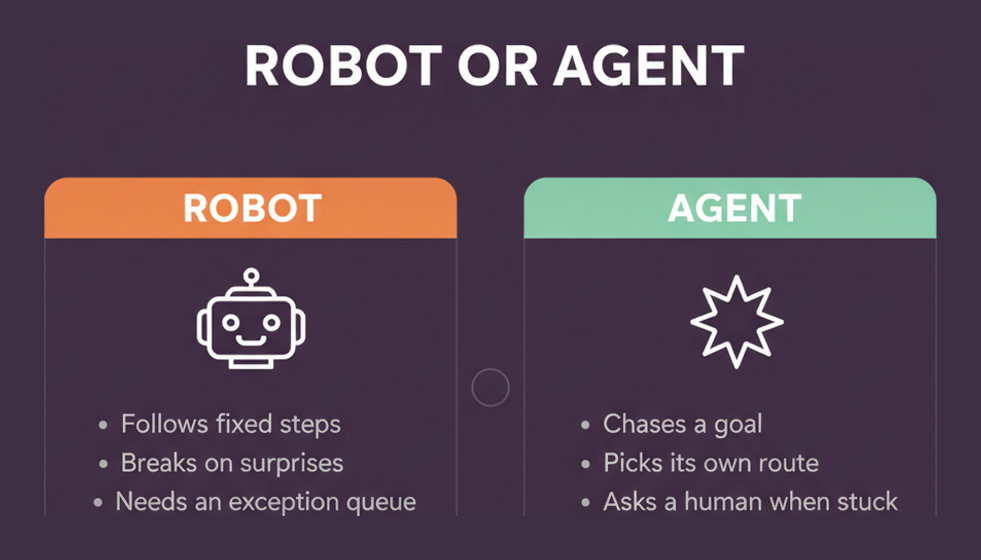
That distinction drives the whole first topic, and it is the one candidates from a classic RPA background find hardest to state cleanly, precisely because they know robots so well. The syllabus asks you to identify the challenges of traditional automation done only with robots and humans, and the honest answer is brittleness: every unhandled variation becomes an exception queue.
The four benefits, named
The syllabus lists what agentic automation adds, and it is worth learning as four words rather than as a paragraph: intelligent decision-making, adaptability, goal-oriented execution and multi-task coordination. Expect at least one question that hands you a scenario and asks which of the four is the reason an agent beats a robot there.
The second distinction sits alongside it. Generative AI produces content when asked. Agentic AI takes actions toward a goal, using tools, across multiple steps, without being prompted at each one. A generative model can draft the email. An agent decides the email is needed, drafts it, checks a system, and escalates if the answer is ambiguous.
Agentic Discovery and the Five Parts of an Agent Story
Three objectives, and the most immediately useful part of the syllabus for anyone doing this work rather than sitting the exam. Discovery means assessing a business process for agentic potential across four dimensions: the roles involved, the knowledge context, the technology landscape and the as-is state. Then you write an agent story, and then you prioritise by feasibility and impact.
The agent story has five named characteristics and they are worth memorising in order: trigger, instructions, context, human in the loop, and the tools it integrates with. Each maps onto something you will later configure, which is why the syllabus treats the story as a design artefact rather than as documentation.
Blueprint design turns the story into a specification
The blueprint topic carries five objectives and is where the story becomes buildable: map business process steps to agent tasks, identify agent goals and evaluation criteria, differentiate system prompts from user prompts, map context sources and grounding strategies, and select tools that fit the objective.
The prompt distinction is the third of the four “differentiate” pairs. A system prompt sets the agent’s standing role, constraints and behaviour. A user prompt carries the specific request for this run. Putting a constraint in the wrong one is a real design error, not a stylistic preference, and it is exactly the sort of thing a scenario question tests.
What Does Context Grounding Mean in UiAAA Terms?
Grounding means giving the agent access to your organisation’s own information so its answers come from real data rather than from what the model happens to have absorbed. The topic carries two objectives: describe and use context grounding, and define its sources and configuration options.
The syllabus names the sources explicitly: storage buckets and the Integration Service. That specificity matters, because it turns a fuzzy concept into a question with a right answer. If you can say where the grounding content lives and how the agent reaches it, you have the topic.
Grounding also connects backwards to blueprint design, where mapping context sources and grounding strategies is a named objective, and forwards to evaluations, because an agent that answers from the wrong source is unreliable in a way that only evaluation will catch. Treat the three as one chain rather than three topics.
Why Do Escalations and Evaluations Belong Together?
Because both are answers to the same question: how do you trust an agent that decides for itself. Escalations cover human in the loop and the logic that raises one. Evaluations cover reliability, and the difference between a deterministic evaluation and a model-graded one. Two objectives each, four in total, and they are the governance half of the syllabus.
Human in the loop is not a safety net bolted on afterwards. It is one of the five characteristics of the agent story, which means the exam expects you to decide at design time where a human must approve, review or take over. Defining the logic for raising an escalation is the practical version of that decision.
The fourth distinction
A deterministic evaluation checks something that has a fixed correct answer: did the agent return the right account number, did it call the right tool. A model-graded evaluation uses a model to judge something that does not: was the summary faithful, was the tone appropriate. Knowing which kind fits a given criterion is the examinable skill, and it is the last of the four pairs the syllabus asks you to differentiate.
Which UiPath Products Does the Exam Name?
Five, and they divide neatly by job. Studio Web is where you create agent tools and design their input and output schema. Integration Service creates the connections and supplies connector actions you map into agent prompts. Maestro orchestrates. Orchestrator runs the classic automation workflows Maestro can invoke. Autopilot for everyone is the option you reach for when a full agent is not warranted.
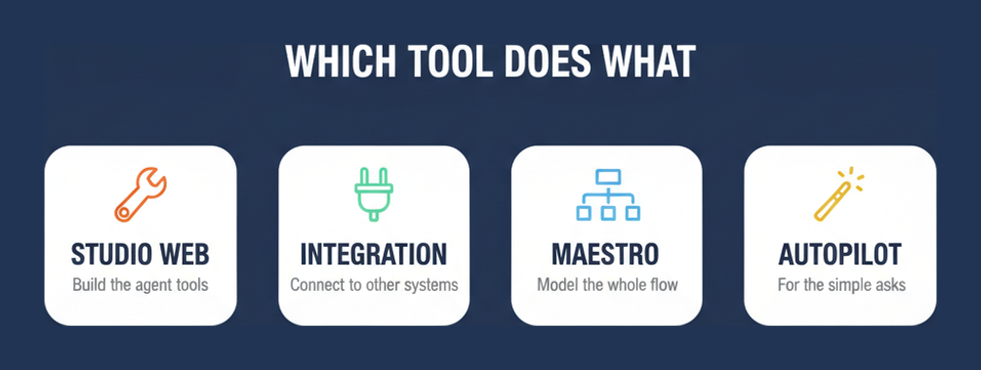
Maestro is the topic most likely to be unfamiliar, and it is the one with a real external dependency. The syllabus asks you to use BPMN to model business processes and map tasks to robots, agents and humans, and to configure Service Tasks that invoke an agent with “Start and wait for agent” or invoke a workflow from Orchestrator.
BPMN is assumed, not taught
Nothing in the syllabus explains BPMN, so if the notation is new to you that gap has to be closed separately. The BPMN specification is the authoritative source, and the parts that matter here are modest: events, tasks, gateways and the idea of a service task. The Studio Web overview covers the other half, which is where tools actually get built.
Autopilot for everyone carries a single objective and is the smallest topic on the paper: describe when it should be used. Do not over-study it, but do not skip it either, because one objective on a 60-question exam is still likely to be one or two questions.
What Are the UiAAA Exam Format and Cost?
Sixty questions in 90 minutes for $150, with a 70 percent pass mark, scheduled through Pearson VUE. The named preparation is the Agentic Automation Developer Associate training. Seventy percent of 60 is 42 correct answers, so there is room for 18 mistakes across ten topics.
| Field | Value |
|---|---|
| Exam name | UiPath Certified Professional Agentic Automation Associate |
| Exam code | UiAAA |
| Questions | 60 |
| Duration | 90 minutes |
| Passing score | 70 percent, which is 42 of 60 |
| Price | $150 USD |
| Scheduling | Pearson VUE |
| Training | Agentic Automation Developer Associate |
Ninety seconds per question is a comfortable budget for a paper built on definitions and short scenarios. The eighteen-mistake margin is generous by associate-exam standards, and it means you can be genuinely weak in one small topic without failing, provided the concepts and discovery topics are solid.
At $150 this is also the second cheapest exam of its kind in the current market, which changes the calculus for teams. It is affordable enough to certify a working group rather than an individual, and that is closer to how agentic automation actually lands in an organisation.
Who Should Take It, and What Does It Change?
RPA developers who need to extend into agent design, business analysts who scope automation, process owners who have to decide where agents belong, and consultants delivering UiPath work. UiPath says explicitly that the credential suits technical and non-technical roles, and the syllabus supports that: almost none of it requires writing code.
For an existing UiPath developer, the value is vocabulary and design method rather than tooling. You already know Orchestrator and workflows. What is new is the agent story, the grounding chain, the escalation logic and the evaluation types, and those are the parts of a design conversation you will be expected to lead.
What the numbers say, with the usual caveat
UiPath’s own State of the Automation Professional survey in 2024, covering more than 1,900 automation professionals, reports that 59 percent said certification helped them improve their skills, 24 percent said it helped them secure a new job and 19 percent said it helped them change careers. That is a vendor surveying its own community, so read it as directional rather than independent. For a market-wide view of what the underlying role pays, current RPA developer pay data is a more neutral reference point.
If you want the fuller picture of what an associate-level UiPath paper feels like before committing, the UiAAA exam materials assembled for this credential are a reasonable place to calibrate.
How Should You Prepare for UiAAA?
Start with the four distinctions, because they are the spine of the paper and the cheapest thing to get right. Then build one small agent end to end, because discovery, blueprint, grounding, escalation and evaluation are all much easier to remember once you have done each of them once. Leave Autopilot and Maestro configuration until last.
- Write out the four differentiations in your own words first, covering agent against robot, agentic AI against generative AI, system prompt against user prompt, and deterministic against model-graded evaluation.
- Take one real process from your own organisation and write an agent story for it, naming all five characteristics explicitly so that trigger, instructions, context, human in the loop and tools each have a concrete answer.
- Turn that story into a blueprint by mapping the process steps to agent tasks, writing the goal, and stating the evaluation criteria you would judge the agent against.
- Build one agent tool in Studio Web with a deliberate input and output schema, then create a connection through Integration Service and map a connector action into a prompt.
- Add grounding from a storage bucket and then deliberately remove it, so you can see for yourself what an ungrounded answer looks like and why the exam treats grounding as a reliability control.
- Finish by modelling the same process in Maestro with BPMN, placing a Service Task that starts and waits for the agent and a second that calls an Orchestrator workflow, so the orchestration topic becomes something you have drawn rather than read.
Two evenings on the distinctions and a weekend on the build is a realistic plan for someone already inside the UiPath ecosystem. If agents are entirely new, add a week and spend it on the concepts topic, which is the largest by objective count and the foundation for everything after it.
Frequently Asked Questions
How many questions are on the UiAAA exam?
Sixty questions in 90 minutes, which is 90 seconds each. That is a comfortable budget for a paper made of definitions and short scenarios rather than long calculations.
What is the passing score for the UiPath Agentic Automation Associate?
Seventy percent, which is 42 correct answers out of 60. You can afford 18 mistakes, so a single weak topic among the ten is survivable.
How much does UiAAA cost?
$150 USD, booked through Pearson VUE. The named preparation is the Agentic Automation Developer Associate training, and the exam is affordable enough that organisations often certify a whole working group rather than one person.
Do you need to be a developer to take this exam?
No. UiPath states that the credential suits both technical and non-technical roles, and the syllabus bears that out. Almost every objective is about design, judgement or vocabulary rather than about writing code.
What is the difference between an agent and a robot?
A robot executes a sequence somebody defined in advance. An agent is given a goal, tools and context, and works out its own route. That is why an agent needs evaluation criteria and an escalation path while a robot needs an exception queue.
What are the five characteristics of an agent story?
Trigger, instructions, context, human in the loop, and the tools the agent integrates with. The syllabus names all five, and each maps onto something you later configure, so the story is a design artefact rather than documentation.
What is context grounding?
Giving an agent access to your organisation’s own information so its answers come from real data. The syllabus names storage buckets and the Integration Service as the grounding sources and expects you to know their configuration options.
What is the difference between a deterministic and a model-graded evaluation?
A deterministic evaluation checks something with a fixed correct answer, such as whether the right account number was returned. A model-graded evaluation uses a model to judge something subjective, such as whether a summary was faithful.
Do you need to know BPMN for UiAAA?
Yes, at a working level. The Maestro topic asks you to use BPMN to model processes and map tasks to robots, agents and humans, and the syllabus does not teach the notation, so events, tasks, gateways and service tasks have to be learned separately.
Are the UiAAA topics weighted?
No percentage weightings are published. Ten topics are listed with their objectives only, and the objective counts range from six down to one, so treat that count as surface area rather than as a mark allocation.
Conclusion
UiAAA is a design credential for a world where robots are no longer the only thing running a process. Ten topics, no weightings, 60 questions in 90 minutes at $150, and a 70 percent bar that leaves eighteen mistakes of room. Its spine is four distinctions the syllabus asks you to make explicitly, and its centre of gravity is discovery and blueprint design rather than tooling.
Prepare in that order: nail the four pairs, write a real agent story, build one tool, ground it, then model the whole thing in Maestro. If you are weighing this against the other AI-flavoured UiPath credentials, the Specialized AI Associate covers document and communications intelligence rather than agents, and the two answer genuinely different questions. Then book the seat.


