
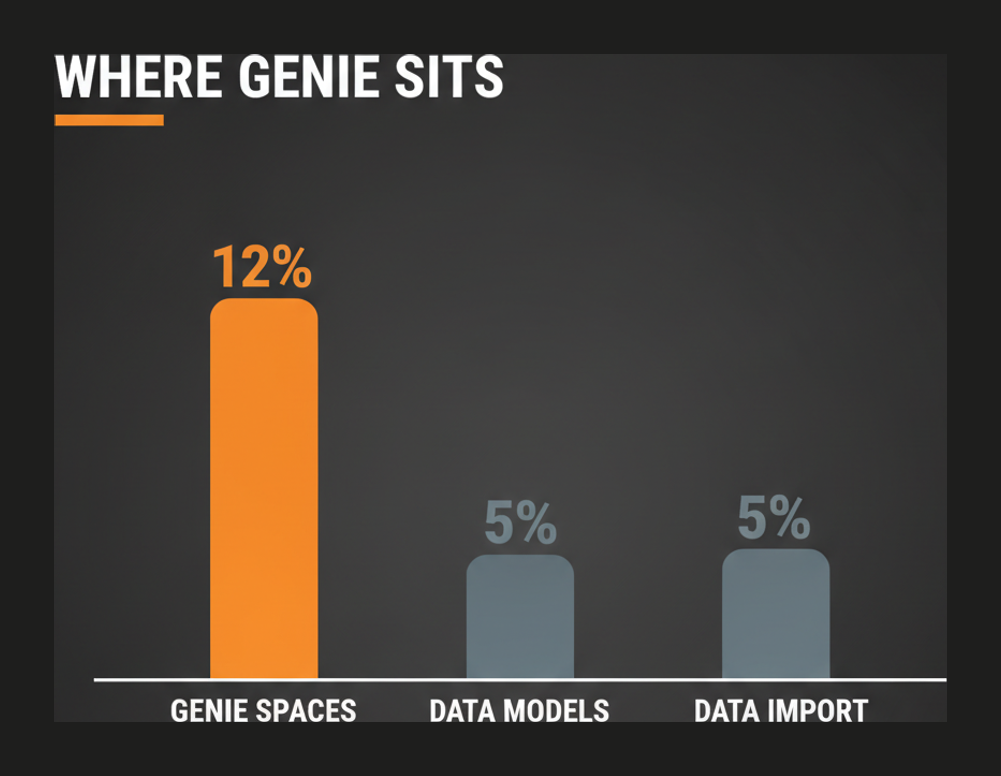
An analyst certification now grades you on how well you set up an AI assistant for other people. Developing, sharing and maintaining AI/BI Genie spaces is worth 12 percent of the Databricks Certified Data Analyst Associate exam, which is more than data modelling and importing data put together. That is not a footnote in the blueprint. It is the seventh of nine domains, and it did not exist in the job description of a data analyst three years ago.
The rest of the syllabus is recognisable enough: querying, analysing query performance, dashboards, governance and a small amount of schema design. But the Genie domain changes what the credential is claiming. It says an analyst is now partly responsible for the quality of the answers a language model gives to colleagues who never write SQL. Across 45 questions in 90 minutes at a 70 percent bar, this guide works through all nine weighted domains and shows where that shift shows up.
Why Are Genie Spaces Worth 12 Percent of an Analyst Exam?
Because Databricks now treats curating an AI answering surface as analyst work rather than platform work. The domain asks you to describe what a Genie space is, create one by writing sample questions and domain instructions, choose a SQL warehouse, curate Unity Catalog datasets and vet queries as trusted assets, then optimise the space by tracking accuracy and feedback.
Read those objectives closely and they are all editorial judgements dressed as configuration. Which questions are representative. Which instructions prevent a wrong reading. Which query is reliable enough to be promoted to a trusted asset. Those decisions require knowing the data, which is exactly why they landed with the analyst rather than with an engineer.
The optimisation objective is the one that signals how seriously Databricks means it. It asks you to track user questions and response accuracy, gather stakeholder feedback, validate against benchmarks and refresh Unity Catalog metadata. That is an ongoing operational responsibility, not a one-off setup task, and it is examinable.
What Are the Nine Domains and Their Weightings?
The exam publishes nine weighted domains. Executing queries using Databricks SQL leads at 20 percent, followed by dashboards and visualizations at 16 percent, analyzing queries at 15 percent and Genie spaces at 12 percent. Platform understanding takes 11 percent, and the remaining four domains share the last 26 percent between them.
| Domain | Weight | Core of what it asks |
|---|---|---|
| Executing queries using Databricks SQL and SQL Warehouses | 20% | Joins and set operations, aggregates including approximate count distinct, sorting and filtering, materialized views against streaming tables, cross-system queries against a federated source, Delta Lake time travel, and the role of a SQL warehouse |
| Creating Dashboards and Visualizations in Databricks | 16% | AI/BI dashboards with multi-tab layouts and several datasets, visualizations in notebooks and the SQL editor, parameters, sharing permissions and embedding, scheduled refresh, alerts with thresholds, and picking the right chart |
| Analyzing Queries | 15% | Photon, finding poorly performing queries with Query Insights and the query profiler, Delta Lake history and audit, query history and caching, Liquid Clustering, and fixing a query that returns the wrong result |
| Developing, Sharing and Maintaining AI/BI Genie spaces | 12% | Purpose and components, creating a space with sample questions and instructions, curating datasets and trusted assets, permissions and embedding, and ongoing optimisation against accuracy and feedback |
| Understanding of Databricks Data + AI Platform | 11% | Core components including Mosaic AI, Delta Live Tables, Lakeflow Jobs, Delta Lake, Unity Catalog and Databricks SQL, plus Catalog Explorer concepts and Databricks Marketplace |
| Managing Data | 8% | Discovering and querying certified datasets, tagging assets and viewing lineage, and cleaning data in SQL including invalid and missing values |
| Securing Data | 8% | Unity Catalog roles and sharing settings, the three-level namespace, and storage practice including table ownership and personal data protection |
| Importing Data | 5% | Ingestion from object storage, Delta Sharing to external systems, API-driven intake, Auto Loader, Marketplace, and uploading a file through the workspace |
| Data Modeling with Databricks SQL | 5% | Star, snowflake and data vault schemas for analytical workloads, and how they align with the Medallion architecture |
The shape is worth pausing on. Four domains carry 63 percent between them and all four are about working with queries and their output. The classical analyst-training topics, modelling and ingestion, sit at 5 percent each.
How Many Questions Does Each Domain Carry?
Applying the weightings to 45 scored questions gives 9 on executing queries, 7 on dashboards, 7 on analyzing queries, 5 on Genie spaces, 5 on platform understanding, 4 each on managing and securing data, and 2 each on importing data and data modelling. Passing needs 70 percent, which is 32 correct answers.
| Domain | Weight | Approximate questions of 45 |
|---|---|---|
| Executing queries using Databricks SQL | 20% | 9 |
| Creating Dashboards and Visualizations | 16% | 7 |
| Analyzing Queries | 15% | 7 |
| AI/BI Genie spaces | 12% | 5 |
| Databricks Data + AI Platform | 11% | 5 |
| Managing Data | 8% | 4 |
| Securing Data | 8% | 4 |
| Importing Data | 5% | 2 |
| Data Modeling with Databricks SQL | 5% | 2 |
Thirty-two of 45 leaves 13 questions to lose. Because no domain is larger than nine questions, there is no single block that can carry you and no single block that can sink you, which makes this a coverage exam rather than a specialism exam. Reading the Data Analyst Associate syllabus objective by objective is the fastest way to see how granular each of those small domains really is.
What Is the Exam Format and What Does It Cost?
Forty-five scored questions in 90 minutes, at a registration fee of $200 US dollars and a 70 percent pass mark. Delivery is proctored, either online or at a test centre, and there are no prerequisites. Databricks recommends around six months of hands-on experience performing the tasks in the exam guide.
| Detail | Value |
|---|---|
| Credential | Databricks Certified Data Analyst Associate |
| Scored questions | 45, plus unscored items with extra time allowed |
| Duration | 90 minutes |
| Passing score | 70% |
| Registration fee | $200 USD |
| Question type | Multiple choice, no test aides permitted |
| Language | English |
| Delivery | Proctored, online or test centre |
| Validity | Two years, then recertify on the current version |
| Recommended training | Data Analysis with Databricks |
Two details from the Databricks certification page change how you should prepare. The exam carries unscored items alongside the 45 scored ones, with additional time factored in, so the paper is longer than 45 questions. And Databricks states that the SQL used in the exam adheres to ANSI SQL standards, which means portable SQL knowledge transfers directly rather than being replaced by dialect quirks.
The two-year validity is the other planning fact. This is not a credential you earn once. Recertification requires taking the current version of the exam, which by definition will have moved on, and the Genie domain is evidence of how quickly that happens.
Why Is Executing Queries the Largest Domain?
Because it holds the skills every other domain depends on. At 20 percent, roughly nine questions, it covers joins with single or multiple keys, set operations including union and union all, aggregates such as count, approximate count distinct, mean and summary statistics, sorting, filtering, and creating managed and external tables from several sources.
Views, materialized views and streaming tables
The objective asks you to create a materialized view and to know when a streaming table is the right choice instead, and separately to distinguish a dynamic view from a materialized one. These distinctions are the most commonly missed part of the domain, because all three look similar in a catalogue listing and behave very differently.
Time travel and federated sources
Two objectives reach outside ordinary SQL. Delta Lake time travel lets you query a historical version of a table, and cross-system analytics means joining a Delta table to a federated source. Delta Lake itself is an open project governed under the Linux Foundation, which is why its behaviour is documented independently of Databricks.
Because the exam’s SQL follows the ANSI standard, anyone comfortable with a mainstream engine can lean on that. The Spark SQL reference is the closest published description of how these constructs behave on the engine underneath.
What Does Analyzing Queries Expect You to Fix?
Both speed and correctness. The 15 percent domain covers Photon and the workloads it supports, identifying poorly performing queries through Query Insights and the query profiler, using Delta Lake history to audit and compare results, using query history and caching to cut development time, applying Liquid Clustering, and fixing a query that does not return what was wanted.
That last objective is unusual and worth noting. Most performance domains stop at making a query faster; this one also asks you to correct a query that produces the wrong answer. Expect items that show you a result set and a requirement and ask what is wrong with the SQL between them.
Liquid Clustering is the newest concept in the domain. It replaces manual partitioning decisions with a clustering scheme that adapts, and the exam frames it in terms of improving speed when filtering large tables on particular columns. Knowing why it exists is more useful than knowing its syntax.
How Much Dashboard Work Is Examined?
Sixteen percent, roughly seven questions, and the objectives are broader than building charts. They cover AI/BI dashboards with multi-tab layouts, several data sources and widget types, visualizations inside notebooks and the SQL editor, defining and testing parameters, permissions and sharing including embedding in external apps, scheduling automatic refresh, and configuring alerts with a threshold and a destination.
Sharing is the part candidates underestimate. The objective names three distinct routes, to workspace users and groups, to external users through a link, and embedded into another application, and each has different permission consequences. Questions in this area tend to describe an audience and ask which route fits.
Alerts are also examinable in their own right. Configuring a threshold and a destination is a small task, but it is the only place on the paper where the analyst is asked to make something happen without a person looking at a screen, which is why it gets its own objective.
Where Do Unity Catalog and Security Fit?
Across three domains rather than one, which is why governance feels larger on this exam than its individual weightings suggest. Managing Data at 8 percent, Securing Data at 8 percent and part of the platform domain at 11 percent all rest on Unity Catalog, giving governance a combined presence well beyond either 8 percent block on its own.
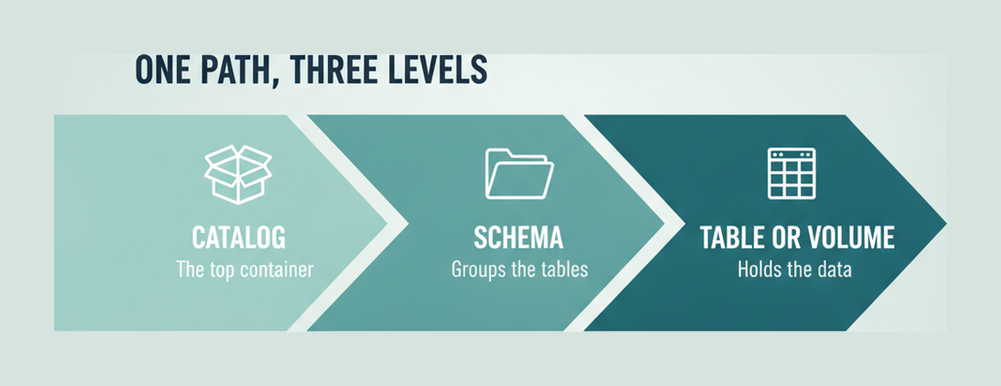
The three-level namespace is the concept to fix first. Catalog, then schema, then tables or volumes: almost every governance question resolves to knowing which level a permission or an object belongs to. Alongside it sit tagging a data asset, viewing its lineage, and understanding what marks a dataset as certified.
Securing Data adds ownership and personal data protection to that. Table ownership determines who can change what, and the objective on protecting personal information is the only place the exam touches compliance, framed as storage and management practice rather than as regulation. Earlier coverage in this Data Analyst Associate guide is a useful comparison point for how much this credential has changed.
How Should You Sequence Your Preparation?
Start where the marks concentrate, then work outward to the small domains that are cheap to secure. Four domains carry 63 percent between them and all four involve queries or their output, so query fluency is the foundation. The Genie domain deserves early attention despite its size, because it is the material least likely to be covered by existing experience.
- Begin with executing queries, working joins, set operations, aggregates, filtering and sorting until they are automatic, then add materialized views, streaming tables and Delta Lake time travel.
- Move to analyzing queries next, learning Photon, the query profiler and Query Insights, caching and Liquid Clustering, and practising the harder objective of correcting a query that returns the wrong result.
- Take the Genie spaces domain third rather than last, since curating datasets, writing sample questions and vetting trusted assets is the newest analyst responsibility and the least likely to be familiar.
- Cover dashboards and visualizations together, paying particular attention to the three sharing routes and to configuring an alert with a threshold and a destination.
- Learn the Unity Catalog three-level namespace once and apply it across the managing, securing and platform domains, which together lean on it more than any single weighting shows.
- Finish with importing data and data modelling, worth two questions each, treating them as the cheapest marks on the paper rather than as major topics.
Six to eight weeks suits an analyst already working in Databricks, and closer to twelve for someone arriving from a different warehouse platform who needs to learn Unity Catalog and Genie from scratch. Anyone assembling study material will find the earlier exam materials roundup a reasonable starting inventory to work from.
Frequently Asked Questions
How many questions are on the Databricks Data Analyst Associate exam?
Forty-five scored questions in 90 minutes, plus unscored items that do not affect your result. Databricks factors additional time into the limit to account for those extra questions.
What is the passing score?
Seventy percent, which on 45 scored questions is 32 correct answers. That leaves 13 to lose, and since no domain exceeds nine questions, coverage matters more than depth in any one area.
How much does the certification cost?
Two hundred US dollars to register. Delivery is proctored either online or at a test centre, and no test aides are permitted during the exam.
Are Genie spaces really on the exam?
Yes, as their own domain worth 12 percent, roughly five questions. It covers creating a space, curating Unity Catalog datasets, vetting trusted assets, setting permissions and optimising against user feedback.
Does the certification expire?
Yes, after two years. Recertifying means taking the current version of the exam, which will have moved on, as the addition of the Genie spaces domain demonstrates.
Are there prerequisites?
None, though Databricks recommends around six months of hands-on experience performing the data analysis tasks set out in the exam guide before attempting it.
Which SQL dialect does the exam use?
Databricks states that the SQL in this exam adheres to ANSI SQL standards, so portable SQL knowledge transfers directly rather than being replaced by platform-specific syntax.
Which domain is the largest?
Executing queries using Databricks SQL and SQL Warehouses at 20 percent, roughly nine questions. It covers joins, set operations, aggregates, views, time travel and federated queries.
How much data modelling is on the exam?
Five percent, about two questions. It asks about star, snowflake and data vault schemas for analytical workloads and how they align with the Medallion architecture.
How long does preparation usually take?
Six to eight weeks for an analyst already working in Databricks, and around twelve weeks for someone coming from another warehouse platform who needs Unity Catalog and Genie from scratch.
Conclusion
The Databricks Certified Data Analyst Associate is a coverage exam with a message embedded in its weightings. Four query-centred domains carry 63 percent, governance is distributed across three more, and a domain that did not exist in earlier analyst credentials now carries 12 percent because curating an AI answering surface has become part of the job.
Build query fluency first, learn to diagnose both slow and wrong queries, then treat Genie spaces as a genuine study topic rather than a curiosity. With 32 of 45 needed and no domain larger than nine questions, the reliable route is even coverage plus honest attention to whichever objectives your daily work has never made you practise. Working through the published syllabus one domain at a time will show you which those are.


