Most people preparing for the AVIXA CTS certification study equipment. They learn projector specifications, memorise connector types, and revise signal formats, expecting a paper about kit. The exam is not built that way. The Certified Technology Specialist blueprint is organised as a job analysis: four duties, ten tasks, and a percentage attached to every single task rather than to broad knowledge areas.
That structure changes what preparation means. Conducting a site survey is worth 9 percent on its own. Integrating an AV solution is worth 15 percent, and so is managing that integration. A candidate who knows every product on the market and has never written a scope of work is aiming at the wrong target. This guide takes the CTS blueprint duty by duty and task by task, sets out the mechanics and the real cost of sitting it, and explains what AVIXA expects you to have done before you apply.
What Is the AVIXA CTS Certification?
CTS is the Certified Technology Specialist credential awarded by AVIXA, the trade association for the audiovisual industry. It is the general-practitioner certification in AV: it covers the whole lifecycle of a system, from working out what a client needs through designing, installing, supporting and maintaining it, rather than specialising in any one stage.
Audiovisual work sits awkwardly between trades. It borrows from electronics, networking, acoustics, lighting, construction and project management, and no single one of those disciplines describes it. The audiovisual field has historically had few portable credentials, which is a large part of why CTS carries weight with employers and on tender documents.
AVIXA sets out the credential and its application process on its own CTS certification page. Two points there are worth knowing before you start. There are no formal prerequisites to apply, and AVIXA recommends around six months of AV experience rather than requiring it.
That openness is easy to misread. No prerequisite does not mean no expectation. The blueprint is written from a job analysis of what working AV professionals actually do, so a candidate with no site experience is being asked to reason about tasks they have never performed.
How Is the CTS Exam Weighted Across the Four Duties?
The CTS blueprint splits into four duties: Creating AV Solutions at 35 percent, Implementing AV Solutions at 30 percent, Servicing AV Solutions at 20 percent, and Supporting AV System Operation at 15 percent. Underneath those sit ten individual tasks, each carrying its own published percentage, which is unusually granular for a certification blueprint.
| Duty | Duty weight | Task | Task weight |
|---|---|---|---|
| A. Creating AV Solutions | 35% | Conduct a customer needs analysis | 7% |
| A. Creating AV Solutions | 35% | Conduct site survey | 9% |
| A. Creating AV Solutions | 35% | Develop an AV project scope | 9% |
| A. Creating AV Solutions | 35% | Design AV solutions | 10% |
| B. Implementing AV Solutions | 30% | Integrate AV solution | 15% |
| B. Implementing AV Solutions | 30% | Managing AV integration | 15% |
| C. Supporting AV System Operation | 15% | Provide AV support | 15% |
| D. Servicing AV Solutions | 20% | Supervise AV operations | 4% |
| D. Servicing AV Solutions | 20% | Conduct maintenance activities | 8% |
| D. Servicing AV Solutions | 20% | Troubleshoot and repair AV solutions | 8% |
Read down the task column and the exam’s real shape appears. The two largest single tasks are integrating an AV solution and managing that integration, at 15 percent each. Providing AV support matches them at 15 percent. Those three tasks alone are 45 percent of the paper, and none of them is a design activity.
At the other end, supervising AV operations is worth 4 percent, the smallest task on the blueprint. It is the one candidates most often over-prepare, because it sounds senior. Nine questions of the paper turn on maintenance and troubleshooting between them, more than twice its weight.
What Are the CTS Exam Details?
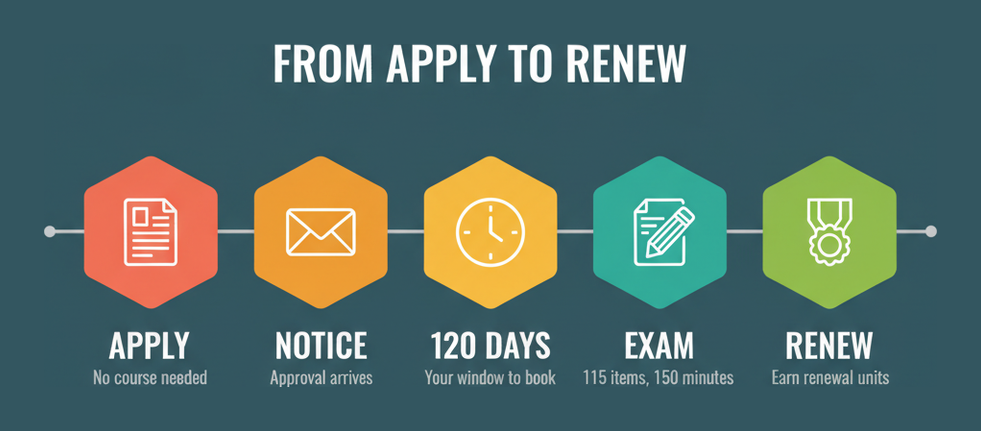
The CTS exam is 115 questions in 150 minutes, scored on a scaled range where 350 out of 500 is a pass, and delivered through Pearson VUE. That works out at roughly 78 seconds per question, which is generous by certification standards and reflects the scenario framing of much of the paper.
| Detail | Value |
|---|---|
| Certification name | AVIXA Certified Technology Specialist (CTS) |
| Exam code | CTS |
| Questions | 115 |
| Duration | 150 minutes |
| Passing score | 350 out of 500 (scaled) |
| Delivery | Pearson VUE |
Booking runs through Pearson VUE AVIXA examinations once AVIXA has approved your application. There is a detail in that sequence worth planning around: your eligibility notice gives you 120 days to sit the exam, counted from the day the notice is emailed. Applying before you are ready starts a clock rather than reserving a place.
A scaled score of 350 out of 500 is not the same as 70 percent of the questions. Scaling adjusts for the difficulty of the particular form you are given, so two candidates answering the same number of items correctly on different forms can land on different scaled scores. Practising against CTS exam questions is useful for finding weak duties, but treat any raw percentage you score as a rough guide rather than a prediction.
How Much Does the CTS Exam Cost?
The CTS exam costs 490 US dollars for non-members and 390 US dollars for AVIXA Premium and Elite members, a 100 dollar difference that is one of the more meaningful membership arguments in the industry. AVIXA also publishes the fee in euros, pounds and Australian dollars, and operates discounted pricing for candidates in eligible emerging economies.
| Candidate | USD | EUR | GBP | AUD |
|---|---|---|---|---|
| Non-member | $490 | 475 | 395 | 780 |
| Premium and Elite member | $390 | 375 | 315 | 620 |
The regional pricing matters more than it looks. Candidates in India, South East Asia and parts of Latin America regularly search for the local cost precisely because the headline dollar figure is misleading for them, and AVIXA lists the qualifying countries in its candidate handbook rather than on the pricing summary.
One more cost is easy to miss. AVIXA does not require any preparatory course before the exam, so the training spend is genuinely optional. Candidates who buy the two-course sequence are choosing structure, not clearing a gate.
What Does Creating AV Solutions Actually Cover?
Creating AV Solutions is the largest duty at 35 percent, and it covers everything that happens before anything is installed: understanding what the customer needs, surveying the room, writing the project scope, and producing the design. Its four tasks are weighted at 7, 9, 9 and 10 percent, so no single one dominates.
The site survey task at 9 percent is broader than most candidates expect. The blueprint names lighting, access, acoustics, seating, finishes, architectural features, dimensions and logistical constraints. That is a walk-the-room discipline, and it rewards anyone who has actually stood in a half-finished space with a tape measure and a light meter.
Scope and design are separate skills
Developing a project scope and designing the solution are listed as two distinct tasks for a reason. Scope defines what the system will and will not do and which components are in the package. Design produces the drawings, the program report and the bill of materials. Conflating them is the classic route to a project that is delivered exactly as drawn and still fails the client.
Customer needs analysis, the smallest task in this duty at 7 percent, is also the one most often skipped in real projects. The exam treats it as the foundation the other three tasks stand on, and questions here tend to test whether you can separate what a client asked for from what they actually require.
Why Do Implementation and Service Take Half the Paper?
Implementing AV Solutions is 30 percent and Servicing AV Solutions is 20 percent, so together they carry half the exam. Add Supporting AV System Operation at 15 percent and roughly two thirds of CTS is about what happens after the design is signed off, which is where AV careers are actually spent.
Implementation splits evenly into two 15 percent tasks. Integrating the solution covers systems verification and supply installation, the hands-on half. Managing the integration covers training, schematics, warranties, operations manuals and as-built drawings, the documentation half. Both are the same weight, and the second is routinely the weaker area for technically strong candidates.
Servicing splits three ways. Supervising AV operations is 4 percent, conducting maintenance activities is 8 percent, and troubleshooting and repairing solutions is 8 percent. The maintenance task explicitly names preventative maintenance, firmware upgrades and equipment upgrades, which places firmware management squarely inside the exam scope.
Support is a whole duty on its own
Supporting AV System Operation is a single 15 percent task, and its scope is wider than the name suggests: troubleshooting, remote assistance, live event support, in-room operation and end-user training. Live event support in particular is a distinct skill, closer to broadcast operations than to installation work, and it is worth deliberate revision if your background is fixed installs.
How Should You Prepare for the CTS Exam?
Preparation for the AVIXA CTS certification works best when it follows the blueprint’s own order, because the four duties describe a project lifecycle rather than four separate subjects. Working through them in sequence means each duty arrives with the context the previous one built.
- Audit yourself against all ten tasks first, scoring each one honestly as done regularly, done occasionally, or never done, before opening a single study resource.
- Close the never-done gaps with real exposure, walking a site survey with a colleague or reading a completed scope of work end to end, since these tasks are hard to learn from a page.
- Study the design and documentation tasks together, working from a real bill of materials and its matching as-built drawings so the connection between them is concrete.
- Apply only when the audit shows no never-done tasks left, because the eligibility notice starts a 120 day clock the moment it is emailed.
- Finish with a full timed rehearsal of 150 minutes across all four duties, then review by task rather than by score to see which of the ten is still costing you marks.
AVIXA publishes its own two-course sequence and supporting material through its certification prep overview, which is worth reading even if you do not buy the courses, because it shows how AVIXA itself groups the material. For a wider view of what the credential involves before you commit, the site’s CTS certification overview covers the application route and what candidates typically find hardest.
The step most people get wrong is the fourth one. Applying early feels like progress and is the single most common reason a candidate ends up sitting the exam underprepared, because 120 days disappears quickly around a full project schedule.
Which AVIXA Credential Comes After CTS?
CTS is the general credential and the entry point to two specialisms. CTS-D covers design, CTS-I covers installation, and both require CTS first. AVIXA also offers ANP, the Audiovisual Network Professional credential, for practitioners whose work has moved decisively toward networked AV.
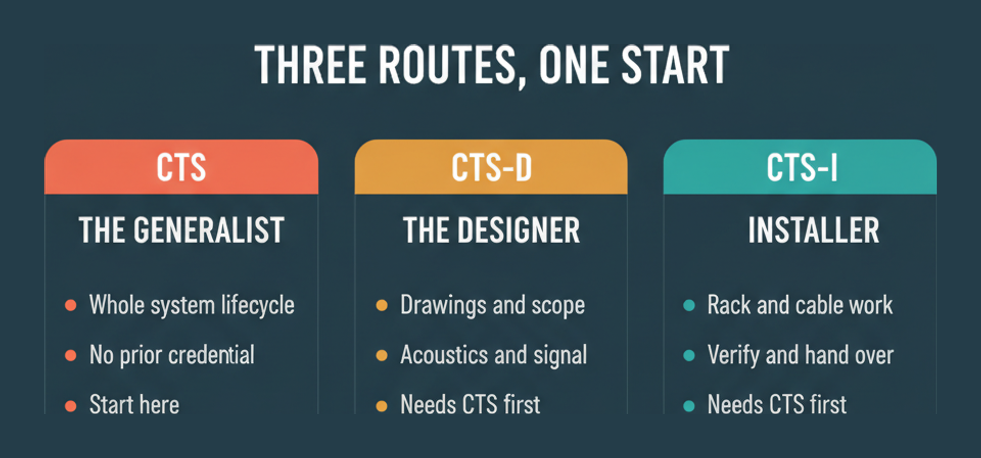
Choosing between the two specialist paths is mostly a question of where your time already goes. If the Creating AV Solutions duty felt like familiar ground and the integration tasks felt like revision, design is the natural direction. If the reverse was true, installation is. Candidates weighing the design route will find the specialist blueprint noticeably deeper in acoustics and signal management, and our CTS-D exam resources set out what changes at that level.
ANP sits slightly apart. It is not a tier above CTS so much as a sideways move for AV professionals working with IP-based distribution, network design and converged infrastructure. For anyone whose recent projects have involved more switch configuration than cable pulling, it may matter more than either specialism.
Whichever direction you take, the credential has to be maintained rather than simply earned. AVIXA runs a renewal-unit programme, and CTS holders accumulate renewal units through continuing education and industry participation to keep the credential current.
Frequently Asked Questions
How many questions are on the AVIXA CTS exam?
One hundred and fifteen questions in 150 minutes. That is roughly 78 seconds per question, which is comfortable by certification standards and reflects how many items are framed as short scenarios rather than direct recall.
What is the passing score for the CTS exam?
Three hundred and fifty out of a scaled 500. Because the score is scaled rather than a raw percentage, two candidates answering the same number of questions correctly on different exam forms can receive different final scores.
How much does the CTS exam cost?
Four hundred and ninety US dollars for non-members and 390 dollars for AVIXA Premium and Elite members. AVIXA also publishes euro, pound and Australian dollar pricing, and discounted rates apply in eligible emerging economies.
Are there prerequisites for the AVIXA CTS certification?
No formal prerequisites are required to apply. AVIXA recommends around six months of audiovisual experience, which is guidance rather than a gate, but the blueprint assumes familiarity with real project work.
Which CTS duty carries the most marks?
Creating AV Solutions, at 35 percent. Implementing AV Solutions follows at 30 percent, Servicing AV Solutions at 20 percent, and Supporting AV System Operation at 15 percent as a single task.
How long is the CTS eligibility window?
One hundred and twenty days from the day your eligibility notice is emailed to you. The clock starts on approval rather than on booking, so applying before you are ready shortens your effective preparation time.
Do I have to take an AVIXA course before the CTS exam?
No. AVIXA states that no preparatory course is required to sit the exam. The two-course sequence it publishes is optional structure for candidates who want a guided path through the blueprint.
What is the difference between CTS, CTS-D and CTS-I?
CTS is the general credential covering the whole AV lifecycle. CTS-D specialises in design and CTS-I in installation, and both require CTS as a prerequisite before you can pursue them.
Is troubleshooting part of the CTS exam?
Yes, in two places. Troubleshooting and repairing AV solutions is an 8 percent task under Servicing, and troubleshooting also appears inside the 15 percent Supporting AV System Operation task alongside remote assistance and live event support.
How long should I prepare for the CTS exam?
Long enough to close every never-done task in a self-audit against the ten blueprint tasks. For someone already working across design and install, that is often a matter of weeks. For a candidate strong in only one duty, it is longer.
Conclusion
The AVIXA CTS certification measures a job, not a product catalogue. Four duties, ten tasks and a published percentage on every one of them tell you exactly where the 115 questions sit, and two thirds of them land after the design is finished. Integration, integration management and support are worth 45 percent between them.
Score yourself task by task against the blueprint before you spend anything, close the gaps where you have never done the work rather than the ones where you feel rusty, and apply only when the 120 day eligibility clock will work in your favour. The task table above is the honest checklist to keep returning to.


