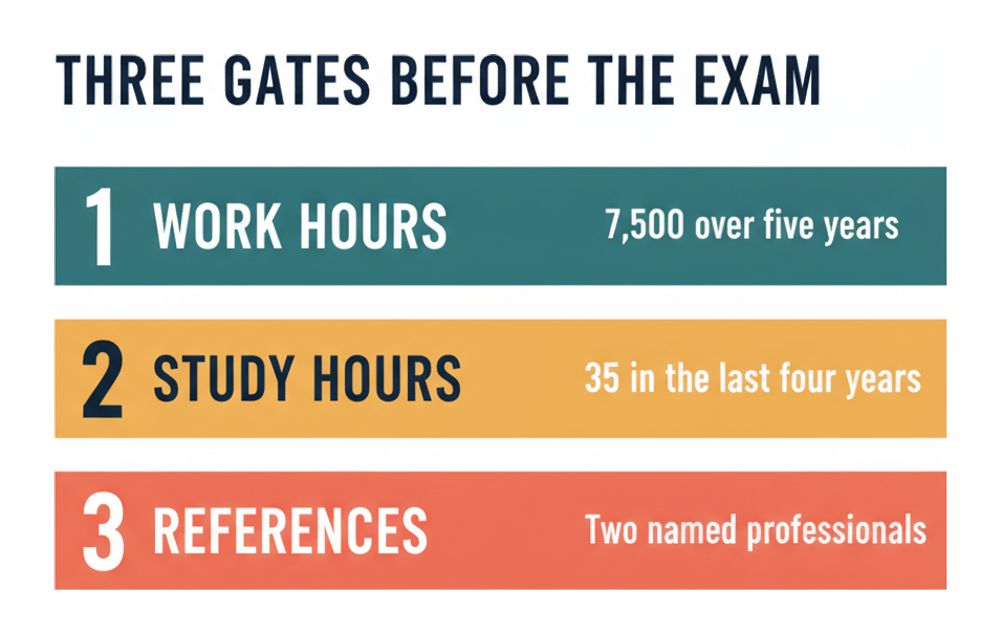
Most people who fail to get CBAP certified never sit the exam. They are stopped by an application, and specifically by three numbers on it: 7,500 hours of business analysis work inside the last ten years, 35 professional development hours inside the last four, and two professional references willing to put their name to your practice.
That order matters, because it inverts how the credential is usually presented. Study guides, courses and practice tests all assume the exam is the obstacle. For the IIBA Certified Business Analysis Professional it is the second one. Seven and a half thousand hours is roughly four full time years of doing the work, documented well enough to survive an audit, and no amount of revision substitutes for it. This guide takes the CBAP certification requirements first, then the exam they unlock: 120 case-study questions in 210 minutes, six weighted knowledge areas, and a fee ladder that changes shape depending on whether you join IIBA.
What Are the CBAP Certification Requirements?
The CBAP certification requirements are 7,500 hours of business analysis work experience gained in the last ten years, 35 professional development hours completed in the last four years, and two professional references. All three are documented in an application that costs 145 US dollars, is non-refundable, and expires twelve months after purchase if it is not completed.
None of the three is negotiable, and none is checked by the exam. They are checked by IIBA before you are allowed to book, and the official CBAP page sets all three out in the same order. The application is a separate transaction from the exam fee, which catches people out: paying 145 dollars buys you the right to be assessed, not the right to sit.
| Requirement | Threshold | Window |
|---|---|---|
| Business analysis work experience | 7,500 hours, across five or more years | Last 10 years |
| Professional development hours | 35 hours | Last 4 years |
| Professional references | Two | No stated window |
| Application validity | Expires if unused | 12 months from purchase |
The twelve month expiry is the quietest trap in the set. Buying the application early to lock in a price, then letting work overtake preparation, means paying again. Treat the purchase as the start of a countdown rather than a bookmark.
How Are the 7,500 Hours Actually Counted?
The 7,500 hours must be business analysis work as the BABOK Guide defines it, spread across five or more years within the last decade. That works out at roughly 1,500 hours a year for five years, or about four full time years of doing the work. Hours are recorded against the six BABOK knowledge areas, and a candidate has to be able to describe which area each block of work sat in.
Two things about that framing tend to surprise people. The first is that job title is irrelevant. Plenty of people with business analyst on their contract spend most of a year writing tickets and chasing sign off, and plenty of product managers, solution architects and delivery leads spend most of a year doing textbook business analysis. What counts is the activity.
The second is the coverage expectation. Hours concentrated entirely in elicitation and requirements documentation are still hours, but a candidate whose whole career has sat in two knowledge areas will find the strategy analysis and solution evaluation questions unfamiliar in a way that revision struggles to fix.
Documenting it before you need to
The practical advice from anyone who has been through the process is to build the log while the projects are still fresh, not at application time. For each engagement, record the dates, the client or department, the hours, and which knowledge areas the work touched. Reconstructing four years of that from memory is where most applications stall.
The two references
References must be professional, which in practice means a career manager, a client, or a CBAP recipient who has seen your work. They are not a formality: IIBA is asking someone to confirm that the experience log describes what actually happened.
What Does the CBAP Exam Look Like?
The CBAP exam runs 210 minutes and carries 120 questions with a passing score of 70 percent. IIBA describes the items as case-study and scenario-based multiple choice rather than straight recall. It is a computer-based exam that can be taken online under proctored conditions or at a PSI test centre.
| Field | Value |
|---|---|
| Exam name | IIBA Certified Business Analysis Professional |
| Exam code | CBAP |
| Questions | 120 |
| Duration | 210 minutes |
| Passing score | 70% |
| Question style | Case-study and scenario-based multiple choice |
| Delivery | Online proctored or PSI test centre |
Three and a half hours for 120 questions gives you 105 seconds each, which sounds workable until you meet the format. A case-study item presents a situation of several paragraphs and then asks what a business analyst should do next. Reading is a real cost on this paper in a way it is not on a recall exam, and candidates who run out of time usually do so in the last twenty questions.
The 70 percent pass mark leaves room to lose 36 questions, which is far more forgiving than most professional credentials. That generosity is deliberate. IIBA is testing judgement across scenarios where more than one answer is defensible, so the marking scheme absorbs a degree of reasonable disagreement. Working through CBAP practice material in that scenario format is the only reliable way to calibrate to it.
Why Is Requirements Analysis and Design Definition Worth 30 Percent?
Requirements Analysis and Design Definition carries 30 percent of the CBAP exam, twice the weight of any other knowledge area apart from Strategy Analysis and Requirements Life Cycle Management, which sit at 15 percent each. Roughly 36 of the 120 questions come from it. No other single area comes close.
| Knowledge area | Weight | Roughly |
|---|---|---|
| Requirements Analysis and Design Definition | 30% | 36 questions |
| Requirements Life Cycle Management | 15% | 18 questions |
| Strategy Analysis | 15% | 18 questions |
| Business analysis planning and monitoring | 14% | 17 questions |
| Solution Evaluation | 14% | 17 questions |
| Elicitation and Collaboration | 12% | 14 questions |
The reason is that this area is where analysis actually happens. Everything else in BABOK either sets up the work, manages it, or checks it afterwards. Requirements Analysis and Design Definition is the specifying, modelling, prioritising and validating that produces the thing being managed.
At CBAP level the questions in it are pitched at expert judgement rather than technique recall. The syllabus repeatedly uses phrasing like creating rules for an approach and guiding practice in an activity, which is a different standard from being able to do the activity yourself. You are being asked what a senior practitioner would advise, in a scenario where a less experienced analyst would already have committed to something.
The practical consequence for revision is uncomfortable but clear. If you have only so many hours, put them here. A candidate strong in this one area and merely competent everywhere else is far better placed than one evenly spread, because 30 percent of the paper turns on it.
What Does CBAP Really Cost End to End?
A first time CBAP candidate who joins IIBA pays 495 US dollars in total: a 145 dollar application fee plus a 350 dollar member exam fee, with the first year of membership included. A non-member pays 650 dollars for the same two steps. A retake adds 295 dollars for members or 450 for non-members, and recertification every three years costs 85 or 120.
| Fee | Member | Non-member |
|---|---|---|
| Application | $145 | $145 |
| Exam | $350 | $505 |
| Retake | $295 | $450 |
| Recertification, every three years | $85 | $120 |
The member and non-member gap on the exam alone is 155 dollars, and IIBA includes the first year of membership with the exam fee. That makes the non-member route the more expensive way to buy the same thing, which is presumably the point.
Two costs are missing from the table and belong in any honest budget. The 35 professional development hours have to come from somewhere, and if your employer does not fund training that is a real line item. So is the reading time: the BABOK Guide is the reference standard and it is not a weekend.
Should You Take CBAP or CCBA?
The eligibility rule usually answers this before preference does. CBAP asks for 7,500 hours across five or more years; CCBA, the tier below it, asks for substantially less. An analyst three years into the discipline is not choosing between them, and an analyst with a decade behind them has no reason to take the lower tier.
Where the question becomes genuine is around the boundary. If you are at five or six thousand hours and could plausibly reach 7,500 within a year, the calculation is whether to certify now at the lower tier or wait and go straight to CBAP. IIBA’s own audience description for CBAP is instructive here: it names CCBA holders first, then senior, lead, principal and enterprise business analysts, business analysis managers, business architects and product managers. CCBA is treated as a stepping stone rather than a destination.
There is a second consideration that has nothing to do with hours. The CBAP exam is written at an advisory level, asking what a senior practitioner would recommend. Someone who has always worked inside a defined process, executing rather than shaping it, may hold the hours and still find the framing unfamiliar. Honest self-assessment against that standard is worth more than counting.
How Does the BABOK Guide Map to the Exam?
The six CBAP knowledge areas are the six BABOK knowledge areas, in the same order and under the same names. The exam is a test of the standard rather than of a separate syllabus, so the BABOK Guide functions as both the reference and the blueprint. What the exam adds is weighting and altitude.
That one to one mapping is genuinely useful, because it means a chapter of the guide is a study unit and the percentage next to a knowledge area tells you how long to spend in it. There is no translation step and no hidden vendor syllabus.
The altitude difference is where preparation goes wrong. BABOK describes tasks, inputs, techniques and outputs neutrally. CBAP asks you to apply them under pressure in a scenario where information is incomplete and stakeholders disagree. Reading the guide cover to cover produces recognition; working scenarios produces the judgement the paper actually scores. The discipline itself has a much longer history than the credential, and a broader view of business analysis practice helps make sense of why the knowledge areas are cut the way they are.
How Should You Prepare for the CBAP Exam?
Preparation works best in two distinct phases, because the CBAP certification requirements and the exam test different things. The application is an evidence exercise that rewards records; the exam is a judgement exercise that rewards scenario practice. Running them in sequence rather than together keeps each honest.
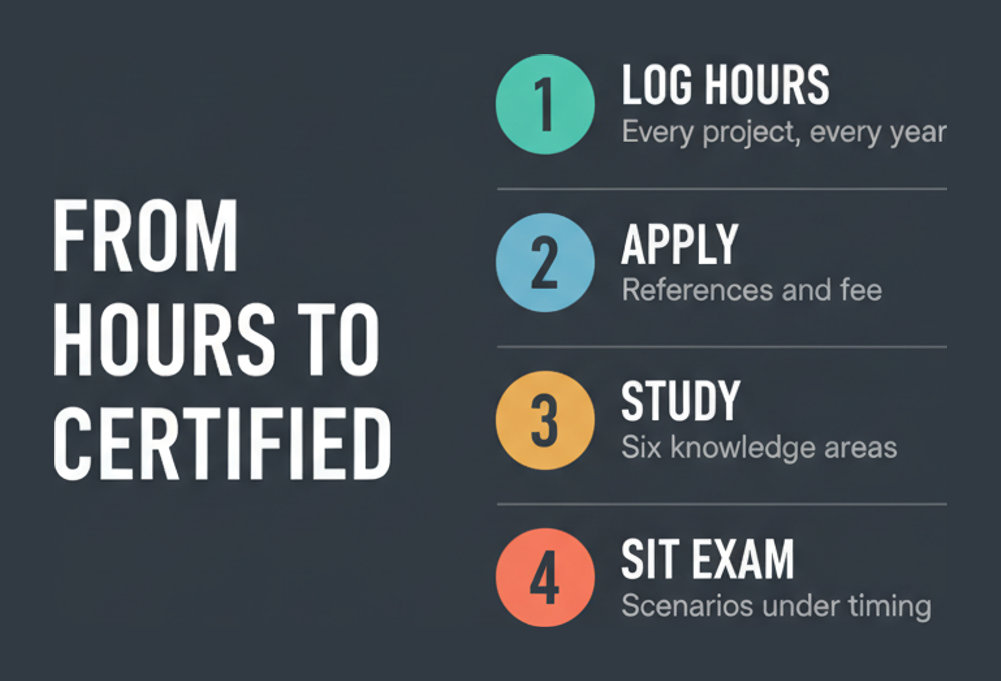
- Build the experience log first, recording every engagement from the last ten years with its dates, hours and the BABOK knowledge areas it touched, before you spend anything.
- Total the hours against the 7,500 threshold and check the spread across the six knowledge areas, because a career concentrated in two of them signals exactly where the exam will hurt.
- Secure the 35 professional development hours and the two professional references, then buy the application knowing the twelve month clock starts immediately.
- Read the BABOK Guide once end to end for structure rather than retention, so the six knowledge areas and their boundaries are fixed before any detailed study.
- Spend the largest block of study time in Requirements Analysis and Design Definition, since it alone accounts for 30 percent of the paper.
- Work Strategy Analysis and Requirements Life Cycle Management next at 15 percent each, then the three remaining areas.
- Practise with case-study and scenario items under timing, because 210 minutes for 120 questions is tighter than it looks once reading time is included.
The CertificationBox CBAP exam preparation guide collects the practice material for that final step in one place.
What Happens After You Pass
CBAP is not permanent. The credential has to be recertified every three years, at 85 dollars for members or 120 for non-members, which means continuing professional development is part of holding it rather than a one off cost. That recurring obligation is worth factoring in before you start.
On the career side, the credential does what a senior professional certification usually does: it opens doors rather than raising a number directly. Business analysis pay tracks seniority, sector and location far more than it tracks certification, and reported senior analyst salaries vary widely for exactly those reasons. What CBAP reliably does is qualify you for the roles that ask for it, and give a hiring manager an independent read on experience that would otherwise be taken on trust.
The other benefit is quieter and harder to price. Documenting 7,500 hours against a formal standard forces most analysts to notice which knowledge areas they have never really worked in. Several people describe the application itself as the more useful half of the process, which is an unusual thing to say about paperwork.
Frequently Asked Questions
What are the CBAP certification requirements?
7,500 hours of business analysis work experience across five or more years in the last ten, 35 professional development hours in the last four years, and two professional references, all documented in a 145 dollar application.
How many questions are on the CBAP exam?
120 questions in 210 minutes. IIBA describes them as case-study and scenario-based multiple choice, so reading time is a genuine cost rather than an afterthought.
What is the passing score for CBAP?
70 percent. That leaves room to lose 36 of the 120 questions, which is more forgiving than most senior credentials because several scenario answers are defensible.
How much does CBAP cost in total?
495 US dollars for a member taking it first time, made up of a 145 dollar application and a 350 dollar exam fee with the first year of membership included. A non-member pays 650.
Which knowledge area is worth the most marks?
Requirements Analysis and Design Definition at 30 percent, roughly 36 questions. Strategy Analysis and Requirements Life Cycle Management follow at 15 percent each.
Where is the CBAP exam delivered?
It is a computer-based exam taken either online under proctored conditions or at a PSI test centre, so a physical test centre is an option rather than a requirement.
Does the CBAP application expire?
Yes. The application expires twelve months after purchase, and the fee is non-refundable and non-transferable, so buying it early to reserve a price is a poor idea.
Do I need to be an IIBA member?
No, but the member exam fee is 155 dollars lower and the first year of membership is included with it, which makes the non-member route the more expensive way to buy the same exam.
Is CBAP harder than CCBA?
It is pitched higher. CCBA sits below CBAP in the same programme and asks for substantially less experience, and IIBA names CCBA holders as a natural CBAP audience rather than treating the two as alternatives.
How often does CBAP need renewing?
Every three years, at 85 dollars for members or 120 for non-members. Continuing professional development is part of holding the credential rather than a one off cost at the start.
Conclusion
The honest summary of CBAP is that the credential rewards a career rather than a study period. Seven and a half thousand hours across five years cannot be revised into existence, and the exam that follows is written to test the judgement those hours are supposed to have produced.
So the useful sequence is the reverse of the usual one. Build the experience log first and see whether the numbers are there and where the gaps sit. If they are, the exam itself is well signposted: 120 scenario questions in 210 minutes at 70 percent, with 30 percent of the marks concentrated in Requirements Analysis and Design Definition. Practising in that scenario format is what turns documented experience into a pass. If you are weighing the other tiers against this one first, the IIBA certification hub sets them out together.


