Multicloud Automation is the name printed on the certificate. Read the twelve published objectives and two product names do almost all of the work: Nutanix Self-Service and X-Play.
That gap between the title and the blueprint is the single most useful thing to know before booking NCP-MCA. The Nutanix Certified Professional Multicloud Automation exam is 75 multiple choice questions in 120 minutes at 200 US dollars, scored on a scale of 1000 to 6000 with 3000 to pass, and its three sections cover automation concepts, deploying and configuring Self-Service, and validating what you built. Nobody is being asked to compare cloud providers. The NCP-MCA certification tests whether you can build a blueprint, wire up a playbook, and work out why neither of them did what you expected.
What Does the NCP-MCA Certification Actually Test?
NCP-MCA tests automation principles and the automation capabilities built into the Nutanix platform, across three sections: describing and differentiating automation concepts, deploying and configuring Self-Service and its related components, and validating blueprints, runbooks, playbooks and automation settings. It is a product exam wearing a category name.
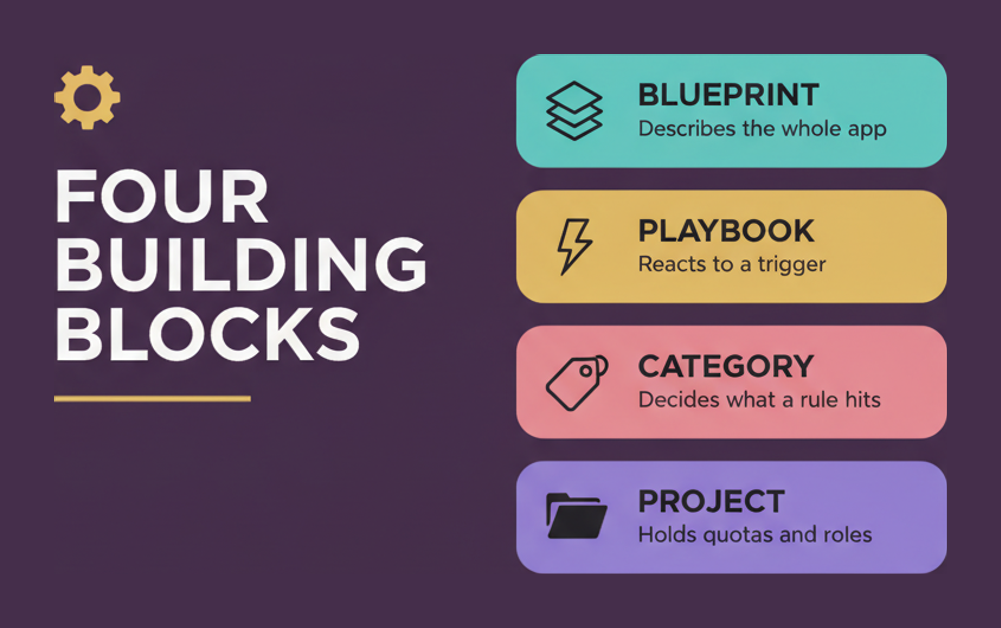
Look at what the objectives name and the scope becomes concrete. Blueprints, substrates, day-two actions, tasks, packages, built-in macros and application profiles. Projects with role-based access control, quotas and assigned infrastructure. Categories and the policies they trigger. Playbooks with action galleries, plays, alerts and third-party integrations. Runbooks, approval policies and scheduler tasks.
The word multicloud earns its place in one narrow sense: Self-Service can deploy to several account types through configured providers and environments, and one objective covers exactly that. But the skill being measured is authoring and operating Nutanix automation, not designing a cloud strategy.
That distinction matters most for candidates coming from a general automation background. Fluency with declarative infrastructure as code transfers as a way of thinking, but not as answers. The exam wants the Nutanix implementation of those ideas.
What Are the NCP-MCA Exam Details?
NCP-MCA is 75 multiple choice questions in 120 minutes, priced at 200 US dollars per attempt and scheduled directly through Nutanix rather than a third-party test centre network. Scoring uses a scale running from 1000 to 6000, with 3000 required to pass. Nutanix recommends its Multicloud Automation Administration course as preparation.
| Field | Value |
|---|---|
| Exam name | Nutanix Certified Professional – Multicloud Automation |
| Exam code | NCP-MCA |
| Questions | 75, multiple choice |
| Duration | 120 minutes |
| Passing score | 3000 on a scale of 1000 to 6000 |
| Price | $200 USD per attempt |
| Recommended training | Nutanix Multicloud Automation Administration |
| Scheduling | Nutanix |
| Published sections | 3, unweighted |
Ninety-six seconds a question is a comfortable pace by professional-exam standards, and it needs to be, because several items hand you a graphic or a log to interpret before you can answer. Nutanix confirms the question count, the time limit and the fee on its own NCP-MCA certification page, which also notes that passing earns a Credly digital badge.
What the scaled score does and does not tell you
A 1000 to 6000 scale with a 3000 threshold is not a percentage, and converting it into one is a mistake. Scaled scoring exists so that different forms of the same exam can be compared fairly, which means the number of questions you need right varies slightly with the form you receive. Treat 3000 as the bar and ignore the arithmetic.
What Are the Three NCP-MCA Sections?
The blueprint publishes three sections and no weightings. Automation concepts and principles carries five objectives, deploying and configuring Self-Service carries five, and validating blueprints, runbooks, playbooks and automation settings carries two. Objective count is the only ranking signal available, and it points squarely at the first two sections.
| Section | Objectives | What it covers |
|---|---|---|
| Describe and Differentiate Automation Concepts and Principles | 5 | Turning a manual process into an automated one, event-driven playbooks and their components, categories, and projects with Self-Service enabled |
| Deploy and Configure Self-Service and Related Components | 5 | Building blueprints, managing deployed applications, configuration settings, blueprint and runbook governance features, and Self-Service requirements |
| Validate Blueprints, Runbooks, Playbooks, and Automation Settings | 2 | Validating project and playbook configuration, and diagnosing the cause of an automation failure from evidence |
Two objectives is not two questions. The validation section is short because its objectives are broad: one of them alone covers interpreting a screenshot, inferring an issue from a log, optimising a workflow, triaging from an image and diagnosing blueprint or runbook deployment failures. Judged by content rather than by objective count, it is far from small.
Because the demand for this code is overwhelmingly question-shaped, calibrating against real items is the fastest way to find out whether your Self-Service habits match what the exam considers correct. Working NCP-MCA sample questions does that in a way that re-reading the objective list cannot.
What Is Nutanix Self-Service and Why Does It Dominate the Blueprint?
Nutanix Self-Service is the platform’s application automation and provisioning layer. It publishes blueprints that describe an application and the infrastructure it needs, then deploys, scales, manages and retires that application as a unit. Five of the twelve NCP-MCA objectives sit inside it, which makes it the exam’s centre of gravity.
The blueprint vocabulary the exam expects
One objective alone names nine things you have to be able to build or choose: the blueprint itself, a substrate, a day-two action, a task, install and uninstall package configuration, the right task type for a given script language, built-in macros, application infrastructure requirements, and whether an application profile is needed. That is a checklist, and it is worth treating as one.
A second objective covers the lifecycle afterwards: scaling a managed application out and in, retiring it, managing it, and executing a task or runbook against it. A third covers what has to exist first, including providers, environments, supported accounts, Marketplace capabilities, endpoints and task library items.
Nutanix documents all of this in its Self-Service operations guide, and the objective wording tracks it closely enough that reading the guide with the blueprint beside you is an efficient study session.
How Do Playbooks and X-Play Fit In?
X-Play is the event-driven half of Nutanix automation, and playbooks are what it produces. A playbook has a trigger and a set of actions, drawn from an action gallery, and it can run against multiple virtual infrastructure resources at once. Three of the first section’s five objectives involve playbooks in some form.
The examinable relationship is between the two halves. Playbooks react to something happening, typically an alert or a manual trigger. Self-Service provisions and manages things on request. One objective explicitly covers integrating a playbook with Self-Service automation, which is where the two meet.
Categories are the connective tissue underneath both. The blueprint asks you to create and configure categories, explain their effects, and then, given a category and a blueprint, infer whether a policy will apply to a virtual machine. That last one is a reasoning question rather than a recall question, and it is the sort of thing candidates get wrong when they have configured categories without ever tracing their consequences.
Projects complete the picture. They carry role-based access control, quotas and assigned infrastructure, which is how an organisation stops self-service from becoming a free-for-all.
Why Does the Exam Show You Screenshots and Logs?
Six NCP-MCA objectives begin by handing you something to look at rather than something to recall. A graphic showing pre-provisioning steps. A category and a blueprint. A playbook and a symptom. A screenshot. A log. An image to triage from. That phrasing is a deliberate signal about how the questions are constructed.
The practical consequence is that memorising menu paths will not help. You are being shown the state of a system and asked what went wrong or what happens next, which is a diagnostic skill rather than a procedural one.
It also explains why the validation section can carry only two objectives and still matter. Diagnosing an automation failure from a log uses the same reasoning as working a runbook under pressure: you read the evidence, form a hypothesis about which step failed, and check it. Candidates who have only ever watched their own automation succeed have not practised that.
How Should You Prepare for the NCP-MCA Exam?
Preparation should be weighted by objective count and by how much of the blueprint each product carries. Self-Service holds five objectives directly and appears inside several others, so it earns the most time. Nutanix recommends its Multicloud Automation Administration course, and there is no published prerequisite exam.
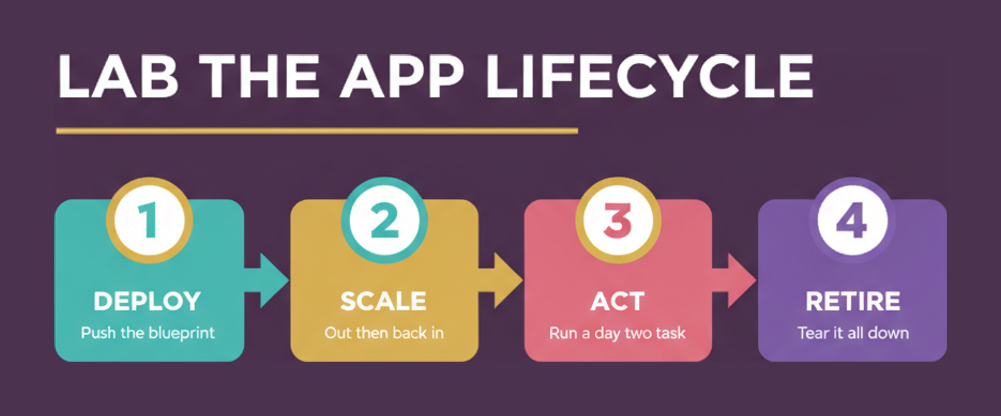
- Build a Self-Service blueprint end to end, covering the substrate, tasks, packages, macros and an application profile, because one objective names all of them together.
- Deploy that blueprint, then scale it out, scale it in, run a day-two action against it and retire it, so the application lifecycle objectives come from experience rather than reading.
- Set up the layer underneath it: providers, environments, accounts, endpoints and a task library item, since a Self-Service deployment fails without them.
- Create categories, attach them to a blueprint, and trace whether a policy actually applies to the resulting virtual machine, which is a reasoning objective rather than a configuration one.
- Build an event-driven playbook in X-Play with a real trigger, then arrange its steps and add a third-party integration.
- Integrate that playbook with a Self-Service deployment, because the blueprint names the join between the two products explicitly.
- Configure a project with role-based access control, quotas and assigned infrastructure, and confirm you can explain what each control prevents.
- Break your own automation deliberately and diagnose it from the log and the interface, since six objectives supply an artefact and ask you to infer the fault.
If you are choosing between professional-level Nutanix exams, the NCP-MCI infrastructure exam covers the platform layer this one automates.
Who Is the NCP-MCA Certification For?
NCP-MCA suits an administrator whose organisation has already bought into Nutanix Self-Service and X-Play, and who is being asked to turn manual provisioning into something a project team can self-serve. It is a poor fit for anyone whose automation work happens in other tools, because the objectives are specific to the Nutanix implementation.
The honest prerequisite is access. Almost every objective assumes you can log into an environment with Self-Service enabled and build something in it, and a candidate without that access will be studying a product they cannot touch. Nutanix publishes no formal prerequisite exam, but the objectives assume the platform knowledge that NCP-MCI covers.
There is a second audience worth naming: infrastructure engineers who already automate with general-purpose tooling and now have Nutanix in the estate. For them the concepts are familiar and the vocabulary is not, which usually makes the first section easier than expected and the Self-Service section harder. The Nutanix certification hub is a useful place to see how the exams relate before committing to one.
Frequently Asked Questions
How many questions are on the NCP-MCA exam?
75 multiple choice questions in 120 minutes, which works out at about 96 seconds each. Nutanix publishes both figures on its own certification detail page and the money-site syllabus page carries the same values.
What is the passing score for NCP-MCA?
3000 on a scale that runs from 1000 to 6000. It is a scaled score rather than a percentage, so the number of questions needed varies slightly with the form of the exam you receive.
How much does the NCP-MCA exam cost?
200 US dollars per attempt. Scheduling goes through Nutanix directly rather than through a third-party test centre storefront, and passing earns a Credly digital badge.
Is NCP-MCA really about multiple clouds?
Only narrowly. One objective covers configuring providers and environments so Self-Service can deploy to various supported account types. The rest of the blueprint is about Nutanix Self-Service, X-Play, categories and projects.
What is Nutanix Self-Service?
The platform’s application automation layer. Blueprints describe an application and its infrastructure, and Self-Service deploys, scales, manages and retires it as a unit. Five of the twelve NCP-MCA objectives sit inside it.
What is X-Play on the NCP-MCA blueprint?
The event-driven automation engine that produces playbooks. A playbook pairs a trigger with actions from an action gallery, can span multiple resources, and can be integrated with Self-Service automation.
Are the NCP-MCA sections weighted?
No weightings are published. The only ranking signal is objective count: five objectives in the concepts section, five in the Self-Service section and two in the validation section.
Do I need NCP-MCI before NCP-MCA?
Nutanix publishes no formal prerequisite. In practice the objectives assume platform knowledge of the kind NCP-MCI covers, and access to an environment with Self-Service enabled matters more than the earlier certificate.
Does the exam include screenshots and logs?
Yes. Six objectives supply an artefact rather than a description, including a graphic, a screenshot, a log and an image, and ask you to interpret it or infer the fault behind it.
What training does Nutanix recommend for NCP-MCA?
Nutanix Multicloud Automation Administration is the recommended course. It is not mandatory, and the exam assumes hands-on time in an environment with Self-Service enabled rather than course attendance.
Conclusion
Book this exam for what it examines rather than for what it is called. Multicloud Automation is the credential name, and Nutanix Self-Service plus X-Play is the syllabus.
That reframing makes the study plan obvious. Five of the twelve objectives sit inside Self-Service, so build a blueprint properly and then live with it: deploy it, scale it, run a day-two action, retire it. Add the layer underneath, since providers, environments and endpoints are what a deployment silently depends on. Learn categories well enough to trace whether a policy will actually reach a virtual machine, then build a playbook with a real trigger and wire it into a Self-Service deployment, because that join is named explicitly on the blueprint. Finish by breaking your own automation and diagnosing it from a log, since six objectives hand you evidence and ask what went wrong. With no weightings published and a scaled pass mark, honest hands-on time is the only reliable preparation.


