
Three hundred and sixty five minutes of an 815 minute syllabus go to one chapter.
That chapter is prompt engineering, and the proportion tells you what the testing with generative AI certification is really about. CT-GenAI, the ISTQB Certified Tester specialist module for testing with generative AI, is a 40 question paper sat in 60 minutes for around 199 US dollars through Pearson VUE, and passing takes 30 of the 46 available points. The other four chapters cover what a large language model is, what can go wrong with one, how to build test infrastructure around it, and how to roll any of that out across a test organisation. But almost half the recommended study time is spent on writing prompts that get useful test work out of a model, evaluating what comes back and refining it. Anyone expecting a broad AI theory exam has the wrong picture of this credential.
What Is the Testing with Generative AI Certification?
CT-GenAI is ISTQB’s specialist level module for applying generative AI to software testing. It sits above the Foundation Level in the ISTQB scheme and covers using large language models across the testing lifecycle: analysis, design, implementation, monitoring and reporting. The credential is aimed at people doing test work with a model, not at people building models.
That distinction shapes every chapter. There is no requirement to train a network, derive a loss function or reason about architecture at the research level. What there is instead is a body of practice for getting reliable test artefacts out of a system that is, by design, non deterministic. The syllabus treats that unreliability as the central engineering problem rather than an inconvenience.
ISTQB updated the syllabus to version 1.1, sharpening the emphasis on real world applications, advanced prompting practice and responsible adoption. That last theme runs further than most testers expect, taking in hallucinations, bias, privacy, security and even the energy cost of running models at scale. Candidates who want to see how that translates into question form usually work through the CT-GenAI practice exam before committing to a booking.
Where it sits in the ISTQB scheme
It is a specialist module, which in ISTQB terms means a focused subject rather than a tier of seniority. Holding it does not advance you along the core track. The ISTQB certification scheme continues through the Core Advanced modules and Expert Level separately, and CT-GenAI runs alongside that path rather than inside it.
Can You Even Sit CT-GenAI? The Prerequisite Nobody Mentions
Only if you already hold ISTQB Certified Tester Foundation Level. CTFL is a mandatory prerequisite for CT-GenAI, stated plainly on ISTQB’s own credential page, and there is no alternative route and no experience based waiver. Without it you cannot sit the exam, however much generative AI work you have done.
This catches people out because the prerequisite is easy to miss. Many summaries of the exam list the fee, the duration and the question count and say nothing about eligibility, so a candidate can plan a study schedule and get as far as booking before discovering the gate. If you do not hold CTFL, that is the exam to sit first.
The requirement makes sense once you read the syllabus. Every chapter assumes you already know what test analysis is, what a test condition is, what test monitoring and control mean and how a test process is organised. The generative AI material is layered onto that vocabulary rather than explained alongside it. A candidate without the Foundation grounding would spend the exam translating.
There is no stated requirement for prior AI experience, and none is implied by the objectives. The syllabus starts by distinguishing symbolic AI, classical machine learning, deep learning and generative AI, which is where someone with no background would need to start anyway. The details are set out on the official CT-GenAI page.
What Are the CT-GenAI Exam Details?
CT-GenAI is 40 questions answered in 60 minutes, scored out of 46 points with 30 points needed to pass, which works out at 65 percent. The fee is around 199 US dollars and delivery is through Pearson VUE. Candidates sitting the exam in a language that is not their native one receive an extra 25 percent of time.
| Field | Value |
|---|---|
| Exam name | ISTQB Certified Tester, Testing with Generative AI |
| Exam code | CT-GenAI |
| Questions | 40 |
| Total points | 46 |
| Points to pass | 30, which is 65 percent |
| Duration | 60 minutes, plus 25 percent in a non-native language |
| Fee | USD 199 |
| Format | Multiple choice |
| Prerequisite | ISTQB Certified Tester Foundation Level |
| Delivery | Pearson VUE |
| Syllabus version | 1.1 |
The forty six points against forty questions is the detail worth pausing on. Some items are worth more than one point, which means the exam is not a flat count of right answers and a handful of heavier questions carry disproportionate weight. ISTQB does not publish which ones, so the practical response is simply to answer everything rather than triaging by apparent difficulty.
Sixty minutes for forty questions is ninety seconds each, which is tight for an exam where several objectives are phrased as apply and select rather than recall. Questions that ask which prompting technique fits a given test task take longer to read than a definition question, and there is no reading time allowance beyond the language extension.
Why Does Prompt Engineering Take Nearly Half the Syllabus?
Because prompting is the skill the rest of the credential depends on. Prompt Engineering for Effective Software Testing carries 365 of the syllabus’s 815 recommended study minutes, roughly 45 percent, and it is the only chapter that asks you to produce something rather than understand something. Its objectives run from prompt structure through applying prompts to real test tasks and on to evaluating what comes back.

| Chapter | Recommended study minutes |
|---|---|
| Introduction to Generative AI for Software Testing | 100 |
| Prompt Engineering for Effective Software Testing | 365 |
| Managing Risks of Generative AI in Software Testing | 160 |
| LLM-Powered Solutions for Software Testing | 110 |
| Deploying and Integrating Generative AI in Test Organizations | 80 |
Read that table as study time rather than as exam weighting. Neither ISTQB nor the published syllabus summary states how the forty questions divide between the five chapters, so nobody can honestly tell you that 45 percent of the paper is prompting. What the minutes do tell you is where the authors think the learning effort belongs, and that is a reliable planning signal even without the question split.
The chapter breaks into three parts. Effective prompt development covers prompt structure, the core prompting techniques and the difference between a system prompt and a user prompt. Applying the techniques covers test analysis, test design and implementation, and test monitoring and control, each as a separate objective. Evaluation covers the metrics for judging what a model produced and the techniques for refining a prompt iteratively.
The objective people underestimate
Selecting the appropriate prompting technique for a given context and test task is the one that separates candidates. Knowing the techniques is recall. Choosing between them when a scenario describes a specific task, a specific constraint and a specific quality bar is judgement, and it is the shape most of this chapter’s questions take.
What Does the Risk Chapter Actually Make You Learn?
Four distinct risk areas at 160 recommended minutes, the second largest chapter. Managing Risks of Generative AI in Software Testing covers hallucinations, reasoning errors and biases; data privacy and security; energy consumption and environmental impact; and the AI regulations, standards and best practice frameworks that increasingly govern all three.
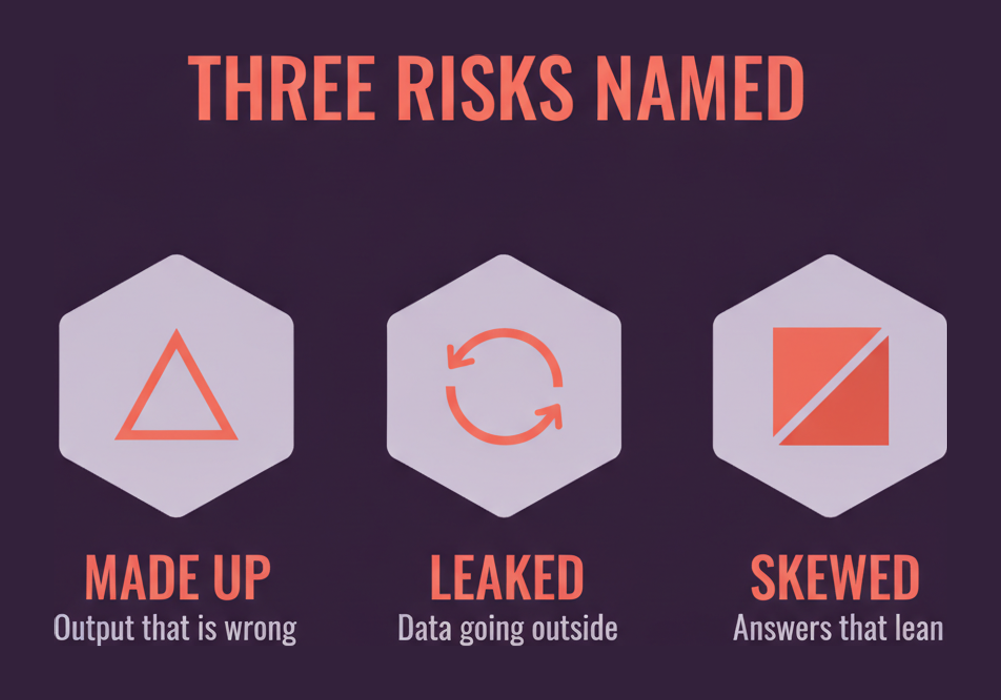
The hallucination material goes beyond defining the term. The objectives ask you to identify hallucinations, reasoning errors and biases in actual model output, summarise mitigation techniques for each in a test context, and recall how to handle non deterministic behaviour. That last point matters more in testing than almost anywhere else: a test asset that changes between generations is not a test asset yet.
Privacy and security is the area with the clearest external reference point. Feeding production data, defect reports or source code into a hosted model creates exposure that did not exist before, and the syllabus asks for both the risks and the mitigations. OWASP’s Top 10 for LLM applications maps closely onto this objective and is the most efficient way to give the topic structure.
The regulations objective is deliberately broad, asking only that you recall examples of relevant regulations, standards and frameworks. The NIST AI Risk Management Framework is the example most commonly cited in practice, and knowing one framework properly serves better than half remembering four.
Energy consumption gets a single objective and is the chapter’s smallest piece. It asks how task characteristics and model usage affect energy cost, which in practice means understanding that model size and call volume drive consumption. It is a short topic and worth a short study session.
What Is in the LLM-Powered Solutions Chapter?
The architecture around the model, at 110 recommended minutes. LLM-Powered Solutions for Software Testing covers the key architectural components of a language model backed testing setup, Retrieval-Augmented Generation, the role of LLM powered agents in automating test processes, fine tuning models for specific test tasks, and LLMOps.
Retrieval-Augmented Generation is the concept to get right. It is the pattern where a model’s answer is grounded in documents retrieved at query time rather than in whatever was in its training data, and in a testing context those documents are usually requirements, specifications or existing test assets. It is the practical answer to a model that does not know your system.
Agents are the newer material. The objective asks you to explain their role in automating test processes, which means understanding that an agent plans and executes a sequence of steps rather than answering a single prompt. Fine tuning and LLMOps close the chapter by covering how a model is adapted to a specific test task and how it is then deployed and managed over time.
- Know what each architectural component contributes, not just its name
- Be able to say when retrieval beats fine tuning and when it does not
- Understand what an agent adds over a single prompt
- Treat LLMOps as the operations discipline it is, not as a synonym for deployment
Who Should Take This Certification?
Testers, test analysts, automation engineers and test managers who already hold CTFL and whose organisations have started putting language models into test work. ISTQB also names user acceptance testers, developers, project and quality managers, business analysts, IT directors and consultants as an audience, which is a broader list than most specialist modules carry.
The strongest fit is a tester who has already been experimenting. If you have asked a model to generate test cases from a requirement and been disappointed by what came back, the prompt engineering chapter will read as an explanation of why, and the evaluation objectives will read as the missing half of what you were doing. That is the moment this credential is worth most.
It also suits a test manager who has to make a decision rather than write a prompt. The final chapter covers shadow AI, defining a strategy, choosing between large and small language models and the phases of adoption, all of which are management problems rather than technique problems. A manager can get real value from that chapter alone.
It is a weaker fit for someone without CTFL, who simply cannot sit it, and for someone wanting to build AI systems rather than test with them. Testers already holding the AI testing module will find some conceptual overlap but a different centre of gravity, and our guide to the ISTQB CT-AI exam covers that neighbouring credential in detail.
What you get out of it
- A structured account of prompting for test work rather than accumulated habit
- Vocabulary for arguing about model risk with people outside the test team
- Enough architecture to tell a retrieval problem from a prompting problem
- A defensible position when someone proposes pasting production data into a chat window
How Should You Prepare for CT-GenAI?
By following the study minutes, since they are the only proportional signal the syllabus publishes. Prompt engineering is worth more preparation time than the other four chapters put together at one end, and deployment is worth a single session at the other. Practical work on prompts beats reading about them at every stage.
- Confirm you hold ISTQB Certified Tester Foundation Level before anything else, because CT-GenAI is closed to you without it and no amount of preparation changes that.
- Read the introductory chapter once to fix the vocabulary, learning the difference between foundation, instruction tuned and reasoning models properly since later chapters assume it.
- Write real prompts against a real requirement from your own work, asking a model to produce test conditions, then test cases, then data, so that each applying objective has an experience attached to it.
- Deliberately break those prompts by removing context, so you can recognise a hallucination and a reasoning error in output rather than only in a definition.
- Learn one risk framework properly rather than skimming several, and map its categories onto the privacy, security and bias objectives in the risk chapter.
- Study retrieval and fine tuning as alternatives to one another, since most architecture questions turn on choosing between them for a stated constraint.
- Finish with the deployment chapter in a single session, treating shadow AI and the adoption phases as the management vocabulary they are.
Time yourself on practice questions from the start rather than at the end. Ninety seconds per question is the real constraint on a paper where several objectives ask you to select and apply rather than recall, and candidates who discover that in the exam room lose marks they had the knowledge to earn. Testers preparing for other ISTQB specialist modules report the same, and our notes on the CT-STE exam materials cover how the specialist papers differ from the Foundation format.
Frequently Asked Questions
How many questions are on the CT-GenAI exam?
Forty questions in 60 minutes, scored across 46 total points. Because some items carry more than one point, the number of questions and the number of points are deliberately different figures.
What is the CT-GenAI passing score?
Thirty of the 46 available points, which ISTQB expresses as 65 percent. It is a share of points rather than a share of questions, so heavier items matter more than a flat count suggests.
Do I need any certification before CT-GenAI?
Yes. ISTQB Certified Tester Foundation Level is a mandatory prerequisite with no alternative route and no experience waiver. Without CTFL you cannot sit the exam at all.
How much does the exam cost?
Around 199 US dollars. ISTQB does not publish a single global price because exams are sold through member boards and exam providers, so the figure varies by region and provider.
How long should I study for CT-GenAI?
The syllabus recommends 815 minutes of study across its five chapters, a little under fourteen hours. Roughly 365 of those minutes belong to the prompt engineering chapter alone.
Is prompt engineering the biggest part of the exam?
It is the biggest part of the recommended study time at 365 of 815 minutes. Neither ISTQB nor the published syllabus states how the 40 questions divide between chapters, so the question share is not known.
Do I get extra time if English is not my first language?
Yes. ISTQB grants a 25 percent extension for candidates sitting the exam in a language that is not their native one, taking the window from 60 minutes to 75.
Does CT-GenAI require any AI experience?
No prior AI experience is required. The first chapter starts by distinguishing symbolic AI, classical machine learning, deep learning and generative AI, so the syllabus builds the background it needs.
What comes after CT-GenAI?
It is a specialist module rather than a rung on the core ladder. ISTQB names the Core Advanced modules, covering test analysis, technical test analysis, test management and test engineering, as the onward path, followed later by Expert Level.
Conclusion
The testing with generative AI certification is narrower and more practical than its name suggests. Forty questions in 60 minutes, 30 of 46 points to pass, around 199 US dollars, CTFL required first, and a syllabus whose recommended study time is dominated by one chapter on writing, applying and evaluating prompts for test work. The remaining chapters handle model risk, the architecture around a model, and rolling any of it out across a test organisation.
Preparation should follow that shape rather than treating five chapters as five equal subjects. Write real prompts against real requirements, break them deliberately so you can recognise failure modes in output, learn one risk framework properly, and time yourself from the first practice question rather than the last. Working through a full practice set is the quickest way to find out which chapter still owes you study time.


