
Nobody watches you take this one. The FinOps Certified Practitioner exam is unproctored, and buying it gives you three attempts across twelve months rather than one high stakes hour. That single structural fact reframes the whole preparation question, and almost nobody mentions it.
What it does not do is make the exam soft. Fifty questions, sixty minutes, and a 75 percent bar, with 58 percent of the marks concentrated in just two of the six domains. Knowing which two is the difference between revising evenly and revising usefully.
Table of Contents
- What is the FinOps certification, and who actually awards it?
- How is the FOCP exam delivered and scored?
- Where do the FOCP marks actually sit?
- Why do Capabilities and Lifecycle carry 58 percent between them?
- What the FOCP exam does not test
- Three attempts in twelve months changes how you prepare
- How long does the credential last?
- How should a cloud engineer prepare for FOCP?
- Who actually benefits from a FinOps certification?
- Frequently Asked Questions
- Conclusion
What is the FinOps certification, and who actually awards it?
The FinOps certification most people mean is the FinOps Certified Practitioner, exam code FOCP, and it is awarded by the FinOps Foundation rather than by a cloud vendor. The FinOps Foundation sits under the Linux Foundation umbrella, which is why the credential is often listed under Linux Foundation cloud and containers certifications, but the exam, the syllabus and the certificate all come from the Foundation itself.
That ownership matters more than it sounds. Because no cloud provider writes the exam, nothing in it is specific to one billing console. FOCP tests a discipline: how an organisation brings engineering, finance and business together to get value out of variable cloud spend. The published FinOps Framework is the source material, and the exam is essentially a check that you can work inside it.
It is a practitioner level credential, not an expert one. The Foundation positions it as the entry point into a career track that continues into more specialised credentials, and it assumes familiarity with cloud rather than deep engineering skill.
How is the FOCP exam delivered and scored?
FOCP is a 50 question exam with a 60 minute limit and a 75 percent pass mark, taken online and unproctored. The FinOps Foundation confirms every one of those figures on its own FOCP certification exam page, and adds that the purchase covers three attempts within twelve months of the purchase date rather than a single sitting.
| Field | Value |
|---|---|
| Credential name | FinOps Certified Practitioner |
| Exam code | FOCP |
| Questions | 50 multiple choice |
| Duration | 60 minutes |
| Passing score | 75 percent |
| Price | $325 USD for the standalone exam |
| Proctoring | None |
| Attempts included | Three, within 12 months of purchase |
| Credential validity | 24 months |
| Awarding body | FinOps Foundation |
Seventy five percent of 50 questions means 38 correct answers, with room for 12 wrong ones. That is a tighter margin than most practitioner level exams, and it is the reason domain weighting matters so much here: losing a whole domain is survivable only if it is one of the small ones. Sitting a FOCP practice test broken down by domain is the quickest way to find out which one would sink you.
The absence of proctoring is a genuine convenience rather than a loophole. The clock is still 60 minutes, the questions still require you to have internalised the Framework, and 72 seconds per question does not leave time to look things up. Treat it as an open environment you will not have time to use.
Where do the FOCP marks actually sit?
The FOCP syllabus divides into six domains, and unlike many practitioner exams it publishes a weighting against every one of them. Two domains, FinOps Lifecycle at 30 percent and FinOps Capabilities at 28 percent, account for 58 percent of the paper between them. The remaining four share the other 42 percent.
| Domain | Objectives | Weight |
|---|---|---|
| FinOps Lifecycle | Describe the FinOps lifecycle, its phases and purpose; understand the basic processes that FinOps teams enact in the FinOps Lifecycle | 30% |
| FinOps Capabilities | Understand the six pillars of FinOps Capabilities; describe the activities associated with each capability | 28% |
| What is FinOps & FinOps Principles | Define FinOps; understand each of the FinOps Principles | 12% |
| FinOps Teams & Motivation | Describe the skills, roles and responsibilities of a FinOps Team; describe where a FinOps team would be situated; understand what drives a FinOps team’s size, position and makeup | 12% |
| Terminology & the Cloud Bill | Understand basic cloud, FinOps, DevOps and Finance terminology; describe the characteristics of the Cloud Bills | 10% |
| Challenge of Cloud | Understand the challenges of working with Cloud; recognize the differences between Cloud and Traditional IT | 8% |
Read as question counts rather than percentages, the picture sharpens. Lifecycle is worth roughly 15 questions and Capabilities roughly 14. Challenge of Cloud is worth about four. A candidate who spends equal evenings on all six domains has given the same attention to a four question topic as to a fifteen question one.
Why do Capabilities and Lifecycle carry 58 percent between them?
Those two domains carry the weight because they are the only ones that describe what a FinOps team does rather than what FinOps is. Principles, terminology and team structure are context. Capabilities and Lifecycle are the operating model, and the exam is built to check you could actually run one.
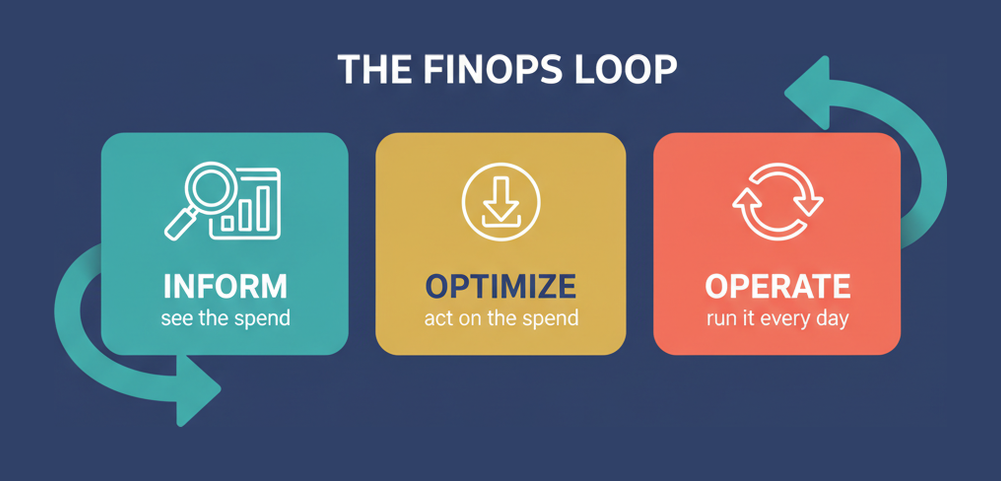
The Lifecycle domain, at 30 percent
The FinOps Foundation names three phases: Inform, Optimize and Operate. Inform is about visibility into spend, Optimize is about acting on it, and Operate is about running the practice continuously. The exam asks which phase a described situation belongs to, what a team does in each phase, and why a given activity would be premature in one phase and correct in another. Expect scenarios rather than definitions.
The recurring trap is assuming the phases are a project with an end. They are a loop, and a maturing organisation revisits the earliest phase for every new workload. Questions that describe a team declaring the work finished are usually testing exactly that.
The Capabilities domain, at 28 percent
Capabilities are the specific practices a FinOps team performs, grouped under a small number of pillars, and the objective asks you to describe the activities associated with each. This is the domain where memorisation genuinely helps, because the groupings are a published taxonomy rather than something you can derive from first principles.
It also connects to real tooling more than the rest of the syllabus. Cost allocation, showback and chargeback are recognised practices with open implementations behind them, and the vendor neutral OpenCost project is a useful way to see what allocation means in practice if your experience is on the finance side rather than the engineering side.
What the FOCP exam does not test
FOCP does not test any cloud provider’s console, pricing calculator, CLI or billing export format. It does not require you to write a query, build a dashboard or configure a budget alert. Candidates arriving from a hands on cloud role frequently over prepare on exactly those things and under prepare on the Framework taxonomy.
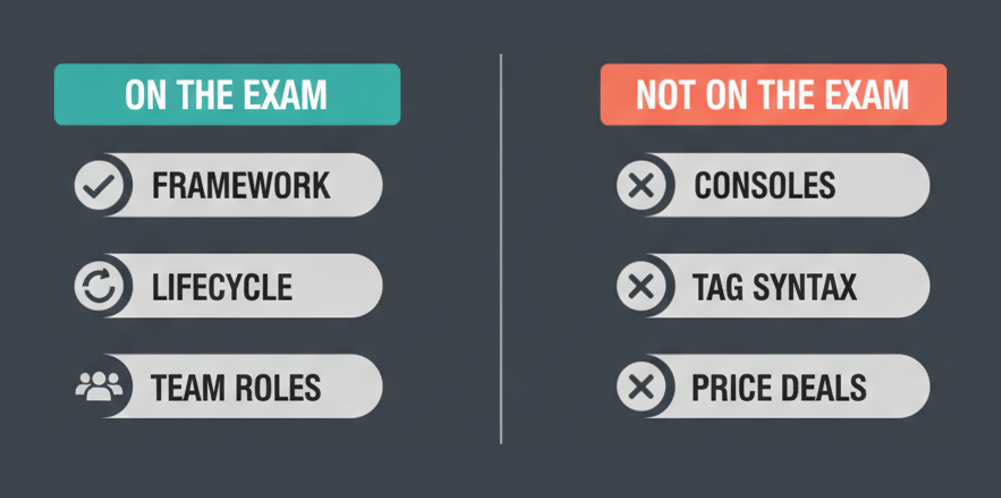
Three specific things people revise unnecessarily:
- Provider specific discount mechanisms and their commercial terms, which vary by provider and are not what the questions are about
- Tagging syntax and policy enforcement mechanics, as opposed to the reason allocation matters
- Deep unit economics mathematics, when the exam wants you to recognise the concept and where it sits in the lifecycle
The inverse is also true. Engineers routinely underestimate the finance side of the Terminology and the Cloud Bill domain, which is only 10 percent but is also the domain where a technical candidate is most likely to lose every question in it.
Three attempts in twelve months changes how you prepare
The purchase buys three attempts within twelve months, which is unusually generous and worth planning around rather than ignoring. The rational strategy is not to treat attempt one as disposable, but it does mean a genuine first attempt is far cheaper than on an exam where a retake is another full fee.
What that structure supports is a diagnostic first sitting. If you are within reach of the material, sitting the exam early gives you the strongest possible signal about which of the six domains is weak, and you still hold two attempts and most of a year. On a single attempt exam that would be reckless. Here it is a legitimate tactic.
The counterweight is that no score breakdown by domain is promised, so the diagnostic value comes from your own sense of which questions felt unfamiliar. Write down the topics that surprised you the moment you finish, because that recollection fades within an hour.
How long does the credential last?
The FinOps Certified Practitioner certification is valid for 24 months from the date you pass. The Foundation states this alongside the exam details, together with the certificate and Credly badge you receive immediately on passing.
Two years is short by certification standards, and it is deliberate. FinOps as a discipline has changed substantially in that timeframe, with new capability areas and a shifting emphasis toward software and AI spend rather than infrastructure alone. A credential that outlived those changes would not mean much.
Plan the renewal as a genuine refresh rather than an administrative one, and if you are mapping out the wider programme, our earlier FOCP exam preparation resources cover the study material side in more depth than this format guide does.
How should a cloud engineer prepare for FOCP?
A cloud engineer preparing for FOCP needs roughly three weeks of evenings, weighted heavily toward the two large domains and toward the finance vocabulary that engineering roles rarely use. The sequence below front loads the 58 percent and leaves the small domains until the material is familiar.
- Read the FinOps Framework end to end first, so the vocabulary is in place before any domain revision begins
- Spend the largest block on Capabilities and Lifecycle together, mapping each capability to the lifecycle phase where it is performed
- Work through the finance side of Terminology and the Cloud Bill next, because it is the domain where a technical candidate loses whole questions
- Cover Principles, Teams and Challenge of Cloud last, since they are context domains worth 32 percent combined and largely comprehension rather than recall
- Sit full length timed sets until you finish inside 60 minutes with a margin, then use your first official attempt as a real one
Two practical notes. Map every capability to a lifecycle phase explicitly, on paper, because a large share of the 58 percent sits precisely at that join. And do the reading in the Foundation’s own words, since the exam uses the published taxonomy rather than paraphrases of it.
Who actually benefits from a FinOps certification?
FOCP pays off most clearly for people who sit between two functions and need shared language to work across them. Cloud engineers who keep being asked to justify spend, finance analysts who have inherited a cloud bill nobody can explain, and platform leads standing up a cost practice from nothing all get concrete value from a common taxonomy.
It is a weaker investment for two groups. Deep infrastructure specialists with no organisational remit will find most of the syllabus describes meetings they do not attend. And anyone hoping the credential alone will create a FinOps role in an organisation that has not decided it wants one will be disappointed, because the certification describes a practice rather than a job title.
Where it does land, it lands quickly, because the discipline is young enough that a shared vocabulary is genuinely scarce. If you are assembling a broader cloud and containers credential set around it, the wider Linux Foundation certification programme covers the adjacent engineering credentials that pair naturally with a cost practice.
Frequently Asked Questions
How many questions are on the FOCP exam?
Fifty multiple choice questions within a 60 minute limit. The FinOps Foundation publishes both figures on its own exam page, and the money site syllabus page gives the same numbers.
What is the passing score for the FinOps Certified Practitioner exam?
Seventy five percent, which works out at 38 correct answers from 50. That leaves a margin of 12 wrong answers, which is tighter than most practitioner level credentials.
How much does the FinOps certification cost?
The standalone certification exam is $325 USD. That purchase includes three attempts within twelve months of the purchase date, and bundles that add course materials or further credentials are priced separately.
Is the FOCP exam proctored?
No. The FinOps Foundation states explicitly that you are not proctored while taking the exam. The 60 minute time limit still applies, so there is no practical time to look answers up.
How long is the FinOps Certified Practitioner certification valid?
Twenty four months from the date you pass. The discipline changes quickly enough that the renewal is a genuine refresh rather than an administrative formality.
Which FOCP domain carries the most marks?
FinOps Lifecycle at 30 percent, closely followed by FinOps Capabilities at 28 percent. Together those two domains carry 58 percent of the paper, or roughly 29 of the 50 questions.
Do you need cloud engineering experience to pass FOCP?
No. The exam tests the FinOps Framework rather than any provider’s console or tooling, so finance and business candidates are within reach. What they do need is comfort with basic cloud terminology, which is its own 10 percent domain.
Who awards the FinOps Certified Practitioner credential?
The FinOps Foundation, which sits under the Linux Foundation umbrella. That is why the credential often appears in Linux Foundation cloud and containers listings even though the Foundation writes and delivers the exam itself.
Can you retake the FOCP exam if you fail?
Yes. The purchase includes three attempts, and all three must be used within twelve months of the purchase date. After that window a new purchase is required.
Is FOCP tied to AWS, Azure or Google Cloud?
No. It is deliberately provider neutral. Nothing in the six domains depends on one billing console, one pricing model or one discount mechanism, which is what makes the credential portable across employers.
Conclusion
FOCP is a short, provider neutral exam with an unusually forgiving purchase structure and an unusually demanding pass mark. Fifty questions, 60 minutes, 75 percent, $325 USD for three attempts inside a year, and a credential that expires after 24 months.
The preparation decision is settled by the weighting table rather than by instinct. Lifecycle and Capabilities are 58 percent of the paper and deserve more than half the study time; Challenge of Cloud is 8 percent and deserves an evening. Read the Framework in the Foundation’s own words, map every capability to the lifecycle phase where it happens, give the finance vocabulary genuine attention if you come from engineering, and then use the first of your three attempts as a real one.


