A pass mark of 860 out of 1000 sounds brutal until you notice the scale starts at 300, not at zero. That single detail reframes the whole exam, and it is the kind of thing a candidate discovers on results day rather than while planning.
NetSec-Analyst is Palo Alto Networks’ Specialist tier credential for the people who actually build and maintain firewall configuration: 60 questions, 90 minutes, four weighted domains, and a syllabus that puts 60 percent of the marks into object and policy creation before it asks about anything else.
Table of Contents
- What is the network security analyst certification?
- Specialist sits above Professional in Palo Alto’s scheme
- How is the NetSec-Analyst exam delivered and scored?
- What does 860 on a 300 to 1000 scale actually mean?
- How are the four domains weighted?
- Why do objects and policies carry 60 percent between them?
- Strata Cloud Manager is a quarter of the exam on its own
- What does the troubleshooting domain actually ask?
- Who is this certification written for?
- How should you prepare for NetSec-Analyst?
- Frequently Asked Questions
- Conclusion
What is the network security analyst certification?
The network security analyst certification is Palo Alto Networks’ credential for analysts and firewall administrators, formally the Palo Alto Networks Certified Network Security Analyst and coded NetSec-Analyst. It validates object configuration, policy creation, and centralised management through Strata Cloud Manager, and it adds the ability to improve security posture and troubleshoot a configured environment.
What distinguishes it from the engineer level credentials in the same platform is the work it describes. An engineer exam asks how a firewall is deployed and integrated. This one asks what you put into it day after day: which security profile, which decryption policy, which external dynamic list, and which centralised object structure keeps all of that manageable across a fleet. Analysts who spend more time tracing slow applications than writing policy may find the ZDX administrator credential a closer match to their day.
Palo Alto’s own Network Security Analyst certification page names a wide target audience for it: network security analysts, firewall administrators, network engineers, security engineers, professional services consultants and technical support engineers. That breadth is accurate rather than marketing. The tasks in the syllabus are done by all of those roles.
Specialist sits above Professional in Palo Alto’s scheme
Palo Alto Networks runs four certification levels, and they are not ordered the way most vendors order theirs. The sequence is Foundational, then Professional, then Specialist, then Architect. NetSec-Analyst is a Specialist credential, which puts it above the Network Security Professional exam rather than below it.
The logic behind it is product depth rather than seniority. Palo Alto describes Professional as validating operations and management across a platform, and Specialist as validating the deployment, operation and management of a product. So Specialist is narrower and deeper, not junior.
Within the Network Security platform, the Specialist tier holds four exams: Network Security Analyst, Next-Generation Firewall Engineer, SD-WAN Engineer and Security Service Edge Engineer. They share a tier and test almost entirely different things, so the tier label tells you very little about which one to sit.
How is the NetSec-Analyst exam delivered and scored?
NetSec-Analyst is 60 questions in 90 minutes, priced at $250 USD, delivered through Pearson VUE, and scored on a scale of 300 to 1000 with 860 required to pass. Palo Alto publishes the level, platform, objectives and target audience on its certification page but keeps the numeric specifications in a downloadable datasheet, so the figures here come from the money site’s published syllabus.
| Field | Value |
|---|---|
| Credential name | Palo Alto Networks Certified Network Security Analyst |
| Exam code | NetSec-Analyst |
| Level | Specialist |
| Platform | Network Security |
| Questions | 60 |
| Duration | 90 minutes |
| Scoring | Scaled 300 to 1000, with 860 to pass |
| Price | $250 USD |
| Delivery | Pearson VUE |
| Domains | Four, all weighted |
Ninety minutes across 60 questions is 90 seconds each, which is comfortable for a configuration exam. The time pressure on this paper is low; the precision pressure is high, because most wrong answers are plausible configurations that solve a slightly different problem. Running a NetSec-Analyst practice test broken down by domain is the fastest way to see whether your errors are knowledge gaps or reading errors.
What does 860 on a 300 to 1000 scale actually mean?
The scale runs from 300 to 1000, not from 0 to 1000, so the usable range is 700 points wide and 860 sits 560 points into it. That is roughly 80 percent of the way up the usable scale rather than 86 percent of everything, which is a meaningfully different proposition.
Two things follow from a scaled score of this kind. The first is that it does not convert into a fixed number of correct answers, because items are weighted by difficulty and calibrated across forms. Anyone who tells you 860 means exactly 52 of 60 is guessing. The second is that there is no partial credit to plan around and no domain level score to learn from, so an even standard across all four domains is worth more than a peak in one.
Practically, treat it as a demanding bar and prepare to be comfortable rather than borderline. On a 60 item paper there is very little room for the handful of questions everybody gets wrong.
How are the four domains weighted?
NetSec-Analyst has four domains and publishes a weighting against each. Object Configuration Creation and Application and Policy Creation and Application are 30 percent apiece, Management and Operations is 26 percent, and Troubleshooting is 14 percent.
| Domain | Objectives | Weight |
|---|---|---|
| Object Configuration Creation and Application | Create and apply security profiles and security profile groups; decryption profiles; external dynamic lists; custom objects such as URL categories, signatures and data patterns; Log Forwarding profiles; data security profiles; internet of things security profiles; DoS protection profiles; SD-WAN profiles and templates | 30% |
| Policy Creation and Application | Create and apply Security policies using App-ID, User-ID and Content-ID; NAT policies; decryption policies; application override policies; Policy Based Forwarding policies; SD-WAN routing and service-level agreement policies | 30% |
| Management and Operations | Use a centralized management system including Strata Cloud Manager, folders and snippets, automations and variables, and Strata Logging Service; use Command Center, Activity Insights and Policy Optimizer to improve security posture; use Log Viewer and the Incidents and Alerts page to remediate incidents and alerts | 26% |
| Troubleshooting | Troubleshoot misconfigurations across all management and on-box options; troubleshoot runtime and commit or push errors; troubleshoot device usage and health | 14% |
On a 60 item paper that is roughly 18, 18, 16 and 8 questions. The distribution is deliberate: three quarters of the exam is about making things, and the remaining quarter is about noticing when they are wrong.
Why do objects and policies carry 60 percent between them?
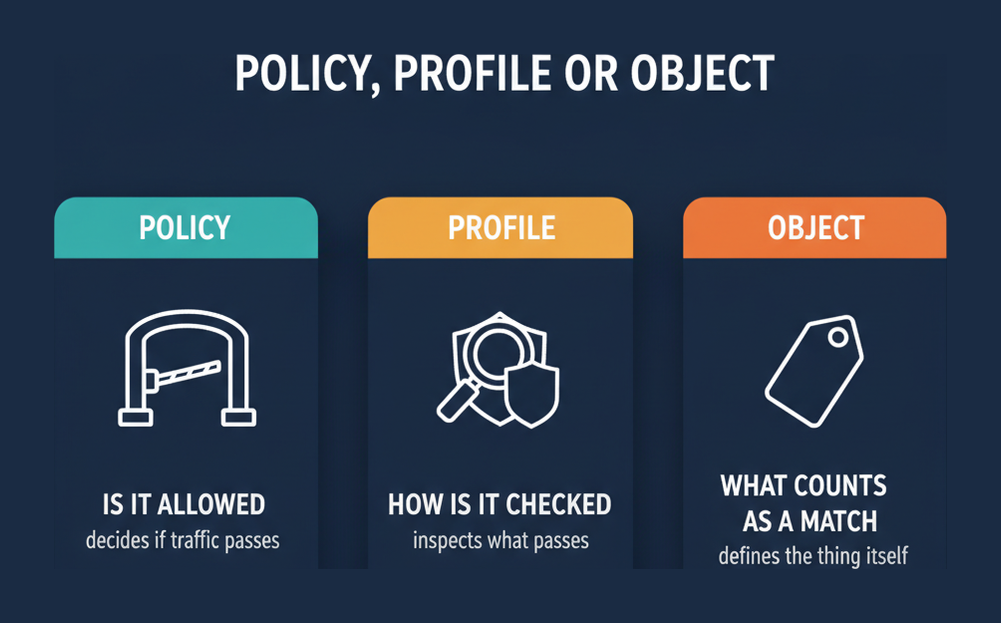
Objects and policies are 60 percent because on this platform they are the entire mechanism of enforcement. A policy decides what is allowed; an object decides what the policy inspects it with. Neither is useful alone, and the exam tests them as two halves of one skill rather than as separate topics.
The object domain is the broader of the two. Nine distinct object families appear in it, from security profile groups and decryption profiles through external dynamic lists to IoT security profiles, DoS protection profiles and SD-WAN templates. That breadth is the difficulty: each family has its own application rules, and a question typically describes a requirement and asks which object family answers it.
The distinction most candidates get wrong
A recurring question shape gives you a requirement that could plausibly be met by a profile, by a custom object or by a policy, and asks which is correct. The reliable way through it is to ask what is being decided. If the answer is whether traffic is permitted at all, it is a policy. If the answer is how permitted traffic is inspected, it is a profile. If the answer is what counts as a match, it is a custom object.
Application override policies and Policy Based Forwarding are the two policy types that catch out candidates from a pure firewall background, because both change how the platform treats traffic rather than whether it passes. Those two deserve deliberate time.
Strata Cloud Manager is a quarter of the exam on its own
Management and Operations is 26 percent, and it is built almost entirely around Strata Cloud Manager and Strata Logging Service. The objectives name folders and snippets, automations and variables, Command Center, Activity Insights, Policy Optimizer, Log Viewer and the Incidents and Alerts page.
Folders and snippets are the concept to settle first. They are how configuration is organised and reused across a fleet in a cloud managed model, and they behave differently from the device group and template structure that Panorama users will expect. A candidate whose entire experience is on-box or Panorama managed will find this domain unfamiliar in a way the other three are not.
Policy Optimizer and Activity Insights sit under the posture improvement objective, and this is where the exam moves from configuration to judgement. Vendor neutral posture frameworks such as the CIS Benchmarks describe the same underlying idea of measuring a configuration against a known good standard, which makes the platform specific tooling easier to reason about.
What does the troubleshooting domain actually ask?
Troubleshooting is 14 percent, roughly eight questions, and its three objectives are narrower than the name suggests: misconfigurations across management and on-box options, runtime and commit or push errors, and device usage and health.
The commit and push objective is the one to read carefully. In a centrally managed estate a change can be valid locally and fail on push, or succeed on push and behave unexpectedly because of where it sat in the folder hierarchy. Questions in this area usually describe an error at commit or push time and ask what caused it, which is a different skill from diagnosing traffic that is not flowing.
The incident and alert remediation work sits in Management and Operations rather than here, which is worth knowing when you are planning revision. If you are strengthening the detection and response side alongside this, our guide to the XSIAM Analyst certification covers the security operations platform where that work properly lives. Frameworks such as MITRE ATT&CK give the vendor neutral vocabulary for the adversary behaviour those alerts describe.
Who is this certification written for?
Palo Alto names six roles explicitly: network security analysts, firewall administrators, network engineers, security engineers, professional services consultants and technical support engineers. What unites them is responsibility for configuration rather than for design, and that is the honest test of fit.
Two groups should think twice. Architects and designers will find the exam asks for a level of configuration detail their role does not touch, and the Architect tier credential is the better match. Security operations analysts whose work is alerts and investigations rather than firewall policy will recognise perhaps a quarter of the syllabus.
The natural neighbour in the same Specialist tier is the firewall engineering credential, which covers deployment and platform integration where this one covers what you configure once the platform is in place. Our walkthrough of the NGFW Engineer exam domains sets out that division in detail, and the two together cover most of what a firewall team does.
How should you prepare for NetSec-Analyst?
This is a configuration exam, so preparation has to be hands-on in a lab where you can create objects and watch policies take effect. Four to six weeks is realistic for someone administering Palo Alto firewalls already; a candidate new to Strata Cloud Manager should add two weeks for that domain alone.
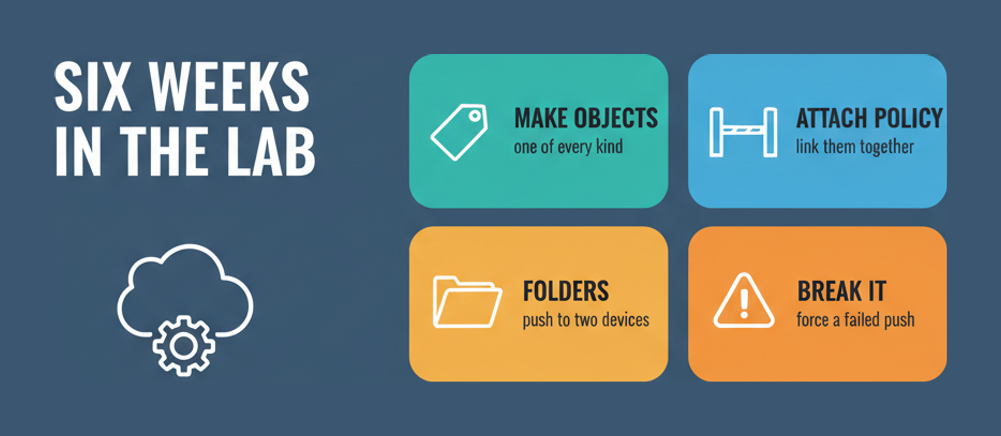
- Start with the object families, creating at least one of every type named in the syllabus so that security profiles, decryption profiles, external dynamic lists and custom objects are concrete rather than remembered
- Move to policies next, building Security, NAT and decryption policies against the objects you just created, so the dependency between the two domains is experiential
- Add the two policy types people skip, application override and Policy Based Forwarding, and observe how each changes the treatment of traffic that would otherwise pass unchanged
- Spend a dedicated block on Strata Cloud Manager, building a folder and snippet structure and pushing the same configuration to more than one device
- Run Policy Optimizer and Command Center against that estate, so the posture improvement objective is something you have used rather than read about
- Finish by breaking things deliberately, forcing commit and push failures and device health issues, then sit timed sets until 60 questions in 90 minutes is routine
The highest value single exercise is step four. Folders and snippets are the concept that separates candidates who have used Strata Cloud Manager from candidates who have read about it, and a quarter of the exam sits on top of it.
Frequently Asked Questions
How many questions are on the NetSec-Analyst exam?
Sixty questions within 90 minutes, according to the money site’s published syllabus. Palo Alto keeps the numeric specifications in a downloadable datasheet rather than on its web page, so this is not an officially rendered figure.
What is the passing score for the network security analyst certification?
Eight hundred and sixty on a scale that runs from 300 to 1000. Because the scale starts at 300 rather than zero, 860 is roughly 80 percent of the way up the usable range, and it does not convert into a fixed number of correct answers.
How much does the NetSec-Analyst exam cost?
$250 USD, with registration through Pearson VUE.
What level is the Network Security Analyst certification?
Specialist. In Palo Alto’s scheme that sits above Professional, because Specialist means narrower and deeper product knowledge rather than a more junior credential.
Which NetSec-Analyst domain carries the most marks?
Two domains tie at 30 percent each: Object Configuration Creation and Application, and Policy Creation and Application. Management and Operations follows at 26 percent and Troubleshooting at 14 percent.
Does the exam require Strata Cloud Manager experience?
Effectively, yes. The Management and Operations domain is 26 percent of the paper and is built around Strata Cloud Manager and Strata Logging Service, including folders, snippets, automations and variables. Panorama experience does not transfer cleanly.
Is there a prerequisite for NetSec-Analyst?
Palo Alto publishes no prerequisite certification for it on its certification page. The recommended route is to review the datasheet topics and then work through the digital learning path.
What is the difference between NetSec-Analyst and the NGFW Engineer exam?
Both are Specialist tier credentials on the Network Security platform, but they test different work. This one covers what you configure once the platform is in place; the engineer credential covers deploying and integrating the platform itself.
Does the exam cover SD-WAN?
Yes, in two places. SD-WAN profiles and templates appear in the object domain, and SD-WAN routing and service-level agreement policies appear in the policy domain.
How much of the exam is troubleshooting?
Fourteen percent, roughly eight questions, covering misconfigurations across management and on-box options, runtime and commit or push errors, and device usage and health. Incident and alert remediation sits in a different domain.
Conclusion
NetSec-Analyst is a configuration exam with an unusually demanding bar: 60 questions, 90 minutes, $250 USD, and 860 on a scale that starts at 300. Four domains weighted 30, 30, 26 and 14 percent put three quarters of the marks on building things correctly and the rest on spotting when they are not.
Prepare in a lab rather than a book, and give Strata Cloud Manager the block of time its 26 percent deserves, because folders and snippets are where Panorama experience stops helping. Build every object family the syllabus names, attach policies to them, then break the estate on purpose. The exam is less about knowing what a feature is than about knowing which of three defensible configurations the described requirement actually calls for.


