Read the syllabus in order and the first thing a MySQL database developer is asked about is not a query. It is which connector to choose, how to configure it, and how to keep its credentials safe. The SQL arrives in the second topic area.
The Oracle MySQL developer certification, exam code 1Z0-909, awards the MySQL 8.0 Database Developer Oracle Certified Professional credential. It runs to 65 questions in 90 minutes at a 62 percent pass mark, across seven topic areas and 31 objectives that reach from connector configuration to document-store access.
Table of Contents
- What is the Oracle MySQL developer certification?
- Why does the syllabus start with connectors rather than SQL?
- What do the seven topic areas cover?
- How is the 1Z0-909 exam delivered and scored?
- The document store is a whole topic area
- Transactions and locking are developer work here
- Is 1Z0-909 the same as the MySQL administrator exam?
- How should an application developer prepare?
- Frequently Asked Questions
- Conclusion
What is the Oracle MySQL developer certification?
The Oracle MySQL developer certification is the professional-level credential for people who build applications against MySQL rather than operate the server. Exam 1Z0-909 awards the title MySQL 8.0 Database Developer Oracle Certified Professional, and it covers connectors, application data access, schema objects, transactions, query optimisation, stored programs and the document store.
Professional is the level, not associate, and Oracle’s own framing on the syllabus page is that the questions test the ability to apply knowledge gained in hands-on practice or professional experience. That is the standard Oracle language for an exam written around work rather than around reading.
The version matters and is worth stating plainly. This is the 8.0 line, and there is no higher-numbered MySQL developer exam in circulation. Residual search demand still exists for the retired 5.7 administrator credential, which is a reliable sign that the 8.0 pair is the current generation rather than a superseded one.
What the credential is not is a database administration qualification with a developer label on it. There is a separate exam for that, and the difference is covered later in this article.
Why does the syllabus start with connectors rather than SQL?
Connectors and APIs is the first of seven topic areas, and it contains five objectives before a single SQL statement appears on the syllabus. The reason is that this exam is written from the application’s point of view: before you query anything, something in your code has to open a connection, authenticate, and handle what comes back.
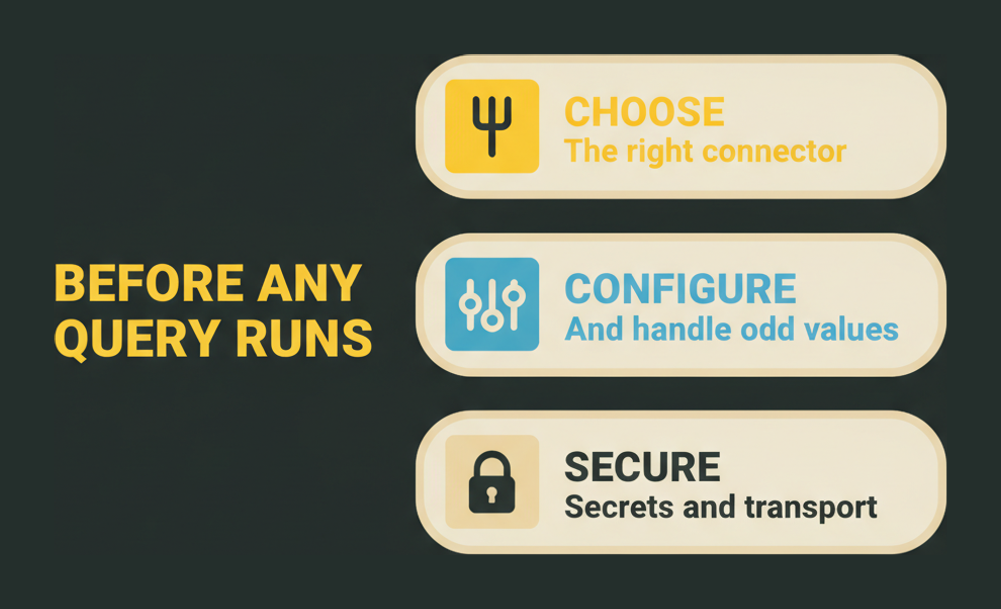
The five objectives are specific about what that involves. Choosing between connectors for a given application. Demonstrating connector use, management and configuration. Retrieving data through a connector. Handling special values. Securing credentials and connections.
Two of those are easy to under-prepare. Handling special values means knowing what a null, a zero date or an out-of-range value becomes on the way from the server into your language’s type system, which differs between connectors. Securing credentials and connections is about where the secret lives and whether the transport is protected, and it is the kind of objective that reads as obvious and tests as specific.
The ordering is a useful signal for planning. A candidate who has only ever written queries in a client tool has not met the first topic area at all, and the fastest way to establish that is to work items rather than to read the list. The sets on the money site’s 1Z0-909 practice exam span all seven areas, so an unfamiliar area surfaces in the first sitting rather than on exam day.
What do the seven topic areas cover?
The seven areas are Connectors and APIs, Data-driven Applications, MySQL Schema Objects and Data, Transactions, Query Optimization, MySQL Stored Programs, and JSON and Document Store. Oracle publishes no percentage weighting for any of them, so the planning unit is the objective rather than the domain and every area has to be treated as examinable.
| Topic area | Objectives | What it really asks |
|---|---|---|
| Connectors and APIs | 5 | Choosing, configuring and securing the connection your application uses |
| Data-driven Applications | 6 | Prepared statements, SQL modes, error and warning handling, aggregation, report generation |
| MySQL Schema Objects and Data | 5 | Views, and storing and processing string, numeric, temporal and spatial data |
| Transactions | 4 | Transaction control in SQL and in code, isolation levels, locking |
| Query Optimization | 3 | Indexes, analysing a query, rewriting a query |
| MySQL Stored Programs | 4 | Stored routines, programming constructs, triggers, scheduled operations |
| JSON and Document Store | 5 | JSON documents, XDevAPI, NoSQL-style development, MySQL Shell |
Counting objectives rather than percentages gives a rough proxy for effort. Data-driven Applications is the largest area at six objectives, and Connectors, Schema Objects and the document store follow at five each. Query Optimization is the smallest at three, which is surprising for a developer exam and worth not over-investing in.
Spatial data deserves a mention because it hides inside a broader objective. The schema area asks you to store and process string, numeric, temporal and spatial data, and spatial types are the one most application developers have never touched. It is one objective among 31, but it is the one most likely to be a complete blank.
How is the 1Z0-909 exam delivered and scored?
1Z0-909 is a 65 question multiple choice exam with a 90 minute limit and a 62 percent pass mark, priced at USD $245 with regional variation. That works out at 83 seconds per question and 41 correct answers to pass, leaving a margin of 24.
| Field | Value |
|---|---|
| Credential awarded | MySQL 8.0 Database Developer Oracle Certified Professional |
| Exam code | 1Z0-909 |
| Level | Professional |
| Questions | 65 |
| Format | Multiple choice |
| Duration | 90 minutes |
| Passing score | 62 percent |
| Price | USD $245, varies by country and currency |
| Topic areas | 7, none weighted |
| Objectives | 31 |
| Product version | MySQL 8.0 |
A 62 percent bar with a 24 question margin is one of the more forgiving arrangements in the Oracle catalogue, and it changes the risk calculation. You can be genuinely weak in one topic area and still pass comfortably. You cannot be weak in two, because the smallest areas are three to five objectives each and two of them together can spend most of that margin.
Eighty three seconds a question is brisk for a paper that includes code reading. Questions that show a stored routine, a trigger body or a connector configuration take longer than a definition question, so bank time early rather than assuming the average holds.
One note on sourcing. Every figure above is published on the money site’s syllabus page for this exam. Oracle’s certification portal returns an error to automated retrieval and its learning site renders in the browser rather than serving readable content, so none of these could be re-confirmed against Oracle directly at the time of writing.
The document store is a whole topic area
JSON and Document Store is one of seven topic areas and carries five objectives: creating and storing JSON documents, processing data inside them, explaining application development with NoSQL and XDevAPI, creating and accessing a document store, and using MySQL Shell to reach it. For a candidate who thinks of MySQL as a relational database, this is the least familiar part of the paper.
Two different things sit in one area
The first is the JSON data type, which is relational MySQL storing a document in a column and giving you functions to query inside it. Oracle’s own JSON data type reference covers validation, path expressions and the operators involved, and most developers who have used MySQL recently have met at least part of it.
The second is the document store itself, reached through XDevAPI and MySQL Shell, where collections behave like a document database rather than like tables. That is a genuinely different programming model, and the objective that asks you to explain NoSQL-style development is testing whether you understand the trade-off rather than the syntax.
Why the specification is worth twenty minutes
Questions about JSON storage often turn on what is and is not legal in a document rather than on MySQL’s functions. Reading the JSON interchange format specification is a short job and it settles the edge cases: duplicate keys, number precision, and what counts as a valid top-level value. Those are exactly the details a well-written question hangs on.
MySQL Shell is named explicitly in the objectives, which means the exam expects familiarity with the tool rather than just the concept. Installing it and creating a collection takes an afternoon and removes an entire category of uncertainty.
Transactions and locking are developer work here
The Transactions area has four objectives and two of them describe work many developers assume belongs to a database administrator: resolving consistency problems with isolation levels, and understanding locking mechanisms within MySQL. On this exam they are developer responsibilities, because the application is where a transaction is opened and where a deadlock surfaces.
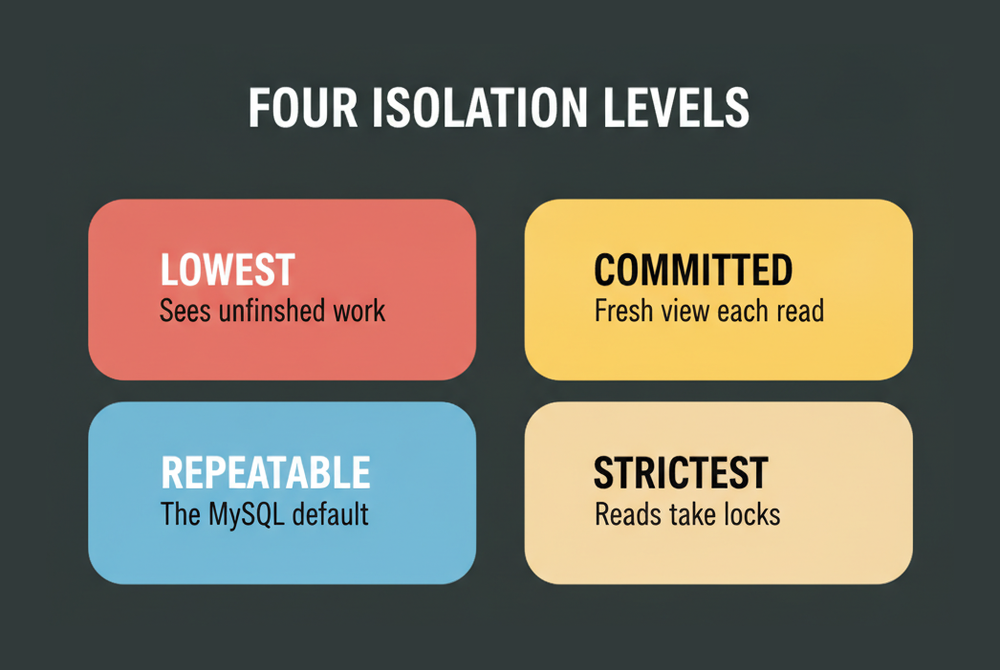
The isolation level objective is the one to study properly rather than skim. InnoDB offers four levels and the differences between them are only visible when two sessions interleave, which is not something you notice while writing single-threaded code.
- Read uncommitted, where a session can see another session’s uncommitted changes.
- Read committed, where each statement sees a fresh snapshot.
- Repeatable read, InnoDB’s default, where the snapshot is fixed at the first read in the transaction.
- Serializable, where reads become locking reads and concurrency drops accordingly.
Oracle’s InnoDB isolation level documentation sets out exactly what each level permits, and the anomalies it describes are the raw material for scenario questions in this area.
The split between controlling transactions in SQL and controlling them in an application is a second thing worth rehearsing. A connector’s autocommit behaviour, and whether a framework is opening transactions on your behalf, changes what a given block of code actually does, and the exam asks about both sides.
Is 1Z0-909 the same as the MySQL administrator exam?
No. Oracle publishes two MySQL 8.0 professional credentials: the developer exam, 1Z0-909, and the administrator exam, 1Z0-908. They share the product and very little else. The developer exam is written from inside an application, and the administrator exam is written from inside the server.
| Comparison point | 1Z0-909 Developer | 1Z0-908 Administrator |
|---|---|---|
| Point of view | The application connecting to MySQL | The server MySQL runs on |
| Opening topic | Connectors and APIs | Installation and configuration |
| Typical daily work | Writing queries, routines and application data access | Backup, replication, security, monitoring, tuning the instance |
| Document store | A full topic area | Not a developer-style topic area |
| Who it suits | Application and backend developers | Database administrators and platform engineers |
Search behaviour shows the confusion is real. Administrator-shaped queries carry far more volume than developer-shaped ones, so a developer searching for MySQL certification information lands on administrator material first and comes away with the wrong picture of what 1Z0-909 asks.
If you already hold an Oracle database developer credential the transfer is partial rather than complete. The PL/SQL developer credential shares the stored-program and optimisation instincts but sits on a different engine with a different procedural language, so the habits carry and the syntax does not.
For a reader deciding between the MySQL line and the Oracle Database line entirely, the Autonomous AI Database exam shows how differently Oracle structures its flagship database credentials, which is a useful contrast before committing to either path.
How should an application developer prepare?
Start with the two topic areas that sit outside normal application work, because they are where a competent MySQL developer is most likely to be genuinely blank. The sequence below moves from unfamiliar to familiar rather than following the syllabus order.
- Audit your experience against all 31 objectives and mark each one as done in anger, read about, or never seen, since there are no weightings to prioritise by.
- Build a small application against MySQL through a connector you have not used before, configuring it deliberately rather than accepting defaults.
- Deliberately return a null, a zero date and an out-of-range value through that connector and see what your language makes of each.
- Install MySQL Shell, create a collection, and write and read documents through XDevAPI so the document store stops being theoretical.
- Store a JSON column in a relational table as well, and query inside it, so the two halves of that topic area stay separate in your head.
- Open two sessions and reproduce a consistency anomaly at each InnoDB isolation level in turn, because reading about them does not stick.
- Write a stored routine, a trigger and a scheduled event, since those are three separate objectives and each has its own syntax quirks.
- Spend an hour on spatial types, which is one objective and the most common complete blank on this paper.
- Finish with timed sets of 65 questions in 90 minutes, checking that no single topic area is dragging you below the 62 percent line.
The audit in step one matters more than its position suggests. With no published weightings there is nothing to optimise against except your own gaps, and the people who fail this exam usually fail it on one area they never opened rather than on a thin understanding spread evenly.
For anyone who wants to look at the engine itself rather than the documentation, the official MySQL Server repository is public, and reading how a feature is implemented is occasionally the fastest way to understand behaviour the manual describes only at a high level.
Frequently Asked Questions
How many questions are on the 1Z0-909 exam?
Sixty five multiple choice questions with a 90 minute limit, which is 83 seconds each. Questions that show routine or connector code take longer than that average, so pace matters.
What is the passing score for the MySQL developer exam?
Sixty two percent, which means 41 correct answers out of 65 and a margin of 24. That is relatively forgiving by Oracle standards, but two weak topic areas will still spend most of it.
How much does 1Z0-909 cost?
USD $245 as published, with pricing varying by country and by localised currency. Training is separate and optional.
Does Oracle publish weightings for the MySQL developer topics?
No. Seven topic areas are published with 31 objectives between them and no percentage attached to any area. Planning has to be built on covering every objective rather than on concentrating where the marks sit.
What is the difference between 1Z0-909 and 1Z0-908?
1Z0-909 is the developer exam and 1Z0-908 is the administrator exam. The developer paper is written from inside an application, covering connectors, application data access and the document store. The administrator paper is written from inside the server.
Do you need to know the MySQL document store?
Yes. JSON and Document Store is one of the seven topic areas and carries five objectives, including XDevAPI and MySQL Shell by name. It cannot be skipped on the grounds that your own applications are purely relational.
How much SQL tuning does the exam cover?
Less than most candidates expect. Query Optimization is the smallest topic area at three objectives, covering indexes, analysing a query and rewriting one. It is worth solid rather than deep preparation.
Is there a MySQL 9 version of this certification?
Not in the current catalogue. The 8.0 developer and administrator exams are the live MySQL pair, and older 5.7 credentials are retired even though search demand for them persists.
Does the exam cover spatial data?
Yes, as part of the schema objects area, alongside string, numeric and temporal data. It is one objective out of 31, and it is the one most application developers have never touched.
Can I verify these figures on Oracle’s own site?
Not readily. Oracle’s certification portal returns an error to automated retrieval and its learning site renders in the browser rather than serving readable content, so published syllabus pages are the practical reference for exam specifications.
Conclusion
The useful way to read 1Z0-909 is by what it assumes rather than by what it lists. It assumes you connect to MySQL from code, that you own the transaction boundaries in that code, and that you have at least looked at the document store. None of those is a given for a developer who writes good SQL.
Everything familiar on this syllabus, the queries, the views, the routines, is the part you will cover fastest. The exam is decided by connectors, the document store and isolation levels, and those are the three to schedule first rather than last.
Once your own gaps are mapped across the 31 objectives, timed practice spanning all seven topic areas is the quickest way to see which of them is still costing you marks.


