There are two Genesys workforce management certifications, their names differ by three words, and they cost exactly the same. Book the wrong one and you will spend 580 dollars proving competence in a product your employer does not run. The catalogues list them one under the other and neither name makes the distinction obvious.
The Genesys workforce management certification you want depends on your platform. GCX-WFM covers Genesys Cloud CX and is 60 questions in 120 minutes at a 65 percent pass mark. GEOP-WFM covers Genesys Engage on-premises and is 45 questions in the same 120 minutes at 70 percent.
Table of Contents
- GCX-WFM or GEOP-WFM: which one is yours?
- What does the GCX-WFM exam look like?
- What do the five GCX-WFM sections cover?
- Why forecasting is the section that separates candidates
- What scheduling and time-off management really asks for
- What does the adherence section actually test?
- Who should take GCX-WFM?
- How should you prepare without published weightings?
- Frequently Asked Questions
- Conclusion
GCX-WFM or GEOP-WFM: which one is yours?
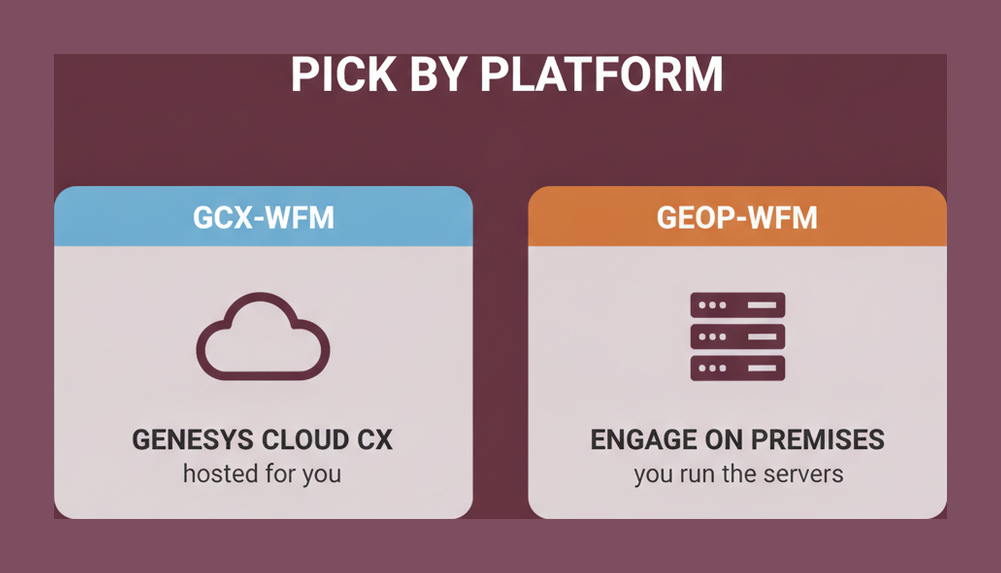
GCX-WFM is the Genesys Cloud CX workforce management credential and GEOP-WFM is the Genesys Engage on-premises one. They are not tiers of the same qualification and neither is a prerequisite for the other. The right choice is decided entirely by which platform your contact centre runs, not by which exam looks more impressive.
| Field | GCX-WFM | GEOP-WFM |
|---|---|---|
| Platform | Genesys Cloud CX | Genesys Engage on-premises |
| Questions | 60 | 45 |
| Duration | 120 minutes | 120 minutes |
| Passing score | 65 percent | 70 percent |
| Price | USD 580 | USD 580 |
| Delivered by | Kryterion Webassessor | Kryterion Webassessor |
| Recommended course | Genesys Cloud: WEM – Workforce Management | Genesys Engage on-premises Workforce Management – Operation |
The syllabuses diverge more than the summary suggests. GEOP-WFM opens with an architecture section covering workforce management servers, the WFM database, web clients and integration with the CIM platform. Nothing equivalent exists in the cloud syllabus, because in Genesys Cloud those components are somebody else’s problem.
That is the real distinction. The on-premises exam asks you to understand and operate a system you host; the cloud exam assumes the system is simply there and asks whether you can run workforce management inside it. Practitioners who have worked through an Engage on-premises credential will recognise how much of that architecture layer the cloud exams drop.
What does the GCX-WFM exam look like?
GCX-WFM is 60 questions in 120 minutes with a 65 percent pass mark, priced at USD 580 and delivered through Kryterion Webassessor. Sixty-five percent of 60 is 39 correct answers, and two minutes a question is among the more generous allowances in the certification field.
| Field | Value |
|---|---|
| Exam name | Genesys Cloud CX Workforce Management Certification |
| Exam code | GCX-WFM |
| Questions | 60 |
| Duration | 120 minutes |
| Passing score | 65 percent, which is 39 correct answers |
| Price | USD 580 |
| Delivered by | Kryterion Webassessor |
| Recommended training | Genesys Cloud: WEM – Workforce Management |
| Sections | 5, with no published weightings |
One caveat belongs here rather than buried at the end. Genesys publishes its certification catalogue through a portal that renders entirely in the browser and returns no readable specification to anything but a human with a screen, so the figures above come from the money site’s syllabus page rather than from a vendor page that could be checked against it. No validity period or recertification rule is stated in this article, because no readable source publishes one.
If you want the section list alongside the exam terms, the money site’s GCX-WFM certification page sets the two out together.
What do the five GCX-WFM sections cover?
GCX-WFM has five sections and no published percentage weightings: workforce management overview and configuration, work plans and work plan rotations, forecasting, scheduling and time-off management, and real-time and historical adherence. Every objective is written as something you do in the product rather than as a concept you know.
That phrasing is the most useful signal available in the absence of weightings. The objective list reads like a task inventory, naming Add a business unit, Manage a management unit, Add a service goal template, Configure activity codes and dozens more in the same shape. These are the titles of articles in the product documentation, which tells you exactly where the questions come from.
| Section | What it asks you to be able to do |
|---|---|
| Overview and configuration | Set up business units and management units, assign agents to management units and planning groups, configure service goal templates and activity codes, and understand WFM permissions and divisions |
| Work plans and rotations | Build work plans with daily shifts and shift activities, assign agents to plans and rotations, validate configurations, and run work plan bids |
| Forecasting | Import historical data, build and edit forecasts in the Forecast Editor, use continuous forecasting, and export a forecast into scheduling |
| Scheduling and time off | Generate forecast-based and blank schedules, edit and publish them, swap shifts, manage staffing groups, and run time-off limits, plans, requests and trades |
| Real-time and historical adherence | Read the Real-Time Adherence view, monitor agents, interpret historical adherence data, and use intraday monitoring |
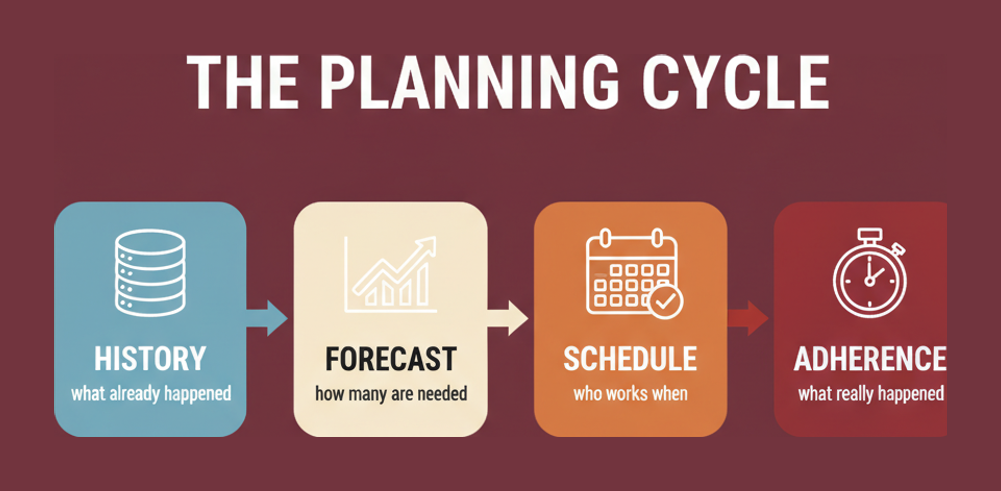
Read as a whole the five sections describe one continuous cycle rather than five subjects, which is how the exam treats them too. Configuration defines who can be scheduled, forecasting says how many are needed, scheduling produces the roster, and adherence measures whether reality matched it.
Why forecasting is the section that separates candidates
Forecasting is the section where product knowledge stops being enough. Configuring a management unit is a clerical task once you know where the screen is; producing a forecast that survives contact with a real week requires judgement about seasonality, trend, and which historical data deserves to be trusted.
The objectives name the mechanics: importing historical data, managing forecast source data, the Forecast Editor itself, continuous forecasting, and exporting a forecast into the scheduling workflow. What they do not say, and what the exam expects you to understand anyway, is why a forecast built on contaminated history produces a schedule that is confidently wrong.
Continuous forecasting is the modern part
Traditional forecasting produces a number for a period and leaves it there. Continuous forecasting keeps revising as new data arrives, which narrows the gap between what was planned and what actually happened. It is named as its own objective, which is a reliable sign it appears in the question set rather than sitting in the background.
The mathematics underneath
Contact centre staffing sits on a body of queueing theory that long predates any of these products. The Erlang unit of traffic is where the relationship between arrival rate, handling time and required agents comes from, and a WFM specialist who understands it reads a forecast differently from one who only knows which button generates it.
The exam does not test the mathematics directly. It tests decisions that only make sense if you have some grasp of it, which is a more demanding thing to prepare for.
What scheduling and time-off management really asks for
The scheduling section is the largest by objective count, and it splits into two halves that feel quite different. The first half is generating and publishing schedules from a forecast. The second half is the human machinery around them: time-off limits, time-off plans, request approvals, shift trades and staffing groups.
The second half is where candidates from a pure analytics background lose ground. Configuring a time-off limit is not difficult, but knowing what a limit does when three agents request the same week, and how that interacts with a published schedule, requires having watched it happen.
Blank schedules are a real exam topic
The objectives distinguish between forecast-based and blank schedules, and the distinction matters operationally. A blank schedule gives you a structure with no generated assignments, which is what you want when the forecast is not trustworthy or when a period is genuinely exceptional. Knowing when to reach for one is a judgement question.
Genesys Tempo appears by name
The mobile application is named in the objectives for time-off and schedule access, which means it is in scope rather than a footnote. Anyone preparing purely from the desktop administrative interface will meet a question they have no basis for answering. The Genesys Cloud workforce management documentation is the fastest way to close that kind of gap, since the objective names map onto its article titles almost one to one.
What does the adherence section actually test?
Real-time and historical adherence is the shortest section by objective count and the one with the most operational weight behind it. It covers the Real-Time Adherence view, monitoring agents against their schedules, interpreting historical adherence data and its configuration, and using intraday monitoring to react to staffing changes as they happen.
Adherence is the point where workforce management stops being a planning exercise and becomes a supervisory one. A schedule is a prediction; adherence is the measurement of how the day actually went, and intraday monitoring is the mechanism for doing something about it before the day is lost.
Historical adherence needs configuring, not just reading
The objective says configuration explicitly. Historical adherence depends on how activity codes were set up several steps earlier, which is why the first section of the syllabus matters more than its clerical tone suggests. An activity code mapped carelessly produces adherence figures that are precisely wrong, and the exam connects those two ends of the syllabus deliberately.
Who should take GCX-WFM?
GCX-WFM suits a workforce management analyst, a contact centre resource planner, a supervisor with scheduling responsibility, or a Genesys Cloud administrator whose remit has grown to include WFM. It is not a general Genesys Cloud credential and it assumes you already know your way around the platform.
The career case is reasonably specific. Workforce management is a recognised speciality with its own job title rather than a task bolted onto an operations role, and published WFM analyst salary data shows a band wide enough that platform-specific proof of competence is worth having.
If you are new to Genesys Cloud entirely
Start elsewhere. The platform-wide professional credential establishes the vocabulary and the navigation this exam takes for granted, and Genesys Cloud CX Professional route is the usual on-ramp. Arriving at GCX-WFM without that grounding means learning two things at once under a 39-mark pass line.
The wider certification picture
Genesys publishes its own WFM certification view, which is worth reading for how the vendor positions the speciality even though it is promotional in tone. It makes clear that workforce management is being treated as a career track rather than a product module, which is the context this credential sits in.
How should you prepare without published weightings?
No weightings are published for GCX-WFM, so there is no marks-based way to prioritise. The alternative is to prepare along the operational cycle, because the syllabus is written as one, and to spend your time where the objectives name the most distinct tasks.
- Confirm which platform you are being examined on before anything else, since the cloud and on-premises credentials share a name and a price but not a syllabus.
- Build a business unit and a management unit in a practice environment, then assign agents and planning groups to them, because every later section depends on that structure existing.
- Configure activity codes deliberately and think about how each one will appear in adherence reporting later, which is the connection the exam draws between the first section and the last.
- Create a work plan with real daily shifts and shift activities, then run a work plan bid, as bids are named separately in the objectives and are easy to skip.
- Import historical data and build a forecast in the Forecast Editor, then rebuild it after deliberately corrupting part of the history to see what the output does.
- Generate both a forecast-based schedule and a blank one, publish them, and work through the difference in what each leaves you to do by hand.
- Run the full time-off cycle from limits and plans through requests, approvals and a shift trade, since the human machinery is the half candidates under-prepare.
- Spend a working day with the Real-Time Adherence view open and use intraday monitoring against a live schedule, which is the only way the last section becomes intuitive.
Use the recommended course as a checklist
The money site names the Genesys Cloud WEM workforce management course as the recommended training, and its module list is effectively the syllabus in delivery order. Even if you do not take it, the outline is a useful way to check that nothing in your own preparation has been left out.
Frequently Asked Questions
What is the difference between GCX-WFM and GEOP-WFM?
GCX-WFM covers Genesys Cloud CX and GEOP-WFM covers Genesys Engage on-premises. They are separate credentials for separate platforms, not tiers of the same one.
How many questions are on the GCX-WFM exam?
Sixty questions in 120 minutes, which is two minutes each. The on-premises equivalent has 45 in the same time.
What is the passing score for GCX-WFM?
Sixty-five percent, which works out at 39 correct answers out of 60. GEOP-WFM sets a higher bar at 70 percent.
What does GCX-WFM cost?
USD 580, the same as the on-premises credential. It is delivered through Kryterion Webassessor.
Are the GCX-WFM sections weighted?
No percentage weightings are published for any of the five sections, so there is no marks-based way to prioritise. Prepare along the operational cycle instead.
How long is GCX-WFM valid?
No validity period or recertification rule is published on any readable source, so none is asserted here. Confirm it with Genesys before assuming the credential is permanent.
Do you need another Genesys certification first?
No prerequisite is published. In practice the platform-wide professional credential is a sensible starting point, because GCX-WFM assumes familiarity with Genesys Cloud navigation and vocabulary.
Does GCX-WFM cover the Genesys Tempo mobile app?
Yes. It is named in the scheduling and time-off objectives for mobile schedule and time-off access, so desktop-only preparation leaves a gap.
Is forecasting the hardest part of the exam?
For most candidates, yes. Configuration and scheduling are learnable from the product; forecasting rewards judgement about data quality and seasonality that only comes from having built one.
How long does preparation usually take?
Four to eight weeks alongside a job, most of it spent inside a practice environment rather than reading, because every objective is phrased as a task rather than a concept.
Conclusion
The first decision on this credential is not how to study, it is which of two similarly named exams belongs to your platform. GCX-WFM is the Genesys Cloud CX one: 60 questions, 120 minutes, 39 marks to pass, 580 dollars, five sections and no published weightings.
Prepare along the cycle the syllabus describes, from configuration through forecasting and scheduling to adherence, and do it in a practice environment rather than on paper, because every objective is written as a task. Give forecasting more time than its objective count suggests, and do not skip the mobile application or the work plan bids.
And treat the published figures as what they are. The vendor’s own catalogue cannot be read by anything but a person with a browser, so confirm the exam terms with Genesys directly before booking.


