There is not a single tool in this syllabus. No Jenkins, no Kubernetes, no Terraform, no cloud provider, no pipeline product of any kind. An advanced DevOps exam that names no technology sounds like a contradiction until you read what it does name: flow, feedback, and continual learning, weighted as if the organisation were the system under test.
The EXIN DevOps Professional certification, exam code DEVOPSP, is 40 multiple choice questions in 90 minutes at a 65 percent pass mark, priced at 295 USD and booked through EXIN. Five domains carry it, and the largest of them, at 30 percent, is feedback.
Table of Contents
- Why does an advanced DevOps exam name no tools?
- What are the DEVOPSP exam facts?
- How do the Three Ways shape the blueprint?
- What does the First Way of flow cover?
- Why is feedback the biggest domain?
- Which two domains do candidates skip?
- Foundation, Professional or Master?
- Who should take this exam?
- How should you prepare?
- Frequently Asked Questions
- Conclusion
Why does an advanced DevOps exam name no tools?
Because EXIN built the blueprint around the Three Ways rather than around a toolchain. The domains are named DevOps adoption, the First Way of flow, the Second Way of feedback, the Third Way of continual learning and experimentation, and information security and change management. Every one describes how work moves through an organisation, not what software moves it.
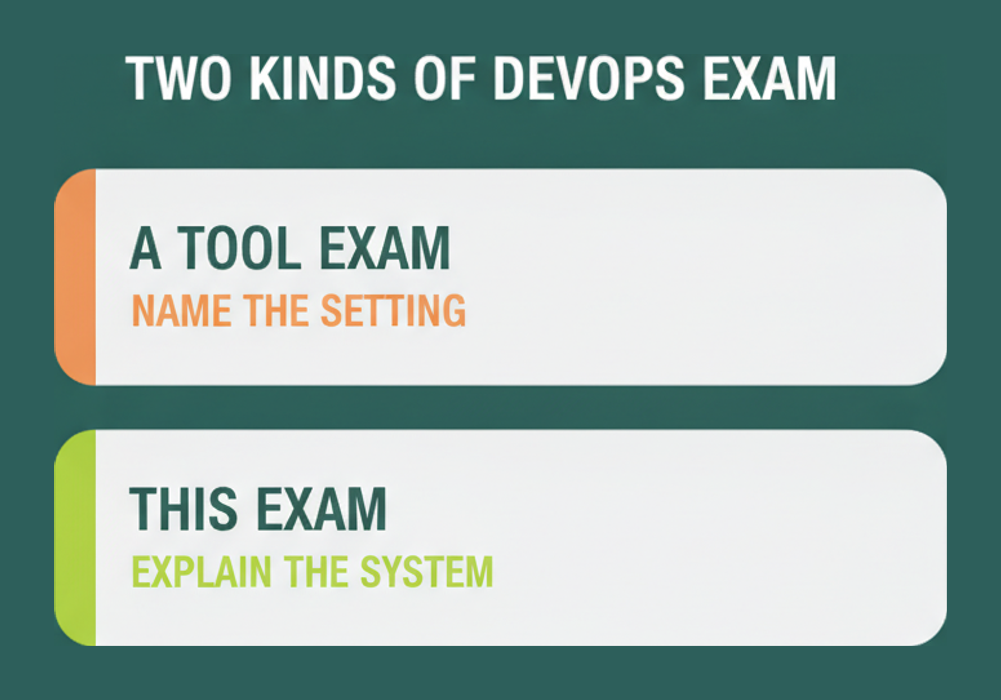
That choice has a practical consequence for candidates. A tool-based exam ages the moment a vendor renames a product, and it rewards whoever has used that product most recently. A principle-based exam stays current for years and rewards whoever has watched delivery actually improve or fail somewhere, which is a different kind of experience and harder to cram.
It also changes what a wrong answer looks like. In a tool exam, wrong means you picked the incorrect flag. Here, wrong usually means you optimised the part instead of the whole: speeding up a deployment step while the queue in front of it grows, or adding a control that makes change safer and slower without measuring either.
What are the DEVOPSP exam facts?
DEVOPSP is 40 multiple choice questions in 90 minutes with a 65 percent pass mark, which means 26 correct answers. It costs 295 USD, is booked through EXIN rather than a test centre network, and is classified by EXIN at Advanced level rather than foundation.
| Field | Value |
|---|---|
| Credential | EXIN DevOps Professional |
| Exam code | DEVOPSP |
| Questions | 40, multiple choice |
| Duration | 90 minutes |
| Pass mark | 65 percent, so 26 of 40 |
| Fee | 295 USD |
| Level | Advanced |
| Open book | No |
| Electronic equipment | Not allowed |
| ECTS credits | 3 |
| Languages | English, Chinese, Japanese, Portuguese |
Every one of those figures except the fee is published by EXIN itself, and the duration, question count and pass mark match the exam catalogue exactly. The closed-book rule is worth noting early: this is a reasoning exam with no reference material, so the vocabulary has to be in your head rather than in a tab.
Two and a quarter minutes per question is comfortable for recall and tight for a scenario you have to reason through, which is what most of these are. Working through items in the exam’s own format is the cheapest way to find out which domains slow you down, and a DEVOPSP practice test will surface that faster than re-reading the syllabus.
How do the Three Ways shape the blueprint?
The Three Ways are the organising idea of modern DevOps literature: improve the flow of work from development to operations, amplify feedback from right to left, and build a culture of continual learning and experimentation. EXIN maps three of its five domains directly onto them, which makes the exam’s priorities unusually legible.
| Domain | Weight | Roughly how many of 40 questions |
|---|---|---|
| DevOps adoption | 12.5% | 5 |
| The First Way: flow | 25% | 10 |
| The Second Way: feedback | 30% | 12 |
| The Third Way: continual learning and experimentation | 20% | 8 |
| Information security and change management | 12.5% | 5 |
Notice what that ordering does. Feedback outweighs flow, which is the opposite of how most teams actually invest: pipelines get built first and telemetry arrives later, if at all. The exam treats that sequence as the common mistake rather than the normal path, and weights accordingly.
The framing comes from the body of DevOps literature published by IT Revolution, which is worth knowing because the exam’s vocabulary is that literature’s vocabulary. Terms such as work in progress, technical debt, lead time and kata appear in the first domain and are used precisely.
What does the First Way of flow cover?
Flow is worth about 10 questions and breaks into four sub-areas with published weights: the deployment pipeline at 12.5 percent of the whole exam, automated testing at 5, continuous integration at 5 and low-risk releases at 2.5. The deployment pipeline alone is therefore half this domain and the single heaviest sub-area on the paper.
What the exam wants here is cause and effect rather than configuration. Why does a large batch size lengthen lead time. Why does an unreliable test suite push teams toward manual verification. Why does trunk-based work reduce merge pain while demanding more discipline. Each of those is a question shape, and none of them requires naming a product.
Low-risk releases, at only 2.5 percent, is the smallest sub-area and still worth reading properly, because the techniques it covers are the ones candidates most often know by a different name than EXIN uses.
Why is feedback the biggest domain?
Feedback is 30 percent of the exam, roughly 12 questions, and splits into telemetry at 7.5 percent, feedback itself at 10, hypothesis-driven development and A/B testing at 5, and review and coordination at 7.5. It is the largest domain and the one that separates a passing candidate from a near miss.
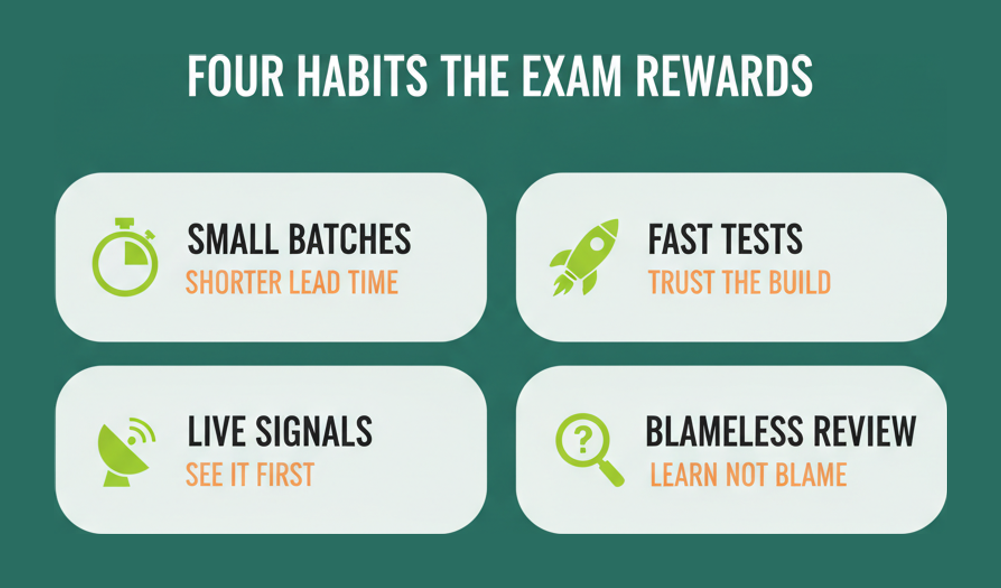
Telemetry questions are about knowing before the customer does: what to instrument, what a useful signal looks like, and why a dashboard nobody reads is not feedback. Review and coordination covers how changes get looked at, which is where peer review, pairing and change advisory processes are compared as feedback mechanisms rather than as governance.
Hypothesis-driven development is the sub-area most often skipped. It asks you to treat a feature as an experiment with a stated expectation and a measurable result, which is a genuinely different habit from shipping and hoping. The delivery research published through the DORA programme is the clearest public grounding for why these measures matter, and it is a useful read even though EXIN does not require it.
Which two domains do candidates skip?
The Third Way, continual learning and experimentation, is 20 percent and divides evenly between learning and discoveries at 10 percent each. It covers blameless retrospectives, the deliberate practice of improvement, and how an organisation turns an incident into something other than blame.
DevOps adoption, at 12.5 percent, is the entry domain: basic concepts including continuous delivery, agile infrastructure, kata, work in progress, technical debt and lead time, then the Three Ways as principles, then how teams and organisations are structured for it. It is five questions of vocabulary and framing, and it is the cheapest domain to secure.
Information security and change management, also 12.5 percent, splits into security at 7.5 percent and change management at 5. Its argument is that security is a shared responsibility built into the pipeline rather than a gate at the end, which is the position set out in the OWASP DevSecOps guideline and codified for software producers in NIST’s secure development framework.
Foundation, Professional or Master?
EXIN runs three DevOps tiers. Foundation introduces the concepts, Professional is this exam at Advanced level, and Master sits above both. Search demand is heaviest on Foundation, which tells you where most candidates start, and the Professional exam assumes the Foundation material rather than repeating it.
The choice is mostly about what you need to do with the credential. Foundation demonstrates literacy and suits people entering the field or adjacent to it. Professional targets people who influence how delivery works: team leads, engineering managers, consultants and senior engineers who are asked why the pipeline is not making things faster.
Anyone weighing this against EXIN’s other credentials will find the scheme consistent in format across its catalogue, and the EXIN Cloud Computing Foundation route shows what the vendor’s foundation tier looks like in practice before you commit to an advanced paper.
Who should take this exam?
DEVOPSP suits engineers and leads who have lived through a delivery transformation, consultants who advise on one, and managers who need a defensible vocabulary for arguing about flow and feedback. EXIN publishes no formal prerequisite, but the Advanced classification is honest about the level.
It is a poor fit for someone looking for a hands-on credential. If your goal is to prove you can build a pipeline, this exam will not test that and a tool-specific certification will. It is equally a poor fit for someone with no exposure to a real delivery organisation, because the scenarios assume you have seen work queue up behind a bottleneck.
For candidates who prefer process credentials generally, the same vendor’s improvement track covers adjacent ground, and the Lean Six Sigma Green Belt shares the measurement mindset that the feedback domain rewards here.
How should you prepare?
Read the Three Ways literature once properly, then study the blueprint’s sub-weightings, because EXIN publishes them and they tell you exactly where the marks are. With 40 questions and a closed book, the goal is fluent vocabulary plus the ability to reason about a delivery system end to end.
- Download EXIN’s preparation guide and sample exam, both published on the credential page, and sit the sample before studying so you know your starting point.
- Give feedback and flow roughly half your time. Together they are 22 of the 40 questions.
- Learn the vocabulary of the adoption domain precisely: work in progress, technical debt, lead time and kata are used in their exact senses.
- For each sub-area, write down one real example from somewhere you have worked. Scenario questions are easier when you have a concrete case to map them onto.
- Practise explaining why a local optimisation can slow the whole system. That idea underlies more questions than any single technique.
- Rehearse under the clock at closed-book conditions, since no reference material is allowed in the exam.
One more thing worth checking before you book: the exam is offered in English, Chinese, Japanese and Portuguese, so a candidate who would rather sit it in one of the latter three does not need to translate the vocabulary twice.
Frequently Asked Questions
How many questions are on the DEVOPSP exam?
Forty multiple choice questions in 90 minutes, confirmed on EXIN’s own page.
What is the pass mark for EXIN DevOps Professional?
Sixty-five percent, which is 26 correct answers out of 40.
How much does the exam cost?
Two hundred and ninety-five US dollars through the exam catalogue. EXIN does not publish a price on the credential page itself, so confirm it when booking.
Is the exam open book?
No. EXIN states plainly that it is closed book and that no electronic equipment is allowed.
What level is this certification?
EXIN classifies it as Advanced, above its Foundation tier and below Master.
Are there prerequisites?
None are published, though the Advanced classification and the blueprint both assume working familiarity with DevOps practice.
Which domain carries the most marks?
The Second Way, feedback, at 30 percent, which is about 12 of the 40 questions.
Does the exam test specific tools?
No. The blueprint names no products at all. It examines flow, feedback, learning, adoption, security and change management as practices.
What languages is the exam available in?
English, Chinese, Japanese and Portuguese.
Does it carry academic credit?
EXIN lists three ECTS credits for this certification.
Conclusion
DEVOPSP is a principles exam wearing an advanced badge. Forty questions, 90 minutes, 65 percent to pass, 295 USD, closed book, and five domains built on the Three Ways rather than on any toolchain.
The weighting is the instruction. Feedback at 30 percent and flow at 25 percent are 22 of the 40 questions, and the exam consistently rewards the candidate who can explain why improving one stage made the whole system slower. Adoption and security are cheap marks by comparison, and worth securing early.
Download EXIN’s preparation guide and sample exam, map each sub-area onto something you have actually watched happen, and rehearse closed book. A syllabus with no tools in it is not an easier exam. It is a different one.


