
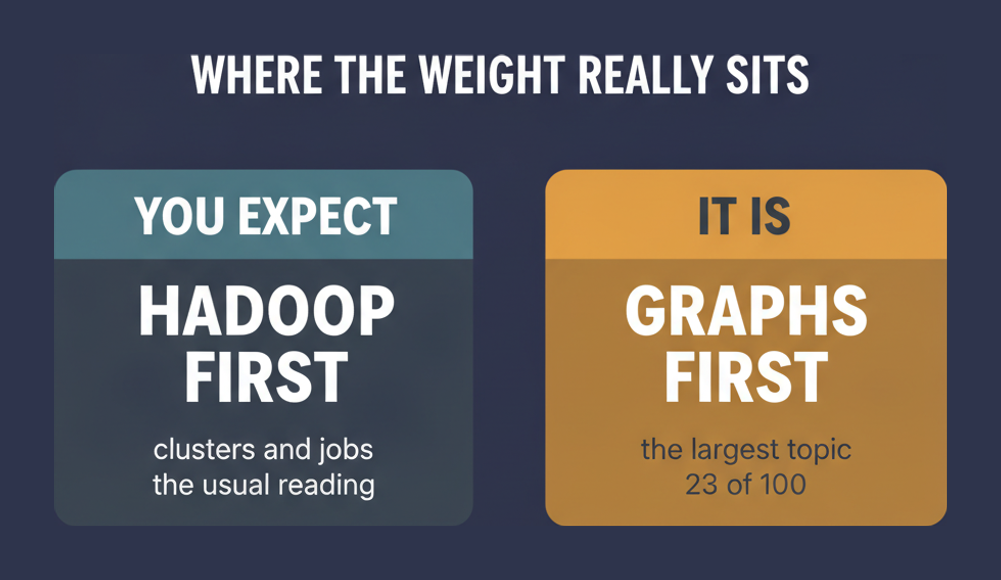
Open any write-up of this exam and you will read about Hadoop. MapReduce, HDFS, Hive, Spark, the familiar list. What almost nobody mentions is that the single largest topic on the paper is not infrastructure at all. It is graph theory.
Social Network Analysis takes 23 percent of the D-AA-OP-23 exam, more than MapReduce and the Hadoop ecosystem put together. For a data science credential that is genuinely unusual, and it changes what preparation should look like for anyone who assumed this was a big-data plumbing paper with some statistics attached.
Table of Contents
- What does D-AA-OP-23 actually weight?
- What are the exam facts, and what does Dell not publish?
- Why is graph theory the biggest topic?
- What does the 20 percent NLP topic cover?
- The Hadoop half, and how current it is
- Theory, methods and visualisation
- How does this compare with the other Dell data exams?
- How do you prepare for a flat blueprint?
- Frequently Asked Questions
- Conclusion
What does D-AA-OP-23 actually weight?
Six topics, all published with weightings, and all of them sit between 12 and 23 percent. There is no dominant block and no trivial one. Social Network Analysis leads at 23 percent, Natural Language Processing follows at 20, and the remaining four split the rest almost evenly.
| Topic | Weight | What it covers |
|---|---|---|
| Social Network Analysis | 23% | SNA and graph theory, communities, network problems and SNA tools |
| Natural Language Processing | 20% | The four main categories of ambiguity, text preprocessing, language modeling |
| MapReduce | 15% | The MapReduce framework in Hadoop, HDFS, YARN |
| Hadoop Ecosystem and NoSQL | 15% | Pig, Hive, NoSQL, HBase, Spark |
| Data Science Theory and Methods | 15% | Simulation, random forests, multinomial logistic regression, maximum entropy |
| Data Visualization | 12% | Perception and visualization, visualization of multivariate data |
A flat distribution is harder to prepare for than a lopsided one, which is the opposite of what most people assume. When one topic carries 40 percent you know where to concentrate. When the smallest topic is still roughly seven questions out of 60, there is nowhere safe to be weak, and the cost of skipping anything is immediate.
It also means the exam resists the usual triage. You cannot decide that visualisation is a minor concern and spend the time on Spark instead, because visualisation is 12 percent and Spark is part of a topic worth 15.
What are the exam facts, and what does Dell not publish?
D-AA-OP-23 is 60 questions in 90 minutes at a 63 percent pass mark, priced at 230 USD and delivered through Pearson VUE. Sixty three percent of 60 is 38 correct answers, which leaves room for 22 wrong ones across six topics.
| Field | Value |
|---|---|
| Exam name | Dell Data Science Optimize |
| Exam code | D-AA-OP-23 |
| Questions | 60 |
| Duration | 90 minutes |
| Passing score | 63 percent, which is 38 correct answers |
| Price | 230 USD |
| Delivery | Pearson VUE |
| Topics | 6, weighted 23, 20, 15, 15, 15 and 12 percent |
Now the honest part. Every figure above comes from the exam catalogue, and none of it could be confirmed a second time against Dell. Dell publishes its official exam description as a PDF rather than a web page, and its certification overview pages return no readable content.
That is not a reason to distrust the numbers, but it is a reason to check them yourself at the point of booking. Treat the table as the catalogue’s account rather than the vendor’s, and confirm the price and duration on the Pearson VUE screen before you pay.
One naming point that catches people out: the code reads like “advanced analytics”, and Dell’s own document filename uses that phrase, but the published exam name is Dell Data Science Optimize. Searching the name and searching the code will not always land you in the same place.
Why is graph theory the biggest topic?
Because Dell built this credential around the analytical problems that relationships create, and relationships are graphs. The topic covers SNA and graph theory, communities, and network problems and the tools that address them, and at 23 percent it is roughly 14 questions.
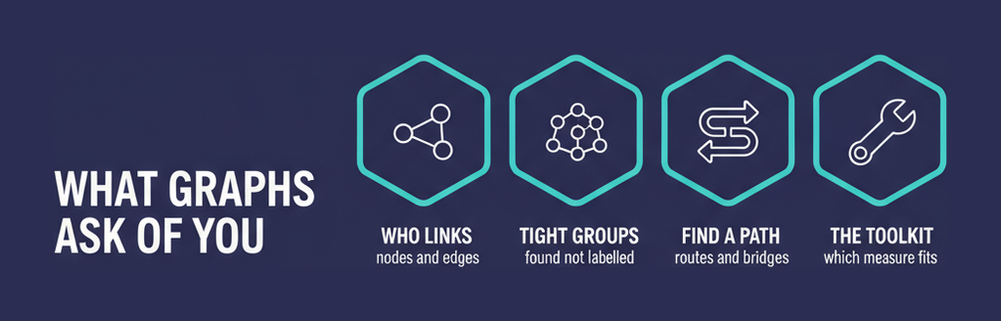
Graph thinking is a genuinely different mode from the tabular reasoning most data science study teaches. A table asks what a row contains; a graph asks what connects to what, how tightly, and which groupings emerge from the connections rather than from a label somebody assigned. Community detection is the clearest example: the groups are discovered from structure, not read from a field.
“Network problems” covers the recognisable tasks: finding the shortest path between two nodes, identifying which nodes are central or influential, spotting bridges whose removal fragments the network, and measuring how tightly clustered a neighbourhood is. Each has a standard measure behind it, and the exam expects you to match the problem to the right one rather than to derive anything.
If this material is unfamiliar, the general reference on social network analysis is a reasonable orientation before you touch exam-specific material, because the vocabulary is the barrier rather than the mathematics.
What does the 20 percent NLP topic cover?
Three objectives: natural language processing and the four main categories of ambiguity, text preprocessing, and language modeling. Twenty percent is around 12 questions, making it the second-largest topic and the other half of the exam’s applied-analytics core.
The ambiguity objective is the one to take literally. The blueprint names four categories, so the exam expects you to distinguish them rather than to discuss ambiguity in general. Lexical ambiguity is a word with more than one meaning; syntactic ambiguity is a sentence that parses more than one way; semantic ambiguity is a reading that remains unclear even once parsed; and pragmatic ambiguity depends on context outside the sentence. Being able to classify an example is exactly the kind of thing a multiple-choice paper can test cleanly.
Text preprocessing is the practical half: tokenisation, normalisation, stop word handling, stemming and lemmatisation. The distinction between stemming and lemmatisation is a standard question because the two produce different outputs for the same input and suit different purposes.
Language modeling completes the topic. Given the vintage of the rest of the blueprint, expect the classical treatment, probability over sequences and n-gram style reasoning, rather than transformer architecture. Prepare for the statistical foundation rather than for current large language model practice.
The Hadoop half, and how current it is
Two topics at 15 percent each, 30 percent together, cover the distributed data stack: the MapReduce framework and its Hadoop implementation, HDFS and YARN in the first; Pig, Hive, NoSQL, HBase and Spark in the second. It is worth being straightforward about what that represents.
This is the classical big-data stack. MapReduce as a programming model and Pig as a scripting layer are no longer how most new analytical workloads are built, and a candidate whose day job is on a modern cloud warehouse may not have touched either. The technologies are stewarded by the Apache Hadoop project and remain in production in many large estates, so the material is real, but it describes an earlier generation of practice.
That matters for two decisions. If you work in a Hadoop estate, 30 percent of this paper is your daily work and the credential is well aimed at you. If you do not, this is 18 questions of unfamiliar ground that you will have to learn deliberately, and you should price that into whether the exam is worth sitting.
The examinable depth is conceptual rather than operational. You are asked what MapReduce does and how it maps onto Hadoop, what HDFS and YARN are responsible for, and which ecosystem component suits which job, rather than to write a job or tune a cluster.
Theory, methods and visualisation
The last two topics take 27 percent between them and are the most conventional part of the paper. Data Science Theory and Methods at 15 percent names simulation, random forests, and multinomial logistic regression with maximum entropy. Data Visualization at 12 percent covers perception and visualization, and visualization of multivariate data.
The statistics topic is unusually specific for a vendor exam. Naming multinomial logistic regression and maximum entropy together is a signal in itself, since the two are closely related formulations of the same idea, and a question that expects you to know they are connected is a different question from one that treats them as separate techniques. Random forests bring ensemble reasoning, and simulation covers generating data to reason about a process you cannot observe directly.
Visualisation is the smallest topic and the one most often dismissed, which is a mistake at 12 percent, roughly seven questions. Note the framing: perception comes first. The objective is about how people read a chart, pre-attentive attributes, and why certain encodings mislead, rather than about which library draws it.
Multivariate visualisation is the more technical half, covering how to show more than two or three dimensions at once without producing something unreadable. It also connects back to the graph topic, since network visualisation is one of the harder multivariate problems on the paper.
How does this compare with the other Dell data exams?
Dell runs several data credentials and they are easy to confuse because the codes look alike. D-AA-OP-23 is the data science Optimize exam. D-DS-FN-23 is the foundations exam, a level below. D-DS-OP-23 is the Optimize exam on the data engineering track, a sibling rather than a successor.
The split matters when choosing. The data engineering track is about building and running the pipelines; this one is about analysing what comes out of them, which is why graph theory, NLP and statistics take 58 percent of it while infrastructure takes 30. A reader who wants the pipeline side should look at the data engineering Optimize route instead.
Foundations against Optimize is a seniority question rather than a subject one. If the topic list here reads as mostly unfamiliar, the foundations exam is the better entry point, and the Optimize paper will still be there afterwards.
There is one more thing worth saying about the family as a whole. The blueprint describes the data scientist role as it was understood before the split into data engineering and machine learning specialisms, which is why one exam spans Hadoop, NLP, graph theory and visualisation. Whether that breadth is a strength depends entirely on the job you are aiming at. An earlier look at the same credential from the career angle is available in the site’s D-AA-OP-23 career guide.
How do you prepare for a flat blueprint?
By covering everything and ranking by unfamiliarity rather than by weight. With no topic above 23 percent and none below 12, the usual tactic of concentrating on the big block does not apply, and the deciding factor becomes which topics you have never worked with.
- Rate yourself honestly against all six topics before planning anything, because the plan follows the gaps rather than the weights.
- Start with Social Network Analysis if graph work is new to you, since it is the largest topic and the one least likely to be covered by your day job.
- Learn the four categories of ambiguity as a classification exercise, with an example of each you came up with yourself.
- Separate stemming from lemmatisation with a worked example, since the distinction is a standard question.
- Cover the Hadoop topics conceptually: what each component is responsible for and which job suits which tool, not how to operate a cluster.
- Connect multinomial logistic regression to maximum entropy rather than learning them as two unrelated techniques.
- Give visualisation one focused session on perception and multivariate encoding, which is enough for 12 percent.
- Work through the D-AA-OP-23 sample questions to see how each topic is actually asked, since the framing varies sharply between them.
One planning note on the margin. Thirty eight correct answers from 60 leaves 22 wrong, which sounds generous until you notice it is spread across six topics. Being genuinely weak in two of them consumes most of that allowance before you have misread a single question elsewhere.
Frequently Asked Questions
How many questions are on the D-AA-OP-23 exam?
Sixty questions in 90 minutes, which is about 90 seconds each.
What is the passing score?
Sixty three percent, which works out at 38 correct answers from 60.
What is the largest topic on the exam?
Social Network Analysis at 23 percent, covering graph theory, communities, and network problems and tools. It is larger than MapReduce and the Hadoop ecosystem combined.
What are the six topics and their weightings?
Social Network Analysis at 23 percent, Natural Language Processing at 20, MapReduce at 15, Hadoop Ecosystem and NoSQL at 15, Data Science Theory and Methods at 15, and Data Visualization at 12.
How much does the exam cost?
Two hundred and thirty US dollars as listed in the exam catalogue. Dell publishes no readable price page, so confirm the figure when you book through Pearson VUE.
Is D-AA-OP-23 the same as D-DS-OP-23?
No. D-AA-OP-23 is the data science Optimize exam and D-DS-OP-23 is the Optimize exam on the data engineering track. They are siblings covering different work, not two versions of one exam.
Does the exam cover modern large language models?
The NLP topic names ambiguity, text preprocessing and language modeling. Given the vintage of the surrounding blueprint, prepare for the classical statistical treatment rather than transformer architecture.
How much Hadoop knowledge do I need?
Thirty percent of the paper is MapReduce and the Hadoop ecosystem, assessed conceptually: what each component does and which suits which job, rather than cluster operations.
How long is the certification valid?
No validity period is published anywhere that can be read, so this guide does not state one. Check your certification record after passing.
Is there an easier Dell data exam to start with?
D-DS-FN-23, the data science foundations exam, sits a level below and is the better entry point if most of this topic list is unfamiliar.
Conclusion
D-AA-OP-23 is a breadth exam with an unexpected centre of gravity. Sixty questions in 90 minutes, 63 percent to pass, 230 USD, and six topics in which graph theory is the largest and visualisation the smallest.
Plan by unfamiliarity rather than by weight, because a flat blueprint offers no safe area to concentrate on. Social Network Analysis and the classical NLP material are where most candidates have the furthest to travel, and the Hadoop half is either your daily work or 18 questions of deliberate study, depending entirely on the estate you work in.
Confirm the figures when you book. Dell publishes its exam description only as a document this kind of check cannot read, so everything above is the catalogue’s account rather than the vendor’s, and the booking screen is where you verify it.


