At ten past nine a finance analyst opens a ticket: the expenses app takes forty seconds to load. The network team says the links are clean. The application team says the servers are idle. The desktop team says the laptop is new. Everyone is probably right about their own part, and the user is still waiting.
That ticket is what ZDXA, the Zscaler Digital Experience Administrator exam, is built around. The Zscaler ZDX certification does not ask you to recite product features. It asks whether you can read a score, judge how many people are affected, follow the path from the device to the application, and say with evidence where the delay sits. This article walks through the 60 questions, the four weighted domains and the skills behind each one.
Table of Contents
- What does the ZDXA exam look like on the day?
- Which four domains does the ZDXA syllabus weight?
- How does the ZDX Score turn a complaint into a number?
- What is the difference between Web Probes and Cloud Path Probes?
- How does ZDX show whose fault the slowdown is?
- What does the 10 percent administration domain cover?
- Who is the Zscaler ZDX certification meant for?
- How should you prepare for ZDXA?
- Frequently Asked Questions
- Conclusion
What does the ZDXA exam look like on the day?
The ZDXA exam has 60 questions in 90 minutes with an 80 percent passing score and a price of 300 USD. It is scheduled through Pearson VUE. The syllabus splits the content into four sections, three of them weighted at 30 percent each and one at 10 percent, so almost all of the marks sit in day to day operations.
| Field | Value |
|---|---|
| Exam name | Zscaler Digital Experience Administrator |
| Exam code | ZDXA |
| Questions | 60 |
| Duration | 90 minutes |
| Passing score | 80 percent |
| Price | 300 USD |
| Scheduling | Pearson VUE |
| Language | English |
| Prerequisites | None that are strict |
Do the arithmetic before you book. Eighty percent of 60 is 48, so you can miss 12 questions and still pass. Ninety minutes across 60 questions is 90 seconds each. That is a comfortable pace for a recall question and a tight one for a scenario that gives you three sets of metrics to compare.
Zscaler prices the exam at 300 USD or one credit per attempt. A failed attempt costs the same again, which is a good reason to treat the 80 percent bar as the real obstacle. Aim to score well above 48 in practice before you pay.
Which four domains does the ZDXA syllabus weight?
The ZDXA syllabus has four sections. Monitoring and Triaging Digital Experience, Operational Configuration and Optimization, and Troubleshooting and Root Cause Analysis each carry 30 percent. Administration and Operational Governance carries 10 percent. On a 60 question paper that is roughly 18 questions for each large section and 6 for the small one.
| Section | Weight | Approximate questions | What it asks you to do |
|---|---|---|---|
| Monitoring and Triaging Digital Experience | 30% | 18 | Read scores and dashboards, judge incident scope, decide who to escalate to |
| Operational Configuration and Optimization | 30% | 18 | Set up applications, probes, hosted monitoring and real user monitoring |
| Troubleshooting and Root Cause Analysis | 30% | 18 | Follow telemetry across device, network and application to a cause |
| Administration and Operational Governance | 10% | 6 | Assign roles, configure alert rules and admin authentication |
The question counts are arithmetic from the published weights, not a published split, so treat them as a planning guide. What matters is the shape. No single section can carry you, and no large section can be skipped. If you lose half the marks in any 30 percent section, you have already used 9 of your 12 misses.
The objectives are also written as verbs. They say explain, interpret, analyze, configure and execute. A good way to see how those verbs become questions is to work through a set of ZDXA sample questions early, before you have studied much. You will notice that many items describe a situation and ask for the next sensible action.
How does the ZDX Score turn a complaint into a number?
The ZDX Score rates digital experience on a scale from 0 to 100. The ZDXA syllabus expects you to explain that the score is derived from the lowest performing metric among Web Probes and Cloud Paths. In other words, the weakest measurement sets the score, so one bad link in the chain is never averaged away.
Why the weakest metric wins
Think about the finance analyst again. Her laptop is healthy and the application servers respond quickly, but her home internet provider is dropping packets. An average would hide that. A score based on the lowest performing metric shows it, because her experience is only as good as the worst part of the journey.
From one score to incident scope
The first objective after the score itself is scope. You are expected to interpret the Performance Dashboard and decide whether a problem affects:
- a single user
- a site
- a region
- most of the organisation
Scope decides the response. One user with a low score points to a device or a home network. A whole site points to the local network or its provider. A widespread drop on one application points to the application or the SaaS vendor. Getting scope right is what stops three teams investigating the same ticket.
What else sits in this domain
The monitoring section also covers how Zscaler Client Connector interacts with the ZDX cloud, comparing applications in the Application view, device health statistics, last mile and intermediate ISP performance, the basics of Copilot, the value of integrations such as call quality monitoring and ServiceNow, and the purpose of the ZDX API.
What is the difference between Web Probes and Cloud Path Probes?
In ZDX, a Web Probe tests the application and a Cloud Path Probe tests the network route to it. Web Probes report on availability and response, such as page fetch and DNS times. Cloud Path Probes report latency and packet loss hop by hop. The ZDXA syllabus asks you to define and differentiate both, along with Hosted Probes.
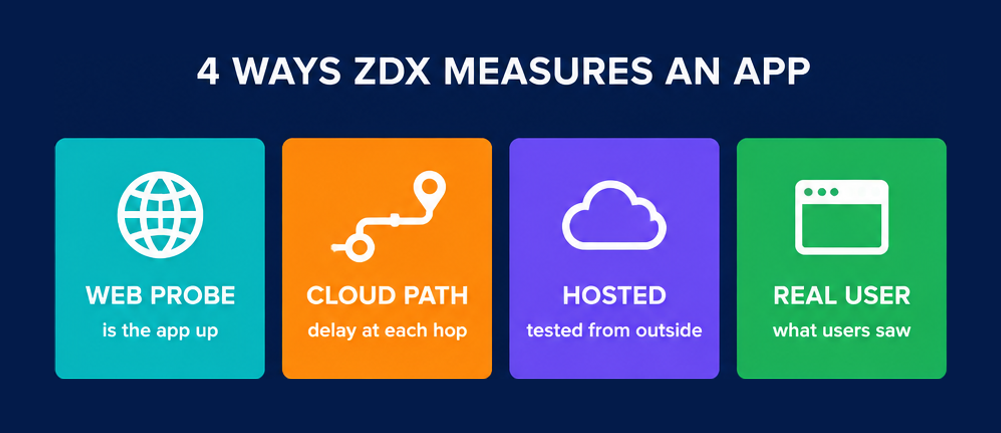
| Probe or method | Runs from | Tells you about | Typical question it answers |
|---|---|---|---|
| Web Probe | The user device | Application availability and response | Is the app itself slow? |
| Cloud Path Probe | The user device | Latency and packet loss at each hop | Where on the route is the delay? |
| Hosted Probe, under Zscaler Managed Monitoring | Zscaler locations around the world | Availability and performance with no user device involved | Is the app down for everyone? |
| Real User Monitoring | The user browser | Performance of real sessions | What did the user actually experience? |
Synthetic tests and real sessions
The first three rows are synthetic. They send a test on a schedule whether or not anyone is working. Real User Monitoring is different, because it records browser based performance metrics from actual sessions. The syllabus wants you to configure both kinds for Predefined Applications and for Custom Applications that you define yourself.
The measurements are older than the product
Nothing about latency or loss is unique to Zscaler. The IETF defined a round-trip delay metric for IP networks in RFC 2681, published in 1999. If you understand what a round trip measures and why a lost packet matters, the Cloud Path view reads like a familiar trace with better labels.
One sample question captures the upkeep side of this domain. It asks why probe configurations need periodic review. The answer is that probes must still reflect where users are and which applications they use. A probe pointed at last year’s application measures nothing useful.
How does ZDX show whose fault the slowdown is?
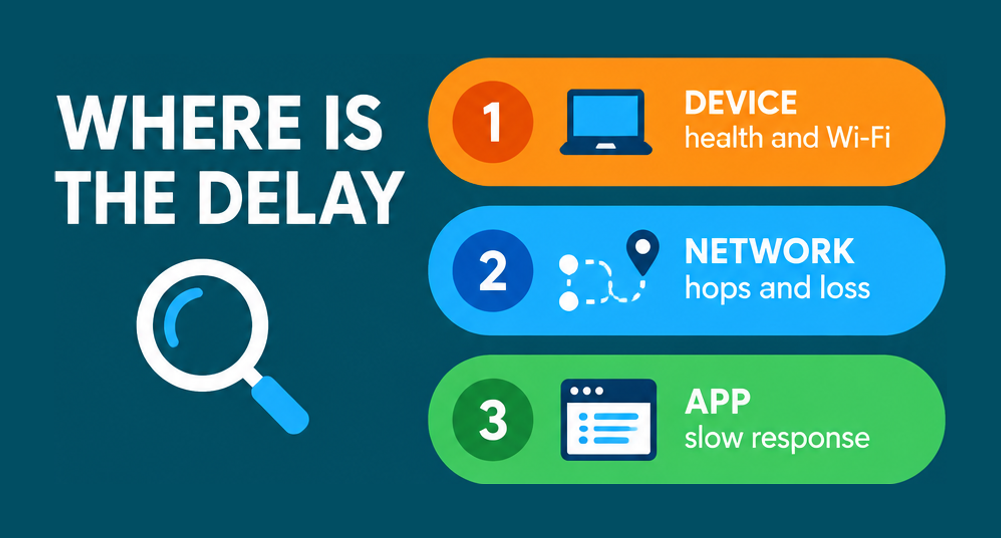
ZDX separates a slow experience into three tiers: the device, the network and the application. The Troubleshooting and Root Cause Analysis section of ZDXA, worth 30 percent, tests whether you can read telemetry from each tier, find the one that is failing, and recommend a remediation or an escalation that the evidence supports.
Reading the three tiers
- Device: health statistics from the laptop, including local Wi-Fi quality.
- Network: path information across every hop, used to find bottlenecks through the entire path.
- Application: response from the service itself.
The logic is elimination. A sample question gives stable network performance with consistently high application response times and asks for the next action. The answer is to escalate to the application owner or the SaaS provider. The network has been cleared by data, so the network team can close its part of the ticket.
Diagnostics, AI and sharing
Beyond the dashboards, the syllabus lists diagnostics session output, Zscaler AI for faster resolution, predefined and customized reports, and organisation wide incident dashboards. It even includes sharing the current state of a page through a shareable URL. That last objective sounds minor, yet it is how evidence reaches another team intact.
Zscaler describes the product in the same terms on its ZDX product overview, which is a useful map of the features the exam names. Customers quoted there talk about time to resolution more than anything else.
“Our remote users are now more productive … ZDX provides full end-to-end visibility…reducing the time it takes to investigate and identify network issues”
The configuration section adds one more remediation skill. You may be asked about running approved remediation or optimization scripts at scale, including prerequisites, permissions and safety considerations, and then validating the outcome.
What does the 10 percent administration domain cover?
Administration and Operational Governance is the smallest ZDXA section at 10 percent, or about 6 of the 60 questions. It covers three tasks: assigning role based access control, configuring alert rules with their notification types, and configuring admin authentication settings for ZDX. It is short, specific and easy to score well on.
Role based access is tested through the principle of giving each person only what the job needs. The syllabus gives its own example: a help desk analyst receives Service Desk access, not Super Admin. Expect a scenario that names a role and asks which level of access fits.
Alert rules are about balance. One sample question asks how alerts should be tuned for proactive monitoring, and the correct answer is to tune thresholds so that sensitivity and noise are balanced. Alerting on every metric buries the real incident. Relying on defaults misses it.
Access control and alerting are common to every platform in this family. If you work with secure access service edge products from more than one vendor, this site’s Fortinet SASE exam article shows how another vendor tests the administrator role.
Who is the Zscaler ZDX certification meant for?
Zscaler designed the Digital Experience Administrator certification for security professionals, network engineers, security engineers and solutions architects. It is the final step in the Zscaler Digital Experience Operationalization learning path, known as EDU 310. There are no strict prerequisites, although Zscaler highly recommends completing that path and its self-guided lab first.
The scope is wider than the name suggests. According to Zscaler, the exam validates an understanding of the zero trust platform and proficiency with ZIA, ZPA and ZDX together. That makes sense in practice. User traffic reaches an application through Zscaler Internet Access or Zscaler Private Access, so you cannot read a path without knowing which service it crosses.
The certification outcomes listed on the Zscaler Academy page are practical ones:
- Understand, describe and configure ZDX components and functions.
- Navigate and analyze the ZDX dashboard, graphs and widgets.
- Pinpoint user experience issues more efficiently.
- Gain a unified view into user experiences in one portal.
In job terms, this suits the person who receives the escalated ticket. That may be a network operations engineer, a service desk lead, or an administrator who already runs a Zscaler tenant and has been asked to add experience monitoring to it.
How should you prepare for ZDXA?
Prepare for ZDXA by following the weights. Spend about 30 percent of your time on each of monitoring, configuration and troubleshooting, and 10 percent on administration. Work through the EDU 310 path and its lab, read the blueprint, then practise scenario questions until you can name the failing tier from the metrics alone.
- Download the blueprint and the study guide from Zscaler, and mark every objective you cannot yet explain aloud.
- Complete the ZDX Operationalization path and the self-guided lab, since hands-on time is what the verbs in the syllabus assume.
- Learn the score first, including why the lowest performing metric sets it and how scope changes the response.
- Configure one Predefined Application and one Custom Application, with a Web Probe and a Cloud Path Probe on each.
- Practise triage on real or lab data by deciding device, network or application before you open the detailed view.
- Finish with roles, alert rules and admin authentication, then sit timed sets of 60 questions in 90 minutes.
Zscaler keeps the registration steps, the practice exam, the exam day rules and the Pearson VUE scheduling guides on its ZDXA exam registration page. Read the rules before you schedule, not on the morning of the exam.
Path analysis is a network skill before it is a product skill. If hop by hop reasoning is new to you, the Palo Alto SD-WAN guide on this site covers path quality from the wide area network side and makes a useful companion read.
Book when your timed scores sit clearly above 48 out of 60. With 12 misses allowed and scenario questions that take longer than 90 seconds, a narrow practice pass is not enough margin.
Frequently Asked Questions
How many questions are on the ZDXA exam?
The ZDXA exam has 60 questions and a 90 minute time limit, which works out at 90 seconds per question.
What is the passing score for ZDXA?
The passing score is 80 percent. On 60 questions that means 48 correct answers, so you can miss 12.
How much does the Zscaler ZDXA exam cost?
The exam costs 300 USD. Zscaler lists the price as 300 USD or one credit per attempt, so a second attempt is charged again.
Are there prerequisites for the Zscaler Digital Experience Administrator exam?
There are no strict prerequisites. Zscaler highly recommends completing the ZDX Operationalization learning path, EDU 310, and its self-guided lab before you attempt the exam.
Which ZDXA domain carries the most weight?
Three domains tie at 30 percent each: monitoring and triage, operational configuration, and troubleshooting with root cause analysis. Administration and governance carries the remaining 10 percent.
What is the ZDX Score?
The ZDX Score is a rating from 0 to 100 for digital experience. The syllabus states it is derived from the lowest performing metric among Web Probes and Cloud Paths.
Where do you take the ZDXA exam?
The exam is scheduled through Pearson VUE. Zscaler publishes an account creation guide and a scheduling guide on its exam page.
Is the ZDXA exam available in languages other than English?
Zscaler lists English as the only available language for the Digital Experience Administrator exam.
Does the ZDXA exam cover ZIA and ZPA as well as ZDX?
Yes. Zscaler says the exam validates an understanding of its zero trust platform and proficiency with ZIA, ZPA and ZDX, because user traffic reaches applications through those services.
Conclusion
The slow expenses app from the opening is not a trick scenario. It is the daily work the Zscaler Digital Experience Administrator exam measures: read the score, set the scope, check the device, follow the path, test the application, and hand the ticket to the team the evidence points to.
The numbers are simple. ZDXA is 60 questions in 90 minutes at an 80 percent passing score for 300 USD, with three domains at 30 percent and one at 10 percent. The balance tells you how to study, because no section is large enough to rescue a weak one.
Start with the blueprint and the lab, build your own probes, and practise naming the failing tier before you look at the answer. When your timed scores hold comfortably above 48, schedule the exam.


