Most Oracle exam pages tell you how much each topic is worth. This one does not. The published syllabus for 1Z0-078 lists thirty topic groups in a flat sequence with no percentages attached to any of them, which leaves candidates guessing at exactly the point where a study plan needs a number.
1Z0-078 is Oracle Database 19c – RAC, ASM, and Grid Infrastructure Administration, and passing it earns Oracle Certified Professional status in that specialism. It is a 120 minute paper of 77 questions at a 65 percent pass mark, and the reason it runs longer than most Oracle exams is that it covers three separate products rather than one. This article sets out what sits inside each of the three, how to plan without weightings, and what Oracle does and does not publish about it.
Table of Contents
- What Does 1Z0-078 Actually Cover?
- What Are the 1Z0-078 Exam Details?
- Why Are There No Topic Weightings?
- What Does the RAC Half of the Blueprint Ask?
- How Much Clusterware and Grid Infrastructure Is Examined?
- What ASM and CloudFS Knowledge Do You Need?
- Is 19c Still the Current RAC Exam?
- How Should You Prepare for 1Z0-078?
- Frequently Asked Questions
- Conclusion
What Does 1Z0-078 Actually Cover?
1Z0-078 covers three products that are normally learned separately: Real Application Clusters, Oracle Clusterware and Grid Infrastructure, and Automatic Storage Management. The syllabus runs to thirty topic groups split across those three areas, and the exam treats them as one body of knowledge because in a real cluster they are inseparable.
| Area | Topic groups | What it is |
|---|---|---|
| Real Application Clusters | 12 | Running one database across several instances, and keeping sessions alive when one fails |
| Grid Infrastructure and Clusterware | 11 | The cluster layer underneath: membership, resources, installation, patching, troubleshooting |
| Automatic Storage Management | 7 | Oracle’s own volume manager and file system, including ACFS and CloudFS |
The practical consequence is that a strong single-instance DBA is perhaps a third of the way prepared. Backup and recovery, initialization parameters and undo tablespaces all appear, but every one of them is asked in its clustered form, where the answer differs from the standalone one. Redo threads per instance, undo tablespaces per instance and RMAN configured for a shared archive destination are the sort of distinction this exam lives on.
What Are the 1Z0-078 Exam Details?
1Z0-078 gives you 120 minutes for 77 multiple choice questions and requires 65 percent to pass. It costs 245 USD, though Oracle notes that pricing varies by country and by localised currency. Passing it awards Oracle Certified Professional, Oracle Database 19c – RAC, ASM, and Grid Infrastructure Administrator.
| Field | Value |
|---|---|
| Exam name | Oracle Database 19c – RAC, ASM, and Grid Infrastructure Administration |
| Exam code | 1Z0-078 |
| Duration | 120 minutes |
| Questions | 77 |
| Passing score | 65 percent |
| Format | Multiple choice |
| Price | USD 245, varying by country |
| Credential earned | Oracle Certified Professional in this specialism |
Those 77 questions in 120 minutes work out at roughly 93 seconds each, which is comfortable for recall items and tight for the scenario questions that describe a cluster behaving oddly and ask for the cause. The 1Z0-078 sample questions are a fair guide to how the longer items are phrased.
One caveat on sourcing. Oracle’s own certification pages could not be read while this article was written: education.oracle.com returns an error with a maintenance notice, and the MyLearn exam pages load their content in the browser rather than serving it, so nothing can be extracted from them. Every figure above therefore comes from the published exam syllabus rather than from a page on Oracle’s site. Treat them as accurate and current, but check Oracle directly before you book if the fee matters to your budget.
Why Are There No Topic Weightings?
The syllabus for 1Z0-078 lists its thirty topic groups without a single percentage. That is unusual for Oracle, whose cloud and application exams normally publish a weight for every domain, and it changes how you have to plan: there is no way to identify a section worth skipping, because no section declares its size.
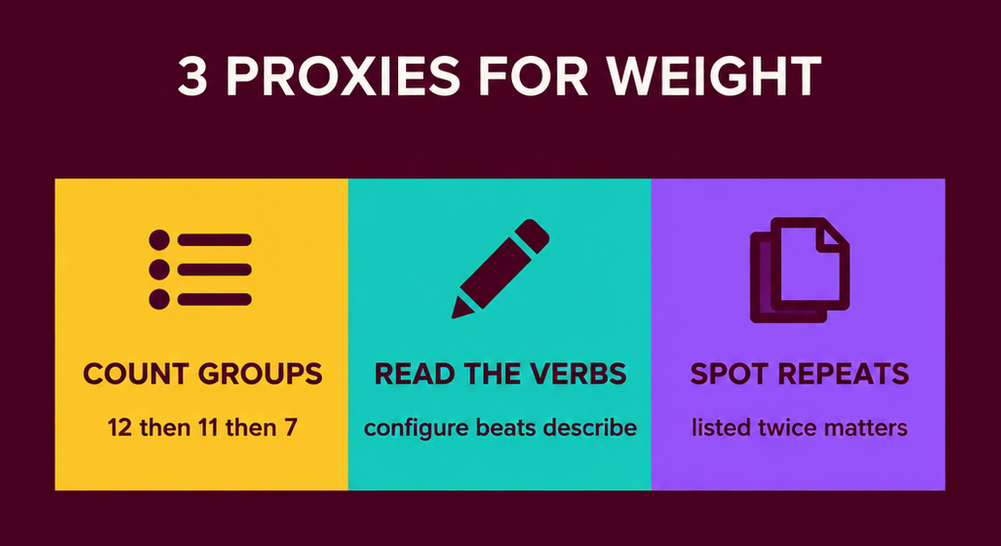
The honest answer is that nobody outside Oracle knows the distribution, and inventing one would be worse than admitting it. What you can use instead is the shape of the syllabus itself. Counting topic groups gives a rough proxy: twelve for RAC, eleven for Grid Infrastructure and Clusterware, seven for ASM. Counting the individual objectives underneath them tilts slightly further toward RAC and Clusterware.
Two other signals are worth more than a guessed percentage. The first is verb choice. The syllabus mixes describe, explain, configure, manage, install and troubleshoot, and the configure and troubleshoot items are the ones that need a cluster to practise on. The second is repetition: patching and upgrading appear twice, once for RAC and once for Grid Infrastructure, and troubleshooting appears as a topic group of its own under Clusterware. Subjects Oracle lists twice are rarely marginal.
What Does the RAC Half of the Blueprint Ask?
The RAC portion is the largest of the three at twelve topic groups. It moves from architecture and installation through day to day administration, then into the areas where clustered databases genuinely differ from standalone ones: global resource coordination, cluster-aware tuning, and keeping client connections alive across an instance failure.
Global resources and cache coordination
This is the conceptual core of RAC and it carries six objectives, more than any other RAC topic group. It covers global concurrency control, global enqueue and instance lock management, the Global Resource Directory, global buffer cache management and the use of affinity to reduce contention. If you have ever wondered what Cache Fusion is actually doing when a block moves between instances, this section is that question examined properly. Oracle’s own RAC administration guide is the reference to work through.
High availability for services and connections
Two topic groups cover this, and together they hold eleven objectives, which makes availability the most heavily specified subject in the RAC half. Services come first: configuring and managing them, service aggregation and tracing, and using services from client applications. Then the connection layer, covering client-side and server-side connect-time load balancing, Transparent Application Failover, the Load Balancing Advisory, Fast Application Notification, Transparent Application Continuity, co-location tags and dynamic services fallback.
Monitoring, tuning and the rest
RAC-specific tuning gets its own group of seven objectives, including AWR and ADDM used in a cluster, RAC-specific wait events and global enqueues, SGA runtime management and the Cluster Database Performance pages. Beyond that the RAC half covers installation and conversion from single instance, redo and undo configuration per instance, RMAN and ARCHIVELOG in a cluster, rolling patches, RAC One Node conversion, Quality of Service Management, and multitenant container and pluggable databases in a clustered environment.
How Much Clusterware and Grid Infrastructure Is Examined?
More than most candidates expect. Grid Infrastructure and Clusterware account for eleven topic groups, only one fewer than RAC itself, and they cover the entire lifecycle of the cluster layer rather than just its concepts. Installation planning, installation, node addition and removal, patching, troubleshooting and application high availability all appear as separate groups.
The opening groups are conceptual: cluster principles and purposes, Grid Plug and Play, hardware best practices, Clusterware architecture and startup sequence, and Flex Clusters including the effect of a node failure. The independent ClusterLabs project is a useful way to see how these ideas look outside Oracle’s implementation, which often makes the Oracle-specific version easier to hold.
From there it becomes operational. Installation planning covers groups and users, system and network requirements and directory creation. The installation group adds ASM disk group configuration and the optional Grid Infrastructure Management Repository. Cluster node management covers the prerequisite steps for extending a cluster, adding nodes with DBCA and deleting a node.
Traditional Clusterware management and policy-based cluster management sit side by side, which is a hint in itself. The traditional group covers daily administration, what-if command evaluation, Oracle Cluster Registry backup and recovery, securing cluster communication and network settings. The policy-based group covers policy sets, server categorisation and activating a policy. Expect to be asked to distinguish administration-managed from policy-managed configurations.
Troubleshooting closes the area out with the Clusterware log file locations, diagcollection.pl, component-level and resource debugging, and OCR file troubleshooting. Zero-downtime patching of Grid Infrastructure appears explicitly in the patching group.
What ASM and CloudFS Knowledge Do You Need?
ASM is the smallest of the three areas at seven topic groups, but it reaches further than storage administrators often assume, because two of those groups cover Oracle CloudFS rather than plain ASM. The material runs from ASM architecture and instance administration through Flex ASM, disk groups, files and directories, and then into ACFS.
The core ASM groups cover the architecture and its components, initialization parameters for an ASM instance, the V$ASM dynamic performance views, and managing ASM instances and their processes. Flex ASM has a group of its own covering architecture, management, installation and configuration. Disk group administration covers creation and deletion, ongoing maintenance, attributes and the performance and scalability considerations that decide how you lay them out.
File-level knowledge is examined too: client tools for accessing ASM files, how files, directories and aliases are created and managed, the format of a fully qualified ASM file name, and disk group templates. The fully qualified name format is the kind of precise detail that suits a multiple choice question, so learn its structure rather than recognising it.
CloudFS is where candidates most often run short. One group covers ASM Dynamic Volume Manager, implementing ACFS, managing volumes and using ACFS snapshots. A second, listed as advanced topics, covers ACFS auditing, tagging, encryption, high availability NFS and ACFS replication. That is nine objectives on a file system many Oracle DBAs never touch in production. An earlier 1Z0-078 walkthrough covers the general study approach, and Oracle’s storage administration guide is the reference for the ASM material itself.
Is 19c Still the Current RAC Exam?
Yes, on the evidence available. 1Z0-078 carries no release suffix, and no higher-numbered replacement exists for RAC, ASM and Grid Infrastructure administration. Oracle has released 23ai exams for database administration and for SQL, but the clustered infrastructure specialism has not been reissued alongside them.
That is worth stating carefully rather than confidently. Oracle’s certification pages cannot be read by any automated means at the moment, so the absence of a successor is established from the exam catalogue rather than from a statement by Oracle that 19c remains current. Nothing found while researching this article suggests a retirement date, and 19c is Oracle’s long term support release, which makes a clustered exam on it a reasonable thing to keep alive.
The practical reading is that the version question matters less here than it would on a cloud exam. Cluster architecture, Cache Fusion, service failover and ASM disk group design are not features that turn over every year, and most of what this exam tests would survive a version bump intact.
How Should You Prepare for 1Z0-078?
Preparation works best built around a cluster you can break, because the majority of the syllabus is configure and troubleshoot rather than describe. With no published weightings to steer by, the sequence below follows the syllabus in the order the three products depend on one another, which is also roughly the order of topic group counts.
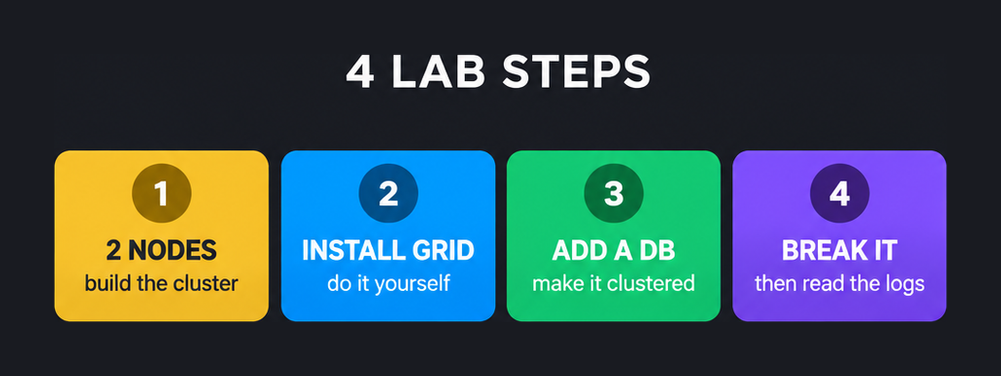
- Build a two node cluster in virtual machines, because almost nothing on this exam can be practised on a single instance.
- Install Grid Infrastructure yourself rather than inheriting one, working through the planning, group and user creation, and network requirements as separate steps.
- Configure ASM disk groups during that installation, then practise adding, dropping and rebalancing them until the maintenance operations are familiar.
- Create a RAC database on top, then convert a single instance database to RAC so that both routes are known.
- Work through services, connect-time load balancing and Transparent Application Failover, which together carry more objectives than any other subject in the RAC half.
- Study global resource coordination and Cache Fusion properly, because the concepts underpin every RAC tuning question.
- Practise node addition and deletion, rolling patches and OCR backup and recovery, then deliberately break the cluster and use the log files and diagcollection.pl to find out why.
- Finish with ACFS and CloudFS, the area production experience is least likely to have given you.
Oracle names three preparation workshops for this exam, covering RAC administration, ASM administration and Clusterware administration separately, which is another signal that the three areas carry comparable weight. For the wider Oracle database certification picture, the Autonomous Database exam breakdown shows how Oracle structures a modern database credential by comparison.
Frequently Asked Questions
How many questions are on the 1Z0-078 exam?
77 multiple choice questions in 120 minutes, with a passing score of 65 percent. That is about 93 seconds per question, which is comfortable for recall items and tighter for the cluster scenarios.
What are the topic weightings for 1Z0-078?
None are published. The syllabus lists thirty topic groups with no percentages attached, which is unusual for Oracle. Plan by topic group counts and by the balance of configure and troubleshoot verbs instead.
How much does 1Z0-078 cost?
245 USD, with the published note that pricing varies by country and by localised currency. Oracle’s own pages could not be read to confirm regional figures, so check the price for your country before booking.
What certification does 1Z0-078 earn?
Oracle Certified Professional, Oracle Database 19c – RAC, ASM, and Grid Infrastructure Administrator. It is a specialism credential covering all three products rather than a step in the general database administration path.
Can I pass 1Z0-078 with single instance experience only?
It would be difficult. Familiar subjects such as redo, undo and RMAN all appear, but each is examined in its clustered form, where the correct answer differs from the standalone one. Most of the syllabus has no single instance equivalent at all.
Which area of the syllabus is largest?
Real Application Clusters, at twelve topic groups, with Grid Infrastructure and Clusterware close behind at eleven and ASM at seven. Since no weightings are published, those counts are the best available proxy rather than a stated distribution.
Is there a 23ai version of this exam?
No replacement was found. Oracle has issued 23ai exams for database administration and SQL, but not for the RAC, ASM and Grid Infrastructure specialism. 19c is Oracle’s long term support release, so the exam remaining on it is unsurprising.
How much ACFS is on the exam?
More than many candidates expect. Two topic groups cover Oracle CloudFS, holding nine objectives between them including auditing, tagging, encryption, high availability NFS and replication. It is commonly the weakest area for working DBAs.
Do I need to install Grid Infrastructure myself to prepare?
It is strongly advisable. Installation planning, installation, node addition and deletion, patching and troubleshooting are all separate topic groups, and they are hard to learn from reading alone. A two node virtual cluster is enough.
Conclusion
1Z0-078 asks for working knowledge of three products at once, and it is the missing weightings that make it awkward to plan rather than the difficulty of any single topic. Thirty topic groups across RAC, Grid Infrastructure and ASM, 77 questions and 120 minutes at a 65 percent pass mark is the whole published specification, and Oracle offers nothing more granular than that.
Plan by structure instead. Twelve topic groups for RAC, eleven for Clusterware and Grid Infrastructure and seven for ASM is the nearest thing to a distribution available, and the configure and troubleshoot objectives tell you where laboratory time is repaid. Build a two node cluster, install the stack yourself, break it deliberately, and give ACFS more attention than production experience has probably given you.


