The change window closes at two in the morning and, for once, the failover has behaved. The standby router picked up the default gateway the moment its partner went down for a firmware upgrade, and nobody at the municipal office noticed a thing. Then the upgraded router finishes booting, sees that it still holds the higher priority, and takes the master role straight back. Every session through the pair drops for a second time in one night, and the on-call engineer is now reading about VRRP preemption at 02:40.
That is a GB0-372 question. GB0-372, H3C Advanced Routing and Switching Technology 1, is the first of the three exams behind the H3CSE-RS+ certification, the H3C Certified Senior Engineer for Routing and Switching Plus credential from H3C. Its seven sections are the technologies a campus network runs on once it is big enough to need redundancy, multicast, access control and proper monitoring. This article works through those sections in the scenario style the exam uses, sets out the price, timing and scoring, and explains how the three-exam senior route fits together.
Table of Contents
- What Does GB0-372 Cost, and How Long Do You Get?
- Which Seven Sections Does the GB0-372 Syllabus Cover?
- How Does GB0-372 Test High Availability?
- What Multicast Knowledge Does the Exam Expect?
- How Is Campus Access Control Examined?
- What Does the Maintenance and Management Section Ask?
- Where Does GB0-372 Sit in the H3CSE-RS+ Route?
- How Should You Prepare for GB0-372?
- Frequently Asked Questions
- Conclusion
What Does GB0-372 Cost, and How Long Do You Get?
GB0-372 costs 135 USD and gives you 60 minutes for 50 questions, with a passing score of 600 out of 1000. Registration is through Prometric, and the exam is delivered as an online test. It is one of three exams for the H3CSE-RS+ certification, so the same fee and format apply twice more for GB0-382 and GB0-392.
| Field | Value |
|---|---|
| Exam name | H3C Advanced Routing and Switching Technology 1 |
| Exam number | GB0-372 |
| Credential | H3C Certified Senior Engineer for Routing and Switching Plus (H3CSE-RS+), together with GB0-382 and GB0-392 |
| Price | 135 USD per exam |
| Duration | 60 minutes |
| Questions | 50 |
| Passing score | 600 out of 1000 |
| Delivery | Online test, registered through Prometric |
| Prerequisite | A valid H3CNE-RS+ certificate |
| Recommended training | Advanced Routing and Switching Technology 1 |
Sixty minutes across 50 questions is 72 seconds per item. That is comfortable for a recall question about a VLAN tag and tight for a scenario that describes two buildings, a directory migration and a symptom that follows users across switches. The sample questions published for this exam are mostly the second kind, and three of the ten ask for two answers, so pace yourself for reading rather than for ticking boxes.
The passing score is a scaled 600 on a 1000 point scale. Neither H3C nor the money site publishes how 50 answers map onto that scale, so do not work backwards to a number of questions you can afford to miss. Treat 600 as the target and aim well above it in practice.
One registration note is worth checking before you book. The syllabus page and H3C’s own certification FAQ both name Prometric as the test provider for the senior routing and switching exams. H3C’s H3CSE-RS+ programme page, however, tells candidates to contact H3C’s learning arm, H3CL, or a local H3C office. If Prometric shows no H3C exams in your country, that contact route is the one to use.
Which Seven Sections Does the GB0-372 Syllabus Cover?
The GB0-372 syllabus has seven sections: Campus Network Overview, VLAN Technologies, Spanning Tree Protocol, High Availability Technologies, IP Multicast, Campus Network Security Technologies, and Campus Network Maintenance and Management. No weightings are published for any of them, so the blueprint gives you no way to prioritise by marks, and no section can safely be skipped.
| Section | What the objectives name |
|---|---|
| Campus Network Overview | IToIP, SOA-based architecture, the hierarchical model, H3C enterprise architecture, campus structure and typical deployment |
| VLAN Technologies | VLAN and IEEE 802.1Q, port types, MVRP, Super VLAN, Isolate-user-VLAN, QinQ, inter-VLAN routing on a Layer 3 switch |
| Spanning Tree Protocol | STP, RSTP and MSTP: concept, work process, characteristics and configuration |
| High Availability Technologies | Link aggregation, VRRP, IRF, DRNI and BFD |
| IP Multicast | Multicast addressing and RPF, IGMPv2, IGMPv3 and IGMP Snooping, PIM-DM, PIM-SM and PIM-SSM, multicast VLAN |
| Campus Network Security Technologies | Threats and protection measures, AAA with RADIUS and TACACS+, 802.1X, dynamic and guest VLAN, MAC authentication, port security, EAD, portal authentication, Ethernet ACLs, SSH |
| Campus Network Maintenance and Management | Management objectives, NQA, SNMP, LLDP, port, remote and stream mirroring, NTP, telemetry |
Read the seven as a campus being built in order. The first three sections are the structure: a hierarchy of access, aggregation and core, VLANs to divide it, and spanning tree to keep it loop free. The fourth makes it survive a failure. The fifth lets it carry one video stream to many receivers. The last two decide who can join and how you find out what went wrong.
The first three sections overlap with the entry-level GB0-192 exam, and that is deliberate. The senior version asks for the extensions rather than the basics: Super VLAN and QinQ rather than a plain 802.1Q trunk, MSTP configuration rather than what a BPDU is. If a topic looks familiar from H3CNE-RS+, expect the question to start one step further in.
How Does GB0-372 Test High Availability?
The High Availability Technologies section of GB0-372 covers five things: link aggregation, VRRP, IRF, DRNI and BFD. The exam tests them as behaviour rather than definitions. A typical item describes what a network did after a reboot or a link failure and asks which setting explains it, which is exactly the shape of the two in the morning failback.
The failback, explained
In the opening scene the recovered router took the master role back because VRRP preemption was enabled and it held the higher priority. That is default behaviour, not a fault. If the operations team wants the role to stay put until they move it deliberately, preemption is the setting to change. The sample question that describes this scenario lists advertisement intervals, interface tracking and virtual MAC ownership as the distractors, and each one is a plausible story if you have only read about VRRP rather than run it.
The protocol itself is an IETF standard. The current specification, VRRP version 3, covers both IPv4 and IPv6 and defines the priority, preemption and advertisement mechanics that H3C implements. Reading the master election section once makes the exam’s VRRP questions feel like a description of something you already understand.
IRF, DRNI and the other three
IRF is H3C’s way of joining several physical switches into one logical device with a single control plane. DRNI is the alternative that keeps two devices separate but lets them present one aggregate link to a downstream switch. The syllabus asks for the principles, typical networking and basic configuration of both, so expect to be asked when you would choose one over the other, not just what the initials stand for.
BFD is the detection layer under all of this. One sample question puts it well: a stadium network runs some links under a dynamic routing protocol and others under static routes, wants sub-second failure detection on both, and will not change either routing design. BFD fits because it runs its own lightweight session over the link, independent of the protocol carried, and then notifies its registered clients so each reconverges without waiting for its own timers.
The best way to see how this section is written is to read the GB0-372 sample questions before you study, not after. Three of the ten are high availability scenarios, and one of them is not about configuration at all. It asks whether a logistics depot should buy hardware with a lower failure rate or deploy sub-second detection with automated failover, and the correct reasoning is that cutting restoration from forty minutes to under a minute removes more downtime than a third fewer failures ever could.
What Multicast Knowledge Does the Exam Expect?
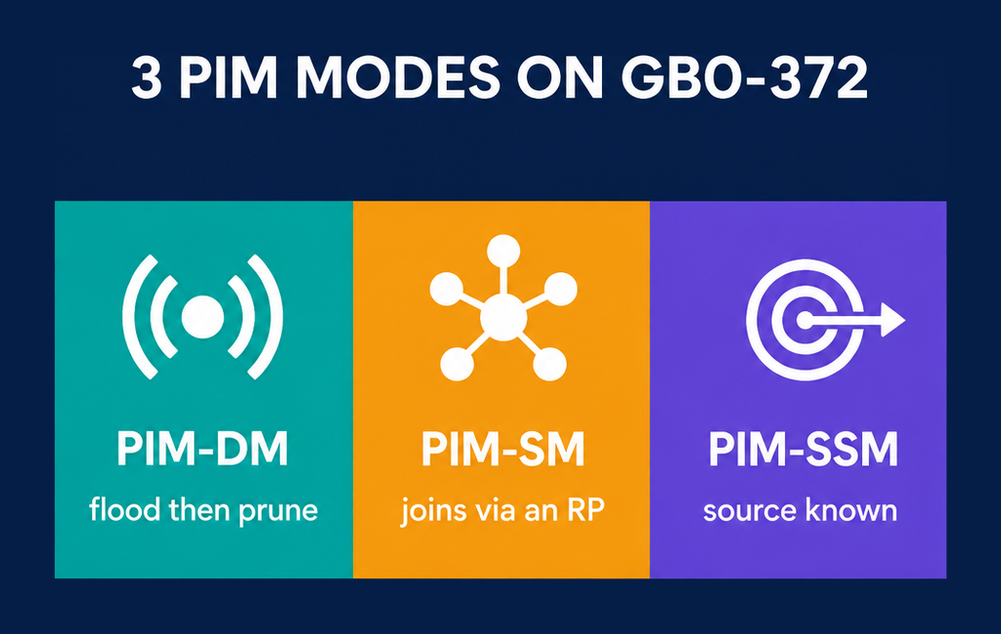
The IP Multicast section of GB0-372 expects you to explain multicast addressing and RPF forwarding, configure group management with IGMPv2, IGMPv3 and IGMP Snooping, configure the three PIM modes, PIM-DM, PIM-SM and PIM-SSM, and understand multicast VLAN. It is the section most candidates coming from a unicast background find newest, and the exam questions it through symptoms.
Snooping on the access layer
The first published sample question is a water utility whose access VLAN floods a video stream to every port even though only three ports have subscribed receivers. The answer is IGMP Snooping on that VLAN, because a switch has to read the membership reports before it can restrict a group to particular ports. The distractors offer RPF checks, multicast VLAN and PIM-SM, and each is a real multicast feature applied at the wrong layer.
PIM-SM without a rendezvous point
The second multicast scenario is subtler. A new aggregation router in a PIM-SM domain has formed neighbours and has the mode enabled, but bootstrap messages are filtered on its path, so it has learned no rendezvous point. Two consequences follow: membership reports from its receivers produce no join towards the shared tree, and a source attached to it is never registered, so receivers elsewhere never learn the source exists. The specification behind that behaviour is RFC 7761 for PIM-SM, which is worth an evening if the register and join mechanics are new to you.
Knowing which mode is which
The exam names all three PIM modes, so the minimum is being able to say what each assumes. Dense mode floods first and prunes back, which suits a small network where most segments want the stream. Sparse mode builds trees on demand around a rendezvous point, which suits a campus where receivers are scattered. Source-specific multicast skips the rendezvous point because the receiver already knows the source, which is why it pairs with IGMPv3.
How Is Campus Access Control Examined?
The Campus Network Security Technologies section of GB0-372 covers AAA with RADIUS and TACACS+, port access control through 802.1X, dynamic VLAN, guest VLAN, MAC address authentication and port security, network access control through H3C’s EAD solution, portal authentication and Ethernet ACLs, and SSH. The exam tests where a fault sits in that chain, not just what each piece does.
The clearest example is the school district in the sample set. Staff who authenticate through 802.1X keep landing in the guest VLAN, the behaviour follows them across two buildings, guests on the same ports land correctly, and the switches have not been touched since a directory migration. The fault is in the authorisation attribute returned for the staff group at authentication, which now names the guest VLAN and is applied by every switch. Nothing on the access ports would produce a symptom that consistent.
That question rewards a habit: separate what the switch decides from what the RADIUS server tells it. 802.1X, dynamic VLAN and guest VLAN are one mechanism seen from three angles. The supplicant proves who it is, the server returns the VLAN, and the switch applies it. Port security and MAC authentication are the fallback for devices that cannot run a supplicant at all, such as printers and cameras.
Portal authentication and EAD sit one layer up, controlling access by web login and by endpoint health rather than by port. SSH closes the section on the management side, replacing Telnet for device access. If you have read this site’s H3CNE-Security firewall exam guide, you will recognise the same AAA and policy vocabulary applied to the firewall instead of the switch, which is a useful way to see where the routing and switching track stops and the security track begins.
What Does the Maintenance and Management Section Ask?
The Campus Network Maintenance and Management section of GB0-372 lists NQA, SNMP, LLDP, mirroring, NTP and telemetry, plus an overview of management objectives and challenges. In the sample questions it is the largest single theme, with four of the ten items, and every one of them turns on how a monitoring protocol actually behaves under load.
Trap or inform
Two of those items are about SNMP notifications. In the first, link-down events from remote encoder sites never reach the management platform although each device logged them locally, and the path crosses a congested link. Switching the devices from Traps to Informs fixes it because an Inform is acknowledged by the manager, so the agent retransmits when no acknowledgement arrives, whereas a Trap is sent once and never confirmed. The second asks what SNMPv2c added over v1, and the answers are GetBulk for retrieving large tables in fewer exchanges, and Inform together with a richer error status set.
Severity, mirroring and time
A stadium network drowning in tens of thousands of syslog messages a minute during an incident is the third scenario. The two correct moves are to restrict which severities each device may send to the collector, so informational and debug output never consumes ingest capacity, and to filter the incident view to the more severe levels first. Raising every device’s configured severity or discarding unrecognised values are the traps.
The remaining objectives are narrower. NQA is H3C’s network quality analyser for scheduled probes, LLDP tells you what is plugged into what, port, remote and stream mirroring send copies of traffic to an analyser, NTP keeps every log timestamp comparable, and telemetry pushes counters to a collector instead of waiting to be polled. The exam asks for basic principles and configuration on each, so know what the feature is for and roughly how it is turned on.
Where Does GB0-372 Sit in the H3CSE-RS+ Route?
GB0-372 is the first of three exams for the H3CSE-RS+ certification. The other two are GB0-382, Advanced Routing and Switching Technology 2, and GB0-392, Network Security Optimization. You need a valid H3CNE-RS+ certificate before you can be awarded the senior credential, each exam result stays valid for 12 months, and the certificate itself is valid for three years.
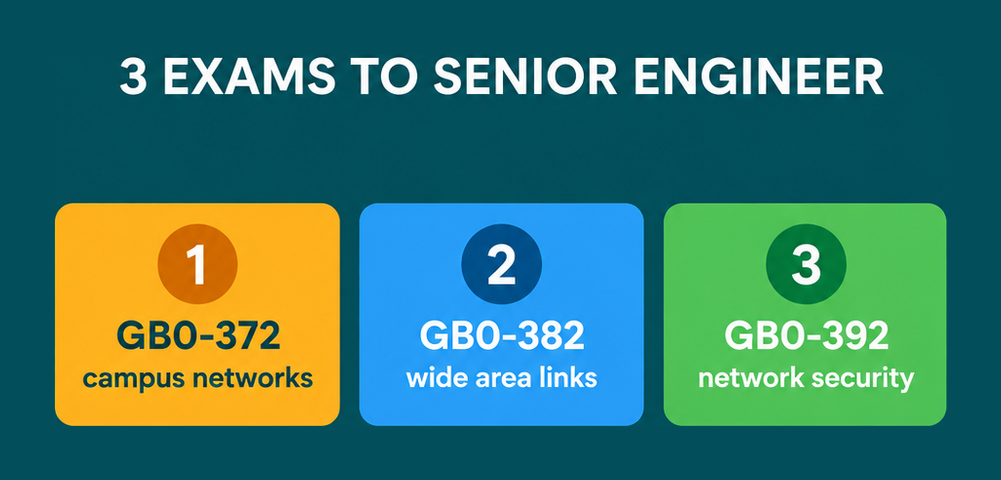
H3C describes the credential as proof of the theoretical knowledge and operational skill needed to deploy campus networks, including routing, switching, multicast, VPN, QoS and basic security, and to build and manage large and medium sized complex networks. GB0-372 delivers the campus half of that promise. GB0-382 moves to routing protocols on large scale networks, and GB0-392 covers secure, optimised WANs, including VPNs, QoS, VXLAN and EVPN.
The three courses behind the exams add up to 15 working days of recommended training, and one sitting of each exam adds up to 405 USD, which is simple arithmetic from the 135 USD fee rather than a package price. H3C lists the full requirements, the recommended course order and the validity rule on its H3CSE-RS+ programme page, and the fee, duration and Prometric details on its certification FAQ page.
Two more facts help with planning. When the certificate expires after three years, H3C’s rule is that you retake the exams rather than submit continuing education. And the plus programme replaced an older H3CSE Routing and Switching route built on GB0-371, GB0-381 and GB0-391 with an H3CNE prerequisite, so if a study guide or an employer’s job description still quotes those codes, it is describing the previous generation of the same credential.
Above the senior tier sits H3CIE-RS+, the expert level, which completes H3C’s three-level routing and switching ladder. Most candidates never need it. The senior credential is the one that maps onto running a campus estate, and GB0-372 is where it starts.
How Should You Prepare for GB0-372?
Prepare for GB0-372 by working the seven sections in the order the syllabus lists them, then spending most of your revision time on the four that carry the scenario questions: high availability, multicast, security and management. Use the official mock exam to check recall and the scenario sample questions to check reasoning, and book only when both feel comfortable inside 72 seconds a question.
- Confirm your H3CNE-RS+ certificate is still valid, because the senior credential cannot be issued without it.
- Print the seven-section objective list and mark every technology you have never configured, since those are the ones the scenario questions will expose.
- Lab VRRP, link aggregation and IRF first, and deliberately break each one so you have seen the failover and the failback behaviour yourself.
- Work through IGMP Snooping and PIM-SM on a small topology, then read the register and join sections of the PIM-SM specification with the lab in front of you.
- Configure 802.1X against a RADIUS server with a dynamic VLAN and a guest VLAN, and watch which side decides the VLAN.
- Sit the official GB0-372 mock examination and the scenario sample questions under a 60 minute clock, and book the exam when both are comfortable.
The official GB0-372 mock examination is dated May 2024 and leans towards recall: access layer functions, Super VLAN behaviour, MAC learning, STP timers and the relationship between RSTP and STP. Several of its items take more than one answer. It is a good measure of whether you know the vocabulary, and a poor measure of whether you can diagnose a symptom, which is why the scenario questions matter as much.
If you want a second set of practice items on this site, the older GB0-372 practice questions page walks through the exam structure and study strategy and quotes the same 50 question, 600 out of 1000 format, which is a useful sign that the exam’s shape has been stable.
Two habits carry the most marks. When a question describes a symptom, ask which device made the decision that produced it, the switch, the server or the router. And when two answers both sound like real features, ask which one operates at the layer the question describes. Both of the published multicast questions and the 802.1X question are solved by exactly that step.
Frequently Asked Questions
How many questions are on the GB0-372 exam?
GB0-372 has 50 questions and a 60 minute time limit, which is 72 seconds per question. The published sample questions include both single-answer and choose-two items.
What is the passing score for GB0-372?
The passing score is 600 out of 1000. Neither H3C nor the money site publishes how the 50 answers map onto that scale, so there is no published number of questions you can miss.
How much does the GB0-372 exam cost?
The exam costs 135 USD. H3C’s certification FAQ lists the same fee for each of the three senior routing and switching exams, so one sitting of all three comes to 405 USD.
Is H3CNE-RS+ required before GB0-372?
A valid H3CNE-RS+ certificate is required to be awarded the H3CSE-RS+ certification. H3C states this as a certification requirement on its programme page, so hold the entry credential before planning the three senior exams.
How many exams are needed for H3CSE-RS+ certification?
Three: GB0-372 Advanced Routing and Switching Technology 1, GB0-382 Advanced Routing and Switching Technology 2, and GB0-392 Network Security Optimization. H3C recommends studying the three courses in that order.
How long is the H3CSE-RS+ certificate valid?
The certificate is valid for three years. On expiry, H3C requires candidates to retake the certification exams. Individual exam results are valid for 12 months.
Does GB0-372 publish weightings for its sections?
No. The syllabus lists seven sections and their objectives without any percentage weighting, so study all seven rather than trying to prioritise by marks.
Where do you register for the GB0-372 exam?
The syllabus page and H3C’s FAQ name Prometric as the test provider, and the exam is delivered online. H3C’s programme page also directs candidates to contact H3CL or a local H3C office for arrangements.
What replaced the old GB0-371 exam?
GB0-372 is the first exam of the current H3CSE-RS+ programme, which replaced the older H3CSE Routing and Switching route built on GB0-371, GB0-381 and GB0-391. Study material quoting the old codes describes the previous generation of the credential.
Conclusion
The failback at two in the morning was not a fault in the network. It was a setting nobody had thought about, and the GB0-372 exam is built from moments like it: a stream flooding a VLAN, a notification lost on a congested link, staff landing in the guest VLAN after a directory change. Each has one explanation and three plausible ones.
The numbers are fixed. GB0-372 is 50 questions in 60 minutes for 135 USD, 600 out of 1000 to pass, seven sections with no weightings, and the first of three exams towards an H3CSE-RS+ certification that requires a valid H3CNE-RS+ and lasts three years.
Lab the high availability and multicast features until you have watched them fail, learn which device makes each decision, and sit the mock and the scenario questions against the clock. When both are comfortable, book.


