The word AI appears in the credential’s name and in exactly one of its five syllabus domains. The Oracle AI Database Administration Professional exam, code 1Z0-183, gives 20 percent of its marks to the new features of Oracle AI Database 26ai, including AI Vector Search, and the other 80 percent to multitenant administration, backup and recovery, performance tuning, and deployment and patching. A DBA who certified on 19c will recognise four of the five domains on sight.
That proportion is the most useful thing to know before booking, because it decides how to prepare. DBExam publishes the exam as 65 questions in 120 minutes, with a pass mark of 60 percent and a fee of $245 USD, and Oracle’s own listing for the Japanese delivery of the same paper confirms the question count, the duration and the pass line. This guide maps where those 65 questions land, explains why third-party pages still call the exam “Oracle Database 23ai Administration Professional”, and sets out how an experienced DBA closes the one gap that is genuinely new.
What Does the Oracle AI Database Administration Professional Credential Certify?
Passing 1Z0-183 earns the Oracle AI Database Administration Certified Professional credential, Oracle’s professional-level recognition for database administrators working on Oracle AI Database. It certifies that a DBA can run a multitenant estate, back it up and recover it with RMAN, diagnose and tune performance, deploy and patch the software stack, and put the release’s AI features to work. It is the professional tier above the Associate exam, 1Z0-182.
The practical reading of that scope is a DBA who is trusted with production. The Associate level checks that someone can create users, manage storage and keep an instance running. The Professional level assumes that and asks about the decisions a senior administrator makes: which backup strategy fits a recovery objective, which PDB should be upgraded in place and which should be transported, where a slow SQL statement is actually spending its time, and how to patch Grid Infrastructure and the database without taking the service down.
Oracle Japan’s exam page describes the credential in the same terms, as proof of advanced skill in multitenant operations design, backup and recovery and tuning, at a level where the holder can advise on the right approach. That advisory framing matters. The scenario questions on this paper tend to describe a situation and ask what a DBA should do, not what a parameter is called.
Who the exam is written for
DBExam targets the exam at candidates with existing exposure to Oracle Database technology who want to progress to the professional credential. In practice that means three groups: holders of the 1Z0-182 Associate who want the next tier; DBAs certified on 12c or 19c who want a current credential without repeating the fundamentals; and administrators who have run 23ai or 26ai in production and want the AI features on their record. Developers and data engineers who do not administer databases are better served by the AI Database SQL Associate.
How Is the 1Z0-183 Exam Structured and Scored?
1Z0-183 is a 65 question multiple choice exam with a 120 minute time limit and a passing score of 60 percent, priced by DBExam at $245 USD with the note that pricing varies by country and currency. Oracle Japan’s listing for the same exam displays 65 questions, 120 minutes and a 60 percent pass line, so the three figures that decide your pacing are confirmed on an Oracle-owned page.
| Exam detail | Value |
|---|---|
| Exam name | Oracle AI Database Administration Professional |
| Exam code | 1Z0-183 (1Z0-183-JPN for the Japanese delivery) |
| Credential awarded | Oracle AI Database Administration Certified Professional |
| Questions | 65 multiple choice |
| Duration | 120 minutes |
| Passing score | 60 percent |
| Price | $245 USD, varies by country (DBExam) |
| Product release named | Oracle AI Database 26ai (Oracle Japan listing) |
| Domains | Five, weighted 20, 20, 25, 15 and 20 percent |
Sixty five questions in 120 minutes is 110 seconds each, which is generous for a recall item and about right for the scenario items that describe a failure, a wait event or a patching situation and ask for the correct next step. A 60 percent pass line on 65 questions means a candidate can miss a substantial number and still pass, so the risk is not an impossible bar; it is spreading preparation across the five domains in proportion to their weight.
Because the weightings are published, the pacing plan writes itself: expect roughly a quarter of the paper on tuning, a fifth each on multitenant, backup and recovery, and the 26ai features, and the remainder on deployment and patching. Rehearsing under the clock matters more on this exam than on the Associate, because the scenario items take longer to read. The 1Z0-183 online practice exam reproduces the question count, the duration and the pass mark, which is the most direct way to find out whether 110 seconds a question is enough for you.
What Oracle’s own listing does and does not say
The only Oracle page that could be read for this article is the Japanese exam listing, which carries the title Oracle AI Database 26ai Administration Professional and the full topic checklist. It displays no price, no validity period and no weightings. Oracle University’s English catalogue returned a maintenance page on the day of writing, so where this article states a figure, it comes from DBExam and, where the Japan page displays the same field, is confirmed there. Nothing below is inferred from a policy table or a sibling exam.
Which Five Domains Carry the 1Z0-183 Marks?
The 1Z0-183 syllabus has five weighted domains: Managing Multitenant Architecture at 20 percent, Performing Backup and Recovery at 20 percent, Managing and Tuning Performance at 25 percent, Deploying, Patching and Upgrades at 15 percent, and New Feature in Oracle AI Database at 20 percent. The 35 topic lines beneath them are listed on the DBExam syllabus page and match Oracle Japan’s checklist line for line.
| Domain | Weight | Topics |
|---|---|---|
| Managing Multitenant Architecture | 20% | Creating CDBs with DBCA and Creating Regular PDBs; Manage Application PDBs within CDBs; Manage CDBs and PDBs; Securing Multitenant Databases; Upgrading the earlier release PDB and Transporting regular PDBs |
| Performing Backup and Recovery | 20% | Configuring and Using RMAN; Define Backup strategies and terminology; Analyze and diagnosing failures in Database; Apply restore and recovery Concepts; Performing Complete Database Recovery; Using Flashback Technologies for data recovery; Transporting Data across platforms; Duplicating Databases; Tune and Troubleshoot RMAN operations |
| Managing and Tuning Performance | 25% | Apply Basic Tuning and Diagnostics; Using Metrics, Alerts, and Baselines; Using AWR-Based Tools to explore and analyze AWR data; Performing Oracle Database Application Monitoring; SQL Statement Processing and Optimization; Reducing the Cost of SQL Operations; Using Real Application Testing; Manage SQL Performance; Tune Oracle Database Instances; Utilize Database In-Memory Column Store |
| Deploying, Patching and Upgrades | 15% | Install Grid Infrastructure and Oracle Database; Creating Databases with DBCA; Patching Grid Infrastructure and Databases; Configure Oracle Restart; Upgrade Grid Infrastructure; Upgrade Oracle Database |
| New Feature in Oracle AI Database | 20% | Implement AI Vector Search; Enhance OLTP and Core Database Features; Introduce Availability Features; Improve Manageability and Performance; Apply Database Security Enhancements |
Read the table as a budget. Tuning is the single largest domain and also the one with the most topic lines, ten, so it rewards breadth: metrics and baselines, AWR, application monitoring, SQL processing, Real Application Testing, instance tuning and the In-Memory column store all appear. Backup and recovery has nine lines in 20 percent, so each line is worth slightly less, but RMAN questions tend to be precise about syntax and sequence. The new feature domain has only five lines for its 20 percent, which means each of those five topics carries more weight than any single line elsewhere on the paper.
One topic line is cut short on the DBExam page
Under Managing and Tuning Performance, DBExam prints the line “Using Real Application Testing to” and stops. Oracle Japan’s checklist shows the item as using Real Application Testing, followed by the separate item on managing SQL performance, which is how the table above presents it. Treat Real Application Testing as its own objective: SQL Performance Analyzer and Database Replay are both fair game.
Why Is Only One Fifth of the Exam About AI?
The AI share of 1Z0-183 is 20 percent because the credential certifies database administration of Oracle AI Database, not AI engineering. The fifth domain covers what the release added: AI Vector Search, OLTP and core feature enhancements, availability features, manageability and performance improvements, and security enhancements. The other four domains are the administration work that the AI features run on top of, and they have not shrunk to make room.
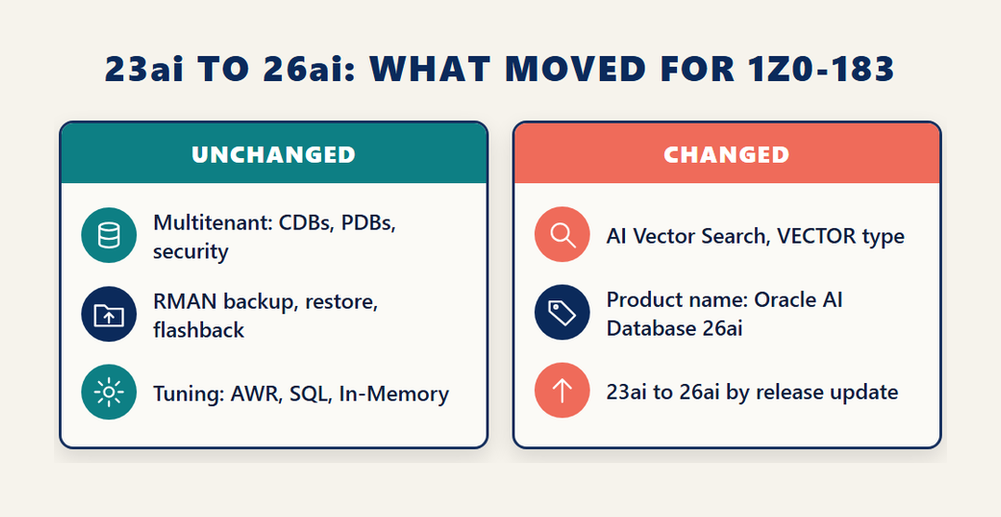
The naming is where candidates get confused. Oracle introduced 1Z0-183 while the product was called Oracle Database 23ai, which is why dump sites and course titles still carry that name. In October 2025 Oracle released Oracle AI Database 26ai as the long-term support release that replaces 23ai, and the Oracle AI Database 26ai announcement says customers move from 23ai to 26ai by applying the October 2025 release update, with no database upgrade and no application recertification. The exam followed the product: Oracle Japan now titles it Oracle AI Database 26ai Administration Professional, and the code stayed 1Z0-183.
“In this monumental release, Oracle has architected AI and data together to create a next-generation, AI-native database.”
What AI Vector Search asks of a DBA
The headline topic is Implement AI Vector Search. Oracle’s documentation describes it as querying data by semantics rather than keywords, built on the VECTOR data type, which stores embeddings alongside business data in ordinary tables. Two administrative facts from the AI Vector Search overview are the kind the exam tests: the VECTOR type arrived with Oracle AI Database 26ai, and using it requires the COMPATIBLE initialization parameter at 23.4.0 or higher. A DBA is expected to know the prerequisite, not to train an embedding model.
If the idea of storing embeddings in a relational table is new, the general vector database concept is worth twenty minutes before the Oracle specifics, because the exam’s vocabulary assumes you know what a similarity search is and why an index on vectors behaves differently from a B-tree. Then return to the Oracle side: creating a table with a VECTOR column, loading embeddings, and running a similarity query is the whole of what a professional-level administrator needs to demonstrate.
The other four new feature lines
The remaining topics in the domain are broad by design. Enhancements to OLTP and core features, availability, manageability and performance, and security are each a heading in the 26ai new features guide rather than a single feature, so the right preparation is to read that guide’s chapter list and note which items change a DBA’s daily work. Questions in this domain are more likely to ask what a feature does and when to use it than to ask for syntax.
How Does Performance Tuning Earn Its 25 Percent?
Managing and Tuning Performance is the largest domain on 1Z0-183 at 25 percent and the deepest, with ten topic lines running from basic diagnostics through AWR, application monitoring, SQL optimisation, Real Application Testing, instance tuning and the In-Memory column store. It carries the most marks because it is where professional-level judgement shows: the exam wants a DBA who can find the cause of a slow system rather than restart it.
The ten lines fall into three groups. The first is diagnosis: basic tuning and diagnostics, metrics, alerts and baselines, and AWR-based tools. Expect questions on which report to run for which symptom, what a baseline is for, and how to read the top wait events. The second group is SQL: statement processing and optimisation, reducing the cost of SQL operations, Real Application Testing, and managing SQL performance. Here the questions turn on the optimizer, execution plans, SQL profiles and plan baselines, and on how to test a change before it reaches production. The third group is the instance and memory: tuning the instance and using the In-Memory column store, where sizing, population and which workloads benefit are the usual angles.
Why this domain decides most passes
With a 60 percent pass line, a candidate who is strong across the four classic domains can afford weakness in the AI domain, but nobody can afford weakness in tuning, because it is a quarter of the paper and its questions are the longest to read. Working DBAs usually know their own monitoring tools well and the Oracle-native ones less well. The exam asks about the Oracle-native ones: AWR, ADDM, ASH, SQL Tuning Advisor, SQL Access Advisor and the Database Replay and SQL Performance Analyzer pair that make up Real Application Testing. If you have been living inside a third-party monitoring console, this is the domain to lab.
Multitenant, Backup and Recovery: The 40 Percent That Has Not Moved
Managing Multitenant Architecture and Performing Backup and Recovery are worth 20 percent each on 1Z0-183, and between them they are the most stable part of the paper. A DBA who has run container databases and RMAN on 19c will find the objectives familiar: creating CDBs and PDBs with DBCA, application containers, securing PDBs, upgrading and transporting PDBs, backup strategy, failure diagnosis, complete recovery, flashback, cross-platform transport, duplication, and RMAN tuning.
Familiar does not mean easy. Multitenant questions on a professional paper tend to be about the boundary cases: what an application PDB can share from its application root, how to move a PDB from an earlier release into a 26ai CDB, and which security settings apply at the CDB level versus inside one PDB. The objective on upgrading an earlier release PDB and transporting regular PDBs is where the release change matters most, because the exam can describe a 19c PDB and ask for the correct route into the current container.
Backup and recovery is sequence-sensitive
RMAN questions reward candidates who know the order of operations. Define the strategy, configure the channels and retention, take the backup, diagnose the failure with the Data Recovery Advisor, restore, recover, open. Flashback adds a second decision tree: when a flashback query, flashback table, flashback drop or flashback database is the right tool, and when it is not available at all because the prerequisite was never enabled. Duplicating databases and transporting data across platforms round out the domain and are both areas where a candidate who has only ever restored to the same host will be tested on something they have not done.
Deploying, Patching and Upgrades, the 15 percent domain, belongs with these two in spirit. Installing Grid Infrastructure and the database, creating databases with DBCA, patching both layers, configuring Oracle Restart, and upgrading Grid Infrastructure and the database are all lifecycle tasks. The DBExam sample set includes a question that separates the tool that updates the software binaries from the one that applies the matching changes inside the database, which is a fair indication of how precise the patching questions are.
Where Does 1Z0-183 Sit on the Oracle DBA Certification Path?
1Z0-183 is the professional-level exam in Oracle’s AI Database administration track, sitting above the Associate exam 1Z0-182 and alongside the specialist database credentials such as the RAC and Grid Infrastructure exam 1Z0-078 and the Autonomous AI Database exam 1Z0-931-26. The Associate certifies core administration; the Professional certifies the judgement to run production; the specialist exams go deep on one platform or feature set.
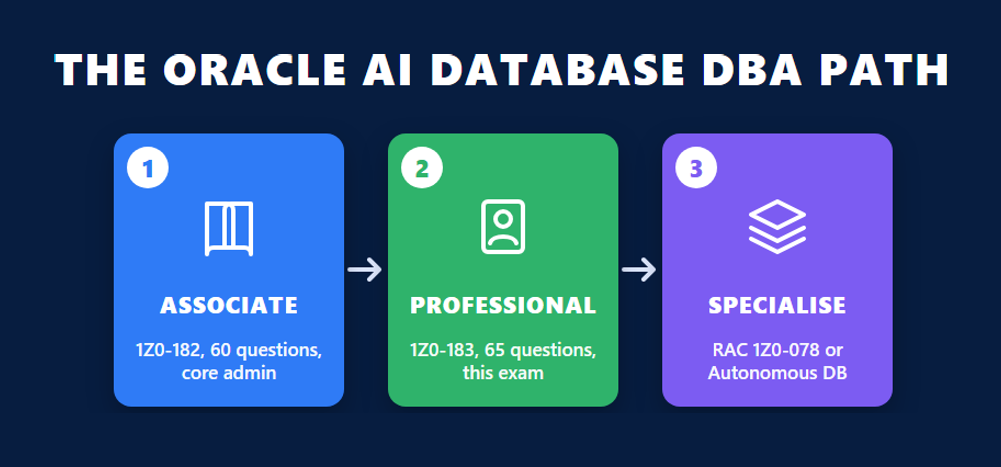
Whether the Associate is formally required before the Professional is a question this article does not answer with a figure, because no readable English Oracle page displays the requirement. Oracle Japan’s page lists prerequisites for its own ORACLE MASTER Gold credential, which is a Japanese scheme with its own rules. What can be said is that the two exams are designed as a pair: the Associate covers the fundamentals the Professional assumes, and DBExam describes 1Z0-183 as the exam for candidates with existing Oracle Database experience. A DBA coming from 19c without the Associate should at least read its syllabus to confirm nothing in it is unfamiliar.
Choosing the order
For a new DBA the order is the obvious one: Associate first, then Professional. The 1Z0-182 Associate guide on this site walks the 13 domains of that exam and the ten-week plan that fits it. For an experienced DBA the better question is which specialist credential comes after the Professional, and that depends on the estate: clustered databases point to the RAC exam, Autonomous Database on OCI points to 1Z0-931-26, and a team adopting vector workloads has already covered its ground inside 1Z0-183.
The searches that land on this topic show the confusion. People search for an Oracle DBA certification path far more often than for any one exam code, and most of what they find is a list of codes with no indication of level. The level is in the name: Associate, Professional, then the specialist titles. 1Z0-183 is the middle step, and for most working DBAs it is the one that changes what their employer sees on a CV.
How Should an Experienced DBA Prepare for 1Z0-183?
Preparation for 1Z0-183 should follow the weightings: a quarter of the time on tuning, a fifth each on multitenant, RMAN and the 26ai features, and the rest on deployment and patching, with the AI domain studied first because it is the only material most candidates have never seen. A 26ai lab is not optional, since the VECTOR type and the new feature chapters cannot be practised on an older release.
The plan below is ordered by dependency. Each step produces something the next step needs, so a candidate who skips the lab build cannot do the vector exercise, and a candidate who skips the AWR baseline cannot do the tuning comparison.
- Build a single Oracle AI Database 26ai lab with Grid Infrastructure and Oracle Restart, so that every later exercise runs on the release the exam names.
- Create a CDB with DBCA, add a regular PDB and an application container, then plug in a PDB from an earlier release so the upgrade and transport objective has been done rather than read.
- Configure RMAN with a retention policy, take a full backup, simulate a lost datafile, and recover it completely, then repeat the exercise using a flashback feature so the two recovery routes are distinct in your mind.
- Capture an AWR baseline, run a deliberately bad SQL statement, and use SQL Tuning Advisor and SQL Performance Analyzer to fix it, which covers the diagnosis, SQL and Real Application Testing groups of the tuning domain in one session.
- Create a table with a VECTOR column, load a handful of embeddings, and run a similarity query, after confirming the COMPATIBLE parameter meets the documented minimum.
- Apply a Release Update to the lab, updating the Oracle home binaries and then the database, so the two-tool patching sequence the sample questions describe is familiar.
- Sit a full-length timed practice exam, score it against the five domains, and spend the final week on whichever domain scored lowest relative to its weight.
For the fifth domain, the reading source is Oracle’s own 26ai new features guide, which is organised by the same headings the syllabus uses: OLTP and core, availability, manageability and performance, and security. Read the chapter summaries, not every feature, and note the ones that change a DBA’s daily work. For the exam specifications themselves, the Oracle Japan exam page is the one Oracle-owned page that currently displays the question count, duration and pass line, and its topic checklist is a useful cross-check on the syllabus table above.
What to do after passing
A DBA who passes 1Z0-183 and runs clustered databases has a natural next exam, and the RAC and Grid exam guide on this site explains why 1Z0-078 behaves like three products in one paper. Candidates on Autonomous Database should look at 1Z0-931-26 instead. Either way, the professional credential is the one that the specialist exams assume you hold.
Frequently Asked Questions
How many questions are on the 1Z0-183 exam?
Sixty five multiple choice questions in 120 minutes. DBExam publishes those figures, and Oracle Japan’s listing for the same exam displays 65 questions and 120 minutes.
What is the 1Z0-183 passing score?
Sixty percent. The figure appears on the DBExam syllabus page and on Oracle Japan’s exam page as the pass line.
How much does the Oracle AI Database Administration Professional exam cost?
DBExam lists the fee as $245 USD and notes that pricing varies by country and local currency. The Oracle Japan page displays no price, so the DBExam figure is the only visible source.
Is 1Z0-183 the 23ai exam or the 26ai exam?
Both names refer to the same exam code. 1Z0-183 was introduced under the Oracle Database 23ai name, and Oracle AI Database 26ai replaced 23ai in October 2025 as the long-term support release. Oracle Japan now titles the exam Oracle AI Database 26ai Administration Professional; the code did not change.
Do I need 1Z0-182 before 1Z0-183?
No readable English Oracle page displays a prerequisite for the global credential, so this article does not state one. The Associate exam covers the fundamentals the Professional assumes, and taking it first is the designed route for a new DBA.
How much of 1Z0-183 is about AI?
One domain of five, New Feature in Oracle AI Database, at 20 percent. Its topics are AI Vector Search, OLTP and core enhancements, availability, manageability and performance, and security enhancements. The other 80 percent is multitenant, backup and recovery, tuning, and deployment and patching.
Which domain is worth the most on 1Z0-183?
Managing and Tuning Performance at 25 percent, with ten topic lines covering diagnostics, AWR, application monitoring, SQL optimisation, Real Application Testing, instance tuning and the In-Memory column store.
What is AI Vector Search in exam terms?
Querying data by semantic similarity using the VECTOR data type, which stores embeddings in ordinary tables. The documented administrative prerequisite is the COMPATIBLE initialization parameter at 23.4.0 or higher. The exam expects a DBA to implement it, not to build the models.
How long is the Oracle AI Database Administration Certified Professional credential valid?
No readable Oracle page or DBExam page displays a validity period for this credential, so no figure is given here. Check Oracle’s certification portal for the current policy before relying on a renewal date.
Is there a successor code to 1Z0-183?
No. The only variant in circulation is 1Z0-183-JPN, the Japanese-language delivery of the same exam. The product rename from 23ai to 26ai did not renumber the exam.
Conclusion
The Oracle AI Database Administration Professional exam is 80 percent a classic professional DBA paper and 20 percent the first Oracle certification material on AI Vector Search and the other 26ai additions. That split is the whole strategy: an experienced DBA should budget by the published weightings, lab the tuning domain against Oracle-native tools, and treat the fifth domain as the one piece of genuinely new study. The spec figures are stable and confirmed on an Oracle-owned page, the code has survived the product rename, and the credential sits exactly where a working DBA’s CV needs it, between the Associate and the specialist exams. Build the 26ai lab, work the seven steps in order, and sit a timed practice paper before you book.


