A sales dashboard takes far too long to open, regional managers can see each other’s numbers, and nobody can say which of three revenue data sources is the real one. A Tableau consultant is the person called in to sort that out, and the Salesforce Tableau Consultant exam, code Analytics-Con-301, asks whether you would diagnose those problems correctly before you touch a single worksheet.
The exam is not a build test. It hands you situations and asks what you would recommend, why a calculation returns the wrong answer, or which governance setting fits a requirement. This guide covers how the exam is set up, how its four domains are weighted, why calculations and workbook design carry the biggest share of the marks, and a preparation order that follows the weighting.
Table of Contents
- What Does the Salesforce Tableau Consultant Exam Test?
- How Is Analytics-Con-301 Set Up?
- How Are the Four Domains Weighted?
- Why Do Calculations and Workbooks Carry 40 Percent?
- What Does Evaluate Current State Ask a Consultant to Judge?
- How Should You Approach Data Connections and Row-Level Security?
- What Governance Skills Does the Exam Expect?
- Who Is the Tableau Consultant Credential Built For?
- How Should You Prepare for Analytics-Con-301?
- Frequently Asked Questions About the Salesforce Tableau Consultant Exam
- Conclusion
What Does the Salesforce Tableau Consultant Exam Test?
The Salesforce Tableau Consultant exam tests whether you can turn a customer’s business problem into a sound Tableau design and fix what is already broken. It covers assessing an existing analytics setup, planning data connections and row-level security, designing and troubleshooting advanced calculations and workbooks, and setting up governance for published content across Tableau Server and Tableau Cloud.
Tableau describes certified consultants as people who help customers understand their data and realise business value, with expertise in visual design, performance, scalability, adoption and governance. That list is a good summary of the syllabus. Almost every objective begins with a verb such as recommend, evaluate, identify or troubleshoot, which tells you the questions are about judgement rather than menu paths.
Tableau lists the credential at the Advanced level on its official certification page, alongside the Data Analyst, Server Administrator and Architect credentials. The same page notes that Tableau certifications are now part of the Salesforce certification experience, which is why the full name carries the Salesforce prefix.
How Is Analytics-Con-301 Set Up?
Analytics-Con-301 is a 60 question exam with a 105 minute time limit and a 63 percent passing score. Registration costs $200 USD, a retake costs $100 USD, and the exam is booked through Pearson VUE. Those figures come from the exam’s syllabus page, and Salesforce’s own pages publish no figures that differ from them.
| Exam detail | Analytics-Con-301 |
|---|---|
| Exam name | Salesforce Tableau Consultant |
| Credential | Salesforce Certified Tableau Consultant |
| Exam code | Analytics-Con-301 |
| Questions | 60 |
| Duration | 105 minutes |
| Passing score | 63% |
| Registration fee | $200 USD |
| Retake fee | $100 USD |
| Registration | Pearson VUE |
| Recommended training | Analyst Learning Path, Designer Learning Path |
Before you book, work through the Analytics-Con-301 sample questions to see how the scenarios are phrased. They show quickly that most items describe a customer situation and ask for the best recommendation, not a definition.
Tableau Certified Consultant, TCC-C01 and the Current Code
Older study material and forum threads call this credential Tableau Certified Consultant and use the code TCC-C01. Searches still mix the old and new names. The exam you book today is Analytics-Con-301, and its title is Salesforce Tableau Consultant. When you read older notes, check the timing and fee they quote against the figures above rather than trusting them, because the current syllabus page lists 105 minutes.
How Are the Four Domains Weighted?
Analytics-Con-301 has four domains. Design and Troubleshoot Calculations and Workbooks carries 40 percent, Evaluate Current State and Plan and Prepare Data Connections carry 22 percent each, and Establish Governance and Support Published Content carries 16 percent. On a 60 question exam, that weighting means calculations and workbook design shape more of your score than any other area.
| Domain | Weight | Objectives |
|---|---|---|
| Evaluate Current State | 22% | Map current state of analytics to future state; evaluate current data structures |
| Plan and Prepare Data Connections | 22% | Plan for data transformation; design a row-level security (RLS) data structure; plan and implement advanced connections to data |
| Design and Troubleshoot Calculations and Workbooks | 40% | Design analytics for advanced use cases; design workbooks to optimize performance; implement advanced calculations that include multiple steps |
| Establish Governance and Support Published Content | 16% | Recommend and apply a Tableau governance strategy; leverage administrative views; recommend a content distribution strategy |
Two things follow from that table. First, the two 22 percent domains together equal the calculations domain alone, so a candidate who is strong on design but weak on data planning still has a large gap to close. Second, governance is the smallest domain, but its objectives are broad, and it is easy to leave it until the last week and then run out of time.
Why Do Calculations and Workbooks Carry 40 Percent?
Calculations and workbooks carry 40 percent of Analytics-Con-301 because that is where consulting work most often succeeds or fails. The domain covers advanced chart choices and dashboard interactivity, workbook performance, and multi-step calculations such as nested LODs and advanced table calculations. It is also the domain where the order of operations decides whether a number on screen is right.
Designing for Advanced Use Cases
The syllabus asks you to recommend when an advanced chart type is the right answer, naming Sankey, chord, radar, tile map, small multiples and data densification. Expect to be asked which chart fits a stated business question, not how to drag the fields. The same objective group covers advanced interactivity: dynamic URL actions, parameter actions and filter actions.
This objective group also includes identifying and troubleshooting the effect of the Tableau order of operations on calculations. Tableau’s guide to the order of operations walks through two standard fixes: turning a dimension filter into a context filter so that a top N filter acts on already filtered data, and replacing a table calculation with a FIXED level of detail expression. Both are exactly the kind of correction a scenario question expects you to choose.
Designing Workbooks for Performance
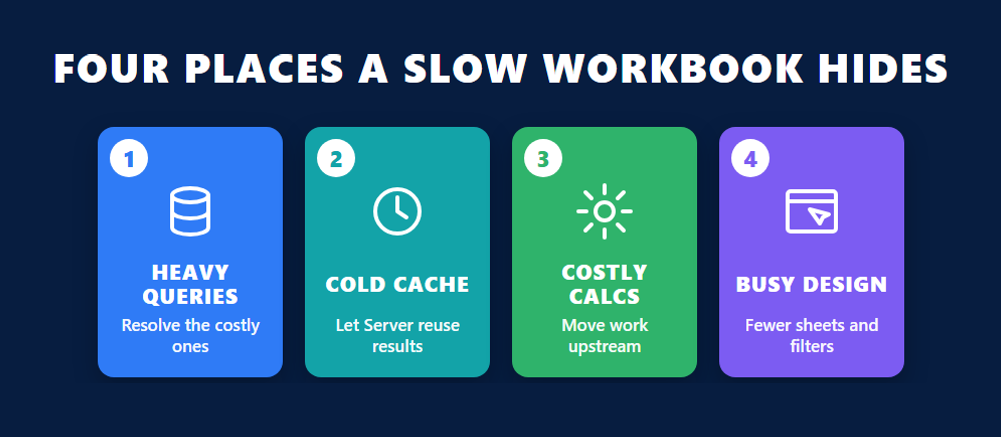
Performance objectives are practical. You need to identify and resolve resource-intensive queries, maximise caching for Tableau Server, spot slow calculations such as string comparisons, IF THEN statements and LOD expressions, and decide which calculations should be moved upstream of Tableau. Design elements count too: the number of sheets, the number of filters and image size are all named.
The syllabus also expects you to interpret performance recordings. Tableau’s page on how to record workbook performance shows the events a recording breaks out, including query execution, compiling queries and, on Tableau Server, server rendering. Reading which event dominates is how you decide whether the fix belongs in the data, the calculation or the layout.
Multi-Step Calculations
The final objective group is the most technical. It lists aggregations that include dimensions, advanced table calculations such as window, nested table or multi-directional calculations, advanced date functions such as fiscal calendars, and advanced LODs such as nested LODs. You are also asked to combine these and troubleshoot the result. If you rarely write nested LODs in daily work, this is the area to practise most.
What Does Evaluate Current State Ask a Consultant to Judge?
Evaluate Current State, worth 22 percent, asks you to judge a customer’s existing analytics setup and decide where it should go. It covers mapping business needs to Tableau capabilities, recommending Tableau Server or Tableau Cloud including migration, planning a Tableau Server upgrade, and checking whether existing data structures support the business, how their lineage looks, and where they carry performance risks.
The first half of the domain is about translation. A business owner describes what they want to know, and you translate that into Tableau terms using best practices. The second half is an audit of the data itself: does it actually support the stated needs, where does it come from, and which structures will slow things down once usage grows.
The deployment questions deserve attention because they are recommendations with consequences. Recommending Tableau Cloud over Tableau Server, or planning a Server upgrade, means weighing what the customer already runs against what they need next. Read each scenario for the constraint that decides it, since there is usually one detail that rules an option out.
How Should You Approach Data Connections and Row-Level Security?
Plan and Prepare Data Connections, worth 22 percent, covers three objective groups: planning data transformation and the minimum level of granularity, designing a row-level security structure with an entitlement table, and choosing advanced connection methods such as Web Data Connectors, web extract APIs, custom SQL, ODBC and Tableau Bridge. Aggregation strategy across Tableau Desktop, Prep, Cloud and Server is part of it too.
Row-Level Security Is the Heart of This Domain
The syllabus names three RLS tasks: implement RLS and an entitlement table, identify group functions versus user functions, and compare RLS approaches. Tableau’s row-level security overview sets out the options you will be comparing:
- A user filter that maps users to values by hand, which Tableau calls convenient but high maintenance, because it is done per workbook and must be updated as the user base changes
- A dynamic user filter driven by a security field in the data, which is less error prone because the calculated field automates it
- Data policies on virtual connections, which let a Creator manage row-level security for each connection in one place when Data Management is enabled
A typical question gives you a user base, a data source and a maintenance constraint, then asks which approach fits. Knowing the trade-off of each option matters more than memorising the steps to build it.
Connection Methods and Granularity
The connection objectives ask you to recommend a method for reaching data and to create connections with Tableau Bridge, which keeps cloud content fed from data that sits on a private network. Pair that with the transformation objectives: decide whether data should be shaped before it reaches Tableau, and set the minimum granularity the analysis actually needs.
What Governance Skills Does the Exam Expect?
Establish Governance and Support Published Content, worth 16 percent, expects you to map an organisation’s governance requirements to Tableau features, recommend how to secure access to content, and protect data quality by certifying data sources, minimising data proliferation and configuring data quality warnings. It also covers administrative views and a content distribution strategy across the workbook lifecycle.
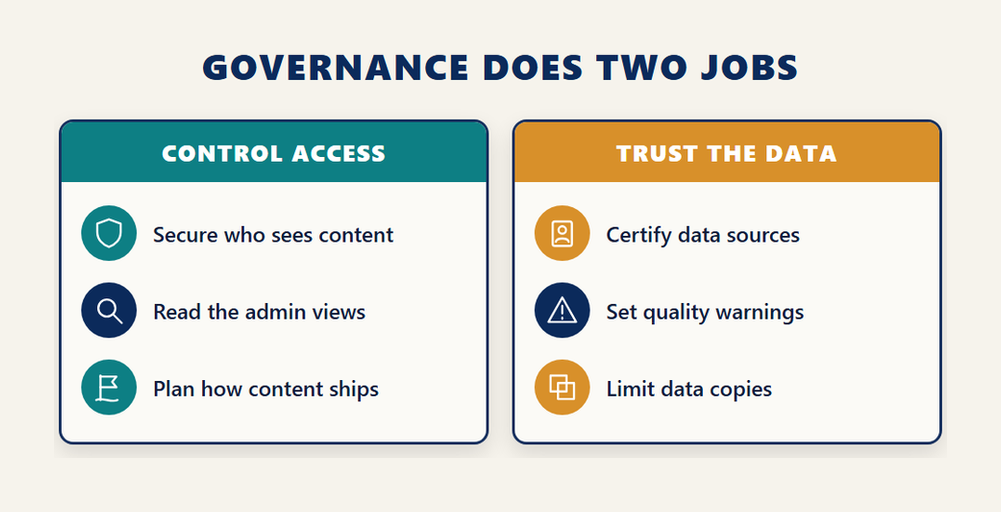
Governance questions tend to describe a policy and ask which features enforce it. Two goals sit side by side: controlling who sees what, and keeping people working from trusted data. If you want a vendor-neutral frame for that thinking, the DAMA data management body of knowledge treats governance and data quality as core disciplines, and its vocabulary maps well onto the exam’s wording.
Administrative views get their own objective group. You need to know which insights require an administrative view and which view and data source suit a given scenario. The distribution objectives then ask for an approach to the workbook lifecycle, covering building, testing, deployment, distribution and maintenance, which is where governance meets day-to-day delivery.
Who Is the Tableau Consultant Credential Built For?
The Tableau Consultant credential is built for people who advise on Tableau rather than only build in it: partner consultants, internal analytics leads, and senior developers who are asked to assess deployments, design data access and set standards. It suits candidates who already create advanced workbooks and want to prove they can recommend the right design for a customer.
Because the exam sits at the Advanced level, it is not an entry point. Candidates usually arrive after time with Tableau Desktop and Tableau Prep, and the recommended training is the Analyst and Designer learning paths. If you are still deciding between this credential and the platform side of the Tableau track, our guide to the Tableau Architect exam covers the implementation-focused alternative.
The role overlaps with administration and architecture but is not the same. A consultant is judged on whether the recommendation fits the customer, so the exam rewards people who ask why before how. That is the habit worth building during preparation.
How Should You Prepare for Analytics-Con-301?
Prepare for Analytics-Con-301 by following the weighting: spend the most time on calculations and workbook performance, then data connections and current-state evaluation, and finish with governance. Practise on real workbooks rather than reading alone, because the questions describe symptoms you need to have seen, such as a wrong total caused by filter order or a slow dashboard caused by design.
- Read the four domains and their objectives line by line, and mark each one you have never done in a real project.
- Rebuild the order of operations scenarios in Tableau Desktop until you can predict when a context filter or a FIXED LOD changes the answer.
- Run performance recordings on your own slow workbooks and practise naming the cause from the recording alone.
- Build each row-level security approach once, including an entitlement table, and write down when you would recommend each.
- Review governance features, administrative views and a content lifecycle against a policy you invent for a sample company.
- Finish with timed sample questions and review every miss against the objective it came from.
Readers who want a sense of where the credential leads after the exam can look at our piece on Tableau consultant career paths, written when the credential still carried the Tableau Certified Consultant name.
Frequently Asked Questions About the Salesforce Tableau Consultant Exam
How many questions are on the Salesforce Tableau Consultant exam?
Analytics-Con-301 has 60 questions and a 105 minute time limit, according to its syllabus page.
What score do you need to pass Analytics-Con-301?
The passing score is 63 percent.
How much does the Tableau Consultant exam cost?
Registration costs $200 USD and a retake costs $100 USD. The exam is booked through Pearson VUE.
Is Analytics-Con-301 the same as TCC-C01?
TCC-C01 and the Tableau Certified Consultant name appear in older material for this credential. The exam booked today is Analytics-Con-301, titled Salesforce Tableau Consultant, and it awards the Salesforce Certified Tableau Consultant credential.
Which domain carries the most weight?
Design and Troubleshoot Calculations and Workbooks carries 40 percent. Evaluate Current State and Plan and Prepare Data Connections carry 22 percent each, and Establish Governance and Support Published Content carries 16 percent.
Is the Tableau Consultant exam hands-on?
The syllabus is written as recommend, evaluate, identify and troubleshoot tasks, so expect scenario questions that ask for the best decision rather than a build in a live product.
What level is the Salesforce Certified Tableau Consultant credential?
Tableau lists it at the Advanced level, alongside the Data Analyst, Server Administrator and Architect credentials.
What training does the syllabus recommend?
The syllabus page lists the Analyst Learning Path and the Designer Learning Path as recommended training.
Does the exam cover row-level security?
Yes. The data connections domain asks you to implement RLS with an entitlement table, tell group functions from user functions, and compare RLS approaches.
Conclusion
The Salesforce Tableau Consultant exam rewards judgement. Its 60 questions, 105 minutes and 63 percent pass mark sit on four domains, and Design and Troubleshoot Calculations and Workbooks alone carries 40 percent, so the order of operations, performance recordings and multi-step calculations deserve the most practice. The two 22 percent domains test how you assess a deployment and plan data access, with row-level security at the centre, while governance rounds out the remaining 16 percent.
Study by weight, practise on real workbooks, and check every older note that still says TCC-C01 against the current figures. When you can explain why a recommendation fits a customer, not just how to build it, you are ready to book Analytics-Con-301.


