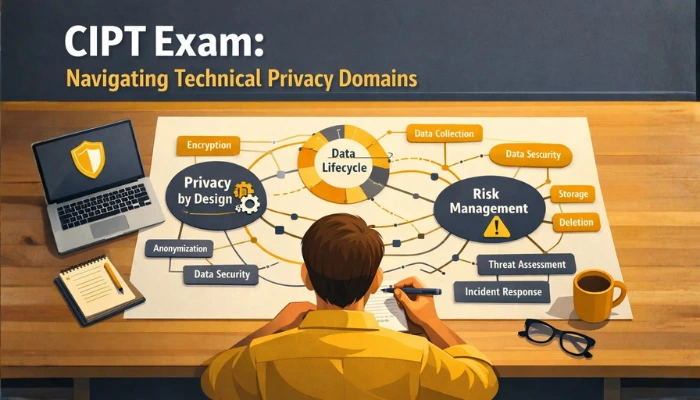
The IAPP CIPT (Certified Information Privacy Technologist) certification from the IAPP validates a professional’s expertise in privacy-enhancing technologies and the operationalization of privacy by design principles. In an increasingly data-driven world, the CIPT stands as a crucial credential for technologists tasked with embedding privacy into products, services, and operations from inception. This CIPT certification bridges the gap between legal privacy requirements and their practical technical implementation, making it indispensable for those building and maintaining privacy-conscious systems. It ensures that individuals possess the fundamental understanding to integrate privacy considerations throughout the entire technology lifecycle, thereby mitigating risks and fostering trust. The same body now runs an AI oversight credential, explained in our AIGP governance exam.
Understanding the IAPP CIPT’s Strategic Role
The IAPP CIPT Certification signifies more than just technical proficiency; it represents a forward-thinking approach to managing data and technology. It equips professionals with the knowledge to apply privacy principles in real-world scenarios, moving beyond theoretical understanding to practical application. This credential is vital for engineers, developers, and IT professionals who are at the forefront of designing and deploying systems that handle personal data responsibly. As regulatory landscapes evolve and consumer expectations for privacy heighten, the demand for individuals capable of translating policy into technical solutions grows exponentially. The CIPT plays a strategic role in cultivating a workforce that can proactively address privacy challenges.
CIPT Examination Structure and Scoring
Achieving the IAPP CIPT certification requires passing the CIPT exam, a comprehensive assessment designed to evaluate a candidate’s technical privacy knowledge. Understanding the exam’s format is crucial for effective preparation. The exam is administered by the IAPP and aims to certify individuals capable of applying privacy principles in technical contexts.
The IAPP CIPT exam details are as follows:
- Exam Name: IAPP Certified Information Privacy Technologist (CIPT)
- Exam Code: CIPT
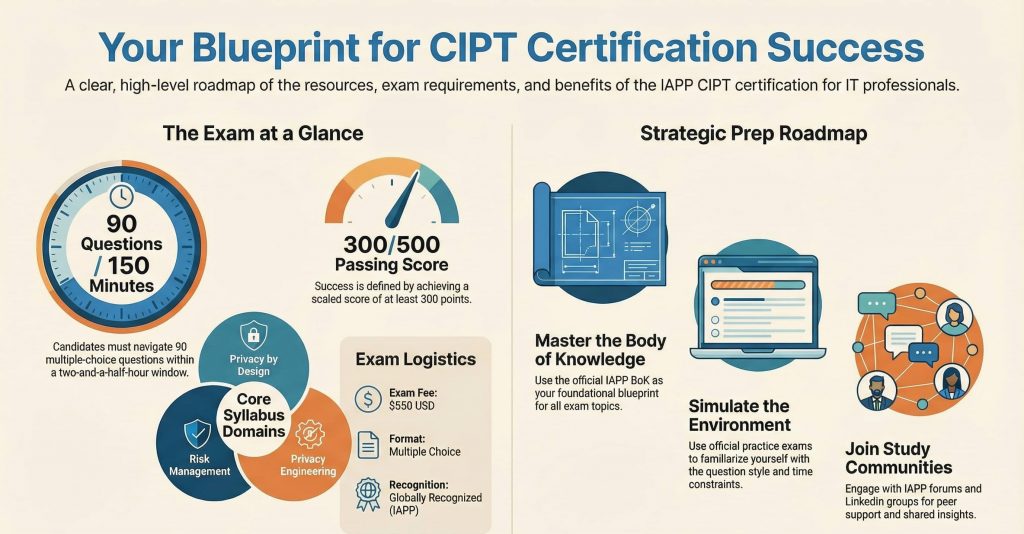
- Exam Price: $550 (USD)
- Duration: 150 minutes
- Number of Questions: 90
- Passing Score: 300 out of 500
This structure ensures a thorough evaluation of a candidate’s ability to navigate complex privacy engineering challenges and validate their readiness for a pivotal role in data protection.
Mastering Core Domains of Privacy Technology
The IAPP Certified Information Privacy Technologist exam syllabus covers critical domains essential for any professional in privacy engineering. These topics reflect the multifaceted nature of integrating privacy into technological solutions, emphasizing both conceptual understanding and practical application. Candidates must develop a robust grasp of each area to excel in their roles and pass the CIPT exam. The CIPT exam syllabus overview is comprehensive, covering the technical intricacies required for privacy implementation.
The core syllabus topics for the IAPP CIPT certification include:
- The privacy technologist’s role in the context of the organization.
- Data collection, use, dissemination, and destruction processes.
- Comprehensive privacy risk management strategies.
- Implementation of Privacy by Design principles.
- Foundations of privacy engineering and privacy governance.
Each domain builds upon the others, forming a holistic view of privacy management from a technical perspective.
Addressing Privacy Challenges Through Engineering
Privacy engineering is not merely about compliance; it’s about anticipating and mitigating risks inherent in data processing systems. This critical discipline, heavily emphasized in the IAPP CIPT Certification, involves applying engineering principles to build systems that respect user privacy by default and by design. Professionals with this certification can implement robust controls and mechanisms that protect personal data throughout its lifecycle. They are equipped to identify vulnerabilities, assess privacy impacts, and integrate technical solutions that make data protection an intrinsic part of system architecture, rather than an afterthought. This proactive stance is what differentiates a true privacy technologist.
Implementing Privacy by Design for Robust Systems
The concept of privacy by design is central to the IAPP CIPT’s philosophy, advocating for the embedding of privacy into the design and operation of information systems, network infrastructures, and business practices. This proactive approach ensures that privacy is the default setting for all data collection and processing activities. For CIPT-certified professionals, this means translating abstract principles into concrete technical specifications and architectural choices. They focus on solutions that minimize data, anonymize information, provide transparency, and offer user control, thereby creating systems that are inherently more trustworthy. Understanding privacy by design principles for IAPP CIPT is foundational.
Key tenets of Privacy by Design include:
- Proactive, not Reactive: Anticipating and preventing privacy breaches before they occur.
- Privacy as Default: Ensuring personal data is automatically protected in any IT system or business practice.
- Embedded Privacy: Integrating privacy into the design and architecture of IT systems.
- Full Functionality: Avoiding false dichotomies and ensuring privacy measures do not compromise functionality.
- End-to-End Security: Protecting data throughout its entire lifecycle.
- Visibility and Transparency: Keeping operations visible and understandable to stakeholders.
- Respect for User Privacy: Centering designs around user interests, offering strong privacy defaults, appropriate notice, and empowering user-friendly options.
This comprehensive framework guides technologists in creating resilient privacy infrastructures.
Unlocking Career Growth with CIPT Credentials
The IAPP CIPT certification significantly enhances career opportunities for technical professionals. In a market hungry for privacy expertise, holding this credential distinguishes individuals as specialists capable of tackling the complex intersection of technology and privacy law. Benefits of IAPP CIPT certification extend to various roles, from privacy engineers and architects to security analysts and IT managers. Companies are increasingly seeking professionals who can build privacy into their products and processes, rather than simply reacting to regulations. This certification opens doors to roles with greater responsibility, higher earning potential, and leadership positions in the privacy domain, making IAPP Certified Information Privacy Technologist career opportunities robust.
The career benefits of earning the CIPT include:
- Elevated Expertise: Demonstrates a deep understanding of privacy engineering principles.
- Enhanced Marketability: Positions you as a sought-after expert in data privacy technology.
- Increased Earning Potential: Often correlates with higher salaries in specialized privacy roles.
- Leadership Opportunities: Qualifies individuals for roles in developing and managing privacy programs.
- Global Recognition: The IAPP is a globally recognized authority in privacy, lending prestige to the certification.
- Contribution to Compliance: Empowers you to help organizations meet and exceed global privacy regulations.
These advantages solidify the CIPT’s value in a competitive professional landscape.
Crafting a Winning CIPT Exam Preparation Plan
Effective preparation is paramount for success in the IAPP CIPT exam. Candidates should adopt a structured approach, leveraging official resources and high-quality study materials. Developing a robust study plan involves understanding the CIPT exam syllabus overview deeply and allocating sufficient time to each domain. Many professionals question, “Is the IAPP CIPT exam difficult?” While challenging, thorough preparation significantly increases the chances of success. It’s not just about memorization; it’s about understanding the practical application of privacy technologies.
Essential Study Materials for CIPT Success
The best resources for IAPP CIPT exam preparation often combine theoretical knowledge with practical application. Official IAPP CIPT training courses online provide structured learning paths, which can be invaluable. Supplementing these with self-study materials and practice questions is highly recommended. Utilizing IAPP Certified Information Privacy Technologist study materials efficiently can make a substantial difference.
Key components of a strong preparation strategy include:
- Official IAPP Resources: The IAPP provides study guides, textbooks, and training specific to the CIPT exam. These resources are designed to cover all exam objectives and topics thoroughly.
- IAPP CIPT Training Courses: Engaging in structured courses, whether online or in-person, can provide a comprehensive overview and clarify complex concepts. Learn more about official IAPP CIPT training courses to enhance your study.
- Practice Questions: Regularly testing your knowledge with IAPP CIPT practice questions and answers helps identify areas of weakness and familiarizes you with the exam format. Finding quality CIPT practice questions is vital for realistic assessment.
- Study Groups and Forums: Collaborating with peers can offer diverse perspectives and reinforce understanding.
Avoid using “dumps” or unauthorized materials, as they compromise ethical preparation and often lead to failure. For comprehensive CIPT resources, consider exploring a reputable platform offering comprehensive CIPT resources.
Advancing Data Governance with Technical Acumen
The CIPT certification equips professionals with the technical acumen to implement and maintain effective data governance frameworks. This involves not only understanding policies but also knowing how to operationalize them through technology. Data privacy technology fundamentals IAPP CIPT encompass the tools and techniques used to protect data, manage consent, and ensure compliance with various regulations. CIPT-certified individuals are pivotal in translating legal requirements into functional system architectures, ensuring that data is handled ethically and securely at every stage. They are the architects of trustworthy data ecosystems, providing the technical leadership necessary for robust governance.
Integrating Privacy Technology into Operations
The practical application of privacy technology is central to a CIPT-certified professional’s role. This includes understanding encryption methods, data anonymization techniques, access controls, and secure development practices. These technical skills ensure that organizations can implement privacy by default and privacy by design in their systems and operations. The ability to integrate these technologies effectively is crucial for maintaining compliance and building consumer trust. It’s about making privacy an inherent part of the operational fabric.
Key areas of technological integration include:
- Data Masking and Anonymization: Techniques to protect sensitive data while allowing for analytics and testing.
- Access Control Mechanisms: Implementing role-based access controls and least privilege principles.
- Secure Development Life Cycles (SDLC): Embedding security and privacy checkpoints throughout software development.
- Privacy-Enhancing Cryptography: Utilizing encryption and hashing to protect data in transit and at rest.
- Consent Management Platforms: Deploying systems to manage and track user consent effectively.
These technical interventions are critical for building privacy-resilient systems.
Sustaining Expertise: CIPT Maintenance and Development
Earning the IAPP CIPT certification is a significant achievement, but maintaining its validity requires ongoing commitment to professional development. The privacy landscape is constantly evolving, with new technologies and regulations emerging regularly. IAPP CIPT certification renewal requirements ensure that certified professionals stay current with these changes, reinforcing their expertise and credibility. This continuous learning approach safeguards the value of the credential and ensures that CIPT holders remain at the forefront of privacy engineering.
To maintain your CIPT certification, you typically need to:
- Earn CPE Credits: Accumulate Continuing Privacy Education (CPE) credits over a two-year period by participating in privacy-related activities like attending conferences, webinars, or publishing relevant work.
- Pay Maintenance Fees: Keep your IAPP membership and certification current by paying applicable renewal fees.
- Stay Informed: Continuously engage with new developments in privacy laws, regulations, and technological advancements.
For detailed information on renewal, candidates should refer to the official IAPP CIPT page.
Conclusion
The IAPP CIPT certification is rapidly becoming a cornerstone for technologists navigating the complex world of data privacy. It signifies a profound commitment to ethical data handling and equips professionals with the specialized skills needed to engineer privacy into the very fabric of technological innovation. For those aiming to lead in the privacy engineering domain, the CIPT offers a clear path forward, solidifying expertise and unlocking unparalleled career opportunities. This credential is not just about compliance; it’s about pioneering the next generation of secure, trustworthy, and privacy-respecting systems.
Embark on your journey to becoming an IAPP Certified Information Privacy Technologist today and distinguish yourself as a leader in the privacy engineering frontier. Begin by exploring comprehensive study strategies and leveraging quality resources to prepare effectively. For more insights on how to pass your CIPT exam with confidence, discover effective CIPT strategies that lead to success.
Frequently Asked Questions
Q.1 What is the IAPP CIPT certification?
A. The IAPP CIPT (Certified Information Privacy Technologist) certification is a globally recognized credential that validates a professional’s expertise in designing, developing, and deploying privacy-protective technologies and practices within an organization. It bridges the gap between privacy law and technical implementation.
Q.2 How difficult is the IAPP CIPT exam?
A. The IAPP CIPT exam is considered challenging due to its comprehensive coverage of both technical concepts and privacy principles. Success requires dedicated study of the syllabus, practical understanding of privacy engineering, and extensive use of official and supplementary study materials.
Q.3 What are the career prospects for IAPP CIPT certified professionals?
A. IAPP CIPT certification significantly enhances career prospects in roles such as privacy engineer, privacy architect, IT manager, security consultant, and data protection officer. Demand for these specialized skills is high, leading to increased job opportunities and competitive salaries in the evolving privacy landscape.
Q.4 What is the cost associated with the IAPP CIPT certification?
A. The IAPP CIPT exam price is $550 (USD). This cost covers the exam registration fee, though additional expenses may include IAPP membership, official training courses, and study materials, which are separate investments in your preparation.
Q.5 What are the best study resources for the IAPP CIPT exam?
A. Effective study resources for the IAPP CIPT exam include official IAPP publications, CIPT training courses, and practice questions. Utilizing these materials helps candidates familiarize themselves with the exam objectives and topics, ensuring thorough preparation and a higher likelihood of success.


