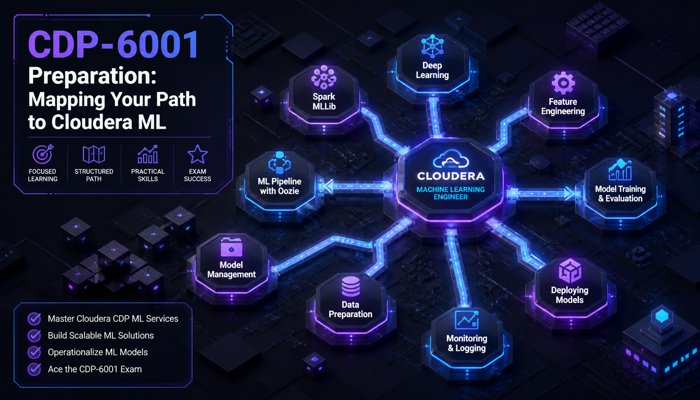
The Cloudera CDP Machine Learning Engineer (CDP-6001) certification validates a professional’s ability to develop, train, and deploy machine learning models using Cloudera Data Platform (CDP). This expert-level credential from Cloudera is designed for data scientists, machine learning engineers, and developers who work with large datasets and need to implement ML solutions efficiently within the Cloudera ecosystem. Achieving this certification demonstrates proficiency across various machine learning frameworks, data processing, and model deployment strategies specific to CDP. This article delves into the exam’s structure, syllabus, benefits, and provides critical insights to prepare effectively, emphasizing the role of quality Cloudera CDP-6001 practice question sets to ensure your readiness for the CDP-6001 exam.
Grasping the Cloudera CDP-6001 Fundamentals
Understanding the foundational elements of the Cloudera CDP Machine Learning Engineer certification is the first step towards successful preparation. This exam, identified by the code CDP-6001, is designed to thoroughly assess a candidate’s practical skills in applying machine learning concepts within the Cloudera Data Platform environment. It covers a broad spectrum of competencies required to build robust and scalable ML solutions. Knowing the specific details regarding the exam’s format and administrative aspects is crucial for candidates to manage their time and expectations effectively during the test.
The CDP-6001 exam is structured to challenge your understanding and application of machine learning principles. It is a timed assessment, requiring candidates to answer 45 questions within a 90-minute timeframe. This structure demands efficient decision-making and a solid grasp of the subject matter. The passing score for the CDP-6001 exam is set at 60%, emphasizing the need for comprehensive preparation across all covered topics. The cost to take this certification exam is $330 USD, a standard investment for a credential of this caliber. Prospective candidates can find comprehensive details about the exam, including registration procedures and the latest updates, by visiting the official exam page. Understanding these core parameters helps frame your study plan and preparation timeline.
CDP-6001 Exam at a Glance
To summarize the key information:
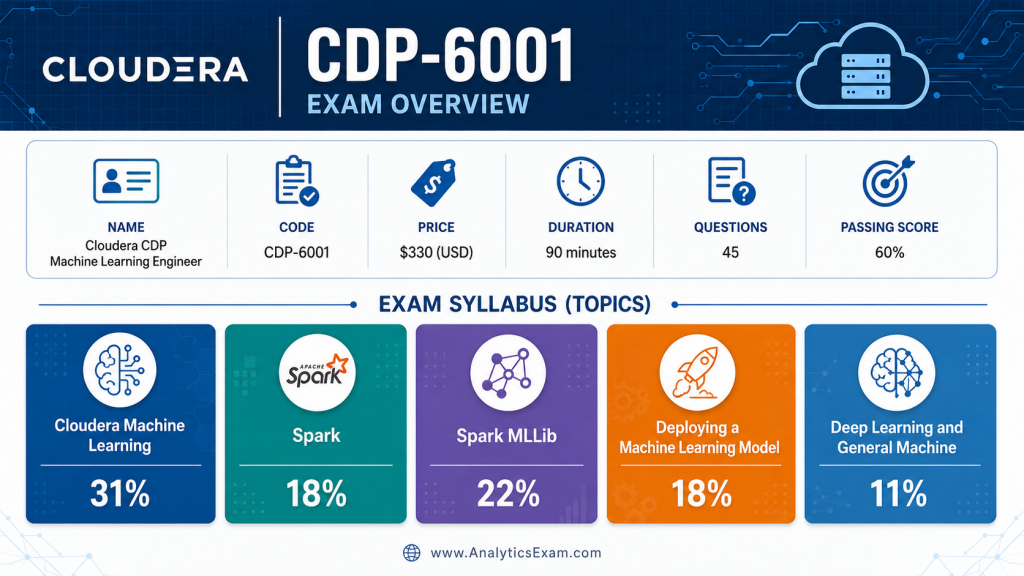
These details provide a clear overview of what to expect on exam day. The fixed duration and number of questions mean you will need to allocate approximately two minutes per question, highlighting the importance of not only knowing the answers but also being able to arrive at them efficiently.
Exploring the Cloudera Machine Learning Engineer Syllabus
The Cloudera CDP-6001 syllabus is meticulously designed to cover the core competencies a Machine Learning Engineer needs when working with Cloudera Data Platform. It outlines the specific technical areas and their respective weightages, providing a clear roadmap for your study efforts. A deep understanding of each domain is vital, as the exam questions are distributed proportionally according to these weightages. Candidates should prioritize their study time based on these allocations to ensure they cover the most impactful areas thoroughly.
The examination content is broken down into five primary domains, each focusing on a critical aspect of machine learning within the Cloudera ecosystem. These domains collectively build the profile of a skilled Cloudera CDP Machine Learning Engineer.
Cloudera Machine Learning (31%)
This significant portion of the exam focuses on your ability to utilize Cloudera Machine Learning (CML) effectively. It includes understanding CML workspaces, projects, engines, and how to interact with data in CDP. This section assesses your proficiency in setting up, managing, and running machine learning experiments within the Cloudera environment, including data access, feature engineering, and model training.
Spark (18%)
Apache Spark is a cornerstone of big data processing, and its application in machine learning is heavily tested. This section covers Spark’s core functionalities relevant to ML workloads, such as data manipulation with DataFrames and RDDs, understanding Spark architecture, and optimizing Spark jobs for performance. Proficiency in Spark SQL and batch processing is also typically examined here.
Spark MLLib (22%)
Spark MLlib is Spark’s machine learning library, offering a wide array of algorithms and utilities. This domain evaluates your knowledge of using MLlib for common machine learning tasks, including classification, regression, clustering, and collaborative filtering. It also assesses your ability to perform feature transformation, model selection, and evaluate model performance using MLlib tools.
Deploying a Machine Learning Model (18%)
Beyond training, the ability to deploy machine learning models into production is critical. This section focuses on the practical aspects of taking a trained model and making it accessible for inference. Topics typically include model serialization, understanding deployment options within CDP, creating API endpoints for models, and managing model versions and lifecycle.
Deep Learning and General Machine (11%)
While a smaller portion, this domain ensures candidates have a foundational understanding of deep learning concepts and broader machine learning principles. It may cover topics like neural network basics, popular deep learning frameworks (e.g., TensorFlow, PyTorch, though specific implementation details might be beyond the scope of this particular exam, general concepts are important), and advanced machine learning techniques that extend beyond Spark MLlib.
This detailed breakdown provides a clear outline of where your expertise should lie. Each section builds upon the others, forming a cohesive skill set for a modern machine learning engineer.
Cultivating Essential Skills for CDP-6001
Preparing for the Cloudera CDP-6001 certification goes beyond memorizing facts; it requires cultivating a robust set of skills that enable you to solve real-world machine learning challenges within the Cloudera Data Platform. Candidates must develop hands-on experience with the platform and its tools to confidently tackle the scenario-based questions often found in certification exams. This practical proficiency is what differentiates a theoretical understanding from actual engineering capability.
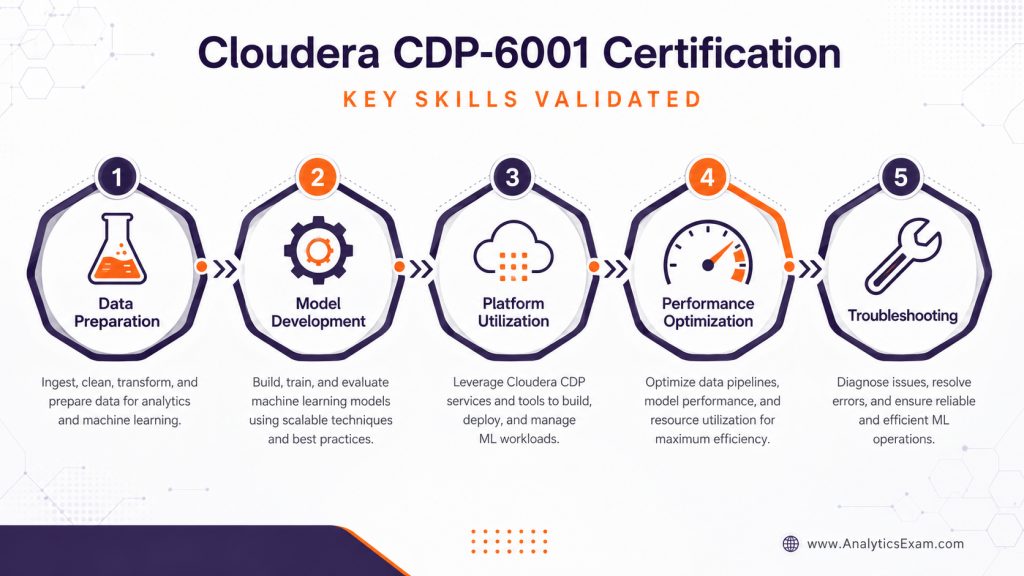
The skills validated by the CDP-6001 exam are directly aligned with the responsibilities of a machine learning engineer working with large-scale data. You will need to demonstrate competence in:
- Data Preparation: Effectively ingesting, transforming, and cleaning large datasets for machine learning using Spark. This includes handling various data formats, addressing missing values, and performing feature engineering.
- Model Development: Building and training various machine learning models (classification, regression, clustering) using Spark MLlib and potentially other frameworks within CML. This involves selecting appropriate algorithms and tuning hyperparameters.
- Platform Utilization: Navigating and operating the Cloudera Machine Learning (CML) environment, including managing projects, sessions, and deploying models as API endpoints. Familiarity with the CML workbench and its functionalities is key.
- Performance Optimization: Understanding how to optimize Spark applications for better performance when dealing with large datasets, ensuring efficient resource utilization and faster processing.
- Troubleshooting: Identifying and resolving common issues that arise during ML pipeline development, from data processing errors to model deployment failures, within the CDP ecosystem.
Developing these skills requires extensive practice, not just theoretical study. Working through labs, personal projects, and leveraging Cloudera’s own certification training programs can significantly enhance your practical abilities. This hands-on approach ensures you are not just familiar with the concepts but are proficient in their application.
Leveraging Cloudera CDP-6001 Practice Questions
One of the most effective strategies for passing the Cloudera CDP-6001 exam is the diligent use of high-quality practice questions. Engaging with Cloudera CDP-6001 practice questions allows candidates to familiarize themselves with the exam format, question types, and time constraints, building confidence and identifying areas that require further study. These practice questions are not merely a test of memory but an opportunity to apply your knowledge in a simulated exam environment, crucial for reinforcing learning and refining problem-solving techniques under pressure.
Effective use of practice questions involves more than just answering them. It requires a systematic approach to review and learn from every question, whether answered correctly or incorrectly. This iterative process helps solidify understanding and prevents repeating similar mistakes on the actual exam.
Familiarization with Exam Structure
Practice questions mirror the actual exam, exposing you to the types of scenarios and questions you’ll encounter. This helps reduce anxiety on exam day, as you’ll already be accustomed to the layout and pace.
Identifying Knowledge Gaps
By working through Cloudera CDP-6001 practice exams, you can pinpoint specific topics where your understanding is weak. This allows you to focus your subsequent study efforts more efficiently, rather than spending time on areas you’ve already mastered. Many candidates find sample questions particularly useful for this purpose.
Improving Time Management
The CDP-6001 exam has a strict time limit. Regular practice helps you develop a sense of pacing, ensuring you don’t spend too much time on any single question and can complete the exam within the allotted 90 minutes. Taking CDP-6001 mock tests under timed conditions is invaluable for this.
Reinforcing Concepts
Actively recalling information to answer practice questions strengthens your memory and deeper understanding of the concepts. It moves beyond passive reading to active learning, which is far more effective for retention.
Building Confidence
Consistently performing well in practice sessions can significantly boost your confidence for the actual exam. This psychological edge can be a critical factor in your overall performance, reducing stress and allowing you to think more clearly.
Remember, the goal of practice questions is not just to get the right answer, but to understand why an answer is correct or incorrect, and to learn the underlying principles. Avoid relying on unethical “exam dumps,” as they do not provide genuine understanding and can lead to failure. Focus instead on legitimate study materials and practice exams that build true competency.
Strategizing Your CDP-6001 Preparation Path
A well-structured preparation strategy is indispensable for succeeding in the Cloudera CDP-6001 certification exam. Given the breadth of topics and the practical nature of the questions, a methodical approach ensures comprehensive coverage and effective skill development. Your preparation should integrate various resources and learning techniques to cater to different aspects of the syllabus and your personal learning style. It is not just about quantity of study, but the quality and strategic deployment of your efforts.
Consider the following elements for a robust study plan:
1.Official Cloudera Resources
Start with the official documentation, training courses, and study guides provided by Cloudera. These resources are directly aligned with the exam objectives and offer the most accurate and up-to-date information. They often include hands-on labs that are crucial for practical skill development.
2. Hands-on Practice
Theoretical knowledge is insufficient for the CDP-6001 exam. Dedicate significant time to practical exercises, building and deploying machine learning models within a Cloudera Data Platform environment. This could involve setting up a sandbox environment, working through tutorials, or participating in online labs.
3. Study Groups and Forums
Engaging with a community of peers can provide valuable insights, different perspectives, and solutions to challenging problems. Online forums, professional networks, and study groups can be excellent resources for collaborative learning.
4. Regular Review and Revision
Schedule regular review sessions to revisit topics, especially those with higher weightage or where you identified knowledge gaps. Spaced repetition can significantly improve retention of complex concepts.
5. Mock Exams and Self-Assessment
Beyond individual practice questions, taking full-length CDP-6001 mock tests under timed conditions is vital. This helps simulate the real exam experience and refine your time management and stress handling skills. Critically review your performance to understand mistakes and areas for improvement.
By combining these strategies, you create a comprehensive and dynamic preparation framework that addresses both the theoretical and practical demands of the Cloudera CDP Machine Learning Engineer certification. Maintain a disciplined schedule and adapt your plan based on your progress and identified areas of weakness. For further guidance on structuring your study, exploring a detailed exam roadmap can be highly beneficial.
Unlocking Career Growth with Cloudera Certification
Achieving the Cloudera CDP Machine Learning Engineer certification is more than just passing an exam; it represents a significant milestone in your professional journey, unlocking numerous avenues for career growth and professional validation. In today’s data-driven world, organizations are increasingly seeking professionals who can not only understand machine learning concepts but also implement them effectively on enterprise-grade platforms. The CDP-6001 credential signals to employers that you possess these crucial, in-demand skills.
The benefits of holding a Cloudera CDP Machine Learning Engineer certification extend across several dimensions:
- Enhanced Credibility: The certification serves as a robust testament to your expertise, differentiating you in a competitive job market. It provides objective proof of your ability to work with Cloudera’s leading data platform for machine learning.
- Increased Earning Potential: Certified professionals often command higher salaries compared to their non-certified counterparts. The specialized skills validated by CDP-6001 are highly valued, reflecting directly in compensation.
- Career Advancement: Holding this certification can open doors to more senior roles and specialized projects within your organization or with new employers. It demonstrates a commitment to professional development and a mastery of advanced ML techniques.
- Validation of Expertise: The CDP-6001 validates a specific set of skills that are critical for success in machine learning engineering, ensuring you are proficient in data preparation, model training, deployment, and operationalization within Cloudera CDP.
- Expanded Professional Network: Being part of the Cloudera certified professional community can lead to networking opportunities with other experts and thought leaders in the big data and machine learning space.
- Contribution to Organizational Success: With validated skills, you can contribute more effectively to your organization’s data science initiatives, driving innovation and delivering tangible business value through robust ML solutions.
This certification is a strategic investment in your future, providing a clear pathway for professional development in the dynamic field of machine learning. It solidifies your position as a capable and recognized expert in the Cloudera ecosystem. Keep up with Cloudera’s ecosystem and announcements through their social channels, like Cloudera on social media.
The Cloudera CDP Machine Learning Engineer (CDP-6001) certification is a powerful credential for professionals aiming to solidify their expertise in machine learning on the Cloudera Data Platform. From understanding the exam’s structure and comprehensive syllabus to employing effective preparation strategies and leveraging quality practice questions, every step contributes to a higher chance of success. This certification not only validates your technical skills but also propels your career forward in the ever-evolving world of data science and machine learning.
Ready to solidify your machine learning engineering expertise with Cloudera? Don’t leave your CDP-6001 exam success to chance. Prepare effectively by integrating official study resources, hands-on practice, and robust self-assessment into your routine. Start practicing with high-quality sample questions to gauge your readiness and refine your skills, and explore a broader range of Cloudera certifications to plan your entire professional development journey. Access a comprehensive study guide to ensure you cover all necessary topics in depth.
Frequently Asked Questions
1. What is the passing score for the Cloudera CDP-6001 exam?
The passing score for the Cloudera CDP Machine Learning Engineer (CDP-6001) certification exam is 60%. Candidates need to achieve this score or higher to successfully earn the credential.
2. How many questions are on the CDP-6001 exam and what is the duration?
The CDP-6001 exam consists of 45 questions, and candidates are allotted 90 minutes to complete the exam. This requires efficient time management during the test.
3. What are the main topics covered in the Cloudera CDP Machine Learning Engineer syllabus?
The main topics covered include Cloudera Machine Learning (31%), Spark (18%), Spark MLLib (22%), Deploying a Machine Learning Model (18%), and Deep Learning and General Machine (11%).
4. Are there any prerequisites for taking the CDP-6001 exam?
While Cloudera typically recommends prior experience with machine learning concepts and working knowledge of the Cloudera Data Platform, there are generally no strict certification prerequisites. However, practical experience is highly advised for success.
5. Why is using Cloudera CDP-6001 practice questions important for preparation?
Cloudera CDP-6001 practice questions are crucial for familiarizing candidates with the exam format, identifying knowledge gaps, improving time management, and reinforcing conceptual understanding, all of which are vital for exam success. They help build confidence and assess readiness.


