The EC-Council 712-50 CCISO Exam represents a pinnacle for information security professionals aspiring to executive leadership. This Certified Chief Information Security Officer (CCISO) certification validates the critical knowledge and skills necessary to design, implement, and manage a robust information security program aligned with organizational goals, ensuring resilience against evolving threats. Designed for current and aspiring CISOs, CIOs, Chief Compliance Officers, and other senior information security leaders, this certification is a strategic investment for those ready to shape the future of cybersecurity within their enterprise. This article explores the profound benefits, comprehensive exam structure, and strategic preparation insights to help you navigate the EC-Council 712-50 CCISO exam successfully, unlocking advanced career opportunities and reinforcing your expertise in security governance.
Architecting Security Leadership with EC-Council CCISO
The EC-Council Certified Chief Information Security Officer (CCISO) program is meticulously designed to recognize and empower top-tier information security executives, equipping them with the multifaceted expertise demanded by today’s complex digital landscape. This esteemed credential focuses on the advanced technical and management acumen required to lead enterprise security initiatives, moving beyond purely technical skills to encompass strategic planning, financial management, and effective communication with executive boards. Achieving this certification signifies a candidate’s readiness to steer an organization’s security posture, influencing policies and culture from a C-suite perspective.
In an era where cybersecurity threats pose existential risks to businesses, the CISO role has evolved from a technical gatekeeper to a strategic business enabler. The CCISO program precisely addresses this shift, preparing leaders not just to respond to incidents, but to proactively integrate security into every facet of business operations. It cultivates a holistic understanding of enterprise risk, regulatory compliance, and the intricate balance between security imperatives and business innovation. This certification is a testament to an individual’s capacity to lead high-performing security teams, manage large-scale security projects, and articulate complex security risks in terms meaningful to non-technical stakeholders.
Furthermore, the CCISO credential underlines the importance of a CISO’s role in corporate governance, emphasizing ethical leadership and the diligent management of information assets. It acknowledges that a modern CISO must not only understand technology but also navigate complex business landscapes, regulatory demands like GDPR and CCPA, and the nuances of human behavior that often serve as the weakest link in any security chain. The CCISO certification is, therefore, a testament to a comprehensive understanding of information security leadership, transcending traditional technical roles to embrace a full spectrum of executive responsibilities.
EC-Council 712-50 Exam Blueprint: Structure and Details
Understanding the foundational structure of the EC-Council 712-50 CCISO exam is the first critical step towards a focused and effective preparation strategy. This examination is a rigorous, comprehensive assessment designed to differentiate true executive-level professionals in the cybersecurity domain. It ensures candidates possess the expansive knowledge and strategic foresight required to excel in the demanding Chief Information Security Officer role, capable of making high-stakes decisions under pressure.
The EC-Council 712-50 exam blueprint is structured to evaluate a candidate’s proficiency across a broad spectrum of information security management and leadership competencies. It combines technical depth with strategic thinking, mirroring the diverse challenges a CISO faces daily. This strategic examination solidifies a professional’s credibility and validates their readiness for executive leadership.
Key details of the 712-50 exam include:
• Exam Name: EC-Council Certified Chief Information Security Officer (CCISO)
• Exam Code: 712-50
• Exam Price: $999 (USD), reflecting the premium nature and value of this executive-level credential.
• Duration: Candidates are allotted 150 minutes to complete the examination, requiring efficient time management and a quick grasp of complex scenarios.
• Number of Questions: The exam comprises 150 multiple-choice questions, each designed to test practical application and strategic decision-making, not just theoretical recall.
• Passing Score: Typically ranges from 60-85%. This variable passing score is indicative of EC-Council’s psychometric analysis, ensuring that the threshold accurately reflects the difficulty and maintains the integrity of the certification.
This demanding structure emphasizes both breadth and depth of knowledge, requiring candidates to not only recall facts but also apply strategic thinking to complex, real-world scenarios. Professionals seeking to validate their senior-level expertise will find the EC-Council 712-50 CCISO exam a comprehensive and fitting challenge. Further insights on exam costs, domains, and preparation strategies can be found by exploring a complete guide to CCISO, which offers detailed information on exam logistics and strategic advice.
Cultivating Expertise Across Core Domains
The EC-Council 712-50 CCISO exam spans five critical domains, each representing a foundational pillar of effective information security leadership. Mastery of these areas demonstrates a CISO’s capacity to oversee diverse aspects of an organization’s security landscape, from policy formulation and regulatory compliance to operational execution and strategic financial management. These domains are designed to ensure certified professionals are well-rounded leaders, capable of addressing the multifaceted challenges of modern cybersecurity with authority and foresight.
The comprehensive syllabus highlights the intricate balance between technical understanding, managerial acumen, and strategic planning that defines a successful CISO. Each domain builds upon the other, creating a cohesive framework for managing an enterprise’s security posture.
Exam Content Areas: Navigating the CCISO Syllabus
The 712-50 exam systematically evaluates your proficiency across the following key areas, each demanding a distinct set of skills and knowledge:
• Governance and Risk Management: This domain is paramount for any CISO, focusing on the establishment of a comprehensive information security governance framework. It covers the principles of managing enterprise risk, conducting risk assessments, and ensuring that security strategies are fully aligned with the overarching business objectives. Key elements include understanding legal, regulatory, and contractual requirements (such as SOX, HIPAA, PCI DSS, GDPR), developing effective security policies, and fostering a culture of risk awareness throughout the organization.
• Information Security Controls, Compliance and Audit Management: This domain delves into the practical implementation, maintenance, and oversight of robust security controls. It encompasses adherence to various compliance mandates, ensuring that the organization meets both internal and external standards. A significant portion covers the effective management of security audits, including planning, execution, and follow-up on audit findings to drive continuous improvement. Understanding control frameworks like ISO 27001, NIST, and COBIT is crucial here, alongside managing incident response and business continuity planning.
• Security Program Management & Operations: This area focuses on the strategic planning, execution, and ongoing management of an organization’s entire security program. It encompasses the daily security operations, resource allocation, and the continuous monitoring of security posture to protect critical assets. Topics include security project management, managing security budgets, vendor management, and the overall operational efficiency of security initiatives. This domain stresses the leadership skills required to build, operate, and mature a security program.
• Information Security Core Competencies: A broad and deep domain covering essential security technologies, methodologies, and best practices that underpin enterprise security. While a CISO is not expected to be a hands-on engineer in every area, a strong conceptual and practical understanding is indispensable for informed decision-making and effective team leadership. This includes:
• Access Control: Implementing and managing authentication, authorization, and accounting mechanisms.
• Social Engineering, Phishing Attacks, Identity Theft: Understanding and mitigating human-centric attack vectors.
• Physical Security: Protecting data centers, facilities, and physical assets from unauthorized access.
• Disaster Recovery and Business Continuity Planning: Ensuring organizational resilience and continuous operation in the face of disruptions.
• Firewall, IDS/IPS and Network Defense Systems: Deploying and managing network perimeter and internal segmentation defenses.
• Wireless Security: Securing Wi-Fi networks and other wireless communication channels.
• Virus, Trojans and Malware, and other Malicious Code Threats: Strategies for prevention, detection, and eradication.
• Secure Coding Best Practices and Securing Web Applications: Understanding development lifecycle security and common web vulnerabilities.
• OS Hardening: Securing operating systems against common exploits and misconfigurations.
• Encryption Technologies: Implementing cryptographic solutions for data protection in transit and at rest.
• Vulnerability Assessment and Penetration Testing: Identifying and remediating security weaknesses proactively.
• Threat Management: Developing and implementing strategies to identify, assess, and mitigate emerging threats.
• Incident Response and Computer Forensics: Handling security incidents effectively and conducting post-incident analysis.
• Application Security: Ensuring security throughout the software development lifecycle.
• Virtualization Security: Securing virtualized environments and cloud infrastructure components.
• Cloud Computing Security: Addressing security challenges and best practices in various cloud deployment models.
• Transformative Technologies: Understanding the security implications of AI, IoT, blockchain, and other emerging technologies.
This extensive list underscores the technical breadth expected of a CISO, even in a leadership role, enabling them to speak knowledgeably with their technical teams.
• Strategic Planning, Finance, Procurement, and Third-Party Management: This domain addresses the business-centric aspects of the CISO role, vital for aligning security with enterprise goals. It includes developing long-term security strategies, managing security budgets effectively, overseeing procurement processes for security solutions, and meticulously managing security risks associated with third-party vendors and supply chains. This requires a strong grasp of financial planning, contract negotiation, and due diligence in vendor selection.
These domains collectively form the robust foundation upon which an effective CISO operates, ensuring both technical soundness and strategic business alignment crucial for safeguarding modern enterprises.
Elevating Career Trajectories and Leadership Impact
Pursuing the EC-Council CCISO certification is a definitive step toward not just advancing a career, but fundamentally transforming a professional trajectory, unlocking unparalleled opportunities in senior cybersecurity leadership. This credential is specifically designed to empower individuals with the leadership skills, strategic vision, and comprehensive understanding required to excel at the highest echelons of information security management. It bridges the critical gap between deep technical expertise and executive decision-making, positioning certified professionals as indispensable assets in any organization committed to robust security.
In a rapidly evolving threat landscape, the demand for competent and visionary Chief Information Security Officers has never been greater. The CCISO certification equips leaders to meet this demand head-on, preparing them to tackle complex challenges ranging from sophisticated cyberattacks to intricate regulatory compliance. It’s an investment that yields significant dividends in both personal growth and organizational resilience, cementing a professional’s status as a trusted advisor and strategic leader. Those leaders depend on an intelligence function beneath them, and the threat intelligence analyst certification sets out what EC-Council expects from it.
Strategic Advantages of CCISO Certification: Unlocking New Potential
The value derived from achieving this esteemed certification extends far beyond personal recognition, offering profound and tangible benefits for both individuals and their organizations:
• Enhanced Executive Credibility: The CCISO designation immediately signals a professional’s comprehensive understanding of modern security challenges, earning respect from peers, subordinates, and executive leadership. It provides the confidence to engage with board members and C-suite colleagues on strategic security matters.
• Strategic Influence and Business Alignment: Certified CISOs are better equipped to align security initiatives with overarching business objectives, translating complex technical risks into understandable business terms for board-level discussions and investment justifications. This ability to bridge the technical-business divide is a hallmark of true executive leadership.
• Increased Earning Potential and Career Advancement: As a high-level executive certification, the CCISO often correlates with significantly higher salary expectations and more senior, influential roles within organizations. It positions candidates for top-tier Chief Information Security Officer career path EC-Council CCISO opportunities, showcasing their readiness for greater responsibilities.
• Mastery of Security Governance and Risk Management: The program deepens expertise in establishing robust governance frameworks, proactive risk management strategies, and comprehensive compliance protocols. This mastery is crucial for protecting organizational assets, maintaining reputation, and ensuring regulatory adherence.
• Global Recognition and Networking: EC-Council certifications are globally recognized, opening doors to leadership opportunities across various industries and geographies. Furthermore, becoming part of the exclusive CCISO community provides unparalleled networking opportunities with a global cadre of elite cybersecurity executives.
• Driving Innovation and Resilience: CCISO-certified professionals are adept at integrating innovative security solutions while building resilient security architectures. They foster a culture of security awareness that permeates the entire organization, reducing overall risk exposure.
This certification is not merely a badge of honor; it is an affirmation of a professional’s capacity to lead, innovate, and protect in an ever-evolving threat landscape. For a comprehensive look at how this certification can future-proof your CISO career, consider insights from industry thought leaders.
Strategic Preparation for the 712-50 Examination
Successful navigation of the EC-Council 712-50 CCISO exam requires more than just raw technical knowledge; it demands a strategic, multi-faceted preparation approach that addresses both theoretical understanding and the practical application of CISO responsibilities. Candidates must immerse themselves deeply in the five core domains, ensuring a balanced grasp of governance principles, core technical competencies, and essential business acumen. This comprehensive preparation journey builds not only confidence but also genuine readiness for the rigorous assessment and the responsibilities that follow.
The CCISO exam is designed to test experience and leadership judgment, making methodical study and practical reflection indispensable. Generic test-taking strategies alone will not suffice; a tailored approach focused on real-world application is key.
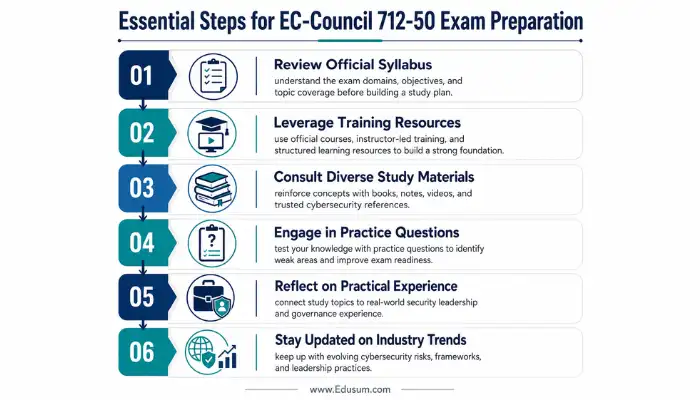
Crafting an Effective Study Plan for the EC-Council 712-50 CCISO Exam
1. Thoroughly Review Official Syllabus: Begin your preparation by meticulously understanding the EC-Council’s official CCISO syllabus. Each domain and sub-topic merits focused attention, highlighting areas where your current expertise might need reinforcement. Develop a study roadmap that allocates time proportionate to the complexity and weight of each section.
2. Leverage Official Training Resources: EC-Council offers official training programs designed to prepare candidates comprehensively for the 712-50 exam. These courses, whether in-person or through an Online EC-Council CCISO certification course, often include expert instruction, hands-on labs, and real-world case studies critical for developing a CISO’s strategic mindset. They provide structured learning that aligns directly with exam objectives.
3. Consult Diverse Study Materials: Supplement official training with a variety of EC-Council 712-50 study materials, including reputable textbooks on information security management, whitepapers from leading industry organizations, and relevant industry reports. A broad perspective enhances understanding of complex security management principles and diverse approaches. For a dedicated and structured resource, consider downloading an EC-Council 712-50 study guide.
4. Engage in Practice Exam Questions: Regularly utilize 712-50 practice exam questions EC-Council to familiarize yourself with the exam format, question types, and the critical skill of time management. This helps identify knowledge gaps, builds test-taking endurance, and refines your ability to apply concepts under pressure. While Edusum offers practice tests, candidates should focus on understanding the underlying concepts rather than memorizing questions.
5. Reflect on Practical Experience: The CCISO exam is heavily experience-based, valuing the application of knowledge in real-world scenarios. Actively reflect on your own professional experiences in information security leadership, connecting theoretical concepts learned during study to practical situations you’ve encountered or managed. This mental exercise is crucial for developing the judgment tested in the exam.
6. Stay Updated on Industry Trends: The cybersecurity landscape is dynamic. Continuously educate yourself on the latest threats, technologies, and regulatory changes. Subscribing to industry newsletters, attending webinars, and participating in professional forums can keep your knowledge current.
Ethical preparation, avoiding any form of illicit “dumps” or unauthorized materials, is paramount for ensuring the integrity of your certification and the genuine value it represents to your career and the industry. Focus on deep learning and understanding, rather than rote memorization, to truly benefit from the EC-Council Chief Information Security Officer training.
Fulfilling the CCISO Eligibility Criteria
The EC-Council CCISO certification is fundamentally an experience-based credential, a deliberate design choice that underscores its focus on practical leadership and seasoned judgment rather than purely academic or entry-level technical knowledge. Aspiring candidates must meet specific and rigorous eligibility criteria to qualify for the 712-50 exam, reflecting the advanced nature and profound responsibilities of the Chief Information Security Officer role. Understanding these EC-Council CCISO certification requirements upfront is absolutely essential for planning your certification journey and ensuring your readiness.
This emphasis on validated experience reinforces the CCISO’s position as a premium certification for information security executives. It ensures that those who achieve the credential have not only the theoretical understanding but also the proven ability to apply complex security management principles in real-world organizational settings, navigating both technical and political landscapes.
Key Eligibility Pathways for the EC-Council 712-50 Exam:
To sit for the EC-Council 712-50 exam, candidates must generally demonstrate substantial and verifiable experience in information security management. The primary pathways for eligibility include:
• Formal Training & Required Experience: This pathway involves completing an official EC-Council CCISO training program, either through an accredited training center, online, or via self-study. Alongside this, candidates are typically required to possess at least five years of experience working in at least three of the five CCISO domains. This combined approach ensures both structured learning and practical application.
• Extensive Experience Pathway: For highly experienced professionals who may not have undergone formal CCISO training, a more extensive background is required. Candidates pursuing this pathway must demonstrate a minimum of ten years of verifiable experience across at least three of the five CCISO domains. This option acknowledges and values the depth of knowledge gained through prolonged, hands-on leadership in information security.
Regardless of the chosen pathway, all experience must be thoroughly documented and verified through a stringent application process. This typically includes submitting detailed résumés, providing references, and potentially supervisor endorsements or other official proof of professional engagement. This rigorous vetting process ensures that only genuinely experienced and qualified professionals are awarded the prestigious CCISO designation, thereby maintaining its high industry standing and credibility. For comprehensive details on the application process and specific requirements, it is highly recommended to refer to the official EC-Council CCISO program page. Ensuring you meet these prerequisites is a crucial first step toward earning your certification.
Maximizing Return on Investment from CCISO
The investment in the EC-Council CCISO certification extends far beyond the financial costs, encompassing significant commitments of time, intellectual effort, and sustained professional development. Evaluating the comprehensive return on investment (ROI) is therefore crucial for any aspiring or current CISO contemplating this advanced credential. This certification promises substantial value, translating into tangible career advancement, increased strategic influence, and a reinforced professional standing. The question of “Is EC-Council CCISO worth it?” is consistently answered affirmatively by those who have leveraged its power to redefine their leadership capabilities and impact.
The CCISO’s ROI is multifaceted, reflecting its holistic approach to security leadership. It’s not just about earning a higher salary, though that is a common outcome; it’s about gaining the strategic insight to drive organizational resilience and contribute at the highest executive levels. This credential acts as a catalyst for deeper professional engagement and greater organizational trust.
Realizing the Value of EC-Council CCISO Certification: Beyond the Credential
• Enhanced Leadership Prowess: The CCISO program is specifically designed to cultivate strategic security leadership EC-Council CCISO, equipping professionals to manage complex security programs effectively, ethically, and in alignment with business objectives. It hones skills in governance, risk, and compliance that are invaluable at the executive level.
• Profound Organizational Impact: Certified CISOs are better positioned to drive meaningful organizational change, implement resilient security architectures, and foster a pervasive culture of security awareness. Their strategic contributions directly enhance business continuity, protect intellectual property, and safeguard the organization’s reputation in the face of cyber threats.
• Significant Market Differentiation: In a competitive job market saturated with various cybersecurity certifications, the CCISO acts as a powerful differentiator. It signals to potential employers an advanced level of expertise, executive readiness, and a proven track record in information security leadership. This distinction often leads to increased EC-Council Chief Information Security Officer salary expectations and access to more prestigious roles.
• Unparalleled Networking Opportunities: Becoming part of the exclusive EC-Council CCISO community opens doors to a global network of elite cybersecurity professionals. This vibrant network fosters invaluable knowledge sharing, collaborative problem-solving, and peer mentorship, providing continuous professional growth and support.
• Confidence in Executive Decision-Making: The comprehensive understanding gained through the CCISO program empowers leaders to make confident, informed decisions regarding security investments, policy development, and incident response, ensuring optimal resource allocation and risk mitigation.
The value of EC-Council CCISO certification is consistently demonstrated through the accelerated career trajectories of its holders, who often ascend to pivotal leadership roles, guiding their organizations through the complex and ever-evolving cybersecurity landscape with unmatched expertise and vision.
Sustaining Your Strategic Security Credential
Achieving the EC-Council CCISO certification is undeniably a significant professional milestone, but maintaining its relevance and validity is an ongoing commitment rather than a one-time achievement. The cybersecurity landscape evolves at a breathtaking pace, necessitating continuous learning, skill refinement, and professional development. The CCISO certification renewal process EC-Council is thoughtfully designed to ensure that certified professionals remain current with the latest threats, emerging technologies, regulatory shifts, and best practices, thereby preserving the integrity, prestige, and tangible value of the credential in the long term.
This commitment to continuous learning underscores the dynamic nature of the CISO role. An effective security leader cannot afford for their knowledge to become stagnant; they must continually adapt and grow to effectively defend against new adversaries and vulnerabilities. The renewal process supports this imperative, ensuring that CCISO holders remain at the forefront of the industry.
Maintaining CCISO Status: The Path to Continued Excellence
Maintaining your CCISO status typically involves accumulating a specified number of Continuing Professional Education (CPE) credits over a designated renewal cycle, usually every three years. These credits serve as proof of ongoing engagement with the cybersecurity field and commitment to professional growth. CPE credits can be earned through various enriching activities, including:
• Attending Industry Events: Participating in cybersecurity conferences, seminars, workshops, and webinars offers exposure to new trends, technologies, and thought leadership.
• Professional Development Courses: Enrolling in advanced cybersecurity courses, executive leadership programs, or specialized training outside of the initial certification.
• Contributions to the Field: Publishing articles or research papers on information security topics, presenting at industry events, or actively contributing to the development of cybersecurity standards and best practices.
• Mentoring and Teaching: Sharing knowledge by teaching cybersecurity courses, mentoring junior professionals, or leading internal training initiatives.
• Professional Engagement: Active participation in professional cybersecurity organizations, peer groups, or advisory boards.
• Vendor Neutral Learning: Any structured learning related to information security management, strategic planning, or risk governance, provided it enhances the CISO’s capabilities.
This proactive approach to professional development ensures that the EC-Council Chief Information Security Officer leadership skills remain sharp, adaptive, and relevant to the demands of a constantly shifting threat landscape. Regular engagement with the broader cybersecurity community and diligent adherence to the specified renewal requirements are key to sustaining this prestigious and highly valued credential, ensuring your expertise remains cutting-edge and impactful.
Conclusion
The EC-Council 712-50 CCISO exam serves as a robust benchmark for senior information security professionals ready to embrace strategic leadership and steer their organizations through the complex digital era. It offers a comprehensive validation of the advanced skills required to architect, implement, and manage enterprise-level security programs, demonstrating an executive’s capacity to navigate intricate business and technical challenges with acumen and foresight. Achieving this certification not only elevates individual career prospects but also significantly strengthens an organization’s overall security posture and resilience against an ever-evolving threat landscape.
Embarking on the CCISO journey is a profound investment in your future, transforming you into a highly capable and globally recognized leader within the elite cybersecurity community. It equips you with the strategic perspective and executive skills necessary to influence decision-making at the highest levels, ensuring that security is not just a technical function but a core business enabler. For those prepared to make a definitive impact and shape the future of information security, the path through the EC-Council 712-50 CCISO exam leads directly to the forefront of strategic security management, where leadership truly counts. Discover how the EC-Council Certified Chief Information Security Officer can redefine your professional trajectory and empower you to lead with confidence. Explore more about the EC-Council Chief Information Security Officer credential and how it can propel your career forward in this critical domain. For a full guide on launching your CISO career and accessing valuable study aids, you can also download comprehensive resources designed to support your journey, launch your CISO career.
Frequently Asked Questions
1. What is the EC-Council 712-50 CCISO Exam?
The EC-Council 712-50 CCISO Exam is the certification assessment for the Certified Chief Information Security Officer credential, validating a professional’s expertise in developing and managing an enterprise information security program. It covers governance, risk, compliance, security operations, and strategic planning from an executive perspective.
2. Who should pursue the EC-Council CCISO certification?
This certification is ideal for current and aspiring CISOs, CIOs, Chief Compliance Officers, Information Security Managers, and other senior-level professionals aiming for executive leadership roles in information security. It targets individuals with significant experience in managing security programs.
3. What are the primary benefits of earning the EC-Council CCISO?
Benefits include enhanced executive credibility, increased strategic influence within an organization, higher earning potential, mastery of security governance, and global recognition. It bridges the gap between technical and business leadership in cybersecurity.
4. What are the experience requirements for the EC-Council 712-50 exam?
Candidates typically need at least five years of experience in at least three of the five CCISO domains with official training, or ten years of experience in at least three domains without formal training. All experience must be verifiable through an application process.
5. How can I best prepare for the EC-Council 712-50 CCISO Exam?
Effective preparation involves reviewing the official syllabus, attending EC-Council’s training programs, utilizing diverse study materials, engaging with practice exam questions, and reflecting on practical leadership experiences. Ethical study practices are crucial for success.


