The Fortinet NSE 6 – FortiEDR 7.0 Administrator certification (NSE6_EDR_AD-7.0) is not merely a checkbox exercise; it validates an administrator’s advanced proficiency in deploying, managing, and troubleshooting FortiEDR solutions. This credential signifies a deep understanding of endpoint detection and response, crucial for protecting modern enterprises against sophisticated cyber threats. Targeted at cybersecurity professionals, system administrators, and security engineers, the NSE6_EDR_AD-7.0 exam assesses the practical skills required to effectively leverage FortiEDR 7.0 for robust endpoint security. This comprehensive article delves into the realistic expectations for this exam, the depth of knowledge required, and effective strategies to ensure success, covering everything from the syllabus to ethical preparation methods.
Unpacking the NSE6_EDR_AD-7.0 Exam Core Elements
Successfully navigating the Fortinet NSE6_EDR_AD-7.0 exam demands a clear understanding of its structure and requirements. This certification is a critical milestone for professionals aiming to specialize in FortiEDR administration, confirming their capability to manage and maintain one of Fortinet’s pivotal security offerings. Candidates should be aware of the specific parameters that define the assessment, ensuring their preparation is both focused and comprehensive. The exam is designed to test not just theoretical knowledge but also practical application in real-world scenarios.
The fundamental details of the NSE6_EDR_AD-7.0 exam are as follows:
- Exam Name: Fortinet NSE 6 – FortiEDR 7.0 Administrator
- Exam Code: NSE6_EDR_AD-7.0
- Exam Price: $200 USD
- Duration: 70 minutes
- Number of Questions: 30-35
- Passing Score: Pass / Fail
These parameters highlight the fast-paced nature of the exam, emphasizing the need for quick recall and accurate decision-making under timed conditions. The pass/fail scoring indicates a mastery threshold, meaning candidates must achieve a sufficiently high score to demonstrate comprehensive understanding.
Mastering Essential FortiEDR 7.0 Administrator Syllabus Knowledge
A thorough grasp of the Fortinet NSE6_EDR_AD-7.0 syllabus is the cornerstone of effective preparation. The topics covered are meticulously chosen to reflect the practical responsibilities of a FortiEDR administrator, ensuring that certified professionals possess the skills to protect endpoints efficiently. Each section of the syllabus builds upon foundational knowledge, progressively introducing more complex aspects of endpoint security management. Understanding the interdependencies between these topics is key to holistic comprehension.
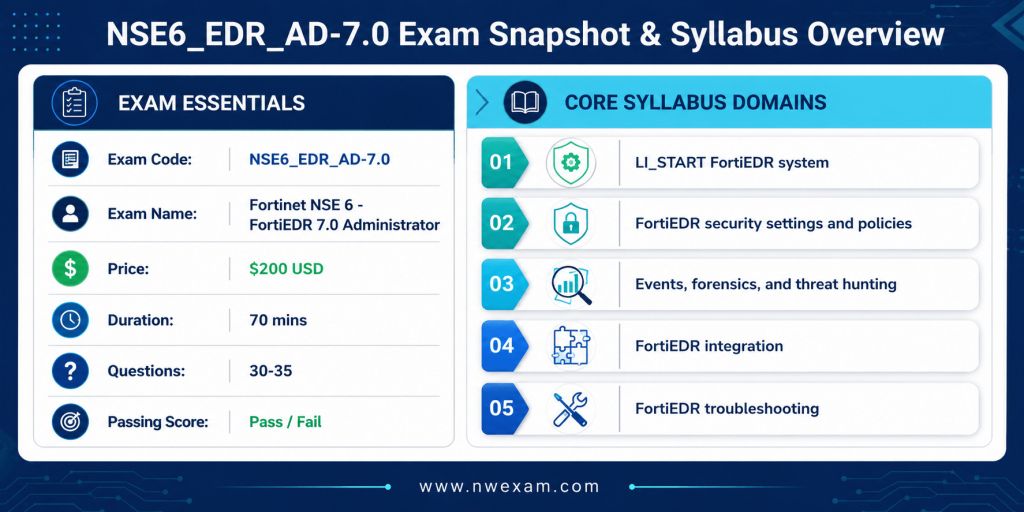
The FortiEDR 7.0 Administrator exam syllabus spans several critical domains:
FortiEDR system: This section covers the architecture, deployment models, and initial configuration of the FortiEDR platform. It involves understanding components like collectors, central managers, and their interaction within an enterprise environment. Candidates must be familiar with system requirements, installation procedures, and basic system health monitoring.
- FortiEDR security settings and policies
- Events, forensics, and threat hunting
- FortiEDR integration
- FortiEDR troubleshooting
Each syllabus topic is designed to test a specific facet of FortiEDR administration, from initial setup to advanced threat response. The integrated nature of these topics means that mastery in one area often enhances understanding in others.
The Learning Curve of Fortinet FortiEDR Administration
Approaching the NSE6_EDR_AD-7.0 certification with a realistic perspective on its difficulty is crucial for success. Many candidates underestimate the depth required to truly master FortiEDR 7.0, which goes beyond mere configuration. The exam challenges administrators to think critically about endpoint security architecture, policy enforcement, and proactive threat management. It demands a blend of theoretical knowledge and hands-on experience, making the learning curve steeper for those without significant practical exposure. Success hinges on a dedicated approach to understanding the underlying principles and operational nuances of the FortiEDR platform. For those looking to broaden their expertise in similar domains, exploring various Fortinet certification path options can provide a structured roadmap for professional growth.
Navigating Complex Security Settings and Policies
One of the primary challenges within the NSE6_EDR_AD-7.0 exam lies in the intricate nature of FortiEDR’s security settings and policies. It’s not enough to simply memorize policy configurations; candidates must understand the logic behind each rule and its potential impact on endpoint behavior and security posture. This includes grasping how different policies interact, the order of precedence, and best practices for creating resilient and effective security rulesets. The ability to fine-tune these settings to minimize false positives while maximizing threat detection is a sophisticated skill that requires careful study and experimentation.
Mastering Threat Hunting and Forensics Capabilities
Beyond configuration, the NSE6_EDR_AD-7.0 exam places significant emphasis on the analytical skills needed for threat hunting and forensics. This domain represents a considerable learning challenge, as it requires more than just knowing how to use the FortiEDR interface. Candidates must develop a detective’s mindset, capable of interpreting complex event data, tracing the kill chain of an attack, and identifying subtle indicators of compromise. This involves understanding various attack techniques, malware behaviors, and forensic methodologies. Practical exercises, labs, and real-world case studies are invaluable for developing this critical expertise, transforming theoretical knowledge into actionable incident response capabilities.
Building a Solid NSE6_EDR_AD-7.0 Preparation Strategy
Effective preparation for the NSE6_EDR_AD-7.0 exam requires a multi-faceted approach, combining structured study with practical application. Given the exam’s focus on administrative skills and troubleshooting, hands-on experience with FortiEDR 7.0 is indispensable. A well-designed study plan should systematically cover each syllabus topic, ensuring no critical area is overlooked. Candidates should allocate sufficient time for both theoretical learning and practical lab exercises, reinforcing concepts through direct engagement with the platform. This holistic strategy helps build the confidence and proficiency necessary to tackle the challenges of the certification.
Leveraging Official Fortinet Training and Documentation
The most reliable resources for NSE6_EDR_AD-7.0 preparation come directly from Fortinet. Engaging with official training courses, whether instructor-led or self-paced, provides a structured learning environment aligned with the exam objectives. These courses are designed to impart the specific knowledge and skills tested in the certification. Furthermore, thorough review of Fortinet’s extensive documentation, including administration guides, deployment guides, and best practice manuals for FortiEDR 7.0, is critical. These documents offer detailed explanations and configuration examples that can clarify complex topics and reinforce understanding. Candidates should not underestimate the value of these authoritative sources.
The Value of Practice Questions and Simulations
Integrating practice questions and lab simulations into your study routine is a highly effective way to assess readiness and identify knowledge gaps. Practice tests for NSE6_EDR_AD-7.0, such as the comprehensive resources available at Fortinet practice questions, can simulate the exam environment, helping candidates become familiar with the question types and time constraints. While these tools should never replace foundational learning, they are excellent for reinforcing concepts and building exam-taking stamina. Lab simulations, on the other hand, provide a sandbox environment to apply theoretical knowledge, configure settings, and troubleshoot issues without impacting a live production system. This hands-on application is invaluable for solidifying practical skills and ensuring real-world readiness.
Advancing Your Career with FortiEDR 7.0 Expertise
Achieving the Fortinet NSE 6 – FortiEDR 7.0 Administrator certification offers significant career advantages, distinguishing professionals in a competitive cybersecurity landscape. This credential validates specialized skills in endpoint detection and response, a domain that is increasingly critical for organizations facing sophisticated cyber threats. Employers actively seek individuals who can demonstrate a proven ability to deploy, manage, and optimize EDR solutions. The NSE6_EDR_AD-7.0 certification signals a commitment to staying current with leading security technologies and best practices, enhancing a professional’s marketability and potential for career advancement.
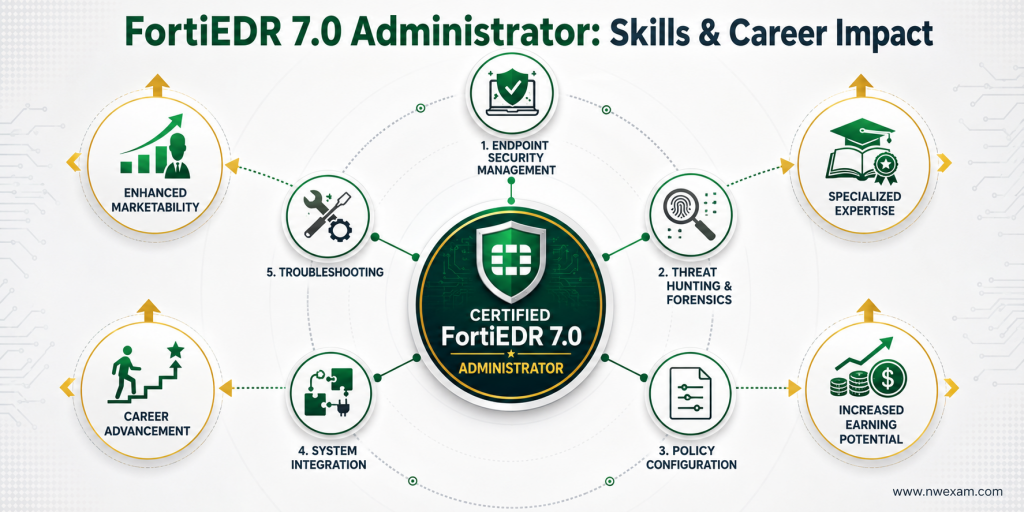
The certification positions professionals for various impactful roles, including:
- Endpoint Security Administrator: Responsible for the day-to-day management and operational integrity of FortiEDR deployments.
- Security Operations Center (SOC) Analyst: Utilizing FortiEDR for threat detection, incident analysis, and response within a SOC environment.
- Incident Response Specialist: Leveraging FortiEDR’s forensic capabilities to investigate breaches and orchestrate recovery efforts.
- Cybersecurity Consultant: Advising clients on endpoint security strategies and implementing FortiEDR solutions to meet specific business needs.
- Security Engineer: Designing, implementing, and maintaining FortiEDR infrastructure as part of a broader security architecture.
These roles highlight the diverse applications of FortiEDR 7.0 expertise across different facets of cybersecurity. The certification not only opens doors to new opportunities but also provides the foundational knowledge to excel in demanding security environments.
Avoiding Common Pitfalls in NSE6_EDR_AD-7.0 Readiness
Many candidates, despite their technical acumen, fall into common traps when preparing for the NSE6_EDR_AD-7.0 exam. Underestimating the exam’s practical application emphasis is a frequent mistake. Some focus too heavily on theoretical knowledge without sufficient hands-on experience, leading to difficulties with scenario-based questions. Another pitfall is inadequate time management during the exam, a consequence of insufficient practice under timed conditions. Addressing these potential weaknesses proactively can significantly improve the chances of success. A mindful approach to preparation that integrates both conceptual understanding and practical skill development is essential.
Ethical Preparation and Resource Selection
The allure of “easy fixes” like exam dumps can be tempting but ultimately detrimental to both a candidate’s learning and career integrity. Relying on such unethical resources not only violates the principles of certification but also undermines genuine skill development. Fortinet, like all reputable certification bodies, designs its exams to validate authentic expertise, not memorized answers. True success comes from understanding the concepts and being able to apply them. Candidates should instead prioritize legitimate FortiEDR administrator training from official sources, engaging with practice questions to identify knowledge gaps, and dedicating time to hands-on lab work. This commitment to ethical and comprehensive study ensures that the certification earned truly reflects a candidate’s capabilities.
Maximizing Study Efficiency and Retention
To avoid pitfalls, candidates should implement strategies that maximize study efficiency and knowledge retention. This includes breaking down the syllabus into manageable chunks, setting realistic study goals, and regularly reviewing previously learned material. Active learning techniques, such as creating flashcards, explaining concepts to others, or building mind maps, can significantly enhance retention compared to passive reading. Furthermore, consistent practice with the FortiEDR platform in a lab environment is paramount. This hands-on application solidifies theoretical understanding and builds the muscle memory necessary for real-world administration and effective exam performance. By adopting these strategies, candidates can build a robust knowledge base and confidence that withstands exam pressure.
Validating Your Endpoint Protection Skills with FortiEDR 7.0
The NSE6_EDR_AD-7.0 certification serves as a robust validation of a professional’s ability to implement and manage advanced endpoint protection using FortiEDR 7.0. In an era where endpoints are prime targets for cyberattacks, having certified experts who can effectively deploy and manage EDR solutions is non-negotiable for organizational security. This certification goes beyond generic cybersecurity knowledge, specifically confirming proficiency in Fortinet’s cutting-edge technology for threat prevention, detection, and automated response. It signifies that an individual possesses the specialized skills to safeguard critical assets against evolving and sophisticated threats, contributing directly to an organization’s resilience.
This credential showcases a professional’s capacity to:
- Design and implement FortiEDR solutions tailored to specific enterprise security requirements.
- Proactively identify, investigate, and mitigate endpoint threats using FortiEDR’s advanced capabilities.
- Develop and enforce comprehensive security policies that balance protection with operational efficiency.
- Integrate FortiEDR with other security tools to create a unified and highly effective threat intelligence ecosystem.
- Troubleshoot and resolve complex issues related to FortiEDR components, ensuring continuous endpoint protection.
Why the NSE6_EDR_AD-7.0 Certification Matters
By validating these core competencies, the NSE6_EDR_AD-7.0 certification assures employers that their security posture is in capable hands. It underscores a professional’s dedication to maintaining a high level of expertise in a rapidly changing threat landscape, solidifying their role as a critical asset in any cybersecurity team.
The Fortinet NSE 6 – FortiEDR 7.0 Administrator certification (NSE6_EDR_AD-7.0) is a challenging yet highly rewarding credential that truly reflects an individual’s expertise in a vital area of cybersecurity. Its learning curve is real, demanding both deep theoretical understanding and extensive practical application. Don’t underestimate this exam. Prepare with a realistic and ethical strategy. This certification validates your FortiEDR 7.0 skills and helps boost your career in endpoint security.
Embarking on the NSE6_EDR_AD-7.0 journey requires dedication, but the return on investment in terms of validated skills and career advancement is substantial. For those ready to commit to comprehensive study and hands-on practice, this certification is a powerful testament to their capabilities as a FortiEDR administrator. Take the initiative to thoroughly prepare, leverage official resources, and engage with practice environments to confidently demonstrate your mastery. Elevate your cybersecurity career and explore Fortinet certifications that align with your professional aspirations and technical expertise.
Frequently Asked Questions
1. What skills does the Fortinet NSE6_EDR_AD-7.0 certification validate?
The Fortinet NSE6_EDR_AD-7.0 certification validates a professional’s expertise in deploying, configuring, managing, and troubleshooting Fortinet’s FortiEDR 7.0 solution. It specifically covers skills in security settings, policy management, event analysis, threat hunting, forensics, system integration, and general administration of the FortiEDR system to protect endpoints.
2. How challenging is the NSE6_EDR_AD-7.0 exam, based on its learning curve?
The NSE6_EDR_AD-7.0 exam is considered challenging due to its emphasis on practical application and deep understanding of FortiEDR 7.0’s advanced features. It requires not just theoretical knowledge but also hands-on experience in policy enforcement, threat hunting, and troubleshooting. Candidates should expect to dedicate significant time to both study and lab work.
3. What types of job roles can benefit from the Fortinet NSE 6 – FortiEDR 7.0 Administrator certification?
Professionals in roles such as Endpoint Security Administrator, Security Operations Center (SOC) Analyst, Incident Response Specialist, Cybersecurity Consultant, and Security Engineer can significantly benefit from this certification. It demonstrates specialized expertise highly valued in organizations requiring robust endpoint detection and response capabilities.
4. Are there any prerequisites for taking the NSE6_EDR_AD-7.0 exam?
While Fortinet does not always enforce strict prerequisites, it is strongly recommended that candidates have a solid understanding of cybersecurity concepts, network infrastructure, and practical experience with endpoint security solutions. Familiarity with Fortinet’s ecosystem and prior NSE certifications (e.g., NSE 4) can also be beneficial, though not mandatory.
5. Why is ethical preparation important for the NSE6_EDR_AD-7.0 exam?
Ethical preparation builds real skills. Use official training and practice tests. Avoid exam dumps, as they reduce certification value and practical knowledge. Honest learning supports long-term career success.


