A privacy policy nobody operates is just a document. The Certified Information Privacy Manager (CIPM) is IAPP’s credential for the people who run privacy programs, not just interpret privacy law. Offered by the International Association of Privacy Professionals (IAPP), the CIPM validates that you can build a privacy framework, operate it day to day, and prove it works under audit. Where legal certifications focus on what the rules say, this one focuses on how you turn those rules into policies, controls, and measurable outcomes. That practical angle is why hiring managers increasingly ask for it when filling privacy leadership roles. This article walks through what the credential tests, how the exam is structured, what it costs, and where it can take your career.
Table of Contents
- What Does the Certified Information Privacy Manager Credential Prove?
- Who Should Earn the IAPP CIPM Certification?
- What Is the CIPM Exam Format and Cost?
- Which Domains Does the CIPM Syllabus Cover?
- How Does the Privacy Program Operational Life Cycle Work?
- How Should You Prepare for the CIPM Exam?
- What Careers and Salaries Follow the CIPM?
- CIPM vs CIPP: Which Privacy Certification Fits Your Role?
- Frequently Asked Questions
- Conclusion
What Does the Certified Information Privacy Manager Credential Prove?
The Certified Information Privacy Manager credential proves you can design, run, and sustain a privacy program across its full life cycle. IAPP built the CIPM around operational skill rather than legal theory, so it tests governance models, data assessments, incident response, and program metrics. Passing signals to employers that you can translate laws such as GDPR into working policies and controls.
That distinction matters. Many privacy roles now sit inside operations, security, or compliance teams rather than legal departments. Those teams need someone who can map data flows, negotiate vendor terms, and report privacy metrics to leadership. The CIPM speaks directly to that skill set, which is why it pairs so often with a role rather than a single regulation.
You can review the official CIPM certification page for IAPP’s own description of the program and its recognition across industries.
Who Should Earn the IAPP CIPM Certification?
The IAPP CIPM certification suits professionals who own or influence how an organization manages personal data. That includes privacy program managers, data protection officers, compliance leads, information governance specialists, and security managers who inherited privacy duties. Candidates usually have a few years of experience and want to formalize the operational knowledge they already apply on the job.
You do not need a law degree to benefit. In fact, the credential often appeals to people moving into privacy from adjacent fields.
- Compliance and risk analysts expanding into data protection
- IT and security managers handling breach response and access controls
- Consultants advising clients on privacy program design
- Auditors who assess privacy controls and reporting
- Legal and GRC professionals who want operational depth
If your career is heading toward privacy engineering instead of management, the CIPP-CN privacy credential and IAPP’s technical tracks may complement your path. Many professionals stack CIPM with a knowledge-based certification for a fuller profile.
What Is the CIPM Exam Format and Cost?
The CIPM exam contains 90 questions and runs for 150 minutes, with a passing score of 300 on a scaled range of 100 to 500. The standard exam fee is $550 USD, and IAPP delivers the test through Pearson VUE at physical test centers and via online proctoring. Understanding these numbers early helps you budget both study time and cost before you register.
| Exam Attribute | Detail |
|---|---|
| Exam name | IAPP Certified Information Privacy Manager (CIPM) |
| Number of questions | 90 |
| Duration | 150 minutes |
| Passing score | 300 out of 500 |
| Exam price | $550 (USD) |
| Delivery | Pearson VUE test centers and online proctoring |
| Recommended text | Privacy Program Management (CIPM) |
Scheduling runs through Pearson VUE test centers, so book early during busy exam windows. To rehearse the question style before test day, work through a realistic CIPM practice test that mirrors the scenario format IAPP uses.
Which Domains Does the CIPM Syllabus Cover?
The CIPM syllabus is organized into six topic areas that follow a privacy program from creation through daily operation. Two areas cover setting up the program, and four cover the operational life cycle: assessing data, protecting personal data, sustaining performance, and responding to requests and incidents. Together they map the complete journey of a privacy program manager.
| Syllabus Topic | Focus |
|---|---|
| Privacy Program: Developing a Framework | Define program scope, privacy strategy, governance model, and applicable laws |
| Privacy Program: Establishing Program Governance | Set policies, roles, metrics, and training across the program life cycle |
| Operational Life Cycle: Assessing Data | Map data inventories, evaluate vendors, physical, and technical controls |
| Operational Life Cycle: Protecting Personal Data | Apply security practices, Privacy by Design, and technical safeguards |
| Operational Life Cycle: Sustaining Program Performance | Measure metrics, audit the program, and manage continuous assessment |
| Operational Life Cycle: Responding to Requests and Incidents | Handle data subject requests, incident response, and post-incident review |
Notice how heavily the blueprint leans on operations. Only the first two topics deal with building the program, while the remaining four keep it running and defensible. That balance tells you where to focus your study energy.
How Does the Privacy Program Operational Life Cycle Work?
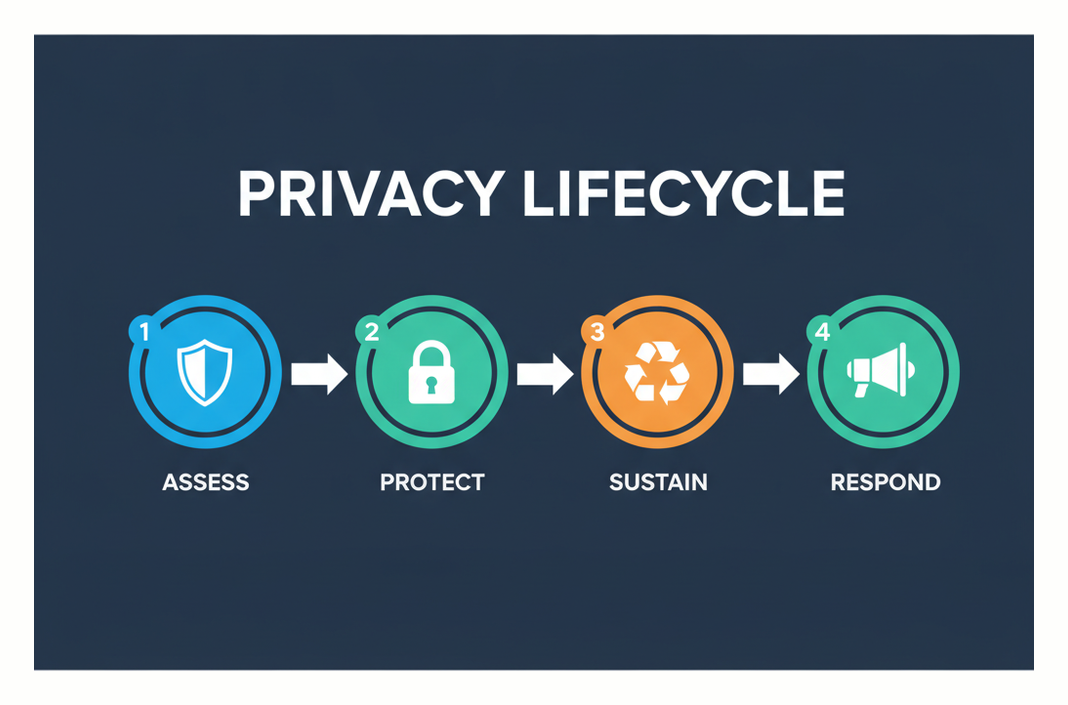
The privacy program operational life cycle is the CIPM’s core model, describing how a program moves through assessing, protecting, sustaining, and responding on a continuous loop. Rather than a one-time project, it treats privacy as an ongoing management discipline. The exam expects you to know what each phase produces and how the phases feed one another over time.
Assessing and Protecting Data
Assessment starts with knowing what you hold. You map data inventories and flows, run gap analyses against applicable laws, and evaluate processors, third-party vendors, and physical and technical controls. Protection then applies the safeguards: data classification, access controls, and Privacy by Design built into the system development life cycle. These two phases turn abstract obligations into concrete controls that people follow.
Sustaining and Responding
Sustaining keeps the program honest through metrics, audits, and continuous risk assessments such as PIAs and DPIAs. Responding covers the moments that test a program hardest: data subject access requests and security incidents. You must know how to handle requests transparently and how to run incident response from containment through post-incident review. Regulations and program frameworks such as the NIST Privacy Framework shape many of these obligations, so the exam ties operational steps back to legal duties.
How Should You Prepare for the CIPM Exam?
Effective CIPM preparation blends IAPP’s official materials with hands-on practice against the six syllabus topics. Because the exam rewards operational judgment, memorizing definitions is not enough. Candidates who pass usually spend six to eight weeks studying while relating each concept back to how they would apply it inside a real organization.
A structured plan keeps that effort focused:
- Read the Privacy Program Management (CIPM) textbook and map each chapter to a syllabus topic.
- Enroll in official training to reinforce the operational life cycle with guided examples.
- Practice scenario questions until you can reason through governance and incident cases quickly.
- Review your own workplace privacy processes as living case studies.
- Take a timed mock exam to build stamina for the 150-minute session.
“The professional skills needed for privacy policy implementation, risk reduction and how to prevent improper handling of personal data.”
IAPP’s official CIPM training is a strong anchor for candidates who prefer instructor-led preparation over self-study alone.
What Careers and Salaries Follow the CIPM?
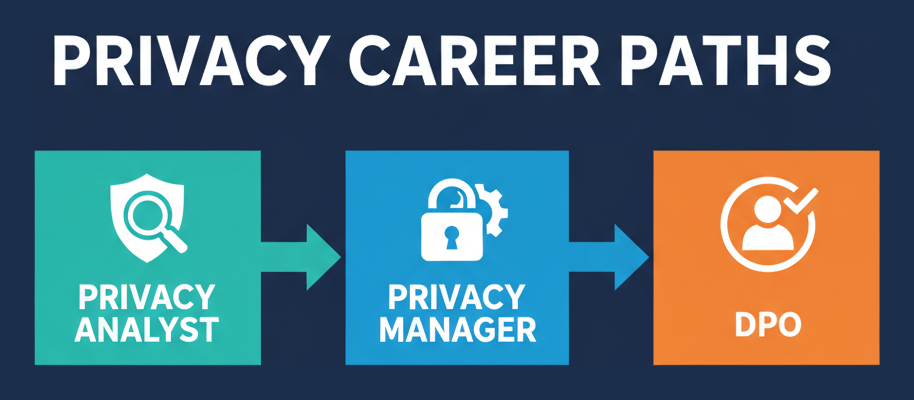
The CIPM opens doors to privacy leadership roles such as privacy program manager, data protection officer, privacy operations lead, and privacy consultant. Because privacy programs now span security, compliance, and legal functions, the credential travels well across industries from healthcare to technology. Employers treat it as evidence that you can own a program rather than advise on one.
Compensation reflects that responsibility. Privacy managers in many markets earn well into six figures, with data protection officers often commanding more in regulated sectors. Demand has grown alongside expanding privacy legislation worldwide, which keeps qualified program managers in short supply. That scarcity gives certified professionals real leverage in salary negotiations and internal promotions.
The credential also pairs naturally with career mobility. As organizations open dedicated privacy offices, the CIPM positions you to move from a supporting role into a role that sets strategy and reports to executives.
CIPM vs CIPP: Which Privacy Certification Fits Your Role?
The CIPM and CIPP are complementary IAPP certifications aimed at different skills. CIPM certifies how to manage and operate a privacy program, while the CIPP family certifies knowledge of privacy laws in a specific jurisdiction. Choosing between them depends on whether your role leans toward running programs or interpreting regulations, though many professionals eventually earn both.
| Consideration | CIPM | CIPP |
|---|---|---|
| Primary focus | Privacy program management and operations | Privacy laws and regulations by region |
| Best for | Program managers, DPOs, privacy operations | Legal, compliance, and policy roles |
| Skill type | Operational and process driven | Knowledge and law driven |
| Common pairing | Stacks with a CIPP jurisdiction credential | Stacks with CIPM for full coverage |
If privacy engineering interests you more than either management or law, the IAPP CIPT certification targets the technical side of privacy. Reading the three tracks side by side helps you plan a credential sequence that matches your career direction.
Frequently Asked Questions
What is the Certified Information Privacy Manager certification?
The CIPM is IAPP’s certification for managing and operating privacy programs. It validates skills in building a privacy framework, running the operational life cycle, and responding to data subject requests and incidents. It focuses on operations rather than legal knowledge alone.
How many questions are on the CIPM exam?
The CIPM exam has 90 questions and lasts 150 minutes. You must reach a scaled score of 300 out of 500 to pass. The questions emphasize scenario-based judgment about privacy program operations rather than simple recall.
How much does the CIPM exam cost?
The standard CIPM exam fee is $550 USD. IAPP also offers membership and training packages that carry separate costs. Retake fees apply if you need to sit the exam again, so budget for materials and potential repeat attempts.
Do I need CIPP before taking CIPM?
No, CIPP is not a prerequisite for CIPM. The two certifications cover different areas, with CIPM focused on program management and CIPP on privacy law. Many professionals earn both, but you can take them in either order.
Is the CIPM exam difficult?
The CIPM is challenging because it tests operational judgment across six topic areas rather than memorization. Candidates with hands-on privacy or compliance experience tend to find the scenarios more intuitive. Structured study over six to eight weeks is a common benchmark for passing.
Where do I take the CIPM exam?
IAPP delivers the CIPM through Pearson VUE. You can sit it at a physical test center or through online proctoring from home. Scheduling is handled directly with Pearson VUE after you register with IAPP.
How long is the CIPM certification valid?
The CIPM requires ongoing continuing privacy education credits and annual maintenance fees to stay active. IAPP sets the exact credit requirements, which you earn through training, conferences, and related professional activity. Maintaining the credential keeps it current with evolving privacy practice.
What jobs can I get with a CIPM?
The CIPM supports roles such as privacy program manager, data protection officer, privacy operations lead, and privacy consultant. It is valued across regulated industries where organizations need someone to own and defend a privacy program end to end.
Conclusion
The Certified Information Privacy Manager credential rewards people who can turn privacy obligations into a working, measurable program. Its six syllabus topics trace a program from framework and governance through the operational life cycle of assessing, protecting, sustaining, and responding. That operational focus is exactly what employers want as privacy teams grow beyond legal departments. If you already handle data protection duties, the CIPM formalizes your skills and strengthens your case for a leadership role. Start by mapping your current experience against the syllabus, then reinforce the gaps with official study and realistic scenario practice so you walk into the exam ready to lead.


