1Z0-948 is the exam behind Oracle GoldenGate 26ai Implementation Associate, and it is a vocabulary exam before it is anything else. Seven topics, fifty questions, ninety minutes. What separates candidates is not whether they understand replication as a concept, because most people sitting this exam already run it. It is whether they can name the moving parts precisely: Extract, Distribution Service, Receiver Service, Replicat, local trails, remote trails, GLOBALS parameters, Integrated Capture.
Those names are not decoration. They are the exam. Six of the seven topics reference components introduced in topic two, which means a candidate who skips the architecture section spends the rest of their preparation reading about things they cannot picture. This guide takes the seven topics in a sequence that actually works, explains what the version label means, sets out what the exam costs and what score it demands, and shows how to plan for a syllabus that publishes no weightings at all.
What Is the Oracle GoldenGate 26ai Certification?
1Z0-948 leads to the Oracle GoldenGate 26ai Implementation Associate credential. It tests the installation, configuration, parameterisation and monitoring of Oracle’s real-time data replication platform across seven topics, from architecture components through mapping and transformation to migration. The paper runs 50 questions in 90 minutes and requires 68 percent to pass. Replication targets frequently sit on autonomous infrastructure, which the 1Z0-931-26 exam guide covers in detail.
Oracle positions GoldenGate as a replication and integration platform that moves committed changes between heterogeneous systems in near real time, and the GoldenGate product overview frames it that way. The associate credential validates the person who builds and runs those pipelines rather than the architect who designs the target estate.
What makes the exam distinctive within Oracle’s catalogue is how component-specific it is. Most associate-level Oracle exams reward broad familiarity. This one asks which process writes to a local trail and which reads from a remote one, and there is no way to reason your way to that from first principles. Replication is one route to availability and clustering is another, which is the ground the Oracle RAC certification covers.
What Does 26ai Actually Refer To?
26ai is the GoldenGate release the exam is built against, and it is the current one. The credential is titled Oracle GoldenGate 26ai Implementation Associate, and the older exam in the same line, 1Z0-947, covers GoldenGate 19c. If you are choosing between them, 1Z0-948 is the newer paper and the one aligned to the release most organisations are moving toward. Replication is one route into Oracle data movement; Oracle EPM data integration is the other, and its exam is weighted very differently.
The practical difference the version makes is architectural. The syllabus names the Distribution Service and the Receiver Service as separate components, and those belong to the microservices architecture rather than to the older classic deployment model. That single detail tells you which documentation set to revise from.
Oracle’s GoldenGate documentation set is organised around that architecture, which makes it the natural companion to the syllabus. Working from older classic-architecture material is the most common way candidates end up learning component names that the exam no longer uses.
Why Should You Learn the Architecture Topic First?
Because six of the seven topics reference components that topic two introduces. Topic two asks you to describe GoldenGate components, create Capture process types for Oracle database, create Replicat process types, explain the Extract, Distribution Service, Receiver Service, Replicat and local and remote trails, and configure the process recovery mechanism. Everything after it assumes you know those names.
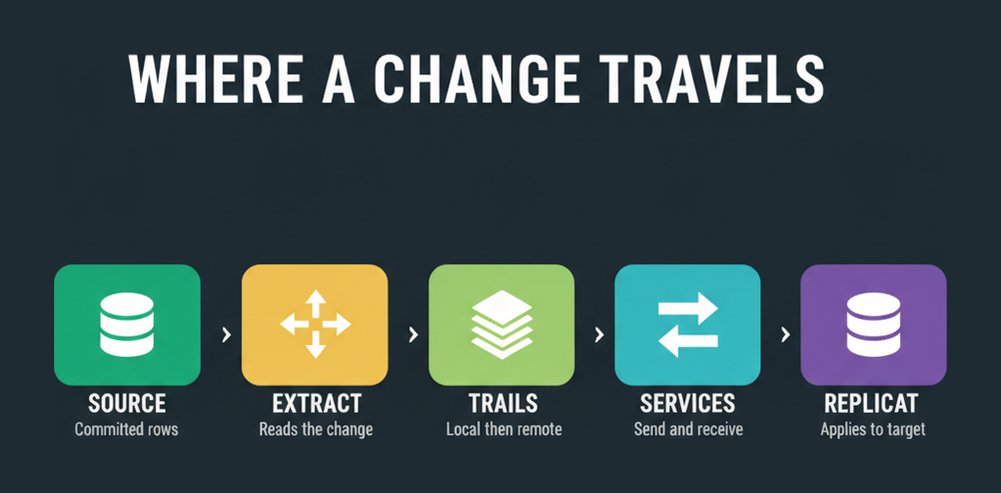
The five names that matter most
Extract reads change records from the source. Trails are the files those records land in, and the distinction between local and remote is which side of the network they sit on. The Distribution Service moves trail data outward, the Receiver Service accepts it at the far end, and Replicat applies it to the target. That is the whole path, and almost every scenario in the exam sits somewhere on it.
Process recovery is the objective people skip
The last objective in topic two is configuring the process recovery mechanism, and it is easy to read past. It is also the thing that decides whether a pipeline survives a restart without losing or duplicating rows, which makes it exactly the sort of objective a 50-question paper likes to test once and decisively.
Learn this topic properly and topics three through seven become recognition rather than memorisation. Learn it last and you will read the other six twice.
How Much of 1Z0-948 Is Installation and Initial Load?
Topic three, Installing and Configuring Oracle GoldenGate, carries six objectives and is the largest installation block on the paper. It covers downloading and installing the product, synchronising source and target with the Initial Load, preparing the database for change data capture, configuring replication component parameter files, using the command interface to create processes, and using the GoldenGate utilities.
Two of those deserve more attention than they usually get. The Initial Load is how a replication pair starts life in sync, and getting it wrong means every subsequent change is applied to a target that was never correct to begin with. Preparing the database for change data capture is the source-side work that makes any of it possible, and it is prerequisite knowledge for topics four and six as well.
- Initial Load is a synchronisation step, not an installation step, and the syllabus deliberately places it here
- Change data capture preparation is source-database work, so it sits outside the GoldenGate binaries entirely
- The command interface objective is about creating processes, so expect questions phrased as tasks rather than as syntax recall
- The utilities objective is broad and under-specified, which makes hands-on exposure the only reliable preparation
Data replication of this kind is a recognised discipline in its own right, and the data integration knowledge area of the DAMA body of knowledge gives useful vocabulary for why initial synchronisation and ongoing capture are treated as separate problems.
What Do the Parameter Topics Expect You to Know?
Topic four, Defining Oracle GoldenGate Parameters, has three objectives: describing GLOBALS parameters, creating solutions using component parameters for replication requirements, and installing GoldenGate parameters. The distinction between global and component-level settings is the whole topic, and it is the sort of hierarchy question that is easy to get backwards under time pressure.
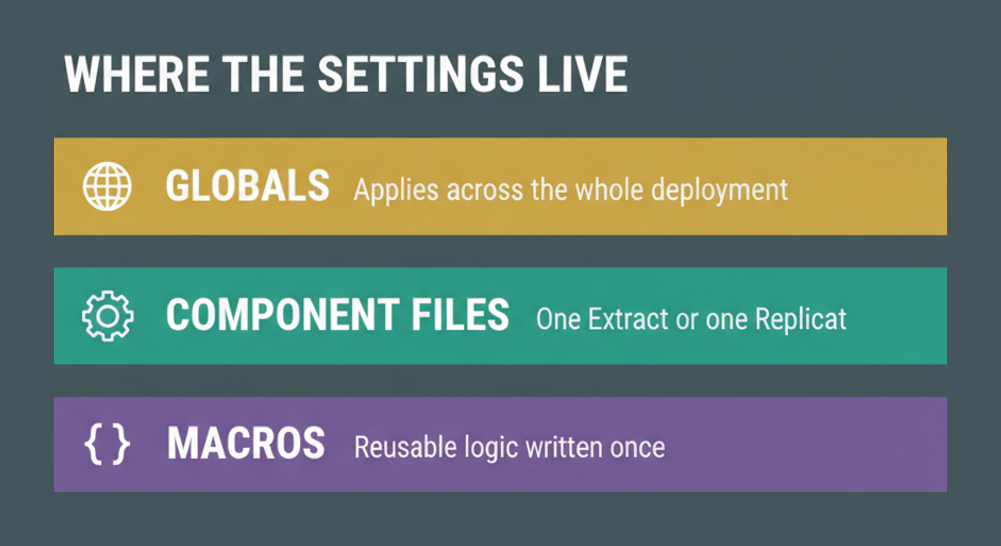
GLOBALS parameters apply across the deployment. Component parameters apply to a single Extract or Replicat. The middle objective is the interesting one because it is phrased as creating solutions for replication requirements, which means the questions are likely to describe a requirement and ask which parameter delivers it, rather than asking what a named parameter does.
Configuration options sit in a separate topic
Topic six, Configuring Oracle GoldenGate, covers DDL replication, compression and encryption options, event actions based on use cases, and Integrated Capture, Replicat and deployment options. Read alongside topic four, this is really the second half of the parameter story: topic four is where settings live, topic six is what the significant ones do.
DDL replication is worth singling out. Replicating data is one problem and replicating schema changes is another, and candidates who have only run steady-state pipelines often have no exposure to the second at all.
How Does the Exam Treat Mapping and Transformation?
Topic five is the smallest on the paper with just two objectives: implementing use cases for transformation functions, and implementing macros for transformation. Small does not mean skippable, because with seven topics across 50 questions even a two-objective topic can carry several marks.
Transformation functions handle the row-level work of reshaping a column between source and target. Macros are the reuse mechanism, letting a piece of parameter logic be written once and referenced repeatedly. The exam frames both as implementation rather than description, which again points at scenario-shaped questions.
The practical advice here is narrow and useful. Write one macro. Not five, not a library, just one that does something real in a parameter file, and then read it back. The mechanics stop being abstract immediately, and the syllabus asks for nothing deeper than that.
What Does Managing, Monitoring and Migrating Cover?
Topic seven bundles four objectives that share an operational character: managing OGG command and data security, managing GoldenGate command and data security, implementing and troubleshooting GoldenGate Monitoring, and configuring the migration process. It is the topic that describes life after the pipeline is running.
Security appears twice in the topic’s own wording, which is unusual and worth taking at face value. Command security governs who can issue operational instructions, and data security governs what moves across the wire and how it is protected. Both are examinable and both are frequently left to defaults in real deployments, which is precisely why candidates find them unfamiliar.
Monitoring is stated as implementing and troubleshooting, not merely configuring. Expect at least one question that describes a symptom rather than asking for a setting. Migration closes the topic and closes the syllabus, covering the move from one deployment to another, which in practice usually means moving off the classic architecture.
What Does 1Z0-948 Cost and What Score Do You Need?
1Z0-948 costs USD $245 and requires 68 percent to pass, which is 34 correct answers out of 50. The paper runs 90 minutes, giving an average of 108 seconds per question. Oracle notes that pricing may vary by country or by localized currency, so confirm the figure for your region when booking.
| Detail | Value |
|---|---|
| Exam code | 1Z0-948 |
| Credential | Oracle GoldenGate 26ai Implementation Associate |
| Questions | 50 |
| Duration | 90 minutes |
| Passing score | 68% |
| Cost | USD $245 |
| Syllabus topics | 7, no published weightings |
| Older exam in the same line | 1Z0-947, GoldenGate 19c |
No weightings are published for this syllabus, which removes the usual planning shortcut. The nearest available proxy is objective count: topic three has six objectives, topic two has five, topics six and seven have three and four, topic four has three, and topics one and five have two each. Weight your time roughly that way and adjust for what you already know.
Treat that as a guide and nothing firmer. Seven topics across 50 questions averages seven questions per topic, and a two-objective topic can still produce a question about a macro you have never written. You can see the raw 1Z0-948 topic list if you want to do the objective count yourself.
Who Is the Implementation Associate Level For?
The credential fits database administrators, data engineers and integration specialists who build and operate replication pipelines. Associate level here means implementation rather than design: you are being asked whether you can stand a pipeline up and keep it running, not whether you can architect a multi-region topology from scratch.
The clearest self-test is the component vocabulary. If Extract, trail, Distribution Service and Replicat are words you use rather than words you have read, the exam validates work you already do. If they are new, you are learning a substantial platform in order to sit an associate paper about it, which only makes sense if GoldenGate is arriving in your environment anyway.
On career value, replication and integration skills sit at the higher end of database administration because the work is unforgiving and the failure modes are visible to the business. Current benchmarks for database administrator pay give a sensible baseline before adding a replication speciality on top.
If you are coming from the previous generation of the product, the site’s GoldenGate 12c exam guide is a useful comparison point for how much the architecture has moved, and the wider Oracle credential index shows where the associate level sits in the rest of the catalogue.
How Should You Sequence Preparation for Seven Unweighted Topics?
Sequence beats allocation when there are no weightings to allocate against. Start with the architecture topic so the component names stop being abstract, then install something so the architecture stops being theoretical, then work outward through parameters, transformation and operations in the order the syllabus itself implies.
- Start with the Overview of the Oracle GoldenGate Architecture, learning Extract, the Distribution Service, the Receiver Service, Replicat and the difference between local and remote trails until you can draw the path without prompting.
- Add the process recovery mechanism to that same session, because it is the objective most candidates read past and the one that decides whether a restarted pipeline stays correct.
- Install GoldenGate on a real pair of databases next, running an Initial Load end to end so that synchronisation and change data capture preparation become something you have done rather than something you have read.
- Move to Defining Oracle GoldenGate Parameters, fixing the distinction between GLOBALS parameters and component parameters firmly before anything else in that topic.
- Take Configuring Oracle GoldenGate immediately afterwards, since DDL replication, compression, encryption and Integrated Capture are the settings that give the parameter hierarchy something to do.
- Write one transformation macro in a real parameter file and read it back, which covers the mapping and transformation topic more effectively than any amount of reading about it.
- Finish with Managing, Monitoring and Migrating, paying particular attention to command security and data security, both of which are named twice in the topic and left at defaults in most real deployments.
- Sit timed papers at 50 questions in 90 minutes, keeping any single question under two minutes so an unfamiliar utility cannot cost you the marks you had already earned.
One caution on sources. Oracle’s certification pages are frequently unavailable to anything but a signed-in browser, so anchor your preparation to the product documentation and a running deployment rather than to a catalogue page you may not be able to open on the day you need it.
Frequently Asked Questions
How many questions are on the 1Z0-948 exam?
The exam contains 50 questions and runs for 90 minutes, which is an average of 108 seconds per question. That is comfortable for a recall item and tight for a scenario that describes a broken replication path.
What score do you need to pass 1Z0-948?
68 percent, which means 34 correct answers out of 50. With seven topics and no published weightings, no single topic is small enough to write off and still reach that mark reliably.
How much does the Oracle GoldenGate 26ai certification cost?
USD $245. Oracle notes that pricing may vary by country or by localized currency, so check your regional price before booking rather than assuming the dollar figure applies everywhere.
What is the difference between 1Z0-948 and 1Z0-947?
1Z0-948 is the GoldenGate 26ai Implementation Associate exam and 1Z0-947 covers GoldenGate 19c. If you are choosing between them, 1Z0-948 is the newer paper and aligns to the current release.
Which topic has the most objectives?
Installing and Configuring Oracle GoldenGate, with six: download and install, Initial Load, change data capture preparation, replication component parameter files, the command interface, and the GoldenGate utilities.
Does the syllabus publish domain weightings?
No. It lists seven topics with their objectives and assigns no percentages. Objective count is the nearest usable proxy, but treat it as a rough guide rather than a blueprint.
What are local and remote trails?
Trails are the files that captured change records are written into. Local trails sit on the source side and remote trails on the target side, and the Distribution and Receiver Services are what move data between them.
Do you need hands-on GoldenGate experience to pass?
It is very difficult without it. The objectives are phrased as create, configure and implement rather than describe, and questions about the utilities and the command interface reward exposure over reading.
Is DDL replication on the exam?
Yes. It appears in the Configuring Oracle GoldenGate topic alongside compression and encryption options. Candidates who have only run steady-state data pipelines often have no exposure to schema change replication.
Who should take this certification?
Database administrators, data engineers and integration specialists who build and run replication pipelines. It validates implementation ability rather than architectural design, which is what associate level means here.
Conclusion
1Z0-948 rewards precision about components far more than it rewards general knowledge of replication. Extract, trails, the Distribution and Receiver Services and Replicat form a single path, and almost every question sits somewhere along it. Learn that path first, install the product and run an Initial Load so the path becomes real, then work outward through the parameter hierarchy, one transformation macro, and the operational topic that closes the syllabus. There are no weightings to plan against, so use objective count as a rough guide and let hands-on exposure fill the gaps. Read the topic list carefully before you book, and make sure the component names are ones you use rather than ones you recognise.


