
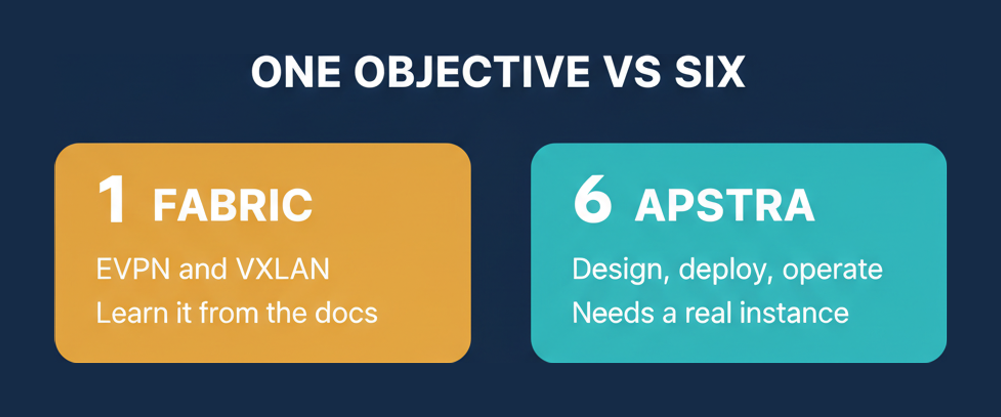
JNCIS-DC is Juniper’s Data Center Specialist credential, earned by passing JN0-481, and its name sets an expectation the syllabus does not meet. Data centre specialist sounds like spine-leaf design, EVPN route types and VXLAN tunnel endpoints. All of that is on the exam. It is objective one of seven.
The other six are Juniper Apstra. Its architecture, its design phase, its build and deploy phases, blueprint operations, multitenancy and intent-based analytics. Six sevenths of the stated objectives name a single software product, which means the honest description of JN0-481 is that it is an Apstra exam with a networking prerequisite baked into the first objective. That changes what preparation looks like: you need access to Apstra far more than you need a lab full of switches. This guide works through all seven objectives in that light, sets out what the JNCIS-DC certification costs, confirms the prerequisite Juniper actually requires, and gives a preparation sequence built around the phases Apstra itself uses.
What Is the JNCIS-DC Certification?
JNCIS-DC is the second of four certifications in Juniper’s Data Center track, earned by passing JN0-481. It covers data centre architectures built on IP fabrics and EVPN-VXLAN, and the design, deployment, operation and analysis of those fabrics through Juniper Apstra. The exam is 65 multiple-choice questions in 90 minutes, delivered by Pearson VUE.
“The second of four certifications in the Data Center track, the JNCIS-DC, Specialist, is designed for data center networking professionals with intermediate knowledge of the Juniper Apstra software and data center devices.”
Read that carefully and Juniper says the quiet part out loud. Apstra software comes first in the sentence, before data centre devices. The credential is aimed at people who already run an intent-based fabric, not at people who configure switches individually.
It also carries a real gate. JNCIA-DC is a stated prerequisite, which is unusual in a market where most vendors treat lower-level credentials as recommendations. You need the associate certification before you can hold this one.
Why Is JN0-481 Mostly an Apstra Exam?
Because six of the seven published objectives name Apstra directly or describe working inside it. Objective one covers IP fabrics, EVPN and VXLAN. Objectives two through seven are Apstra architecture, the Apstra design phase, the Apstra build and deploy phases, blueprint operations, multitenancy using Apstra, and Apstra intent-based analytics. There is no ambiguity in the wording.
This matters more than a typical weighting quirk, because it changes what preparation is even possible. You can learn EVPN route types from documentation and a pair of switches. You cannot learn what a probe anomaly looks like, or what time voyager does, or how a cable map behaves when a device state changes, without an Apstra instance in front of you.
Candidates who miss this arrive having revised protocols and find themselves guessing on questions about property sets and configlets. The Juniper Apstra product pages are the starting point, but reading about the product is a poor substitute for driving it.
What that means for the exam’s difficulty profile
The difficulty is not conceptual. Apstra’s abstractions are reasonable and most experienced network engineers grasp them quickly. The difficulty is vocabulary volume: blueprint, template, logical device, rack type, interface map, device profile, connectivity template, routing zone, probe, configlet. Each is a specific named thing with a specific place in the workflow, and the exam tests whether you know which is which.
What Does the IP Fabric and EVPN-VXLAN Objective Cover?
Objective one is the largest single list on the syllabus with fourteen sub-topics, split across three ideas: IP fabric fundamentals, EVPN, and VXLAN. It covers spine-leaf topology design, ECMP load balancing, underlay and overlay routing strategies, Juniper best practices, and then the protocol detail underneath them.
On the EVPN side the sub-topics are EVPN interface, bridge domain, Ethernet segments, route distinguisher, route target against vrf-import and vrf-export policies, EVPN route types, and edge-routed bridging using Type 2 or Type 5. On the VXLAN side they are control plane options, VNI-to-VLAN mapping, and VTEP functions.
- Route types are the sub-topic most worth over-preparing, because Type 2 against Type 5 recurs in the edge-routed bridging objective as well
- The route target against vrf-import and vrf-export distinction is a policy question, not a protocol question, and candidates routinely conflate them
- VNI-to-VLAN mapping is where the overlay meets the physical fabric, and it is the concept Apstra abstracts away most aggressively
If you want the primary source rather than a vendor summary, EVPN as a network virtualisation overlay is specified in IETF RFC 8365, which is where route types and tunnel endpoint behaviour are defined independently of any implementation.
What Do the Apstra Architecture and Design Objectives Ask For?
Objective two covers the Apstra platform itself: the Apstra server, device agents, the user interface, role-based access control, the event log and syslog. Objective three covers the design phase: data centre reference design, interface maps, device profiles, resources, tags, logical devices, rack types, planning total spine capacity and templates. Together they are the exam’s foundation.
Architecture is short and easily banked
Six sub-topics, all of them platform components rather than networking concepts. Learn what the server does, how device agents get onto a switch, and how RBAC and logging work, and objective two is largely closed. It is the cheapest objective on the paper.
The design phase is where the real vocabulary lives
Nine sub-topics, and the ones people confuse are logical devices, device profiles, interface maps and rack types. A logical device is an abstract port layout. A device profile describes a real piece of hardware including interface naming and speeds. An interface map connects the two. A rack type assembles them into a repeatable unit. Get that chain straight and the design phase stops being a jumble of similar-sounding nouns.
Planning total spine capacity is the one arithmetic sub-topic in the objective, and it is worth practising because it is the sort of thing that produces a single unambiguous exam question.
What Happens in the Build and Deploy Phases?
Objective four has five sub-topics: fabric device management, the blueprint user interface, the cable map, device states and deploy modes. It is the shortest Apstra objective and it sits between design, which is abstract, and blueprint operations, which is where the fabric is already running.
Fabric device management is about getting agents installed and system IDs assigned so Apstra can actually talk to the hardware. The cable map is the record of what is physically plugged into what, and it is the piece most likely to disagree with reality in a real deployment. Device states and deploy modes decide whether Apstra is watching a device, managing it, or actively pushing configuration to it.
The distinction between deploy modes is the examinable heart of the objective. Knowing that a device can be in the blueprint without being under full configuration control is exactly the sort of nuance that separates people who have run a staged rollout from people who have only read about one.
Why Is Blueprint Operations the Largest Objective?
Because it covers everything that happens after the fabric is live, and that is where an operator spends their time. Objective five carries thirteen sub-topics, more than any other Apstra objective, spanning anomaly interpretation, the top-level tabs, querying, change management, reverting, time voyager, property sets and configlets, root cause identification, and structural changes such as adding a rack or a generic system.
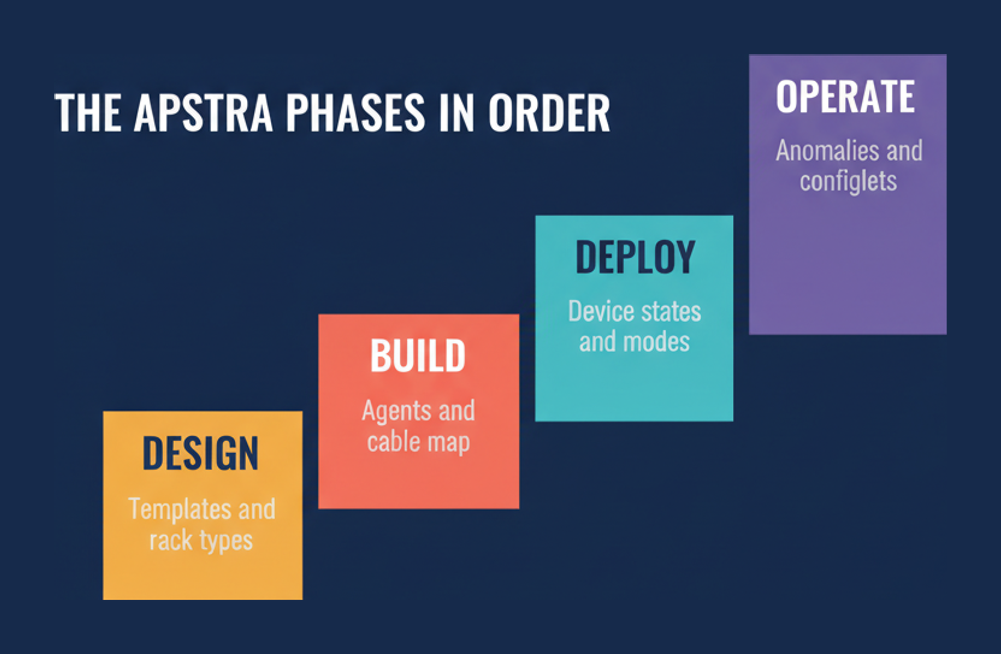
Two ideas anchor the objective. The first is the difference between service anomalies and probe anomalies, which is really a question about whether the fabric has deviated from intent or whether a monitoring probe has fired. The second is the staged and uncommitted model: Apstra lets you build up changes and then commit them, which is why reverting and time voyager exist at all.
Property sets and configlets are the escape hatch
Configlets are how configuration that Apstra does not model natively gets applied anyway, and property sets are how values are supplied to them. They are the answer to almost any exam scenario that describes needing something the reference design does not cover, and they are frequently under-studied because they feel like an edge case.
Configuration types are worth learning by name as well. Rendered, incremental and pristine configurations describe three different views of what is on a device, and knowing which one shows what is a fast mark.
How Does Apstra Handle Multitenancy and Analytics?
Objective six covers multitenancy with seven sub-topics: connectivity templates, routing zones and VRFs, routing policy, virtual networks, security policies, VMware integration and Data Center Interconnect. Objective seven covers intent-based analytics with three: graph explorer, graph queries and analytics probes. They are the two objectives that assume everything before them is already working.
Multitenancy in Apstra terms is mostly about routing zones, which map onto VRFs, and connectivity templates, which attach services to endpoints. Data Center Interconnect extends the same tenancy model between sites, and VMware integration is the one sub-topic that reaches outside the network entirely.
Intent-based analytics is small but conceptually distinct. Apstra models the fabric as a graph, and analytics probes run queries against that graph to detect conditions that violate intent. Understanding that the graph is the data model, and that probes are queries over it, is worth more than memorising individual probe names.
What Does JN0-481 Cost, and Do You Need JNCIA-DC First?
JN0-481 costs $300 and yes, JNCIA-DC is a stated prerequisite. The exam is 65 multiple-choice questions in 90 minutes through Pearson VUE, which is roughly 83 seconds per question. Juniper certifications are valid for three years, and pass or fail status is shown immediately after the exam.
| Detail | Value |
|---|---|
| Exam code | JN0-481 |
| Credential | Data Center Specialist (JNCIS-DC) |
| Questions | 65 multiple choice |
| Duration | 90 minutes |
| Passing score | Variable, approximately 60 to 70 percent |
| Cost | $300 USD |
| Delivery | Pearson VUE |
| Prerequisite | JNCIA-DC |
| Language | English only |
| Validity | 3 years |
| Built against | Apstra 5.1, Junos v24.4 |
The software versions are the detail most worth acting on. The exam is written against Apstra 5.1 and Junos v24.4, so material built on an older Apstra release will describe a user interface that has moved and features that have been renamed. Check the version of any lab you get access to before you trust what it shows you.
Juniper does not publish a fixed pass mark, describing the outcome only as pass or fail delivered immediately. Plan against the higher end of the approximate range rather than the lower one. The prerequisite, the software versions and the three-year validity are all set out on Juniper’s own JNCIS-DC exam details.
Where Does JNCIS-DC Sit in the Data Center Track?
It is the second rung of four: JNCIA-DC at associate level, JNCIS-DC at specialist, JNCIP-DC at professional, and JNCIE-DC at expert. Because the associate certification is a hard prerequisite rather than a suggestion, the track is genuinely sequential in a way most vendor ladders are not.
That has a planning consequence. If you do not hold JNCIA-DC, your first task is not studying Apstra, it is taking the associate exam. Budget for two exams rather than one, and note that the associate paper covers the device-level and fabric fundamentals that JN0-481 assumes you already have. The site’s JNCIA-DC readiness guide covers what that exam expects.
Juniper’s own recommended training for the specialist level is a course on data centre automation using Apstra, which is another signal about where the emphasis sits. The broader Juniper credential index shows how the data centre track compares with the enterprise, service provider, security and Mist AI tracks.
On career value, intent-based fabric operation is a narrower skill than general network engineering and tends to price above it, because the pool of engineers who have actually run Apstra in production is small. Current benchmarks for network engineer pay give a baseline to reason from before adding an automation speciality.
How Should You Prepare Without an Apstra Lab?
The honest answer is that you should not try. Six of the seven objectives describe working inside a specific piece of software, and no amount of reading substitutes for driving it. If lab access is genuinely impossible, front-load the objectives that survive documentation study and treat the rest as a reason to find access before booking.
- Confirm you hold JNCIA-DC first, because Juniper states it as a prerequisite for JNCIS-DC and no amount of Apstra knowledge substitutes for it.
- Work objective one from documentation and a small fabric, fixing EVPN route types, the route target against vrf-import and vrf-export distinction, and VNI-to-VLAN mapping before you touch Apstra at all.
- Learn the Apstra architecture objective next, since six sub-topics covering the server, device agents, the interface, access control and logging is the cheapest set of marks on the paper.
- Fix the design-phase vocabulary chain deliberately, working from logical device to device profile to interface map to rack type until you can say which one describes real hardware and which one is abstract.
- Build a blueprint end to end in a lab if you possibly can, going through the build and deploy phases so that device states, deploy modes and the cable map become things you have watched rather than read.
- Spend your largest single block on blueprint operations, because thirteen sub-topics makes it the biggest Apstra objective, and concentrate on anomalies, the staged and uncommitted model, and configlets with property sets.
- Cover multitenancy and intent-based analytics last, treating routing zones as VRFs and analytics probes as queries over the graph model, which reduces ten sub-topics to two ideas.
- Sit timed papers at 65 questions in 90 minutes, keeping any single question under 80 seconds so an unfamiliar Apstra noun cannot cost you the marks you had already earned.
Working through a realistic JN0-481 question set is the quickest way to discover which of those nouns you actually know and which you only recognise.
Frequently Asked Questions
How many questions are on the JN0-481 exam?
65 multiple-choice questions in 90 minutes, which is roughly 83 seconds each. Juniper confirms the format is multiple choice rather than performance based, so there is no lab component on the exam itself.
Do you need JNCIA-DC before taking JNCIS-DC?
Yes. Juniper lists JNCIA-DC as a prerequisite certification for JN0-481, not merely as a recommendation. Budget for both exams if you do not already hold the associate credential.
What does the JNCIS-DC certification cost?
The exam is $300 USD through Pearson VUE. Juniper does not publish a fixed pass mark for it, describing the result only as a pass or fail shown immediately after you finish.
Is JN0-481 an Apstra exam or a networking exam?
Predominantly Apstra. One of the seven objectives covers IP fabrics, EVPN and VXLAN. The remaining six cover Apstra architecture, design, build and deploy, blueprint operations, multitenancy and intent-based analytics.
Which software versions is the exam built against?
Apstra 5.1 and Junos v24.4. Study material written for an older Apstra release will describe a user interface and feature names that have since changed, so check the version of any lab you use.
How long is the certification valid?
Three years. Juniper applies the same three-year window across its certification programme, so plan recertification into the same cycle as any other Juniper credentials you hold.
Which objective has the most sub-topics?
Objective one, the IP fabric and EVPN-VXLAN objective, with fourteen. Blueprint operations follows closely with thirteen, and it is the largest of the six Apstra objectives.
What is the difference between a service anomaly and a probe anomaly?
A service anomaly means the running fabric has deviated from the intent Apstra holds for it. A probe anomaly means an analytics probe you configured has detected a condition it was set up to watch for.
What are configlets used for?
Configlets apply configuration that the Apstra reference design does not model natively, with property sets supplying the values they need. They are the answer to most scenarios describing a requirement the standard design cannot express.
Is the exam available in languages other than English?
No. Juniper states that the exam is only provided in English, which is worth knowing early if you were planning to sit it in another language.
Conclusion
The most useful thing to know about JN0-481 before you start is how little of it is about switching. One objective covers the fabric protocols; six cover a single automation platform and the vocabulary it uses to describe a data centre. Prepare accordingly: confirm JNCIA-DC first, close out the protocol objective early, then spend the bulk of your time inside Apstra, with blueprint operations getting the largest share because it carries the most sub-topics. Check that any lab you use is running Apstra 5.1, since older releases will teach you names the exam no longer uses. Then test yourself against realistic questions and see which of Apstra’s nouns you genuinely own.


