PMI-CPMAI is the exam code for the PMI Certified Professional in Managing AI, and the question people actually type into Google about it is not what it covers. It is what it costs. The answer is $899 at full price, or $699 if you hold a PMI membership, which makes the $200 gap larger than the membership itself. That single arithmetic detail decides how most candidates book it.
Behind the fee sits a 120-question exam, 160 minutes at a Pearson VUE centre, and a result that arrives as a plain pass or fail with no score attached. The blueprint splits across five domains, and two of them, business needs and data needs, take 26 percent each. This guide works through what the money buys, why half the exam is about problems and data rather than models, how the credential sits against a data science qualification, and whether it adds anything for someone who already holds PMP.
What Does the CPMAI Certification Cost?
The CPMAI certification cost is $899 USD at full price and $699 USD for PMI members. That is a $200 saving, which is more than a standard PMI membership costs, so joining before booking is cheaper than not joining even if you never use another member benefit. The fee covers one attempt at the exam through Pearson VUE.
Why the membership maths matters
Most certification bodies price membership as a modest discount. PMI prices it as a genuine arbitrage on this credential: the discount exceeds the joining fee, so a candidate paying $899 has effectively chosen to pay extra. It is the single most common avoidable mistake with this exam, and it happens because the full price is the number displayed first.
Membership also carries across PMI’s other credentials, which matters if CPMAI is not the last exam you sit. Anyone holding PMP already has it and pays $699 without doing anything.
What the fee does not include
Training is separate. PMI publishes a free introduction to the credential and sells a digital guide on leading and managing AI projects, and neither is bundled into the exam fee. Budget for study material on top, and treat any third-party course price as an addition rather than a substitute.
There is also no published bundle that includes a retake. A failed attempt means paying again, which is a stronger argument than usual for not booking early.
Why Is There No Published CPMAI Passing Score?
CPMAI reports a plain pass or fail. There is no published cut score, no percentage, and no scaled number, so a candidate cannot calculate how close they came. The exam is 120 multiple choice questions in 160 minutes, which is 80 seconds per question, and the whole result reduces to one word.
What that changes about preparation
Without a published threshold you cannot budget marks. There is no “I can afford to write off the smallest domain” calculation available, because you do not know how many questions you can lose. The only safe assumption is that every domain matters and that a weak area is a real risk rather than an accounted-for cost.
It also removes the near-miss signal. On an exam that reports a score, failing at 62 percent against a 65 percent bar tells you to revise lightly and rebook. A bare fail tells you nothing, so a retake means re-preparing broadly rather than surgically.
Why PMI is building this credential now
The demand side is not speculative. The Stack Overflow developer survey found 84 percent of respondents using or planning to use AI tools, up from 76 percent the year before, with 51 percent of professional developers using them daily. Organisations running that many AI initiatives need someone accountable for them who is not a data scientist.
That is the gap CPMAI targets. It certifies the person who scopes, funds, governs and lands an AI project, rather than the person who trains the model.
What Do the Five CPMAI Domains Actually Test?
The CPMAI blueprint has five domains carrying 37 named tasks between them. Business needs and data needs are the two largest at 26 percent each. Operationalising the solution takes 17 percent, model development and evaluation 16 percent, and responsible and trustworthy AI, despite being the domain people expect to dominate, takes only 15 percent.
| Domain | Title | Weight | Tasks |
|---|---|---|---|
| I | Support Responsible and Trustworthy AI Efforts | 15% | 5 |
| II | Identify Business Needs and Solutions | 26% | 10 |
| III | Identify Data Needs | 26% | 9 |
| IV | Manage AI Model Development and Evaluation | 16% | 6 |
| V | Operationalize AI Solution | 17% | 7 |
The responsible AI domain is smaller than expected
Fifteen percent is the smallest slice, and it surprises candidates who assume an AI credential is mostly ethics. The five tasks are concrete rather than philosophical: overseeing a privacy and security plan, managing transparency in data and algorithm selection, running bias checks, monitoring regulatory compliance, and maintaining an accountability audit trail.
The blueprint names GDPR and CCPA directly, along with privacy impact assessments and encryption of training data. The territory maps closely onto the NIST AI framework, which is the most useful free reading for this domain.
“intended for voluntary use and to improve the ability to incorporate trustworthiness considerations into the design, development, use, and evaluation of AI products, services, and systems”
Sitting a mock under time is the quickest way to discover whether your instincts match the weightings, and the CPMAI question bank is organised on the same five-domain split, so a weak result points straight at the domain to revisit.
Why Do Business Needs and Data Needs Share Half the Exam?
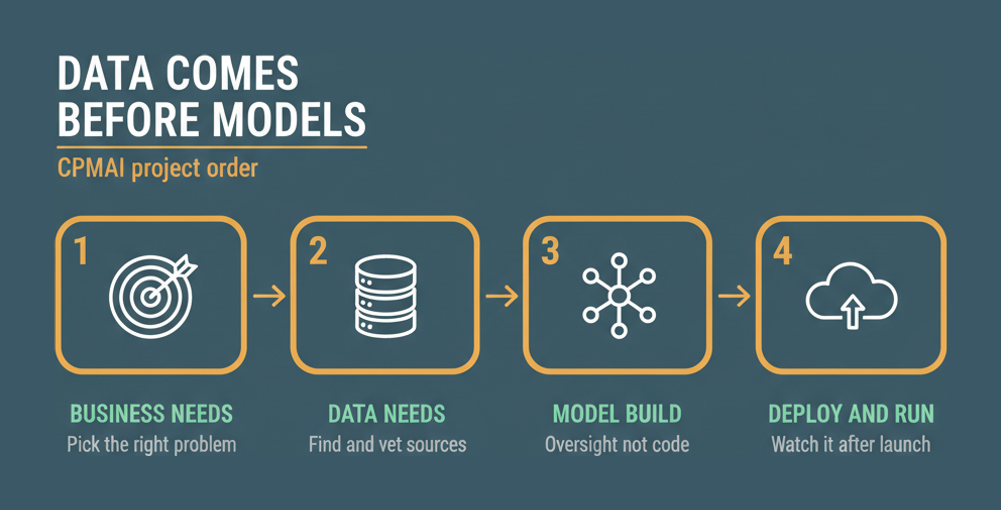
Domains II and III carry 26 percent each, so 52 percent of CPMAI is decided before any model is built. That is deliberate. AI projects fail on the wrong problem and the wrong data far more often than on the wrong algorithm, and the blueprint puts its weight where the failures are.
What Domain II asks of you
Ten tasks, and only one of them touches technology. They run from identifying the problem and its personas, through feasibility, risk assessment across security, safety and ethics, a scope statement, ROI, adoption and integration risk, drafting the solution, success criteria, business case support, and resourcing including hardware and contractors.
Read as a list it is recognisable project management, applied to a domain where feasibility is genuinely uncertain. The distinctive task is comparing AI approaches against traditional alternatives, which is the question a good AI project manager is expected to ask before spending anything.
What Domain III asks of you
- Defining the required data, and finding the subject matter experts who understand it.
- Locating sources, and coordinating the workspace and infrastructure to hold them.
- Gathering the data, then checking privacy, compliance and access before it is used.
- Overseeing evaluation, and deciding whether the data actually meets the solution’s needs.
- Conveying that data understanding upward to leadership in terms they can act on.
That last task is the one that separates this credential from a technical one. The exam expects you to translate a data reality into an executive decision, not to clean the data yourself.
The lineage behind the data-first structure
Putting business understanding and data understanding ahead of modelling is not a PMI invention. It is the shape of the CRISP-DM process model, which has organised analytics work along those phases since the late 1990s. Recognising the ancestry makes the domain order feel logical rather than arbitrary, and it explains why modelling itself is only 16 percent.
How Does CPMAI Differ From a Data Science Credential?
A data science certification tests whether you can build a model. CPMAI tests whether you can run the project around one. The verbs in the blueprint make the split obvious: the tasks say oversee, manage, verify, coordinate and convey, not train, tune or deploy. Only Domain IV touches modelling, and even there the job is governance rather than construction.
Where the two genuinely overlap
Both need enough technical literacy to judge feasibility, and both care about data quality. A CPMAI holder has to know why a class imbalance matters, what a fairness metric is measuring, and when a model has drifted. What they do not have to do is implement any of it.
Domain IV makes the boundary explicit with two separate go/no-go decision tasks: verifying data quality before preparation proceeds, and verifying the model is ready to be operationalised. Those are governance gates, and owning them is the role this credential describes.
Where PMI’s other role credentials sit
PMI has been building narrow, role-specific credentials for several years rather than extending PMP indefinitely. Its construction-focused exam followed the same pattern of taking a general discipline and rebuilding the tasks around one industry’s realities, and the write-up on PMI’s construction credential shows how that structure works in practice.
CPMAI is the same idea applied to AI. If your work is genuinely AI delivery, it is more useful than a broader qualification. If AI is one project among twenty, it is harder to justify.
Is CPMAI Worth It if You Already Hold PMP?
For a PMP holder the calculation is narrower than it looks. You already have the membership, so the exam costs $699 rather than $899, and you already know the project management half of Domains II and V. What you are buying is the AI-specific content: the data domain, the bias and transparency tasks, and the two go/no-go gates.
What the salary question really tells you
Search demand around this credential includes a steady stream of salary queries, which suggests candidates are hoping for a direct uplift. That is the wrong frame. PMI publishes no CPMAI salary data, and any figure quoted elsewhere is inference rather than evidence.
A more honest reference point is what the project management credential itself commands, and PMP compensation data gives a real baseline. CPMAI’s value sits on top of that as an access argument rather than a pay rise: it is what gets you assigned to the AI programme, and the programme is what changes the number.
Who should probably skip it
If nobody in your organisation is funding AI work, the credential certifies capability you will not use, and it has no published recertification pathway that keeps it current for you. If you are a data scientist rather than a delivery lead, the blueprint spends 52 percent of its weight on activities you do not own. And if you are new to project management entirely, the tasks assume a working knowledge of scope, ROI and stakeholder management that CPMAI does not teach.
How Should a Project Manager Prepare for 120 Questions?
Work the two 26 percent domains first, because together they decide half the exam, and leave responsible AI until you have the delivery picture straight. With 80 seconds per question and no published cut score, even coverage across all five domains beats depth in the one you find most interesting.
- Start with Domain III, identifying data needs, because it is the least familiar territory for most project managers and carries the joint-highest weight.
- Move to Domain II, business needs and solutions, mapping each of its ten tasks onto a project you have actually run so the vocabulary sticks.
- Learn the two go/no-go gates in Domain IV as decisions rather than definitions, since the exam frames them as judgement calls.
- Work Domain V by tracing one deployment end to end, from the deployment plan through model governance and metrics to the transition and contingency plans.
- Take Domain I last, reading the responsible AI tasks against a real regulation such as GDPR so the compliance language has something concrete attached to it.
- Finish with full timed mocks at 80 seconds a question, checking that your weakest domain is not one of the two carrying 26 percent.
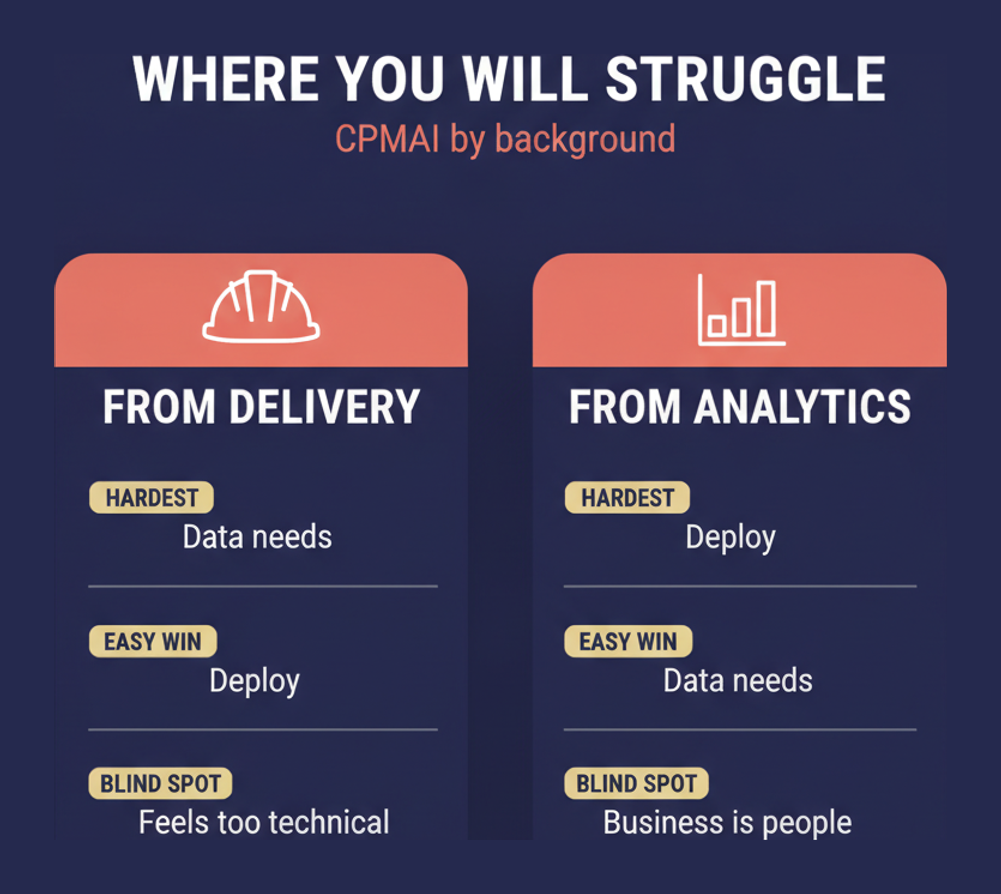
Candidates who came up through delivery usually find Domain III hardest and Domain V easiest. Candidates who came from an analytics background find the reverse, and tend to underestimate how much of Domain II is stakeholder work rather than analysis. The same domain-by-domain discipline works across PMI’s role credentials, and the approach set out for the risk management professional exam transfers cleanly here.
Frequently Asked Questions
How much does the CPMAI certification cost?
PMI members pay $699 USD and non-members pay $899 USD. The $200 gap is larger than a standard PMI membership, so joining before booking costs less than paying full price. The fee covers a single attempt through Pearson VUE and does not include training material.
How many questions are on the PMI-CPMAI exam?
The exam has 120 multiple choice questions and a 160-minute limit, which works out at roughly 80 seconds per question. It is delivered at Pearson VUE test centres. There is no separate practical or scenario component beyond the question format itself.
What is the CPMAI passing score?
PMI publishes no cut score for CPMAI. The result is reported as a plain pass or fail with no percentage or scaled figure attached, so candidates cannot tell how close they came. Prepare for even coverage rather than budgeting marks against a threshold.
Which CPMAI domain carries the most weight?
Two domains tie at 26 percent each: identifying business needs and solutions, and identifying data needs. Together they decide 52 percent of the exam. Operationalising the solution follows at 17 percent, model development at 16, and responsible AI at 15.
Is CPMAI a technical certification?
No. The blueprint’s tasks use oversight verbs throughout, and only one of five domains touches model development. It certifies the person accountable for an AI project rather than the person building the model, so no coding or model training is assessed.
Does CPMAI require PMP first?
The syllabus lists no prerequisite certification. In practice the tasks assume working knowledge of scope definition, ROI, risk assessment and stakeholder management, so candidates without project delivery experience will find Domain II harder than the weighting suggests.
What regulations does the CPMAI exam name?
Domain I names GDPR and CCPA explicitly, alongside privacy impact assessments, encryption and access controls for training data, and sector-specific compliance requirements. The expectation is that you can coordinate with legal teams, not that you can interpret statutes yourself.
How long does it take to prepare for CPMAI?
There is no official study estimate. The realistic driver is which half of the blueprint is new to you: delivery managers usually need longest on the data domain, while analytics professionals need longest on business needs and stakeholder work. Plan around the unfamiliar half rather than a fixed week count.
What are the go/no-go gates in CPMAI?
Domain IV contains two: verifying data quality before data preparation proceeds, and verifying that a model is ready to be operationalised. Both are framed as governance decisions the certified professional owns, which is the clearest expression of what the credential is actually about.
Can you take the CPMAI exam online?
The syllabus lists Pearson VUE as the scheduling route. Pearson VUE operates both test centres and online proctored delivery depending on the certification and region, so confirm the options available where you are at the point of booking rather than assuming either.
Conclusion
The honest answer to what CPMAI costs is $699 if you handle the booking sensibly and $899 if you do not, and the difference is worth more attention than most candidates give it. What the fee buys is a credential aimed squarely at the accountability gap in AI delivery: the person who has to decide whether the data is good enough, whether the model can ship, and who answers for it afterwards.
The blueprint is more useful than the marketing around AI credentials usually suggests, mainly because it puts 52 percent of its weight on problems and data rather than on models. If your work genuinely involves scoping and governing AI initiatives, that emphasis will match your week. Once the five domains are familiar, timed practice at 80 seconds a question is the fastest way to find out whether your weakest area is one of the two that decide half the result.


