Twenty questions. Forty minutes. Seventy five percent to pass. Do the arithmetic on the Copado Robotic Testing certification and you get an uncomfortable number: fifteen correct answers, which means five wrong is the absolute limit. There is no room to write off a domain you did not revise.
That changes what good preparation looks like. On a 60-question paper you can be thin somewhere and recover. On a 20-question paper every domain is small enough that a single blind spot can end the attempt, and at $250 a sitting the cost of finding that out is not trivial. The good news is that the syllabus is short and, unusually, the weightings are published: three domains at 30, 50 and 20 percent. This article walks all three, works out roughly how many questions each is worth, and sets out what to do with the week before you book.
What Does the Copado Robotic Testing Certification Actually Test?
It tests whether you can operate Copado Robotic Testing as a working test automation tool, not whether you can theorise about testing. The syllabus covers general testing concepts and where low code automation fits, the product’s own components, and the QEditor authoring environment. Half the marks sit on the product, which tells you where the exam’s centre of gravity is.
The framing matters because the word “robotic” misleads people. This is not robotic process automation in the sense that UiPath or Blue Prism use it. A robot here is an execution worker that runs your test cases, and the credential is a quality engineering one, aimed at Salesforce QA teams and admins who own regression coverage.
What the product does, in one paragraph
The Copado Robotic Testing platform is low code test automation built around Salesforce but reaching beyond it, into mobile, exploratory and user acceptance testing, and into Agentforce workflows. Copado positions it as usable by no code, low code and pro code teams alike, which is precisely the “low code automation” objective the syllabus names. Robots run in parallel with no published cap, so a regression suite is not queued behind the suite in front of it.
Two adjacent capabilities are worth knowing even though they are not named as objectives. Copado Explorer records every action and screenshot during a manual session and turns a finished session into a permanent automated test case. Test Builder reads a Jira or Azure DevOps user story and generates happy path, edge case and integration scenarios from it. Both explain why the exam treats the product as a system rather than a script editor.
How Are Twenty Questions Split Across Three Domains?
Copado publishes weightings for this exam, which many vendors do not, so the split is not guesswork. Components of Copado Robotic Testing takes 50 percent, General Testing Topics takes 30 percent, and QEditor takes 20 percent. Against a 20-question paper that works out at roughly ten, six and four questions respectively.
| Domain | Weight | Approximate questions | What it is really about |
|---|---|---|---|
| Components of Copado Robotic Testing | 50% | 10 | Robots, suites, projects, product setup, test scripts and generation modes |
| General Testing Topics | 30% | 6 | Software Testing Life Cycle, product features, platform against on premise, low code automation |
| QEditor | 20% | 4 | The purpose of QEditor, QWords, and custom keywords |
Read those numbers next to the pass mark and the strategy writes itself. You need 15 of 20. Getting every Components question right still leaves you needing five of the remaining ten. Getting every QEditor question wrong uses up four of your five permitted errors before you have answered anything else. There is no domain here you can safely skip.
Because the paper is so short, question style matters more than topic coverage. Working through the Robotic Testing sample questions before you book tells you quickly whether the exam is asking for definitions or for judgement, which is the single most useful thing to know going in.
Half the Paper Is the Product Itself
The Components domain carries five objectives and half the marks: robots and how they work, the purpose of suites, the purpose of projects, the setup of Copado Robotic Testing, and test scripts and generation modes. Ten questions across five objectives means each one is worth roughly two, so none of them is safe to leave unread.
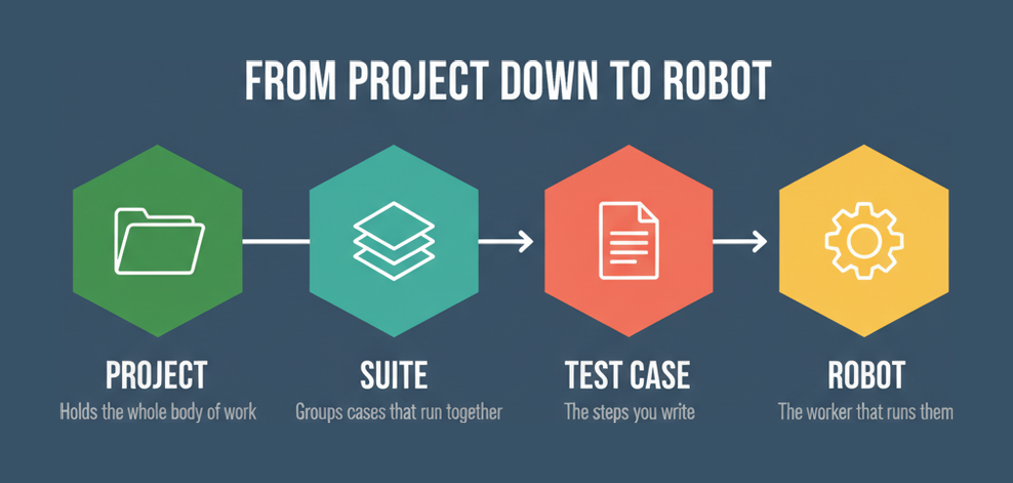
The three structural nouns are where candidates get tangled. A project is the container for a body of testing work. A suite groups test cases that belong together and are run together. A robot is the execution worker that actually runs them. Keeping those three straight, and being able to say what belongs at each level, is worth more marks than any other single fact in the syllabus.
“Making Copado Robotic Testing available in AWS Marketplace gives our customers a faster, easier path to AI-powered test automation at scale.”
That announcement matters to the setup objective, because how the product is procured and deployed is part of what “setup” covers. The AWS Marketplace listing put the product inside existing cloud agreements, which is a different onboarding path from the Salesforce native one.
Generation modes are the objective people skim
“Test scripts and generation modes” sounds like filler and is not. It covers how a test case comes into being: written directly, recorded from a live session, or generated. Knowing which mode produces which kind of artefact, and when each is appropriate, is exactly the sort of thing a two-mark question can hinge on. Detailed behaviour for each mode lives in the Copado documentation portal, which is worth an hour before the exam.
What Are QWords, and Why Does QEditor Get Its Own Domain?
QEditor is the authoring environment where test cases are written, and QWords are the readable single-step commands you write them with. The domain carries 20 percent, or about four questions, across three objectives: the function and purpose of QEditor, what QWords are, and custom keywords. It is small, and it is the part most often left until the night before.
QWords exist so that a test step reads like an instruction rather than like code. Instead of locating an element and dispatching a click, you write the action. That is what makes the tool low code, and it is why the exam separates the editor from the components: you can understand robots and suites perfectly and still not be able to author a case.
If the idea is unfamiliar, this style of authoring has a long history in test tooling, and reading about keyword driven testing generally is a fast way to get the mental model. The custom keywords objective is the extension point: when the supplied QWords do not cover a step, you define your own, and the exam expects you to know why you would.
What Does the General Testing Topics Domain Expect You to Know?
Four objectives and about six questions: the Software Testing Life Cycle, what Copado Robotic Testing is and its main features, platform considerations against on premise, and low code automation. It is the only domain that is not product specific, and it is the one where general QA experience actually helps you.
The Software Testing Life Cycle objective is a vocabulary check. Requirement analysis, test planning, case development, environment setup, execution and closure: know the phases in order and know what each produces. Candidates who have never formally studied test automation basics should spend an evening here, because these questions are cheap marks for anyone who has.
Platform against on premise is a real decision, not a definition
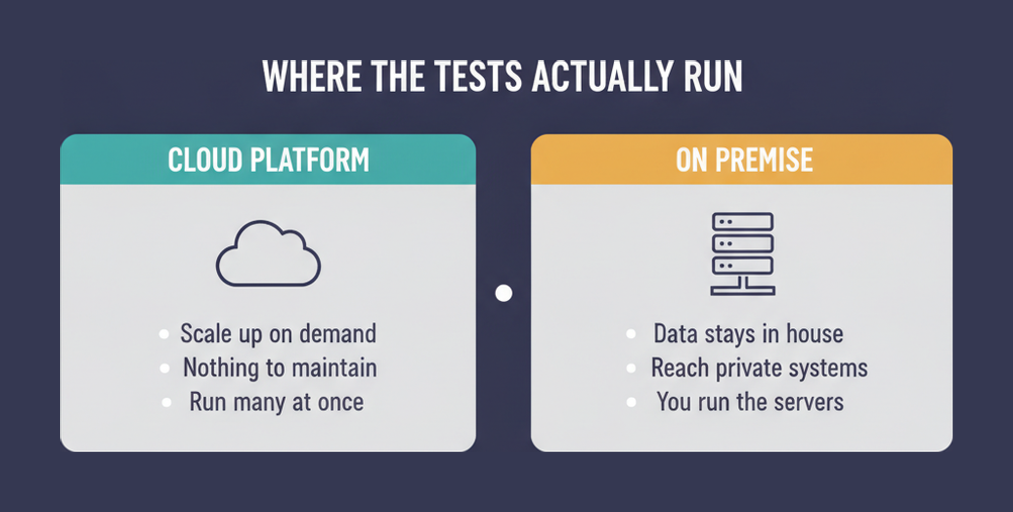
This objective asks you to reason about where testing runs. A cloud platform gives you elastic parallel execution and no infrastructure to maintain. An on premise arrangement gives you control over data residency and network access to systems that are not exposed publicly. The exam is more likely to hand you a constraint and ask which fits than to ask you to define either term.
What Are the Exam Format, Cost and Pass Mark?
The Copado Robotic Testing exam is 20 questions in 40 minutes, costs $250 USD, and requires 75 percent to pass. It is scheduled through Copado directly rather than through a third party test centre, which is unusual and means the booking route runs through the vendor rather than through Pearson VUE or PSI.
| Field | Value |
|---|---|
| Exam name | Copado Robotic Testing |
| Questions | 20 |
| Duration | 40 minutes |
| Passing score | 75 percent, which is 15 of 20 |
| Price | $250 USD |
| Scheduling | Copado, directly |
Two minutes per question is the working budget, and that is comfortable. The pressure on this paper is not time, it is margin. Twenty questions is too few for the law of averages to rescue a weak domain, so treat the 75 percent as the constraint and the 40 minutes as a non-issue.
Where Robotic Testing Sits Among the Copado Credentials
Copado runs a set of credentials rather than a single ladder, and they split by job rather than by seniority. Essentials and the Fundamentals pipeline exams cover deployment and release work, Consultant covers advisory and design work, Extension Builder covers extending the platform, and Robotic Testing covers quality. Picking the right one is a question about your role, not about difficulty.
Robotic Testing is the natural first Copado credential for anyone whose job title contains the word quality or test. It assumes no deployment pipeline knowledge, which the Fundamentals exams do, and no consulting experience, which the Consultant exam does. If you are building a study plan, the Robotic Testing exam materials collected for this exam are the right starting point.
Who actually benefits from it
Salesforce QA engineers, release managers who own regression gates, admins in small teams who test their own changes, and consultants at Copado partners. The credential also travels reasonably well as a signal, because low code test automation skills are not tied to a single employer’s toolchain in the way that a bespoke framework would be.
How Should You Prepare for a Forty Minute Paper?
Work the weightings, and give the smallest domain more attention than its size suggests. QEditor is only four questions, but those four questions are 80 percent of your permitted error budget, and it is the domain most people know least. A week of focused evenings is a realistic plan for anyone already using the product.
- Start by getting the three structural nouns straight, writing down in your own words what a project holds, what a suite groups, and what a robot does, because half the paper depends on that distinction.
- Work through setup next, following the product from an empty organisation to a first executed test case, so that the setup objective becomes a sequence you have actually performed rather than a page you have read.
- Author several test cases by hand in QEditor using QWords, then define one custom keyword, since the custom keywords objective is impossible to fake and quick to satisfy once you have done it once.
- Compare the generation modes directly, creating the same simple test case by writing it, by recording it, and by generating it, and note what differs in the artefact each time.
- Revise the Software Testing Life Cycle phases in order the evening before, treating them as vocabulary rather than theory, because those are the cheapest marks on the paper.
- Finish with a timed run through sample questions, checking that you are answering in under two minutes each and that no single domain is producing more than one error.
The last step is the one that decides the outcome. If a timed run shows two errors clustered in one domain, you have found the thing that will fail you, and you still have time to fix it.
Frequently Asked Questions
How many questions are on the Copado Robotic Testing exam?
Twenty questions in 40 minutes. That is two minutes per question, which is a comfortable pace, so the difficulty of this paper comes from the pass mark rather than from the clock.
What is the passing score for Copado Robotic Testing?
Seventy five percent, which on a 20-question paper means 15 correct answers. You can afford five wrong in total, across all three domains combined.
How much does the Copado Robotic Testing certification cost?
$250 USD. Because the exam is booked through Copado directly rather than through a third party test centre, the registration route runs through the vendor rather than through Pearson VUE or PSI.
What are the three Copado Robotic Testing exam domains?
General Testing Topics at 30 percent, Components of Copado Robotic Testing at 50 percent, and QEditor at 20 percent. That works out at roughly six, ten and four questions on a 20-question paper.
What is a QWord?
A QWord is a readable single-step command used to author test cases in QEditor. It expresses an action in plain terms rather than in code, which is what makes the tool low code, and custom keywords extend the supplied set when a step is not covered.
What is the difference between a project, a suite and a robot?
A project is the container for a body of testing work, a suite groups test cases that are run together, and a robot is the execution worker that runs them. That distinction sits underneath half the marks on the exam.
Is Copado Robotic Testing the same as robotic process automation?
No. Despite the shared word, this is quality engineering rather than business process automation. A robot here executes test cases against an application, it does not automate a back office task.
Do you need Salesforce experience to take this exam?
It is not stated as a prerequisite, and the syllabus is about the testing product rather than about Salesforce configuration. In practice most candidates come from Salesforce quality teams, and the product is built primarily for Salesforce delivery.
Which Copado certification should you take first?
It depends on your role rather than on difficulty. Robotic Testing suits quality and test roles, the Fundamentals pipeline exams suit release and deployment work, Consultant suits advisory work, and Extension Builder suits people extending the platform.
How long does it take to prepare?
For someone already using the product, a week of focused evenings is realistic. For someone new to it, allow longer, because half the exam is about components you can only learn properly by building a project, a suite and a test case yourself.
Conclusion
The Copado Robotic Testing certification is short, cheap by enterprise standards, and unforgiving. Twenty questions, 40 minutes, $250, and a 75 percent bar that leaves room for exactly five mistakes. Half the marks are on the product’s own components, three in ten on general testing knowledge, and two in ten on the QEditor authoring layer.
Prepare in that order but do not treat QEditor as optional, because four questions is most of your error budget. Build a project, group a suite, run a robot, author a case with QWords, then define one custom keyword, and the largest domain stops being memorisation. If you are still choosing between the Copado exams, the Copado certification hub sets out what each one is for. Then book it, and go in knowing the arithmetic.


