Nowhere in 1Z0-1133-26 are you asked to build a plan, model a forecast, or close a period. That surprises people, because Oracle Cloud EPM Data Integration 2026 Implementation Professional sits inside a certification family named after enterprise performance management, and performance management is what finance teams associate with planning and close. This exam certifies the plumbing underneath instead.
Ten topics, 50 questions, 90 minutes, a 68 percent cut score, and $245 USD. What makes it unusual among Oracle credentials is what is missing: there are no published percentage weightings at all. Every topic from source connections to data maps has to be treated as equally examinable, which changes how you prepare for it. This guide sets out the ten topics, what each genuinely asks, and where the exam separates a working integration developer from someone who has read the documentation.
What Does Oracle Cloud EPM Data Integration Actually Do?
Data Integration is the mechanism that moves data and metadata into and between Oracle Fusion Cloud EPM applications. It registers source and target applications, maps periods and categories, runs file-based and direct integrations, and gives users a workbench to inspect what landed. Everything a planning or close process depends on arrives through it.
That makes the credential narrower and more technical than the EPM name suggests. The person who holds it is the one a finance team calls when the general ledger extract stopped arriving, when a mapping produced the wrong entity, or when a nightly load that used to take twenty minutes now takes three hours.
Who the exam is actually written for
Implementation consultants and EPM administrators, rather than finance analysts. The objectives use verbs like install, configure, register, tune and troubleshoot, and almost none of them describe reading a report. Oracle’s own EPM product overview shows where this component sits among the planning, close and reporting applications it feeds.
What Are the Ten Topics on 1Z0-1133-26?
Ten, listed in workflow order rather than by importance: understanding data integration, configuring source connections, registering applications, creating integrations, running them, drill through, pipelines, performance optimisation, the EPM Integration Agent, and data maps. The sequence mirrors how you would build an integration from nothing, which is a useful hint about how the questions are framed.
| # | Topic | What it asks for |
|---|---|---|
| 1 | Understanding Data Integration | Describe the feature set and the capabilities of the EPM Integration Agent |
| 2 | Configuring Source Connections | Describe source connections and set them up |
| 3 | Registering Applications | Identify source and target categories and supported types, then register details and options |
| 4 | Creating Data Integrations | Period and category mapping, global and application and source period mappings, file-based and direct integrations, other data sources |
| 5 | Running Data Integrations | Run integrations, review data in the workbench, view process details |
| 6 | Drill Through to Source Systems | Describe the role of drill through and set it up |
| 7 | Running Jobs Using Pipelines | Create, modify and run pipelines |
| 8 | Optimizing Performance | Optimise integrations, analyse job logs, explain tuning, troubleshoot issues |
| 9 | EPM Integration Agent | Install, configure and start the agent, then run jobs through it |
| 10 | Moving Data with Data Maps | Data maps and smart push, creating and managing maps, configuring Smart Push |
Topic 4 is the widest by objective count, with five separate lines under it covering mapping and integration creation. That is not a published weighting, but it is a reasonable signal about where the depth lies.
Why Do Unweighted Topics Change Your Study Plan?
Because you lose the ability to triage. On a weighted Oracle exam you can look at a 5 percent domain and decide to skim it. Here every topic could be one question or could be eight, and 68 percent of 50 means you may only drop 16. Skipping any single topic is a bet you cannot price.
The practical answer is even coverage with depth added where the objective count is highest. Topics 4 and 8 carry five and four objectives respectively. Topics 6 and 7 carry two each. Weight your revision to the objective count, since that is the only proxy Oracle has published.
Where candidates lose marks anyway
- Period and category mapping, because the global, application and source levels interact and questions test which one wins
- Agent installation, because it is the only topic requiring work outside the cloud interface
- Smart Push configuration, because it looks like a data map and behaves differently
Practising against the money site’s 1Z0-1133-26 sample questions is the fastest way to find out which of those three is your weak one, since the topic list alone will not tell you.
What Is the 1Z0-1133-26 Exam Format?
Fifty multiple choice questions in 90 minutes, with a 68 percent passing score and a $245 USD price that varies by country and local currency. That gives you 108 seconds per question. Thirty-four correct answers pass. The generous clock suits an exam built around configuration scenarios rather than terminology recall.
| Specification | Value |
|---|---|
| Exam code | 1Z0-1133-26 |
| Full name | Oracle Cloud EPM Data Integration 2026 Implementation Professional |
| Questions | 50 |
| Duration | 90 minutes |
| Passing score | 68% |
| Price | USD $245 |
| Published weightings | None |
The year suffix matters more here than on most Oracle exams. Oracle ships EPM on a monthly release cadence with a public readiness site, so the feature set the exam tests moves during the year. Candidates still searching for the 2024 and 2025 codes are, in most cases, revising against a set of features that has since shifted.
Is This the Same as the Old Data Management Exam?
No, and confusing the two is the most common mistake made before booking. Data Integration is the current interface and the one this syllabus describes throughout. Older material, older training and older forum threads still refer to Data Management, and the terminology gap trips up candidates who prepared from the wrong generation of documentation.
The distinction shows up directly in the objectives. Pipelines, which sit in topic 7, are a Data Integration construct. So is the workbench view named in topic 5. Revising from a source that predates them leaves a hole you will not notice until the question arrives.
“As the EPM Cloud market matures, we are seeing more organizations looking for an integrated EPM suite to connect their financial and operational planning with financial close and reporting processes.”
That connection between planning, close and reporting is precisely what an integration developer builds, which is why the credential exists as a separate professional-level exam rather than a section inside a broader EPM paper. Oracle’s Data Integration documentation is the authoritative reference for the current terminology.
Why Does the EPM Integration Agent Get Two Topics?
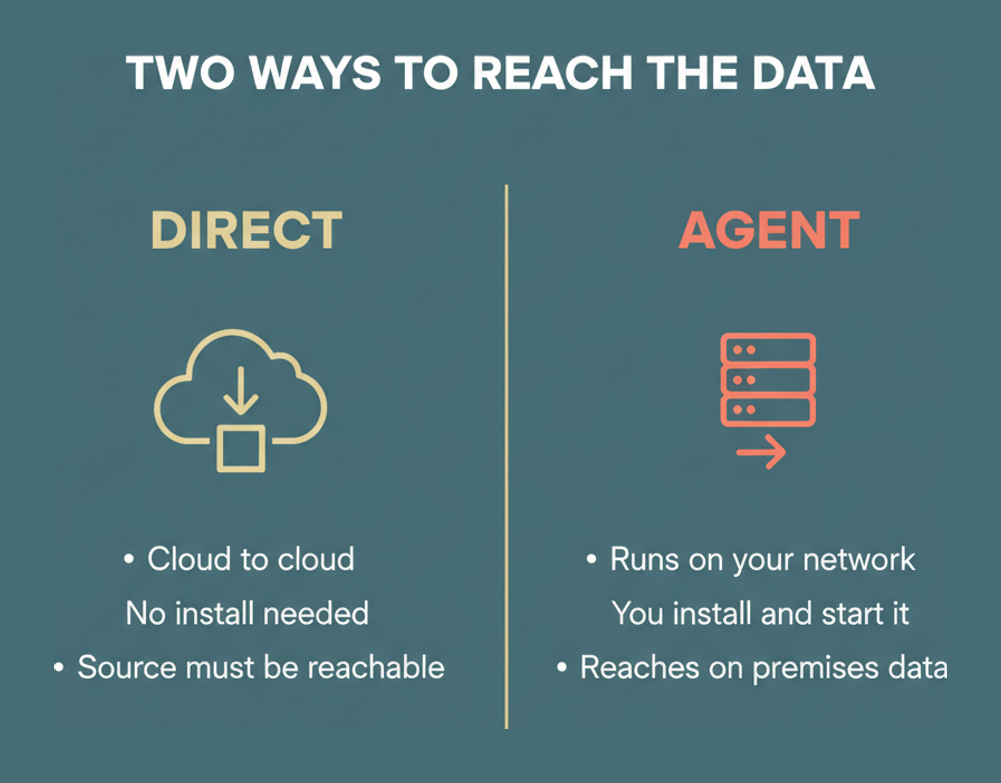
Because it is the only part of the syllabus that runs outside Oracle’s cloud. The agent is named in topic 1, where you describe its capabilities, and again in topic 9, where you install, configure, start and run jobs through it. Two of the ten topics touch it, which is the closest thing to a weighting signal this exam gives.
The reason is architectural. Cloud EPM cannot reach into an on-premises database on its own, so the agent runs inside the customer’s network, executes the query there, and returns the result. Everything about it is therefore a hybrid concern: where it is installed, what credentials it holds, how it is started, and what happens when the network path fails.
What an agent question usually looks like
Scenario-shaped. A customer has data in an on-premises source, cannot open inbound access, and needs a nightly extract. The question is which agent configuration satisfies that, and the wrong answers are usually plausible cloud-side alternatives that would work if the source were already in the cloud.
What Do Pipelines Add That Individual Jobs Do Not?
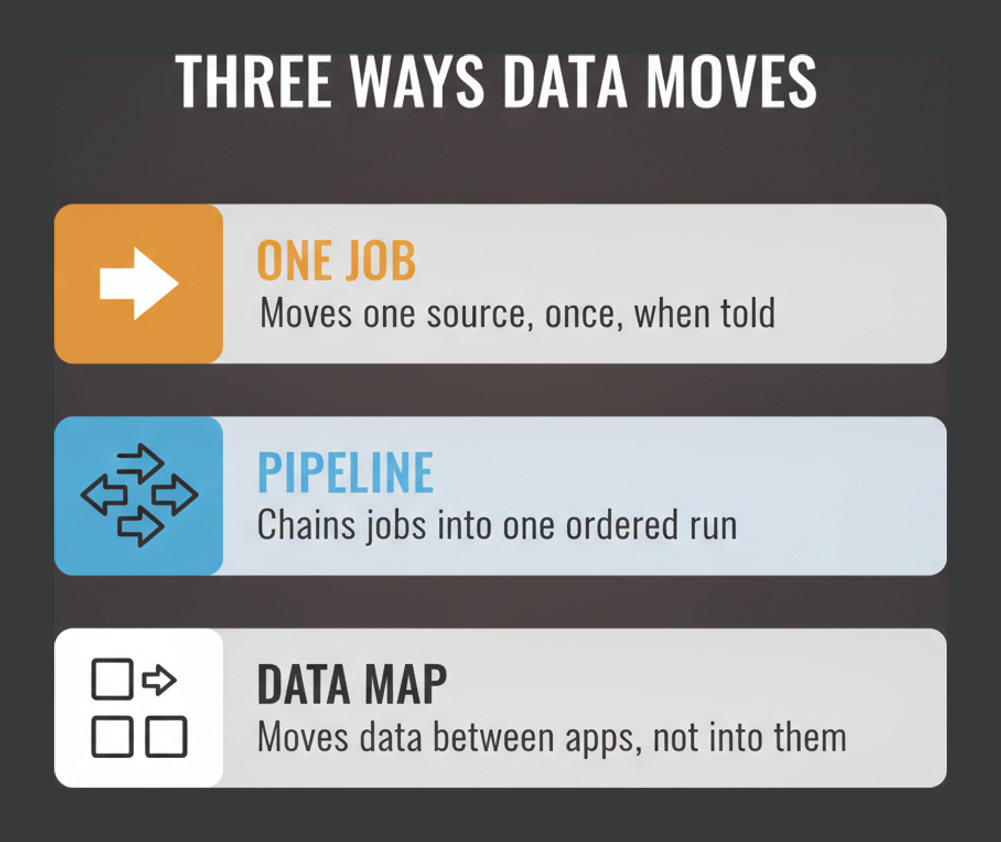
Pipelines chain multiple integration jobs into one orchestrated run, so a sequence that would otherwise be launched by hand or by an external scheduler becomes a single, repeatable object inside Data Integration. Topic 7 asks you to create, modify and run them, which means both the construction and the operational behaviour are examinable.
The examinable subtlety is ordering and failure. A pipeline is only useful if you know what happens to the remaining steps when one fails, and which parts can safely run in parallel. Those are exactly the details a question can hinge on, and they are not obvious from a feature description.
The comparison worth being able to make
- A single integration job moves one source to one target once, and someone has to decide when to run it.
- A pipeline sequences several of those jobs, holds the order, and gives you one thing to schedule and one place to look when it fails.
- Data maps, from topic 10, move data between EPM applications rather than into them, so they solve a different problem again and are not a pipeline substitute.
How Much Does Drill Through Really Matter?
More than its two objectives suggest. Drill through is what lets a user click a number in an EPM application and land on the source record behind it, and topic 6 asks you both to describe its role and to set it up. It is the feature auditors care about, which is why it earns a topic of its own rather than a bullet inside integration creation.
Setting it up is a configuration chain rather than a switch, and the exam tends to test the chain. The source system has to be reachable, the drill definition has to point at something real, and the landing behaviour has to be defined. Break any link and the number stops being traceable.
What Does the Optimisation Topic Expect You to Diagnose?
Four things, named explicitly: optimising integrations, analysing job logs, explaining tuning and other performance considerations, and troubleshooting data integration issues. It is the second-largest topic by objective count and the one that most rewards having actually operated a slow load rather than read about one.
Job log analysis is the objective that separates candidates. A log tells you where time went, and reading one properly means knowing which stage of an integration is which. Someone who has never watched a load run has no mental model to attach the log lines to.
The habits that pay off here
- Know which stages of an integration are set-based and which are row-by-row, because that is usually where the time goes
- Be able to say why a mapping choice slowed a load down, not just that it did
- Recognise the difference between a slow source, a slow transformation and a slow target write
Much of what this topic calls tuning is query behaviour wearing an EPM label, so database fundamentals transfer directly. The Oracle database administration guide covers that ground at the right depth.
Data integration is a recognised discipline in its own right, with an established professional body of knowledge maintained by DAMA International, and the vocabulary there maps cleanly onto what this topic is testing.
Where Does This Sit in the Oracle EPM Certification Path?
It is a professional-level implementation credential alongside the other Oracle Cloud EPM exams rather than a step toward them. Someone certified in Planning or Financial Consolidation and Close covers the application layer. This one covers the layer that feeds them, and the two together describe a complete implementation consultant.
Because Oracle re-releases the code each year, the credential is a statement about a specific release rather than a permanent one. That is worth factoring into when you sit it, since a certification aligned to the current year carries more weight with a client than one aligned to a release two versions back. Oracle publishes what changes each month on its EPM readiness site.
Useful adjacent knowledge
Knowing the application layer helps you design integrations that suit it, because most EPM loads end up feeding a financial process rather than sitting on their own. The Financials Cloud preparation walkthrough covers that side of the stack.
Frequently Asked Questions
How many questions are on the 1Z0-1133-26 exam?
Fifty, with a 90 minute limit. That is 108 seconds per question, which is comfortable and reflects an exam built around configuration scenarios rather than definitions.
What is the passing score for 1Z0-1133-26?
Sixty-eight percent, meaning 34 of the 50 questions correct. With no published topic weightings, you cannot know in advance which topic those 16 permitted errors will come from.
How much does the Oracle EPM Data Integration exam cost?
USD $245, varying by country and local currency. That is the standard Oracle professional-level certification price.
Are the topic weightings published?
No. Ten topics are listed with no percentages attached, so none can safely be skipped. Objective count is the only available proxy, and topics 4 and 8 carry the most objectives.
What is the EPM Integration Agent used for?
It runs inside the customer’s own network so Cloud EPM can extract data and metadata from on-premises sources it cannot reach directly. It appears in two of the ten syllabus topics.
Is Data Integration the same as Data Management?
No. Data Integration is the current interface and the one this syllabus describes. Older documentation and training refer to Data Management, and revising from that material leaves gaps around pipelines and the workbench.
What do pipelines do in Oracle EPM?
They chain several integration jobs into one orchestrated, repeatable run. Topic 7 asks you to create, modify and run them, so both construction and failure behaviour are examinable.
Does the exam require on-premises experience?
Some helps. The EPM Integration Agent is installed and started inside the customer network, so the questions around it assume familiarity with a hybrid deployment rather than a purely cloud one.
Should I take the 2026 release or an older code?
The 2026 release. Oracle ships EPM monthly, so an older code tests a feature set that has since moved, and a current-year credential carries more weight with clients.
Who typically takes this certification?
EPM implementation consultants and administrators rather than finance analysts. The objectives are dominated by install, configure, register, tune and troubleshoot verbs, with almost nothing about interpreting reports.
Conclusion
1Z0-1133-26 certifies the layer beneath enterprise performance management rather than performance management itself. Ten topics, no weightings, and a syllabus written in workflow order from source connection through to data maps. Its two hardest areas are the ones that leave the cloud interface: the Integration Agent, and diagnosing a load that has slowed down.
Prepare it evenly, weight your depth by objective count rather than instinct, and make sure your study material uses Data Integration terminology rather than the older Data Management vocabulary. When the mapping hierarchy and the agent configuration both feel routine, test that against the money site’s scenario questions before you book the 90 minutes.


