Most people hear that the APMP Foundation certification exam is open book and stop worrying about it. That is the wrong conclusion. CF APMP puts 75 questions in front of you with 65 minutes to answer them, which is 52 seconds each, and anyone who has to look something up has already lost the question they are on and part of the next one.
The open book is there because the profession works that way, not because the exam is soft. APMP’s Study Guide and Glossary double as your in-exam reference, exactly as a proposal team would keep a style guide open while writing. This article covers what the five syllabus areas contain, why the biggest of them is not about writing at all, and how to prepare for a paper you cannot read your way through.
What Is the CF APMP Exam Format?
Seventy-five multiple choice questions in 65 minutes, taken open book, booked through the APM Group. The fee is $425 USD for APMP members and $780 USD for non-members. The result is reported as a pass or a fail rather than a percentage, and you have up to a year to sit the exam after booking it.
| Specification | Value |
|---|---|
| Credential | APMP Foundation-Level Certification |
| Post-nominal | CF APMP |
| Questions | 75 |
| Duration | 65 minutes |
| Time per question | 52 seconds |
| Reference material | Open book |
| Result | Pass or fail, no percentage published |
| Fee | Members $425 USD, non-members $780 USD |
That fee gap is worth a moment. Membership costs less than the $355 difference between the two prices, so joining before booking is cheaper than not joining, which APMP acknowledges directly on its enrolment page. The CF APMP sample questions are the quickest way to see whether 52 seconds is realistic for you before committing either amount.
Why Does Open Book Not Make This Exam Easy?
Because the clock, not the recall, is the constraint. At 52 seconds per question there is time to read, decide and click. There is no time to search a glossary. The reference material exists to settle the one or two terms you genuinely blank on, not to substitute for knowing the syllabus.
There is a second reason, and it is about what the exam measures. Proposal work is reference-rich by nature. Nobody writes a compliance matrix from memory. Making the exam open book keeps it testing judgement about which technique applies, which is the actual professional skill, rather than whether you memorised a definition.
How to use the reference material properly
- Know the Glossary well enough that you rarely open it, and know where things are when you do
- Decide in advance the two or three areas where you are most likely to need a check, and bookmark those
- Treat any question that sends you to the guide as a signal to move on and come back, rather than a puzzle to solve now
APMP’s Foundation certification page sets out the six-step route from creating an account to earning the designation, including the free sample exam.
What Do the Five Syllabus Areas Actually Cover?
Understand Business Development, Focus on Customer, Create Deliverables, Manage Processes, and Use Tools and Systems. No percentage weightings are published, but the sub-topic counts differ sharply: one, eleven, nine, eight and four respectively. Focus on Customer is more than twice the size of anything except Create Deliverables.
| Area | Sub-topics | Centre of gravity |
|---|---|---|
| Understand Business Development | 1 | The business development lifecycle as a whole |
| Focus on Customer | 11 | Customer analysis, win themes, value propositions, price-to-win, teaming |
| Create Deliverables | 9 | Compliance matrix, persuasive writing, graphics, document design, pricing data |
| Manage Processes | 8 | Gate decisions, kickoff, reviews, production, virtual teams, lessons learned |
| Use Tools and Systems | 4 | Opportunity plans, content plans, knowledge management, scheduling |
Because there are no weightings, sub-topic count is the only proxy available for where the questions concentrate. Thirty-three sub-topics across 75 questions works out at roughly two questions each, which suggests breadth is rewarded far more than depth in any one technique.
Is This a Writing Exam or a Strategy Exam?
Mostly strategy, which surprises people who come to it as bid writers. The largest area, Focus on Customer, is about deciding what to say and why: customer analysis, competitive intelligence, win themes, value propositions, discriminators, proof points and price-to-win. Persuasive writing appears once, inside the smaller Create Deliverables area.
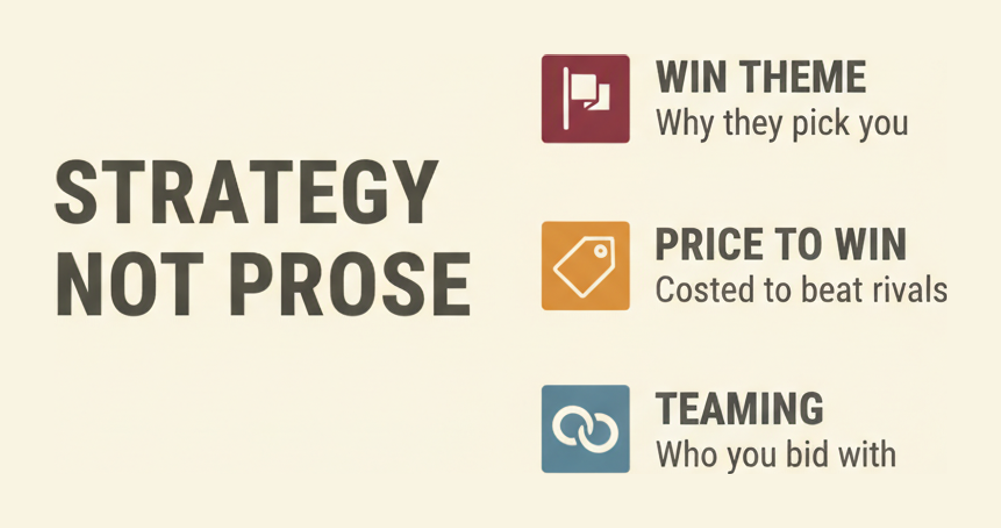
That balance reflects how proposals are actually won and lost. A beautifully written response to a badly understood customer loses to a plainly written one built on the right win themes. The syllabus puts eleven sub-topics behind understanding the customer and buries the prose craft among nine others.
The strategy vocabulary the exam expects
- Features, benefits and discriminators, and the difference between them, which is a classic exam distinction
- Win themes against value propositions against proposal theme statements, three related ideas that are not interchangeable
- Price-to-win as a discipline rather than a discount, sitting alongside teaming decisions
- Compliance and responsiveness treated as separate concepts, which they are
The whole discipline sits on the formal procurement process most organisations run, and the request for proposal process is worth understanding in the round if you have only ever seen your own side of it.
How Much of It Is Running the Process?
Eight sub-topics, roughly a quarter of the syllabus by count, and it is the area experienced writers most often neglect. Manage Processes covers the end-to-end process, gate decisions, kickoff meeting management, daily team management, review management, production management, virtual team management and lessons learned.
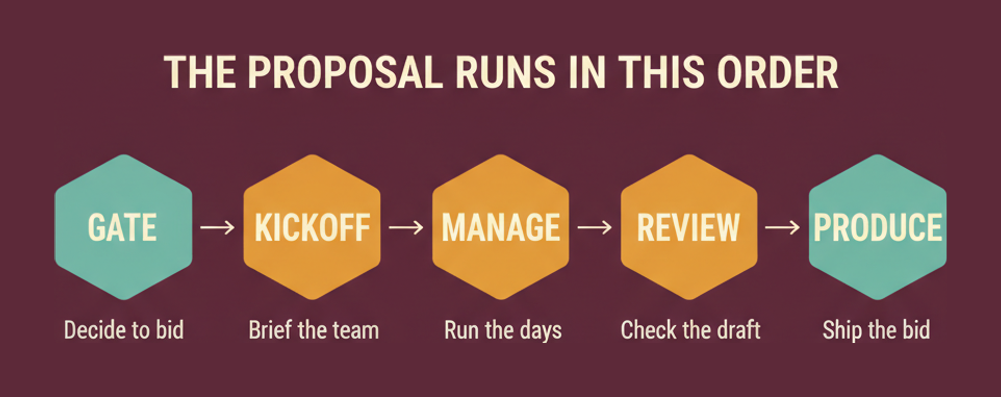
Every one of those is a management activity rather than a content one. Review management alone carries the colour-team review conventions that most proposal shops run on. Gate decisions are the go and no-go points that determine whether a bid happens at all, which is upstream of anything a writer touches.
Why Use Tools and Systems is easy marks
Four sub-topics: opportunity plans, content plans, knowledge management and scheduling. It is the smallest area on the syllabus and the most self-explanatory, so it delivers the best return per hour of study on the whole paper. Learn the four, and treat the area as done.
Foundation or Practitioner: Which Should You Sit?
Foundation, unless you already have several years of bid and proposal experience behind you. CF APMP is the entry credential and tests knowledge of the discipline. The Practitioner level tests applied competence and assumes a working track record, which is why search data shows the two abbreviations behaving as separate markets.
The sequencing question answers itself for most people. Foundation is a single 65 minute paper you can prepare for from the study guide. Practitioner asks you to demonstrate what you have actually done, and no amount of reading substitutes for having run real bids.
The honest test
If you can name the last three proposals you influenced the strategy on, Practitioner is within reach. If you are learning the vocabulary of win themes and compliance matrices for the first time, start at Foundation. APMP’s certification family overview shows how the levels relate.
How Should You Prepare for 52 Seconds a Question?
Prepare for speed rather than depth. Thirty-three sub-topics across 75 questions means most sub-topics get one or two questions, so the winning approach is confident recognition of every term rather than mastery of a few. The open book is a safety net, not a strategy.
- Read the Study Guide once end to end without stopping, so you know the shape of all five areas before you start memorising anything.
- Learn the Glossary next, because the exam is largely a test of whether you can tell closely related terms apart at speed.
- Drill the distinctions that look similar and are not: features against benefits against discriminators, win themes against value propositions, compliance against responsiveness.
- Spend a focused hour on Manage Processes, since it is a quarter of the syllabus and the area experienced writers most often skip.
- Take the free sample exam under a real clock, because 52 seconds a question is the single thing you cannot simulate by reading.
- Bookmark the two or three glossary sections you still hesitate on, and go in knowing you will use the book twice, not twenty times.
Booking early helps more than it sounds like it should, because you get up to a year to sit the exam once it is booked. That turns a vague intention into a deadline you can plan backwards from.
Which Roles Recognise CF APMP?
Proposal managers, bid managers, capture managers, proposal writers and business development staff, particularly in government contracting, professional services, construction and technology sectors where formal procurement dominates. CF APMP is the recognised entry credential in a field that has few of them.
Its practical value is as a signal of shared vocabulary. Proposal teams are assembled quickly from mixed backgrounds, and a credential that guarantees everyone means the same thing by a win theme removes real friction. PayScale’s proposal manager salary data gives a sense of where the role sits in the market.
Where it is close to expected
Large government contractors and the consultancies that bid alongside them treat APMP certification as a normal line on a proposal professional’s profile, and some list it in job specifications. A related walkthrough on this site covers practice test preparation from the study-routine angle rather than the syllabus angle.
Frequently Asked Questions
How many questions are on the APMP Foundation exam?
Seventy-five, with 65 minutes to answer them. That works out at 52 seconds per question, which is the tightest time budget of any comparable entry-level certification.
Is the APMP Foundation exam open book?
Yes. The Study Guide and Glossary double as your in-exam reference materials. The clock rather than recall is the real constraint, so the book helps with one or two terms, not with revision you skipped.
What is the pass mark for CF APMP?
No percentage is published. The result is reported as a pass or a fail, and neither the money site’s syllabus page nor APMP’s own certification page states a numeric threshold.
How much does the APMP Foundation certification cost?
$425 USD for APMP members and $780 USD for non-members. Since membership costs less than the difference, joining before booking is the cheaper route.
What does CF APMP stand for?
Certified Foundation, Association of Proposal Management Professionals. It is used as a post-nominal after your name once the exam is passed.
How long do you have to take the exam after booking?
Up to one year. That makes booking early a useful commitment device, since it converts an intention into a dated deadline you can plan backwards from.
Which syllabus area is the largest?
Focus on Customer, with eleven sub-topics covering customer analysis, competitive intelligence, win themes, value propositions, discriminators, proof points, price-to-win and teaming.
Is APMP Foundation a writing exam?
Not primarily. Persuasive writing is one sub-topic inside Create Deliverables. The bulk of the syllabus is about deciding what to say and managing the process that produces it.
Should I take Foundation or Practitioner first?
Foundation, unless you already have several years of bid experience. Practitioner tests applied competence against a real track record rather than knowledge of the discipline.
Is training required to sit the exam?
No. You can self-study from the Study Guide and Glossary, or prepare through an Accredited Training Organization. Both routes lead to the same exam.
Conclusion
CF APMP is a broad, fast recognition test rather than a deep one. Thirty-three sub-topics, 75 questions, 65 minutes, and an open book that rewards knowing where things are rather than reading them on the day. Its centre of gravity is customer strategy, not prose, which is the single most useful thing to know before you start studying.
Read the guide once for shape, learn the glossary for speed, drill the terms that look alike, and give the process area the hour it deserves. Then sit a timed practice run against the money site’s question set, because the only part of this exam you cannot prepare for by reading is the 52 second clock.


