Every VMware exam before this one rewarded time served. Years of vCenter work, a feel for where settings live, a memory of which wizard does what: all of it counted. The 2V0-17.25 certification breaks that pattern, because the product underneath it was rebuilt. VMware Cloud Foundation 9.0 arrived in June 2025 as an integrated private cloud suite rather than a bundle of separate products, and the exam that carries the code 2V0-17.25 tests the new shape, not the old one.
That matters more than it sounds. The published syllabus for the VMware Cloud Foundation 9.0 Administrator credential lists 59 objectives against a 60-question paper, and 42 of those objectives sit in a single section about deploying, managing, operating and automating VCF itself. Fundamentals, the part that most closely resembles classic vSphere administration, is the smaller half. This guide counts the objectives where they actually fall, explains what the scaled pass mark of 300 out of 500 really asks for, and sets out what a working vSphere administrator still has to learn.
What Is the 2V0-17.25 Certification?
2V0-17.25 is the exam code for VMware Cloud Foundation 9.0 Administrator, which awards the VCP-VCF Administrator credential. It is a 60-question proctored exam delivered through Pearson VUE, priced at $250 US dollars, with an appointment time of 135 minutes and a scaled passing score of 300 out of 500.
The credential sits at professional level and targets the person who runs a VMware Cloud Foundation estate day to day rather than the person who designs one. That distinction runs right through the objective list: the verbs are deploy, configure, manage, monitor and consume, and the recurring phrase is “given a scenario”, which signals situational judgement rather than recall. Running an estate now includes accounting for what it costs, which is the ground cloud cost certification covers.
Two recommended courses sit behind it, VMware Cloud Foundation: Build, Manage, and Secure, and VMware Cloud Foundation: Automate and Operate. The pairing is a useful clue to the exam’s shape. One course covers standing the platform up and securing it; the other covers running and automating it once it exists. The exam draws heavily from both.
Why Does VCF 9.0 Change What the Exam Tests?
Because VCF 9.0 is not a version bump. Broadcom brought the compute, storage and networking teams together to build one integrated private cloud suite instead of discrete products sold separately, and the result has a single operations interface, a self-service provisioning surface for developers, and a Kubernetes service managing containers and virtual machines through the same model.
An exam written against that architecture asks different questions. Where an older paper might have tested how to configure a distributed switch, this one asks you to differentiate between VCF networking components and configure virtual networking fabrics, connectivity, routing and services as parts of one fabric. Where an older paper tested vCenter administration, this one asks how you import an existing vCenter into VMware Cloud Foundation, which is a migration task rather than an administration one.
The independent account of the release is worth reading before you study, because it explains the product logic the objectives assume. Coverage of the VCF 9 release sets out how the suite was assembled, and a longer analysis of what changed covers the operational model the exam keeps returning to.
The practical consequence is that a candidate whose estate has not yet moved to VCF 9.0 cannot rely on familiarity. The concepts transfer; the surfaces do not.
How Are the 2V0-17.25 Objectives Distributed?
The syllabus names three sections and publishes objectives under two of them. Seventeen objectives sit in the fundamentals section and 42 sit in the deploy, configure and operate section, giving 59 published objectives against 60 questions. The middle section, Plan and Design, is named but carries no published objectives at all.
| Section | Sub-areas | Published objectives |
|---|---|---|
| IT Architectures, Technologies, Standards | Private Cloud Vision, VMware Compute Fundamentals, VMware Storage Fundamentals, VMware Network Fundamentals | 17 |
| Plan and Design the VMware by Broadcom Solution | None published | 0 |
| Deploy, Configure, and Operate VMware Cloud Foundation | Deploy and Configure, Manage, Operations, Consume and Automate | 42 |
No percentage weightings are published, so nobody can honestly tell you that operations is worth 30 percent of the paper. What the objective counts do tell you is where the syllabus authors spent their effort, and roughly 71 percent of the published objectives describe running VCF rather than understanding it. Working through 2V0-17.25 sample questions section by section is the quickest way to see whether that distribution matches your own confidence.
Which Sub-Area Carries the Most Objectives?
VCF Operations, with 14 published objectives, more than any other sub-area and more than the entire storage and network fundamentals areas combined. Consume and Automate follows with 12, Deploy and Configure has 9, and Manage has 7. Monitoring and automation together account for 26 of the 59 objectives.
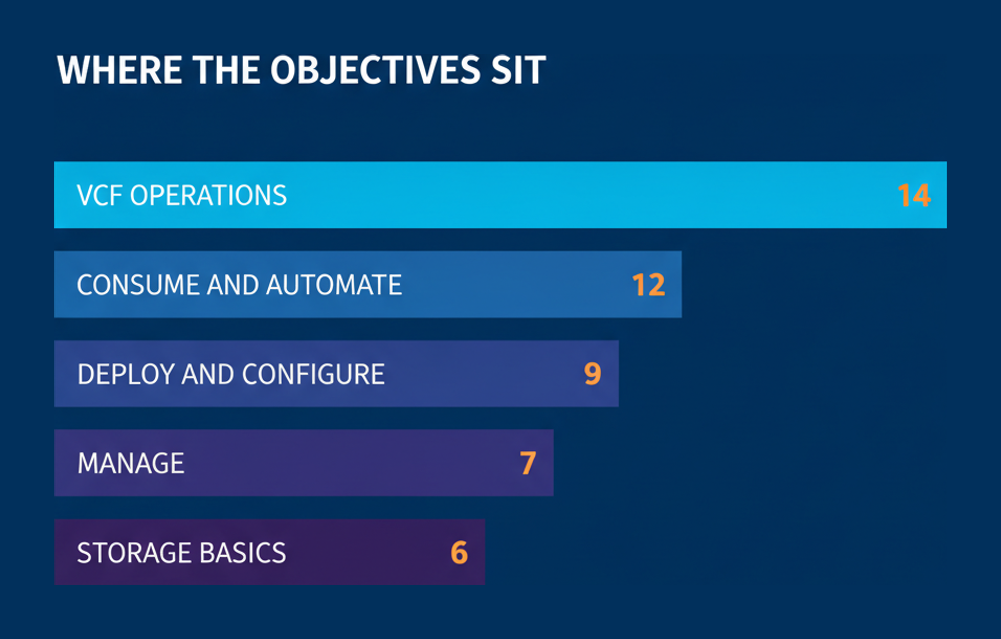
| Sub-area | Objectives | Share of the 59 |
|---|---|---|
| VCF: Operations | 14 | 24% |
| VCF: Consume and Automate | 12 | 20% |
| VCF: Deploy and Configure | 9 | 15% |
| VCF: Manage | 7 | 12% |
| VMware Storage Fundamentals | 6 | 10% |
| VMware Compute Fundamentals | 4 | 7% |
| VMware Network Fundamentals | 4 | 7% |
| Private Cloud Vision | 3 | 5% |
What VCF Operations actually asks
The 14 operations objectives run from cluster components and deployment options through metrics against properties, custom views and reports, shared dashboards, alerting, log events, health and diagnostics, network monitoring, vSAN storage monitoring, policies, application monitoring, security hardening and compliance, and configuration drift. That is a monitoring product in its own right, and treating it as a footnote to infrastructure work is the most common way to underprepare.
What Consume and Automate asks
The 12 automation objectives cover VCF Automation’s use case, its components and deployment options, regions, multi-organizational tenancy, provider networking, provider content libraries, organizational administrator tasks, organizational networks, content management, extensibility for business processes, governance policies, and Supervisor-based services. Tenancy and governance are the unfamiliar parts for most administrators, because they belong to a service-provider mental model rather than a single-estate one.
What Happens to the Plan and Design Section?
The syllabus names Plan and Design the VMware by Broadcom Solution as a section and lists nothing underneath it. Every published objective on the exam therefore belongs to either fundamentals or to deploy, configure and operate. The section header exists; the objectives do not.
The honest reading is the narrow one. A section with no published objectives is a section you cannot study for from the blueprint, and nothing in the readable official material explains the gap. It would be easy to assume the section is inert on an administrator-level exam, and that assumption may well be right, but it is an assumption rather than a documented fact.
What follows practically is simple enough. Plan your revision entirely around the 59 objectives that are published, because they are the only concrete statement of scope available. If design-flavoured judgement does appear, it will read as a scenario question about choosing a deployment model, which the Deploy and Configure objectives already cover directly.
What Are the 2V0-17.25 Exam Details?
The exam runs 60 questions in a 135-minute appointment, costs $250 US dollars, and is passed at a scaled 300 out of 500. Delivery is proctored through Pearson VUE. The official exam guide behind those figures carries a last-updated date of 23 April 2026, so the blueprint in circulation is current.
| Detail | Value |
|---|---|
| Exam name | VMware Cloud Foundation 9.0 Administrator |
| Exam code | 2V0-17.25 |
| Credential awarded | VCP-VCF Administrator |
| Questions | 60 |
| Appointment time | 135 minutes |
| Passing score | 300 of 500, scaled |
| Price | $250 USD |
| Delivery | Proctored through Pearson VUE |
| Recommended training | VCF: Build, Manage, and Secure; VCF: Automate and Operate |
Two details in that table deserve a second look. The 135 minutes is an appointment time, so it includes the administrative wrapper around the questions rather than being pure thinking time. And the pass mark is scaled, which is why it reads as 300 out of 500 instead of a raw count. A scaled mark means you cannot compute how many questions you may miss, and planning around a comfortable margin is guesswork. Broadcom publishes the current figures on its VCP-VCF Administrator page, with the full blueprint in the downloadable VCF Administrator exam guide.
Does 2V0-17.25 Cover vSphere?
Yes, but as a component rather than as the subject. The compute fundamentals objectives ask you to deploy and configure vCenter and ESX, configure a vSphere cluster, deploy and configure virtual machines, and manage a virtual machine through vCenter. That is four objectives out of 59, roughly seven percent of the published list.
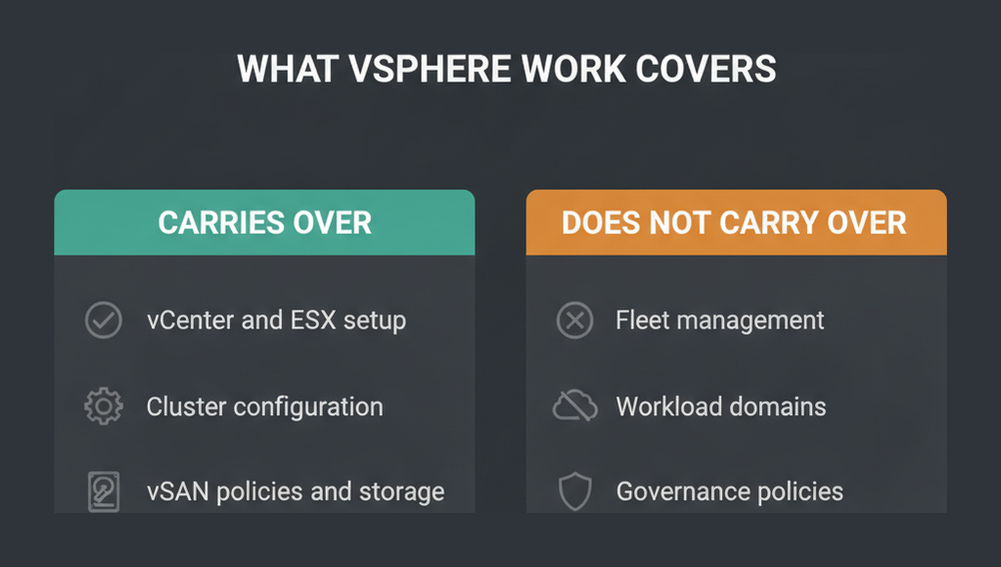
Storage is treated the same way. Six objectives cover vSphere storage configuration, the use cases for vSAN ESA against vSAN OSA, deploying a vSAN cluster, vSAN storage policies, resilience and data availability options, and vSAN space efficiency. A vSphere administrator will recognise all of it, and will still find that recognition accounts for under a fifth of the paper.
The gap is everything above the hypervisor. Fleet management in VCF Operations, workload domains, the VCF Network Gateway, licence and certificate and password management at fleet scale, importing an existing vCenter into the platform, multi-organizational tenancy in VCF Automation: none of that has an obvious vSphere ancestor. Candidates coming from the architect side of the family will find our 2V0-13.25 architect guide a useful map of how the two exams divide the same platform.
How Should a vSphere Administrator Prepare?
Invert the usual order. Start with the material that has no vSphere equivalent, because that is where the objective count is heaviest and the transfer is weakest, and leave compute and storage fundamentals until last, since those are the objectives your existing work already rehearses daily.
- Read the objective list end to end first and mark every objective that names a product you have not personally operated, because those are the ones no amount of vSphere experience will cover.
- Work VCF Operations before anything else, since 14 objectives sit there and the monitoring surface is the largest single block of unfamiliar material on the exam.
- Take VCF Automation next, concentrating on regions, multi-organizational tenancy and governance policies, which assume a service-provider model most single-estate administrators have never used.
- Rehearse the deployment objectives against the deployment models, so that identifying the right model for a scenario becomes a decision you have already made rather than one you reason out under time pressure.
- Finish on compute, storage and networking fundamentals, treating them as a confidence pass rather than a learning exercise, and confirming only that the VCF naming has not moved under you.
- Sit a full timed rehearsal at 135 minutes, because scaled scoring gives you no way to estimate a safety margin and pace is the only variable you control.
The reason this order works is arithmetic rather than preference. Twenty-six of the 59 objectives are in operations and automation. Fourteen are in compute, storage and network fundamentals combined. Spending equal time on both halves would mean spending twice as long per objective on the material you already know.
Where the Credential Sits in the VCF Track
VCP-VCF Administrator is the operator credential in Broadcom’s VMware Cloud Foundation family, sitting alongside rather than beneath the architect and specialist credentials. It proves you can run the platform; a separate exam covers designing it. The two overlap in vocabulary and diverge sharply in what they ask you to produce.
For anyone mapping a path, the useful comparison is with the vSphere professional credential, which remains the right choice for an estate that has not adopted VMware Cloud Foundation. Our 2V0-21.23 blueprint breakdown covers what that exam still tests, and reading the two objective lists side by side makes the boundary obvious.
The strategic question is about your estate, not your CV. If your organisation is on VCF 9.0 or moving to it, this credential describes the job you already do. If it is running vSphere without the wider suite, roughly three quarters of the objectives describe products you do not operate, and the credential becomes an investment in a future role rather than a validation of a current one.
Frequently Asked Questions
What is the 2V0-17.25 exam?
It is the VMware Cloud Foundation 9.0 Administrator exam, which awards the VCP-VCF Administrator credential. It contains 60 questions, runs in a 135-minute appointment, and is delivered proctored through Pearson VUE.
How many questions are on 2V0-17.25?
Sixty. The published syllabus lists 59 objectives, so the paper works out at roughly one question per published objective, although no official mapping between the two is published anywhere.
What is the passing score for 2V0-17.25?
Three hundred out of 500, calculated using a scaled method. Because the score is scaled rather than raw, there is no published way to work out how many questions you are allowed to answer incorrectly.
How much does the 2V0-17.25 exam cost?
Two hundred and fifty US dollars. Scheduling runs through Pearson VUE, and the two recommended courses behind the credential are priced separately by Broadcom and its training partners.
Which section of 2V0-17.25 has the most objectives?
Deploy, Configure, and Operate VMware Cloud Foundation, with 42 of the 59 published objectives. Within it, VCF Operations alone carries 14, more than compute, storage and network fundamentals combined.
Does 2V0-17.25 test vSphere skills?
Only in part. Four compute objectives cover vCenter, ESX, clusters and virtual machines, and six storage objectives cover vSphere storage and vSAN. Together that is ten of 59 objectives, under a fifth of the published list.
Why does the syllabus list a Plan and Design section with nothing in it?
The section is named but carries no published objectives, and no readable official source explains why. Practically, it means all 59 published objectives belong to the other two sections, so revision should be built entirely around those.
Is 2V0-17.25 the same as the VCF Architect exam?
No. 2V0-17.25 is the administrator exam and covers running the platform. The architect exam carries a different code and asks you to design a solution, so the two share vocabulary but test different work.
Is the 2V0-17.25 exam proctored?
Yes. It is delivered as a proctored exam through Pearson VUE. The 135 minutes quoted is an appointment time, so it includes the administrative wrapper around the questions themselves.
How current is the 2V0-17.25 blueprint?
The official exam guide carries a last-updated date of 23 April 2026. That makes it the current statement of scope, and any study material predating VMware Cloud Foundation 9.0 should be treated with caution.
Conclusion
The 2V0-17.25 certification is best understood as an exam about operating a platform, not about virtualising servers. Fifty-nine published objectives, 42 of them in one section, and a scaled pass mark of 300 out of 500 all point the same way: the paper rewards fluency with VCF Operations and VCF Automation far more than it rewards vSphere seniority.
Plan around the objective counts rather than around instinct. Start where the objectives are densest and least familiar, treat compute and storage fundamentals as a confidence pass, and rehearse once at full length because scaled scoring leaves you no way to estimate a margin. Then sit it knowing exactly which quarter of the paper you were weakest on going in.


