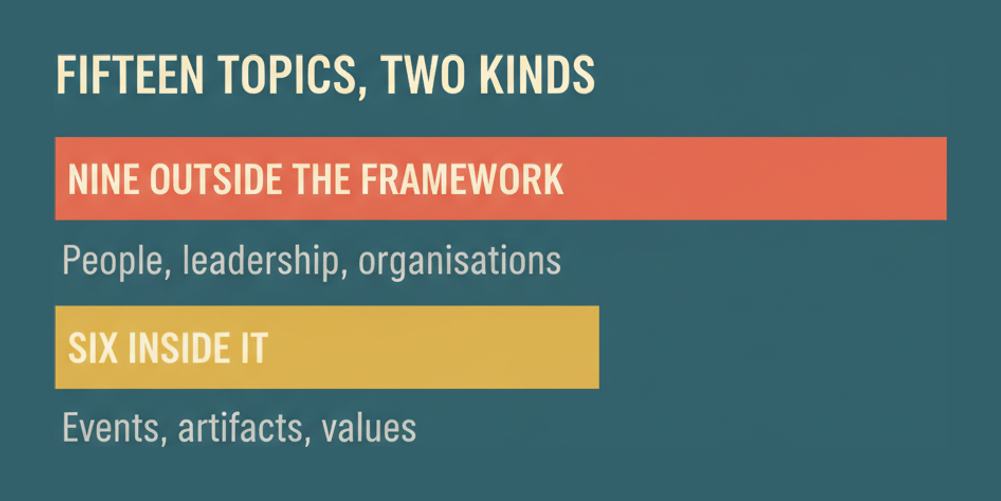
PSM II is not PSM I with the difficulty turned up. That assumption costs candidates $250 a time, because the Professional Scrum Master II assessment is not really an examination of the Scrum framework at all. Of the fifteen topics Scrum.org publishes across five focus areas, only six concern empiricism, the Scrum Team, events, artifacts, the values and the Definition of Done. The other nine are about people, leadership, facilitation, coaching, stakeholders, technical risk and organisational design.
That shift changes what preparation means. Rereading the Scrum Guide until you can recite the accountabilities is exactly the work that got you through the first tier, and it addresses under half of the second. Thirty questions, 90 minutes, a pass mark of 85 percent, and only four wrong answers permitted. This guide sets out where the topics actually sit, what the pass mark leaves you, and what a PSM I holder still has to learn.
What Is the Professional Scrum Master II Assessment?
PSM II is the second tier of Scrum.org’s Scrum Master credential. The assessment contains 30 questions in a 90-minute window, mixes multiple choice, multiple answer and true/false formats, costs $250 per attempt, and is passed at 85 percent. Scrum.org calls it an assessment rather than an exam, which is a fair description of what it does.
The distinction is not marketing. The questions are situational: a scenario describes a team, an organisation or a stakeholder problem, and you choose the response a competent Scrum Master would take. Several questions award partial credit, so a partly-right answer is not automatically a lost mark, which matters more at an 85 percent bar than it would at 65.
Two recommended courses sit behind it, Professional Scrum Master and Professional Scrum Master Advanced Training. The second of those is the clue: this is the tier where Scrum.org expects experience rather than study, and its advanced course exists precisely because the material is not readable off a page.
What Is the Difference Between PSM I and PSM II?
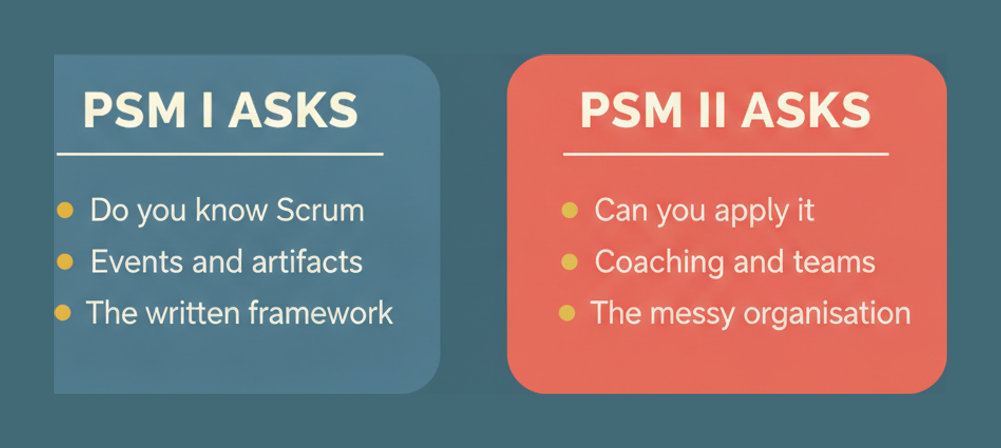
PSM I asks whether you understand Scrum. PSM II asks whether you can apply it in an organisation that does not want to change. The framework itself accounts for six of the fifteen published topics; the remaining nine cover self-managing teams, leadership styles, facilitation, coaching, mentoring, product backlog management, stakeholders, technical risk and organisational design.
The pass mark reinforces the point. PSM I is widely known as a framework-knowledge test with a comfortable margin; PSM II sets 85 percent on 30 questions, which permits four wrong answers in total. On a paper where most items are judgement calls rather than recall, that is a demanding standard.
The practical consequence for a PSM I holder is that framework revision is necessary and nowhere near sufficient. If your daily work is running events and maintaining a board, the six framework topics are already yours and the other nine describe work you may not yet do. Reading the objective list against PSM II exam material is the quickest way to find out which of those nine are unfamiliar.
How Are the Five Focus Areas Split?
Understanding and Applying the Scrum Framework holds six topics. Developing People and Teams holds five. Managing Products with Agility holds two, and Developing and Delivering Products Professionally and Evolving the Agile Organization hold one each. No percentage weightings are published, so topic counts are the only honest measure of emphasis available.
| Focus area | Topics it names | Count |
|---|---|---|
| Understanding and Applying the Scrum Framework | Empiricism; the Scrum Values; the Scrum Team; the Scrum Events; the Scrum Artifacts; Definition of Done | 6 |
| Developing People and Teams | Self-Managing Teams; Leadership Styles; Facilitation; Coaching; Mentoring | 5 |
| Managing Products with Agility | Product Backlog Management; Stakeholders and Customers | 2 |
| Developing and Delivering Products Professionally | Managing Technical Risk | 1 |
| Evolving the Agile Organization | Organizational Design and Culture | 1 |
Counting that way produces the sentence most PSM I holders need to read: nine of fifteen topics sit outside the framework. The exam is weighted toward the parts of the role that no amount of Scrum Guide familiarity prepares you for.
Why Do People and Teams Carry So Many Topics?
Because that is where a Scrum Master’s actual work happens once the events are running. Five of the fifteen topics sit in this focus area alone: self-managing teams, leadership styles, facilitation, coaching and mentoring. Scrum.org treats those as five distinct disciplines rather than as one soft-skills bucket, and the assessment tests the differences between them.
The three that get confused
Facilitation, coaching and mentoring are separate accountabilities, and questions turn on telling them apart. Facilitation leads a group toward an agreed objective while keeping ownership with the participants. Coaching makes the coach a process expert who enables others to reach their own goals through developmental conversations, active listening and thought-provoking questions. Mentoring is a mutually beneficial relationship in which a mentor guides a mentee toward their goals, which the syllabus notes is often confused with coaching.
Leadership and self-management
The leadership topic asks for the difference between leaders and managers and the traits of an agile leadership style, and the syllabus is explicit that it prefers the term agile leadership to servant leadership. Self-managing teams are framed around giving a team the space to determine how to do the work rather than directing it, with the syllabus flagging myths and misunderstandings about self-management as examinable in their own right.
None of that can be answered from the Scrum Guide, which is deliberate. The Scrum Guide itself defines the framework and says almost nothing about how to coach a team through adopting it.
What Does an Eighty-Five Percent Pass Mark Leave You?
Twenty-six correct answers from 30, and four wrong. That is the tightest margin of any tier in the Professional Scrum family, and on a paper of situational judgement questions it means a single misread scenario in each of four different topics is enough to fail.
Partial credit softens this, and it is worth understanding rather than hoping for. Some questions award marks for a partly correct selection, particularly the multiple-answer items where several responses are defensible. That makes answering completely more valuable than answering cautiously: leaving a plausible option unselected can cost fractional marks you had already earned.
Ninety minutes across 30 questions is three minutes each, which is generous by certification standards and appropriate for scenarios that run to a paragraph. Time is not the binding constraint here. The bar is.
What Are the PSM II Exam Details?
PSM II is 30 questions in 90 minutes at 85 percent, priced at $250 per attempt, using multiple choice, multiple answer and true/false formats. The assessment is taken online through Scrum.org, and the resulting certification does not expire.
| Detail | Value |
|---|---|
| Exam name | Scrum.org Professional Scrum Master II |
| Exam code | PSM II |
| Questions | 30 |
| Duration | 90 minutes |
| Passing score | 85 percent, or 26 correct |
| Fee | $250 USD per attempt |
| Formats | Multiple choice, multiple answer, true/false |
| Partial credit | Awarded on some questions |
| Validity | Lifetime, no renewal fee |
| Recommended training | Professional Scrum Master; Professional Scrum Master Advanced |
One scheduling detail is genuinely useful. An assessment password is valid for a single attempt but carries no expiry date, so a purchased attempt can be held for as long as you need before sitting it. Scrum.org sets out the current terms on its own PSM II assessment page.
Does the PSM II Certification Expire?
No. Scrum.org issues its Professional Scrum credentials as lifetime certifications with no annual renewal fee and no continuing-education requirement. Once earned, PSM II stays earned, and a free Credly digital credential comes with it.
That is unusual and worth weighing against the price. Most professional credentials in adjacent fields cost less to sit and more to keep, through recertification cycles measured in credits and years. Here the $250 is a single payment against a permanent result, which changes the calculation for anyone who was hesitating over long-term cost rather than difficulty.
The trade-off is that a non-expiring credential says nothing about currency. A PSM II earned against an older Scrum Guide remains valid, so the market reads it as evidence of capability at a point in time rather than as proof of present practice. That is a reasonable position for a credential this heavily weighted toward judgement.
How Should a PSM I Holder Prepare?
Invert the instinct. Confirm the framework quickly, then spend the bulk of preparation on the nine topics outside it, because those carry the majority of the assessment and none of them yields to rereading the Scrum Guide.
- Re-read the Scrum Guide once as a confirmation pass rather than as study, since the six framework topics are the part your PSM I already covers and rereading them further is the cheapest possible use of time.
- Separate facilitation, coaching and mentoring properly, writing down what distinguishes each from the other two, because questions in this focus area turn on exactly that distinction.
- Work the self-managing teams topic against your own team, identifying where you direct rather than enable, since the syllabus treats myths about self-management as examinable content.
- Study leadership styles in the vendor’s own terms, noting that the syllabus prefers agile leadership to servant leadership and asks for the difference between leaders and managers.
- Cover the four single-topic areas deliberately, because product backlog management, stakeholders, technical risk and organisational design are easy to skip and together account for four of the fifteen topics.
- Rehearse scenario questions rather than definitions, answering every option you consider defensible so that partial credit works in your favour rather than against you.
Candidates who want a structured run at the question style will find our PSM 2 practice test guide covers how to use rehearsal properly rather than as a memorisation exercise.
What the Credential Is Worth in a Career
PSM II sits at the point where a Scrum Master role starts turning into a coaching one. The topics it examines, facilitation, coaching, mentoring, organisational design, stakeholder management, are the ones that separate a team-level Scrum Master from someone operating across several teams, and that is the transition the credential signals.
The compensation picture reflects that boundary rather than the certificate itself. Independent salary data for the agile coach role shows a band above typical Scrum Master pay, and PSM II is one of the few credentials that maps onto the difference in responsibility rather than just onto seniority.
It is also worth knowing what the framework is and is not, historically. The general Scrum framework overview covers the origins and the wider ecosystem of competing certifications, which is useful context when a hiring manager mentions a different body’s credential.
Frequently Asked Questions
What is the Professional Scrum Master II assessment?
PSM II is Scrum.org’s second-tier Scrum Master credential. It contains 30 situational questions in 90 minutes, mixes three question formats, costs $250 per attempt, and is passed at 85 percent.
What is the difference between PSM I and PSM II?
PSM I tests understanding of the Scrum framework. PSM II tests applying it, with nine of its fifteen published topics covering people, leadership, stakeholders, technical risk and organisational design rather than framework mechanics.
What is the passing score for PSM II?
Eighty-five percent, which is 26 correct answers from 30 and only four wrong. It is the tightest margin in the Professional Scrum Master family and the main reason candidates underestimate the tier.
How much does the PSM II assessment cost?
Two hundred and fifty US dollars per attempt. There is no bundled retake, so a failed sitting means paying again, which is why the 85 percent bar deserves respect before booking.
Does the PSM II certification expire?
No. Scrum.org issues lifetime certifications with no annual renewal fee and no continuing-education requirement, and a free Credly digital credential is included with the result.
Is partial credit given on PSM II?
Yes, on some questions. Multiple-answer items can award marks for a partly correct selection, which makes answering every defensible option more valuable than answering cautiously.
Which PSM II focus area has the most topics?
Understanding and Applying the Scrum Framework, with six. Developing People and Teams follows with five, covering self-managing teams, leadership styles, facilitation, coaching and mentoring as separate disciplines.
Do you need PSM I before taking PSM II?
Scrum.org does not require it formally, but the second tier assumes the framework knowledge the first tier certifies. Attempting it without that grounding means paying $250 to discover a gap.
How long is the PSM II assessment?
Ninety minutes for 30 questions, or three minutes each. That is generous for the format, because the questions are paragraph-length scenarios rather than short recall items.
Does PSM II cover coaching and mentoring?
Yes, as two of the five topics in the Developing People and Teams focus area. The syllabus notes they are frequently confused with each other, so questions often turn on distinguishing the two.
Conclusion
The Professional Scrum Master II assessment measures a different thing from the credential below it. Six framework topics against nine covering people, leadership, stakeholders, risk and organisational design, on a paper that permits four wrong answers out of 30 and awards partial credit for judgement rather than recall.
Treat the Scrum Guide as a quick confirmation and spend the real preparation on the nine topics outside it, particularly the five that separate facilitation, coaching and mentoring from one another. The credential never expires, so the $250 buys a permanent result, and the only real question is whether the work you do today already looks like the work the assessment describes.
If it does, and comfortably so, the tier above may be the better target. Our PSM III certification guide covers what the third tier adds and why its format changes again.


