Deploying the WLAN is worth 10 percent of the CWDP certification exam. Designing it is worth 40 percent. Put another way, four times more of the paper is spent on work that happens before anyone climbs a ladder than on the mounting, cabling and configuration that most people picture when they think about wireless projects.
That single ratio is the argument the credential is making. CWNP built CWDP-305 for the person who decides where the access points go and why, not the person who fits them. Add the 25 percent for defining specifications at the front and the 25 percent for validating and optimising at the back, and 90 percent of the exam sits either side of the install. This guide walks the four weighted domains as CWNP publishes them, sets out the mechanics, and explains what the weighting means for how you should prepare.
What Is the CWDP Certification?
CWDP is the Certified Wireless Design Professional credential from CWNP, awarded by passing the CWDP-305 exam. It is a vendor-neutral professional-level certification covering the full design lifecycle of an enterprise wireless LAN, from gathering business and technical requirements through to validating and optimising the network once it is live.
Vendor neutrality is the point rather than a footnote. A Cisco or Aruba wireless credential teaches you a controller and a configuration model. CWDP teaches the design reasoning that applies whichever vendor wins the tender, which is why the objectives talk about coverage, capacity, roaming and interference rather than about product features.
The underlying technology is governed by the IEEE, and the 802.11 standard is the document every design decision ultimately answers to. Interoperability certification sits with the Wi-Fi Alliance, whose generation labels are the shorthand most clients will use when they tell you what they want.
CWDP-305 is the current version. CWNP’s own CWDP credential page records that it was released in 2024 and that its successor, CWDP-306, is not due until 2027, so a candidate sitting it now gets a long useful life from the credential rather than a version about to turn over.
How Is the CWDP-305 Exam Weighted?
CWDP-305 splits into four domains: Define Specifications for the WLAN at 25 percent, Design the WLAN at 40 percent, Deploy the WLAN at 10 percent, and Validate and Optimize the WLAN at 25 percent. Design is not merely the largest domain, it is larger than the other three combined would be if any two of them were removed.
| Domain | Weight | Approximate questions | When it happens on a real project |
|---|---|---|---|
| Design the WLAN | 40% | 24 | After requirements, before procurement |
| Define Specifications for the WLAN | 25% | 15 | At the very start, with the client |
| Validate and Optimize the WLAN | 25% | 15 | After the install, and continuously after that |
| Deploy the WLAN | 10% | 6 | The install window itself |
Question counts are derived from the weightings against a 60-item paper, so treat them as planning figures. The shape is what matters: roughly six questions on deployment against twenty-four on design. An engineer whose experience is entirely installation-side is strong in the smallest domain on the paper.
Practising against CWDP-305 practice questions is the quickest way to see whether your instincts are design instincts or install instincts, because the two produce different answers to the same scenario.
What Are the CWDP-305 Exam Details?
CWDP-305 is 60 questions in 90 minutes with a 70 percent pass mark, priced at 349.99 US dollars and delivered through Prometric rather than Pearson VUE. Ninety minutes across 60 questions gives you 90 seconds each, which is tight for the scenario questions that describe a site and ask what you would specify.
| Detail | Value |
|---|---|
| Certification name | CWNP Wireless Design Professional |
| Exam code | CWDP-305 |
| Questions | 60 |
| Duration | 90 minutes |
| Passing score | 70% |
| Price | $349.99 USD |
| Delivery | Prometric |
| Recommended training | CWDP All-In Digital Bundle, or a live Wi-Fi design training class |
A 70 percent pass mark on 60 questions means 42 correct answers, so you can lose eighteen. That sounds like room until you notice that the design domain alone is worth roughly twenty-four. Losing half of one domain is survivable; losing most of design is not.
CWNP offers two recommended routes: an all-in digital bundle, and a live instructor-led Wi-Fi design class. The live option exists for a reason. Design questions reward having argued a layout with somebody who disagreed with you, which is difficult to replicate alone.
What Does Defining WLAN Specifications Involve?
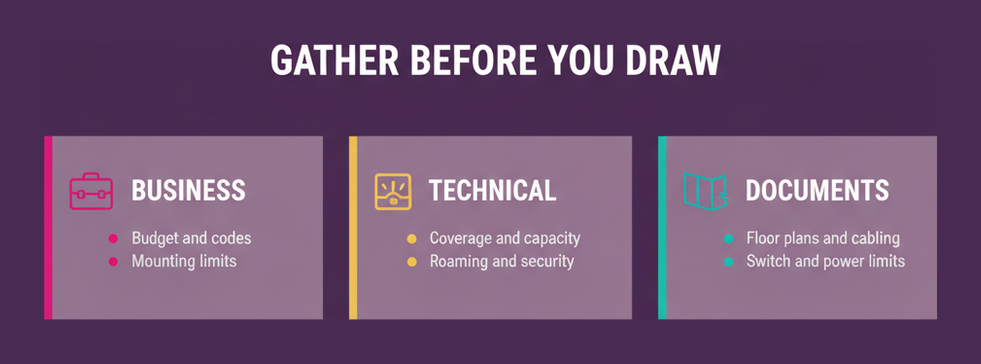
Define Specifications for the WLAN is 25 percent of CWDP-305 and covers three activities: collecting and using business requirements, collecting and defining technical requirements, and collecting existing project documentation. It is the discovery phase, and the objective list is unusually long for a domain of its size.
Business requirements are examined properly
The business side is not a token heading. The objectives name business use cases and justification, user requirements, regulatory compliance, industry compliance, budget, aesthetics, architectural constraints, mounting restrictions, access restrictions, security objectives, monitoring requirements, time constraints, building and safety codes, and common vertical market practices.
Aesthetics and mounting restrictions sit in that list alongside regulatory compliance, which tells you how CWNP thinks about design. A technically perfect layout that the building owner will not permit is not a design, and the exam treats that as a first-order constraint rather than an annoyance.
Technical requirements and existing documentation
The technical list covers vendor selection, location services such as RTLS, latency and quality of service requirements, signal strength, coverage and capacity, high-density considerations, bandwidth, frequency management, and security requirements including guest access, roaming, monitoring, authentication and encryption. Voice over WLAN and bridge links appear as conditional items, examined when the project calls for them.
The documentation objective is the one candidates skip. It asks for validated floor plans, network diagrams, access point locations, existing services including DNS, DHCP, NTP and authentication servers, switch capability and capacity, power and PoE availability, and the cabling infrastructure. None of it is difficult. All of it is the difference between a design that lands and one that meets an unpleasant surprise in week three.
Why Is Design Worth Forty Percent of CWDP-305?
Design carries 40 percent because it is where every requirement gathered in the previous domain gets turned into decisions that cost money and are hard to reverse. Access point placement, channel and power planning, capacity modelling, roaming behaviour and the physical realities of the building all resolve here, and each one constrains the others.
The interdependence is what makes it examinable at this weight. Raising transmit power to fix a coverage hole changes the co-channel interference picture. Adding access points for capacity changes the roaming behaviour. Moving one unit to satisfy a mounting restriction changes the cell edges around it. A design question rarely has a single correct answer in isolation, which is why the domain rewards reasoning rather than recall.
This is also the domain where the vendor-neutral framing earns its keep. Every manufacturer’s planning tool will happily produce a heat map. Knowing whether the heat map is answering the right question, given the client’s density and application mix, is the skill CWDP is testing.
Why Do Deployment and Validation Split So Unevenly?
Deploy the WLAN is 10 percent and Validate and Optimize the WLAN is 25 percent, and the gap between them is deliberate. CWNP is saying that installing to a good design is largely execution, while proving the design worked, and adjusting it when it did not, is professional judgement.
Validation is where a design meets the building. Surveys after installation reveal what the predictive model got wrong: the storeroom whose shelving arrived after the survey, the atrium that reflects more than expected, the client device that roams badly regardless of what the standard says. The optimisation half of the domain is about responding to that evidence systematically rather than by adjusting power until complaints stop.
The 10 percent on deployment should not be read as permission to ignore it. Six questions is still six questions, and on a paper where 42 correct answers is a pass, giving away a whole domain because it looked minor is an expensive way to fail.
Where Does CWDP Sit Against CWNA and CWAP?
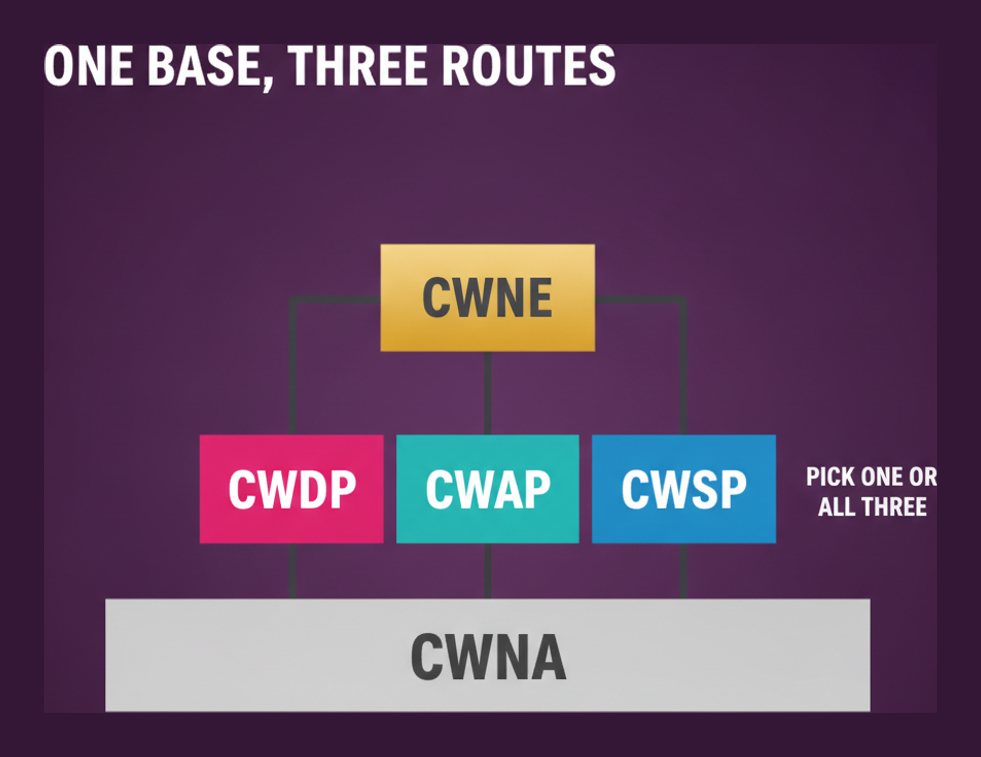
CWNP runs a tiered wireless track. CWNA is the administrator-level foundation, and above it sit three professional-level specialisms: CWDP for design, CWAP for analysis, and CWSP for security. They are siblings rather than a sequence, and which one you take depends on what your work actually involves. CWNP lays the whole ladder out on its Wi-Fi career certifications page.
The distinction between CWDP and CWAP is the one that causes hesitation. CWAP is about understanding what is happening on the air right now, at frame level, when something is wrong. CWDP is about deciding what should be there in the first place. An engineer who spends their week in packet captures is closer to the analysis credential, and our CWAP-405 exam guide covers what that paper demands.
There is a practical overlap worth naming. The Validate and Optimize domain in CWDP borders on CWAP territory, because validating a design means measuring the air. The difference is depth: CWDP asks whether the measurement shows the design met its requirements, while CWAP asks what the individual frames reveal about why it did not.
Above all three sits CWNE, the expert-level credential, which requires the professional-level certifications alongside documented experience. It is a portfolio credential rather than a single exam, and it is the reason the professional tier is worth collecting deliberately rather than one at a time by accident.
How Should You Prepare for CWDP-305?
Preparation for CWDP-305 should follow the project lifecycle the domains describe, because each domain consumes the output of the one before it. Studying design before requirements means learning to place access points without knowing what they are being placed for, which is exactly the habit the exam is testing against.
- Start with the requirements domain and build a real checklist from the objectives, covering business constraints, technical requirements and the existing documentation you would ask a client for.
- Take a building you know well and write its requirements out in full, including the awkward ones such as mounting restrictions, aesthetics and building codes, before drawing anything.
- Design that same building twice, once for coverage and once for capacity, then compare the two layouts and explain to yourself why they differ.
- Work the validation domain against your own design, listing what you would measure after installation to prove each requirement was met, and what you would change if it was not.
- Finish with a timed run of 60 questions in 90 minutes, then review by domain rather than by total score, because losing the design domain is the failure mode that matters.
CWNP’s own all-in digital bundle covers the material, and the live design class is worth the cost if your background is installation rather than planning. For a structured walk through the objectives before you commit, the site’s CWDP-305 study guide sets them out in CWNP’s own order.
Step three is the one that changes results. Designing the same space for two different goals forces the trade-offs into the open, and those trade-offs are what the 24 design questions are made of.
Frequently Asked Questions
What does CWDP stand for?
Certified Wireless Design Professional, a vendor-neutral professional-level credential from CWNP. It is earned by passing the CWDP-305 exam and covers the design lifecycle of an enterprise wireless LAN.
How many questions are on the CWDP-305 exam?
Sixty questions in 90 minutes, which is 90 seconds each. That is tight for the scenario questions, which describe a site and its constraints and ask what you would specify or change.
What is the passing score for CWDP-305?
Seventy percent, which works out at 42 correct answers from 60. You can afford to lose eighteen marks, but the design domain alone is worth roughly twenty-four of them.
How much does the CWDP certification cost?
Three hundred and forty-nine dollars and ninety-nine cents in US currency for the exam itself, booked through Prometric. Training is separate and optional, whether you take the digital bundle or a live class.
Which CWDP-305 domain carries the most marks?
Design the WLAN, at 40 percent. Define Specifications and Validate and Optimize each carry 25 percent, and Deploy the WLAN carries just 10 percent, which is the smallest domain on the paper.
Where do you book the CWDP-305 exam?
Through Prometric. CWNP uses Prometric rather than Pearson VUE, so candidates used to booking other vendor exams will need a separate testing account.
Is CWDP-305 being replaced?
Not soon. CWNP released CWDP-305 in 2024 and has indicated that CWDP-306 will not arrive until 2027, so the current version has a long remaining life compared with several other credentials in the track.
What is the difference between CWDP and CWAP?
CWDP is about deciding what a wireless network should be before it exists. CWAP is about analysing what is happening on the air at frame level once it does. They are sibling professional credentials rather than a sequence.
Do you need CWNA before taking CWDP?
CWNA is the administrator-level foundation of the CWNP track and the assumed grounding for the professional tier. The design objectives take radio fundamentals for granted rather than teaching them.
Does CWDP-305 cover high-density design?
Yes. High-density considerations are named explicitly among the technical requirements you are expected to collect, alongside coverage, capacity, bandwidth, latency and frequency management requirements.
Conclusion
The CWDP certification is weighted the way real wireless projects fail. Design takes 40 percent, requirements and validation take 25 percent each, and the install window that dominates most engineers’ calendars takes 10. Sixty questions, 90 minutes, 70 percent to pass, and a version that runs until at least 2027.
Work the domains in project order, write a full requirements checklist before you draw a single cell, and design one building you know twice with two different goals. If the resulting layouts look the same, that is the gap the exam will find.


