Ask what HCIA-Datacom is and the answer usually arrives as shorthand: Huawei’s routing and switching exam. It is a useful comparison for about ten seconds, and then it starts costing you marks. Four of the eight domains on H12-811 are not routing and not switching, and together they carry 40 percent of the paper.
Wireless, data centre networking, operations and automation, and a campus solution domain all sit inside an associate level blueprint that most candidates revise as though it stopped at OSPF. This walkthrough takes the HCIA-Datacom certification domain by domain as Huawei weights them, sets out what the 60 question paper actually asks, and shows where the credential leads once it is passed.
What Is the HCIA-Datacom Certification?
The HCIA-Datacom certification is Huawei’s associate level credential in data communication, earned by passing exam H12-811. Its full name is Huawei Certified ICT Associate-Datacom, and it covers eight weighted domains running from network reference models and Ethernet switching through IP routing, security services, wireless, data centre basics, operations and a campus networking solution.
Datacom is one of several Huawei ICT tracks, and it is the enterprise networking one. The blueprint is written around Huawei devices and their operating system rather than around abstract theory, so the configuration topics assume you will be working on Huawei switches, routers and access controllers rather than a generic device.
What makes it unusual for an associate paper is the breadth. Most vendor entry credentials stop at the routed and switched network. This one adds a wireless domain, a data centre domain, an operations and automation domain and a solution design domain on top, and gives them real weight rather than a passing mention. H3C splits the same ground differently, and its senior routing and switching credential tests VRRP, IRF, multicast and 802.1X in a single 50 question paper.
What Are the H12-811 Exam Details?
H12-811 carries 60 questions in 90 minutes, is scored out of 1000 with a passing score of 600, and costs 200 US dollars. It is booked through Pearson VUE. Passing it awards the Huawei Certified ICT Associate-Datacom credential, published by Huawei as HCIA-Datacom V1.0.
| Field | Value |
|---|---|
| Exam name | Huawei Certified ICT Associate-Datacom |
| Exam code | H12-811 |
| Number of questions | 60 |
| Duration | 90 minutes |
| Passing score | 600 out of 1000 |
| Price | 200 US dollars |
| Scheduling | Pearson VUE |
Sixty questions in ninety minutes is ninety seconds an item, which is comfortable by certification standards and tells you something about the question style. There is room for a configuration snippet to be read and reasoned about rather than only recognised, so expect stems that show you a command output or a topology and ask what happens next.
The 600 out of 1000 pass mark is a scaled score. It does not mean 36 correct answers out of 60, because items are not worth equal raw marks across the scale, so counting your way to a target is not a strategy. Working through H12-811 sample questions tells you far more about your position than arithmetic on the pass mark does.
How Is H12-811 Weighted Across Eight Domains?
H12-811 splits into eight weighted domains: IP Technology Basics at 25 percent, Ethernet Technology Basics at 20 percent, Network Security and Services at 15 percent, and four domains at 10 percent or below. The three largest carry 60 percent of the paper between them, which leaves 40 percent spread across five smaller domains that are easy to under prepare.
| Domain | Weight | What it really covers |
|---|---|---|
| IP Technology Basics | 25% | Addressing, routing, OSPF and IPv6 |
| Ethernet Technology Basics | 20% | Switching, VLANs, STP and link aggregation |
| Network Security and Services | 15% | ACLs, AAA, NAT and network services |
| Data Communication Network Basics | 10% | Reference models and device operating systems |
| WLAN Technology Basics | 10% | Wireless architecture and configuration |
| Network O and M and Troubleshooting | 10% | Device management, automation and fault finding |
| Data Center Network Basics | 5% | Data centre evolution and DCN concepts |
| Typical Campus Networking Solution | 5% | Campus concepts and project practice |
Read the tail rather than the head. The three small domains at 10, 5 and 5 percent add up to 20 percent of the paper, roughly twelve questions, and they are the ones candidates skip because they look like padding. Twelve questions is more than the gap between most passes and most failures.
There is also a structural point in how Huawei has ordered the list. The domains run in the order you would actually build a network: understand the models, switch the frames, route the packets, secure and translate them, then extend to wireless, data centre and campus. Studying in blueprint order is unusually sensible here.
Why Does IP Technology Carry the Largest Share?
IP Technology Basics is the biggest domain on H12-811 at 25 percent, roughly fifteen questions. It names four sub-topics: IP address and configuration, IP routing basics, OSPF fundamentals and configuration, and IPv6 address and configuration. It is the only domain that carries a named routing protocol, which is why it dominates.
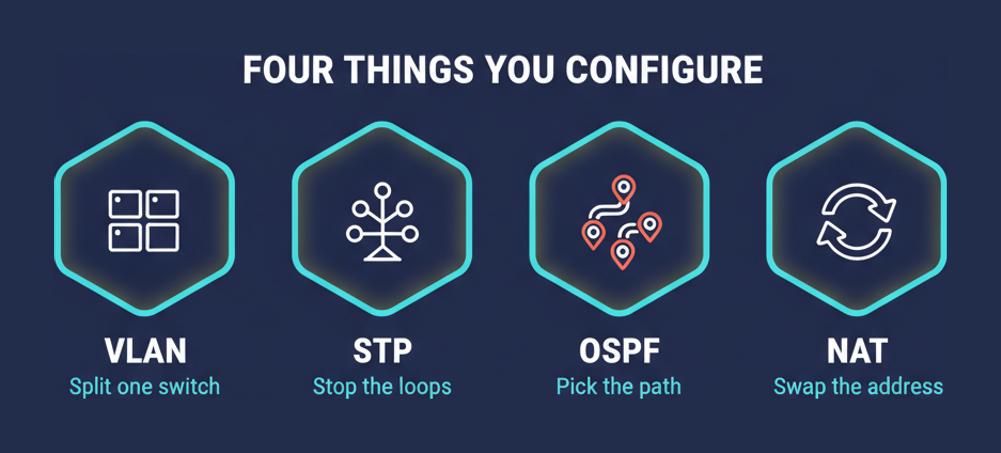
OSPF is the single most examinable technology in the whole blueprint. It appears as its own sub-topic inside the heaviest domain, and it is the protocol every later Huawei credential builds on. Huawei’s own OSPF reference page describes the areas, LSA types and neighbour states in the same vocabulary the exam uses, which matters because terminology differs subtly between vendors.
IPv6 sitting at the same level as IPv4 addressing is a deliberate signal. It is not an appendix topic on this paper. Address structure, configuration and the coexistence questions that follow from running both stacks are inside scope at associate level, which is not true of every vendor’s entry credential.
Routing basics means the table, not just the protocol
The IP routing basics sub-topic is separate from the OSPF one, and that separation is the hint. You are expected to reason about the routing table itself: how routes are selected, what preference and cost do, how static and dynamic entries coexist, and what happens when two sources offer a path to the same destination. Questions of that shape do not require OSPF at all, and they are the ones that catch candidates who learned a protocol without learning the table underneath it.
What Does the Ethernet Domain Expect You to Configure?
Ethernet Technology Basics is worth 20 percent and names four sub-topics: Ethernet switching basics, VLAN fundamentals and configuration, STP fundamentals and configuration, and Ethernet link aggregation. Three of those four say configuration explicitly, so this is the most hands-on domain on the paper.
VLANs are where most of the marks sit in practice, because they underpin everything above them. Access and trunk port behaviour, tagging, the default VLAN, and inter-VLAN routing all follow from the same model, and Huawei’s VLAN documentation sets out the port types in the exact terms the exam uses. Huawei names its port types differently from other vendors, and that difference is examinable.
Spanning tree gets its own sub-topic rather than a mention. Expect root bridge election, port roles and states, and the reasoning about why a particular port ended up blocking. All of it sits on top of the Ethernet layer defined by IEEE 802.3, and the exam expects standard behaviour rather than vendor specific shortcuts.
Link aggregation closes the domain. Two devices, several physical links, one logical one, and a set of rules about which member links may join. It is a small topic with a predictable question shape, and it is the cheapest set of marks in the whole 20 percent.
Which Domains Are Not Routing and Switching?
Four domains on H12-811 sit outside routing and switching entirely: WLAN Technology Basics at 10 percent, Network O and M and Troubleshooting at 10 percent, Data Center Network Basics at 5 percent, and Typical Campus Networking Solution at 5 percent. Together they are 30 percent of the paper, or roughly eighteen questions, and they are the most commonly skipped part of the blueprint.
The WLAN domain names three sub-topics: WLAN overview, WLAN networking architecture, and WLAN fundamentals and configuration. Architecture is the one to take seriously, because the exam distinguishes between the ways access points and controllers are arranged rather than treating wireless as one thing. The Wi-Fi Alliance overview is the neutral reference for the generation names and capabilities that sit under Huawei’s product vocabulary.
Network O and M and Troubleshooting is quietly the most modern domain on the paper. Alongside device management and troubleshooting it names network programming and automation, which puts scripting and programmatic device interaction inside an associate level exam. That is not decoration. It reflects how Huawei expects campus networks to be run.
The data centre domain covers DC evolution and DCN basics at 5 percent, which is concept level rather than configuration level. The campus solution domain, also 5 percent, covers basic concepts of campus networks and practices in campus network projects, and it is the only domain framed around a delivered project rather than a technology. Huawei’s campus network reference covers the architecture those questions assume.
How Much Security Is in an Associate Level Paper?
Network Security and Services is worth 15 percent of H12-811, the third largest domain, and names four sub-topics: ACL fundamentals and configuration, AAA fundamentals and configuration, network services and applications, and NAT fundamentals and configuration. That is roughly nine questions on control, identity and address translation.
ACLs carry more weight than their size suggests, because they appear as a tool elsewhere too. An access control list is how traffic is matched for filtering, and the same matching logic reappears in NAT configuration and in policy questions. Learning the ACL model properly pays for itself twice.
AAA is the identity half. Authentication, authorisation and accounting as a framework, and how a device is configured to use it, sits at associate level here rather than being reserved for a security specialisation. Candidates coming from a pure switching background often meet it for the first time on this exam.
The network services and applications sub-topic is the quiet one. It covers the services a network provides rather than the network itself, and questions here tend to test whether you know which service solves which problem rather than how to configure it in depth.
Where Does HCIA-Datacom Sit in the Huawei Path?
HCIA-Datacom is the entry tier of the Huawei ICT certification ladder, which runs associate, then professional, then expert. HCIA sits at the bottom as the associate credential, HCIP is the professional level above it, and HCIE is the expert level at the top. The Datacom track keeps the same subject at all three tiers, so H12-811 is the first step of a defined route rather than a standalone badge.
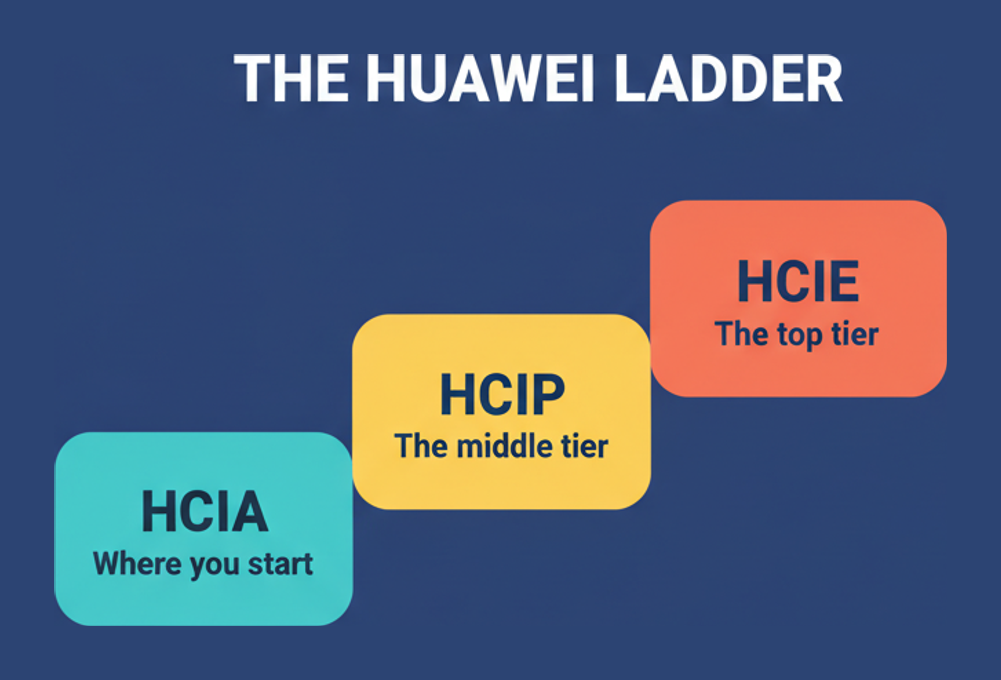
That structure changes how the exam should be treated. The domains that look thin here, wireless, data centre and campus solution, are the ones that expand into full subjects at the professional tier. Learning them properly now is preparation for the next exam, not just for this one.
The step up is real. If you want to see the shape of it, our walkthrough of the H12-891 expert exam shows how far the same Datacom subject travels once it reaches the top tier of the ladder.
One practical consequence for planning: because the tracks share subject matter rather than stacking prerequisites, there is nothing stopping a candidate from studying the associate blueprint in the order that suits their existing job. Someone already running a campus wireless estate can start at the WLAN domain and work backwards without breaking anything.
How Should You Prepare for the H12-811 Exam?
Preparation for HCIA-Datacom works best when the study order follows the blueprint order, because Huawei has written the domains in the sequence a network is actually built. Start with the models and the device operating system, then switch, then route, then secure, then take the four smaller domains seriously rather than leaving them to the final week.
- Learn the network reference models and the Huawei device operating system first, since every configuration topic that follows assumes you can navigate the command line.
- Work through the Ethernet domain hands on, configuring VLANs, spanning tree and link aggregation rather than reading about them, because three of its four sub-topics say configuration explicitly.
- Build the IP domain next, giving OSPF the most time of any single technology on the paper and treating IPv6 addressing as a first class topic rather than an appendix.
- Add ACLs, AAA and NAT together, since the matching logic in an access control list reappears inside NAT configuration and in policy questions.
- Cover the four smaller domains deliberately, allocating real hours to wireless, operations and automation, data centre concepts and the campus solution, which together carry 30 percent of the paper.
- Rehearse under a ninety minute timer across all eight domains at once, so the small domains are answered at the same speed as the large ones.
Give yourself a written record of which domains you keep losing marks on rather than a general feeling about them. Our older H12-811 exam materials page collects the practice resources for that rehearsal in one place.
Frequently Asked Questions
How many questions are on the H12-811 exam?
Sixty questions in 90 minutes, which works out at about ninety seconds per item. That is enough time to read a configuration snippet and reason about it rather than only recognising an answer.
What is the passing score for HCIA-Datacom?
600 out of 1000. It is a scaled score rather than a raw count, so it does not translate into a fixed number of correct answers out of the sixty.
How much does the HCIA-Datacom exam cost?
200 US dollars, booked through Pearson VUE.
Which domain is worth the most on H12-811?
IP Technology Basics at 25 percent, covering IP addressing, routing basics, OSPF and IPv6. Ethernet Technology Basics is second at 20 percent and Network Security and Services third at 15 percent.
Is HCIA-Datacom only about routing and switching?
No. Four domains sit outside routing and switching entirely: WLAN at 10 percent, network operations and troubleshooting at 10 percent, data centre network basics at 5 percent, and a campus networking solution at 5 percent. Together that is 30 percent of the paper.
Does the exam cover automation?
Yes. Network programming and automation is a named sub-topic inside the Network O and M and Troubleshooting domain, which carries 10 percent. Programmatic interaction with devices is inside scope at associate level.
Is IPv6 on the HCIA-Datacom exam?
Yes. IPv6 address and configuration is one of the four sub-topics in the largest domain, listed alongside IPv4 addressing rather than beneath it.
What version of HCIA-Datacom is current?
Huawei publishes the credential as HCIA-Datacom V1.0, and the exam code appears in search demand as both H12-811 and H12-811_V1.0. No successor version has been announced.
What comes after HCIA-Datacom?
HCIP at the professional tier and HCIE at the expert tier. The Datacom subject continues across all three levels, so the smaller domains on this paper expand into full subjects higher up.
How much security is on the exam?
Fifteen percent, covering ACLs, AAA, network services and applications, and NAT. It is a general networking security domain rather than a specialist security syllabus, and it assumes no prior security credential.
Conclusion
The HCIA-Datacom certification is wider than the shorthand suggests. Eight weighted domains, 25 percent on IP technology, 20 percent on Ethernet, 15 percent on security and services, and a full 30 percent spread across wireless, operations and automation, data centre basics and a campus solution. Sixty questions, 90 minutes, 600 out of 1000 to pass, at 200 US dollars through Pearson VUE.
Study it in the order Huawei wrote it, configure the Ethernet topics rather than reading them, give OSPF the largest single block of time, and refuse to treat the four small domains as optional. They are eighteen questions, and eighteen questions decide the result more often than any single protocol does.


