The syllabus for this exam is four lines long. The exam is not.
Every page that describes the Certified Blockchain Solutions Architect credential reproduces the same four skill statements: architect blockchain solutions, work with engineers and technical leaders, choose the right chain for a use case, and work with public and permissioned systems. Blockchain Training Alliance publishes something considerably more specific on its own product page, a list of 22 things a candidate is expected to understand completely, running from Byzantine fault tolerance and hashing to what it actually takes to launch a chain. CBSA is 70 questions in 90 minutes at 275 US dollars, and 70 percent passes. The 22 items are what those 70 questions are drawn from.
What Are the CBSA Exam Mechanics?
CBSA is 70 questions in 90 minutes with a 70 percent pass mark, priced at 275 US dollars for the exam alone or 499 with the preparation course bundled. It is delivered online through the vendor’s own student portal rather than through a testing network, results are immediate, and the credential is valid for two years.
| Field | Value |
|---|---|
| Exam name | Certified Blockchain Solutions Architect |
| Exam code | CBSA |
| Questions | 70 |
| Duration | 90 minutes |
| Passing score | 70% |
| Price | $275 USD exam only, $499 with the preparation course |
| Delivery | Online, launched from the vendor’s student portal |
| Results | Immediate, pass or fail with a percentage |
| Validity | Two years from the day of passing |
| Published objectives | 22, unweighted |
Two numbers set the pace. Seventy questions in ninety minutes is roughly 77 seconds each, which is quick, and 70 percent means 49 correct answers with 21 wrong as the entire allowance. Neither is punishing on its own, but together they reward candidates who recognise a question type instantly rather than reasoning each one out from first principles.
One rule that catches people out
Once the exam is launched it cannot be exited. There is no pausing, no stepping away and returning, and no closing the window to think about it. That is unusual enough among online-delivered exams to be worth planning around: treat the ninety minutes as a fixed appointment rather than something you can start speculatively to see what the questions look like.
How Much Consensus Theory Does CBSA Expect?
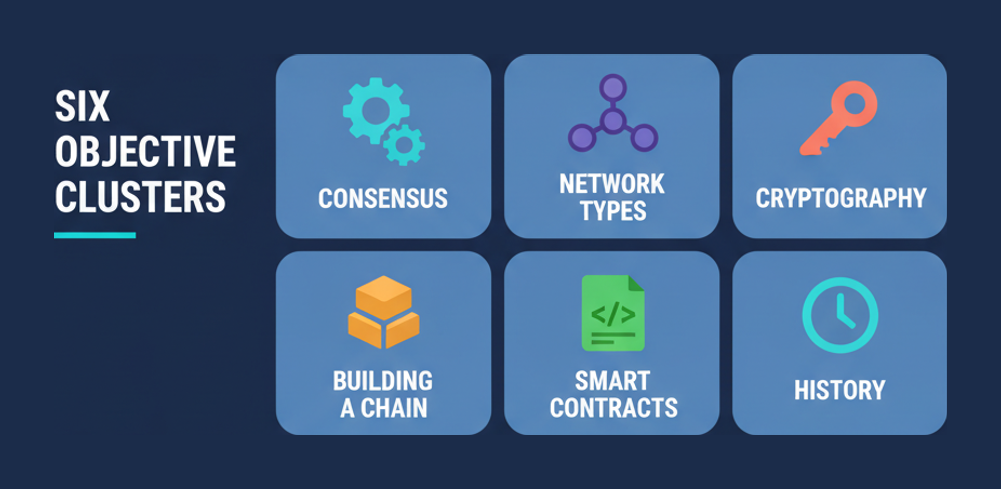
More than a working definition and less than a computer science course. Four of the 22 objectives sit here: the difference between proof of work, proof of stake and other proof systems and why they exist, Byzantine fault tolerance, consensus among blockchains, and when mining is needed and when it is not.
The phrase to notice is “and why they exist”. The exam is not testing whether you can define proof of stake. It is testing whether you can say what problem each proof system was invented to solve, which is the question an architect is actually asked when someone proposes a chain design. Byzantine fault tolerance sits in the list for the same reason: it is the underlying problem statement that makes every proof system make sense.
“When mining is needed and when it is not” is the objective that most directly separates an architect from an enthusiast. A permissioned network among known participants does not need mining and generally does not have it, and being able to explain why without hedging is exactly the competence the credential claims. The technical overview published by the United States NIST blockchain report sets out the same distinctions in vendor-neutral language and is a better first read than any chain’s own documentation.
Public, Private or Permissioned: What Does the Exam Ask?
Four objectives, and they are practical rather than definitional. You are expected to know the difference between the three network types, the common use cases for public chains, the common use cases for private and permissioned ones, and why a cryptocurrency is necessary on certain chain designs but not on others.
That last objective is the sharpest one in the whole list. It is the question a business stakeholder actually asks, usually phrased as whether the project needs a token, and it has a real answer rooted in how the network pays for the work of reaching consensus. An architect who cannot answer it will end up either attaching a token to a project that does not need one or removing incentives from a network that does.
Permissioned systems are named in the skill statement
Working effectively with both public and permissioned blockchain systems is one of only four skill statements the vendor publishes, which puts permissioned networks on equal footing with public ones despite public chains dominating the popular coverage. Anyone whose blockchain experience is entirely public-chain should spend time in a permissioned implementation before booking. The Hyperledger Fabric repository is the most widely used reference for how a permissioned network is structured, and reading its architecture documentation makes the contrast concrete in a way a comparison table cannot.
What Cryptography Knowledge Does a Solutions Architect Need?
Four objectives again, and all of them applied rather than mathematical. Where cryptography fits into a blockchain and which systems are most commonly used, what hashing is, how addresses and public and private keys work together, and security in blockchain as a general topic.
Nothing here requires you to implement an algorithm. The level is the one an architect works at: knowing which primitive is doing which job, so that when a design proposes storing something on chain you can say immediately what is protected by a hash, what is protected by a signature, and what is not protected at all.
The address and key objective is worth extra attention because it is where misunderstanding causes real damage. An address is derived from a public key, a public key is derived from a private key, and the derivation runs one way only. Candidates who have used a wallet without ever reading how it works tend to know the vocabulary and not the direction of the relationship, and questions in this cluster are built to find that out.
Could You Launch a Chain, and Does the Exam Care?
Yes, it cares. Four objectives cover how blocks are written to the chain, what is needed to launch your own blockchain, common problems and considerations when working with public chains, and general awareness of the technology behind common blockchains.
The launch objective is the one that reads most like an architecture interview question, because that is what it is. Answering it properly means covering the network participants, the consensus choice, the governance of who may join, the client software, and how the first block gets there. None of that is exotic knowledge, but it is knowledge that only assembles into an answer if you have thought about it as a whole rather than as separate topics.
“Common problems and considerations in working with public blockchains” is the objective that rewards experience over reading. Transaction cost volatility, confirmation latency, the permanence of anything written, and the fact that a public ledger is public are the considerations a design review actually surfaces. They are also, conveniently, the reasons an architect ends up recommending a permissioned network, which ties this cluster back to the previous one.
How Deep Does CBSA Go on Smart Contracts and Delivery?
Three objectives, pitched at architect level rather than developer level: what a smart contract is, the programming languages used by the most common blockchains, and common testing and deployment practices for chains and the applications built on them.
You are not asked to write code. You are asked to know which language belongs to which platform, which is a genuinely useful thing for an architect to have at recall speed when scoping a team, and to know how chain-based applications are tested and deployed. That second part is where blockchain projects most often fail in practice, because an immutable ledger is unforgiving of a deployment mistake in a way that a conventional database is not.
The testing and deployment objective is the strongest argument for treating this as a solutions architecture credential rather than a technology quiz. Everything else in the list describes the technology; this one describes how you get it into production without regret. Our CBSA exam resources page gathers the preparation material for this and the other clusters in one place.
The Retake Rules Are Stricter Than Most Candidates Expect
Three rules govern what happens after the exam, and together they are unusual. A failed attempt requires a newly purchased voucher, because no retake is included. A minimum of 48 hours must pass before a second attempt. And a candidate who passes may not sit the same exam again within twelve months of passing.
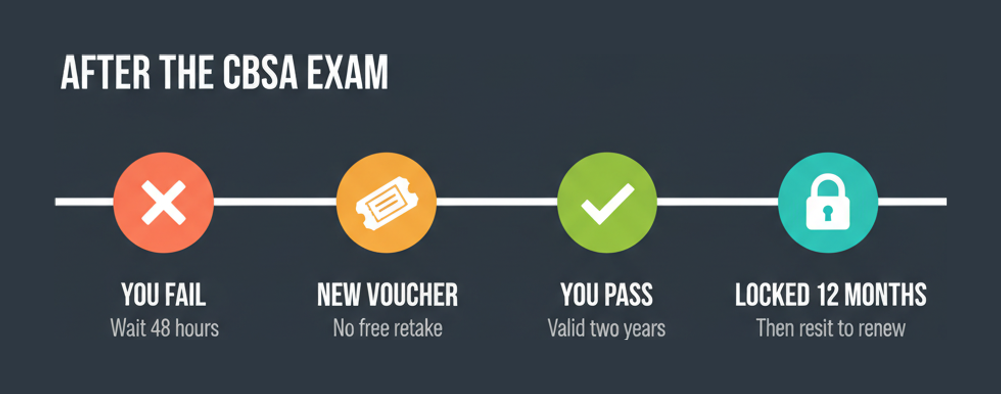
Read those three together and the economics change. There is no cheap second attempt, so booking speculatively to see the question style costs another 275 dollars. The 48 hour rule is generous compared with the week or more some vendors impose, but it only applies once you have paid again.
The twelve month lockout after passing is the one that interacts oddly with the two year validity. The credential expires two years after you pass, and you cannot re-sit for the first twelve of those months, which leaves a twelve month window in which recertification has to happen. Blockchain Training Alliance sells a dedicated CBSA recertification route for exactly that reason, and it is worth knowing the window exists before you reach it.
Is CBSA or CBDE the Right BTA Exam for You?
CBSA is the architecture credential and CBDE is the developer one. The split is visible in the objectives: CBSA asks which language belongs to which platform and how applications are tested and deployed, while the developer exam asks you to work in one. Neither is a prerequisite for the other.
Choose on what you are asked to do at work rather than on which sounds more senior. Someone who is regularly in a room deciding whether a project should use a chain at all, and if so which one, is being asked architect questions. Someone writing and deploying contract code is not, whatever their job title says.
The audience the vendor names for CBSA supports that reading. It lists consultants, programmers and developers, university professors, software engineers, executive technology roles and government officials, which is a decision-maker list with builders included rather than a builders list. If you want the developer path instead, our guide to the CBDE exam strategy covers what changes.
How Should You Prepare for the CBSA Exam?
Work from the 22 objectives rather than from the four skill statements, and treat the clusters in the order that builds on itself. Six steps cover the ground, and the sequence matters because the later objectives assume the earlier ones.
- Start with consensus, because proof systems, Byzantine fault tolerance and the question of when mining is needed underpin every later objective about network design.
- Learn the three network types together with their use cases, and be able to answer why a cryptocurrency is necessary on some designs and not on others without hedging.
- Fix the cryptography relationships in your memory as a one way chain from private key to public key to address, then add what hashing protects and what a signature protects.
- Assemble a complete answer to what it takes to launch a chain, covering participants, consensus choice, governance, client software and the first block, since the objective is written as a single whole rather than as parts.
- Spend time in a permissioned implementation if your experience is entirely public-chain, because permissioned systems carry equal weight in the published skill statements.
- Learn which language belongs to which platform at recall speed, then read how chain applications are tested and deployed, which is the objective closest to real project failure.
Leave the history objective until last. It is one item out of 22, it is the quickest to absorb, and it makes far more sense once the technical clusters have given it something to attach to.
Then work timed questions at roughly 77 seconds each, because that is the real pace, and count how many you get wrong rather than how many you get right. Twenty-one is the whole allowance, and there is no free second attempt to fall back on.
Frequently Asked Questions
How many questions are on the CBSA exam?
70 questions in 90 minutes, which is about 77 seconds each. The vendor describes it as a performance-based evaluation, meaning questions are written to reflect what a solutions architect does on the job.
What is the passing score for CBSA?
70 percent. On a 70 question paper that is 49 correct answers, leaving 21 wrong as the entire margin. Results are reported as pass or fail together with your percentage.
How much does the CBSA exam cost?
275 US dollars for the exam on its own, or 499 for a bundle that adds the online preparation course. A failed attempt needs a newly purchased voucher, because no retake is included.
Is the CBSA exam taken online or at a test centre?
Online. It is launched from the vendor’s own student portal under an exams tab rather than through a third-party testing network, and it cannot be exited once it has begun.
How long is the CBSA certification valid?
Two years from the day you pass. A candidate who has passed cannot sit the same exam again for twelve months, so recertification has to happen in the second half of that two year period.
How many objectives does CBSA actually publish?
Twenty-two, on the vendor’s own product page. The four-line skill summary that appears on most other pages describes the role rather than the examinable content, and it is not weighted or broken down further.
Does CBSA require programming?
No. The delivery cluster asks which language belongs to which common blockchain and how chain applications are tested and deployed, but it does not ask you to write code. The developer credential covers that instead.
Does the exam cover permissioned blockchains as well as public ones?
Equally. Working effectively with both public and permissioned systems is one of only four published skill statements, and separate objectives cover the common use cases for each network type.
What happens if I fail CBSA?
You must wait at least 48 hours and purchase a new exam voucher before attempting it again. The vendor does not report scores on individual items, so a failed attempt tells you your percentage and nothing more granular.
Should I take CBSA or CBDE first?
Neither is a prerequisite for the other. Choose CBSA if your work involves deciding whether and which chain to use, and the developer exam if your work involves building on one.
Conclusion
The four-line skill summary is the least useful thing published about this exam. The 22 objectives are the useful thing, and they describe a genuine architecture syllabus: consensus, network types, cryptography, building and running a chain, and getting applications onto one safely.
Prepare against that list in order, because it builds. Get consensus and network types solid first, since everything later assumes them, and spend real time in a permissioned system if your experience is entirely public. Then respect the mechanics, which are less forgiving than the pass mark suggests: 77 seconds a question, no way out once the exam starts, no included retake, and a twelve month lockout after you pass that leaves a fixed window for recertification. None of that is difficult to plan around. All of it is expensive to discover on the day.


