Every summary of this exam lists four domains as though they were comparable. They are not. One of them is larger than the other three put together, and a study plan that treats the list as a list rather than as a ranking is aimed at the wrong place from the first evening.
The Qlik Replicate certification, exam code QREP, is 50 questions in 120 minutes at an unusually low 54 percent pass mark, and Design alone carries 47 percent of the marks against 23, 22 and 8 for everything else.
Table of Contents
- What is the Qlik Replicate certification?
- Why does one domain carry nearly half the marks?
- How is the QREP exam delivered and scored?
- What sits inside the Design domain?
- Administration is almost a quarter of the paper
- What does the troubleshooting domain actually ask for?
- Why is Operations only 8 percent?
- Does Qlik expect you to have used the product first?
- How should you prepare for QREP?
- Frequently Asked Questions
- Conclusion
What is the Qlik Replicate certification?
The Qlik Replicate certification is Qlik’s credential for practitioners who design and run data replication and change data capture pipelines on the Qlik Replicate platform. It carries the exam code QREP, runs to 50 questions across four weighted domains, and is aimed at someone already operating the product rather than someone evaluating it.
Qlik Replicate moves data between systems continuously rather than in scheduled batches. It reads changes at the source, usually from a transaction log, and applies them at the target, which is why the exam’s vocabulary is endpoints, tasks, transformations and exceptions rather than jobs and schedules.
What makes this credential unusually easy to plan for is that Qlik publishes the domain weightings itself. Most vendors leave that to third parties or omit it entirely. Here the vendor and the money site agree on all four figures, which removes the guesswork that normally dominates the first week of study.
Why does one domain carry nearly half the marks?
Design holds 47 percent of the QREP exam, Administration 23 percent, Troubleshooting 22 percent and Operations 8 percent. On a 50 question paper that is roughly 24 questions in Design and about four in Operations, so the four domains are not four equal parts of a syllabus but one dominant subject with three supporting ones.
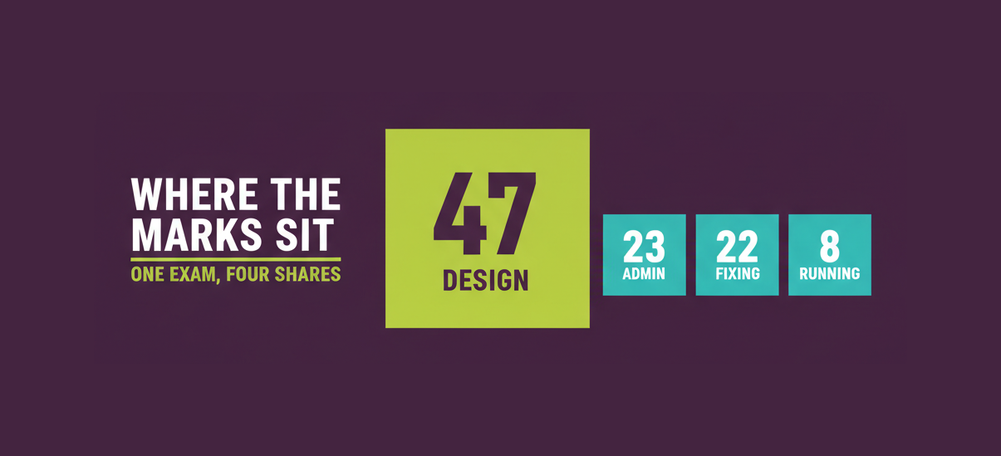
| Domain | Weight | Approximate questions | What it is really about |
|---|---|---|---|
| Design | 47% | 24 | Endpoints, architecture, task type, task settings and transformations |
| Administration | 23% | 12 | Server settings, user roles, Enterprise Manager, deployment options |
| Troubleshooting | 22% | 11 | Logs, error handling, diagnostic packages, exception tables |
| Operations | 8% | 4 | Starting and stopping tasks, and task metadata |
The reason for the imbalance is in the nature of the product. Replication is a configuration discipline. Once a task is designed correctly it runs without intervention, which is exactly why day-to-day operation is worth only four questions while the decisions that produced the task are worth twenty four.
That distribution also tells you what kind of questions to expect. A domain worth nearly half the paper cannot be tested by asking where a button is, so Design questions tend to give a requirement and ask which configuration satisfies it. The sample sets on the money site’s QREP practice exam show that shape clearly, which is useful for calibrating early rather than late.
How is the QREP exam delivered and scored?
QREP is 50 questions in 120 minutes with a 54 percent pass mark, priced at $250 USD and registered through Qlik. Qlik publishes the question count, duration, pass mark and all four domain weightings on its own exam-details page, and every figure matches the money site’s syllabus exactly.
| Field | Value |
|---|---|
| Credential name | Qlik Replicate |
| Exam code | QREP |
| Questions | 50 |
| Duration | 120 minutes |
| Passing score | 54 percent |
| Price | $250 USD |
| Domains | 4, all weighted |
| Registration | Qlik |
| Recommended experience | One year minimum with the Replicate platform |
| Prerequisite certification | None |
Two of those numbers point in opposite directions and both are worth planning around. A 54 percent pass mark is low, meaning 27 correct answers out of 50 and a margin of 23 questions. That is the most generous allowance of any exam covered here.
The time is generous too. Fifty questions in 120 minutes is 144 seconds each, roughly double what a typical vendor product exam allows. Taken together, a low bar and a long clock usually signal one thing: the questions are expected to take thinking rather than recall. That matches a paper whose largest domain asks which configuration meets a requirement.
What sits inside the Design domain?
Design has four objectives and they escalate. Endpoints, then architecture, then task type and task settings, then transformations. Each one is a decision the person configuring a replication pipeline has to make before anything runs, and together they account for roughly 24 of the 50 questions.
Endpoints and architecture
Endpoints are the source and target definitions, and the objective is specifically about the requirements to create and manage them. Different source systems expose change data differently, which is why the endpoint is not a connection string but a set of decisions about how changes will be read.
The architecture objective sits underneath that. Understanding how the platform captures and applies changes is what makes the endpoint choices comprehensible rather than arbitrary. Qlik’s Replicate introduction documentation is the clearest statement of that model and is worth reading before anything else in this domain.
The underlying mechanism is not proprietary. Reading committed changes out of a database’s own write-ahead log is how most change data capture works, and the PostgreSQL logical replication documentation explains the same idea from the database side. Understanding it there makes the endpoint objective substantially easier, because you stop treating each source system as a special case.
Task type and transformations
The third objective asks you to determine which task type to use and which settings go with it, from a stated requirement. That is the heart of the exam. A full load, an ongoing change capture, or a combination of the two are different task types with different consequences for latency, load and recovery, and the requirement in the question is what decides between them.
The fourth objective does the same for transformations: given a requirement, determine which transformation to use. Transformations in a replication pipeline are deliberately limited compared with a full integration tool, so the skill being tested is knowing what belongs in the pipeline and what does not. A relational target and an event streaming target behave very differently once changes start arriving, which is exactly the kind of consequence the task settings objective expects you to have met.
Administration is almost a quarter of the paper
Administration carries 23 percent, roughly 12 questions, across four objectives: server settings, matching user types to roles, setting up the Enterprise Manager, and listing the deployment options. This is the platform side rather than the pipeline side, and it is where candidates who have only ever configured tasks tend to be thin.
Enterprise Manager deserves particular attention because it is a separate component rather than a screen. It is the layer that gives a single view across multiple Replicate servers, which means it exists for estates rather than for single installations. Anyone who has only worked with one server may never have opened it.
The user types and roles objective is phrased as a matching exercise, which is a hint about question style. Expect items that name a responsibility and ask which role grants it, rather than items that ask you to describe the permission model in the abstract.
Deployment options round it out. Where the product runs, and in what configuration, is a question asked at purchase time and rarely revisited, so it is another objective that experience alone may not have covered.
What does the troubleshooting domain actually ask for?
Troubleshooting is 22 percent, about 11 questions, and it is unusually specific for a domain of that size. Four objectives: getting logs from a task, setting error handling and debug log levels, obtaining a diagnostic package, and debugging errors using the attrep_apply_exceptions table.
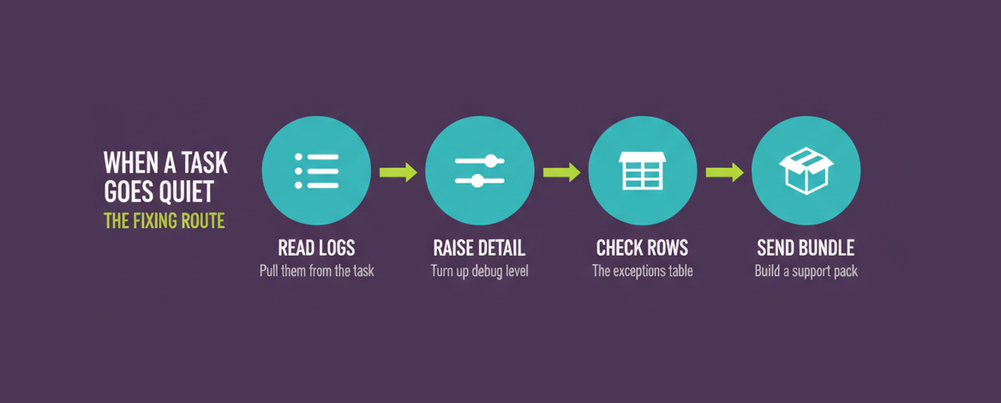
That last objective is the one worth memorising by name. The exceptions table is where the platform records rows it could not apply at the target, and it is the first place an experienced operator looks when a task is running but data is missing. A question naming it is testing whether you have actually debugged a live pipeline.
The diagnostic package objective is similarly practical. It is the bundle you generate when escalating to support, and knowing what it contains and when to produce it is the difference between a resolved ticket and a week of back and forth.
Error handling settings sit alongside debug logging because they answer the same question from two directions: what should the task do when a row fails, and how much detail should it record while deciding. Twenty two percent is a large share for diagnostics, and it reflects a product whose failures are usually silent rather than loud.
Why is Operations only 8 percent?
Operations carries 8 percent, about four questions, and just two objectives: determining when and why to start or stop a task, and identifying the options for handling task metadata. It is the smallest domain on the syllabus by a wide margin, and that is the most revealing number on the page.
A well designed replication pipeline does not need operating. It runs, and the only genuine operational decisions are when to interrupt it and what happens to its state when you do. Stopping a change capture task is not like stopping a batch job, because the source keeps generating changes while you are stopped, so the decision has consequences that a scheduled job does not have.
Task metadata is the other half of that. What the platform remembers about where a task had reached determines whether restarting resumes or reloads, and that single behaviour is why the objective exists at all.
The planning lesson from an 8 percent domain is not to skip it, since four questions is more than a seventh of the 23 question margin. It is to give it an evening rather than a week, and to spend the time saved in Design.
Does Qlik expect you to have used the product first?
Yes, explicitly. Qlik recommends a minimum of one year of practical experience with the Replicate platform before sitting the exam, alongside expertise in onboarding sources and an understanding of the platform’s components. That is a firmer readiness statement than most vendors publish and it is not on the money site’s syllabus page.
A year is a meaningful bar, and the domain weights explain why. An exam that spends nearly half its marks asking which configuration satisfies a requirement is difficult to pass from documentation, because the answers depend on consequences you have seen rather than rules you have read.
There is no prerequisite certification, so nothing blocks an earlier attempt. The recommendation is about the likelihood of passing rather than about eligibility, and Qlik states it on its Qlik Replicate exam details page alongside the weightings.
For anyone mapping out a wider Qlik profile, the vendor’s credentials differ sharply in how much they publish. The Qlik AI Specialist certification is structured quite differently from this one, which is worth knowing before assuming a single preparation approach covers the portfolio.
How should you prepare for QREP?
Preparation for QREP should follow the weightings rather than the domain order. Roughly half your time belongs in Design, a quarter split between Administration and Troubleshooting each, and a single evening in Operations. The low pass mark means the goal is competence across all four rather than mastery of any one.
- Read the Replicate architecture documentation first, because every Design objective assumes you know how changes are captured at the source and applied at the target.
- Build endpoints against at least two different source systems, so that the differences in how each exposes change data become concrete rather than theoretical.
- Create a full load task and a change capture task against the same endpoint pair, and watch what each does, since the task type objective is the single densest part of the exam.
- Apply every transformation type the product offers to a running task, so that determining which transformation a requirement calls for becomes recognition rather than reasoning.
- Set up Enterprise Manager even if you only have one server, because it is a separate component that task-level experience never introduces you to.
- Break a task deliberately by forcing rows to fail at the target, then read the attrep_apply_exceptions table and generate a diagnostic package from the result.
- Stop and restart a change capture task and observe what the retained metadata does to the resume, which is essentially the whole Operations domain in one exercise.
- Finish with timed sets of 50 questions, using the full 120 minutes rather than rushing, since the generous clock is there because the questions expect reasoning.
Four to six weeks is realistic for someone already running Replicate in production. Someone with less than Qlik’s recommended year should expect the Design domain to be the constraint, and should spend the extra time building pipelines rather than reading about them.
Practitioners coming from the data quality side of the Qlik portfolio will find the vocabulary familiar but the emphasis different, and the Talend Data Quality Implementer exam is a useful reference point for how differently Qlik weights its data credentials.
Frequently Asked Questions
How many questions are on the QREP exam?
Fifty questions in 120 minutes, which is about 144 seconds each. That is roughly double the per-question time most vendor product exams allow.
What is the passing score for the Qlik Replicate certification?
Fifty four percent, meaning 27 correct answers out of 50 and a margin of 23. Qlik publishes the same figure on its own exam-details page as the money site’s syllabus does.
How much does QREP cost?
$250 USD, registered through Qlik. The price is published on the money site’s syllabus page rather than on Qlik’s exam-details page, which directs candidates to a purchase link instead.
Which QREP domain carries the most marks?
Design, at 47 percent, which is roughly 24 of the 50 questions. Administration follows at 23 percent, Troubleshooting at 22 percent and Operations at 8 percent.
Does Qlik publish the domain weightings itself?
Yes, and all four match the money site’s syllabus exactly. That is unusual. Most vendors publish topic names without percentages, which makes planning a guess rather than a calculation.
How much experience does Qlik recommend before the exam?
A minimum of one year of practical experience with the Replicate platform, plus expertise in onboarding sources and an understanding of the platform’s components.
Is there a prerequisite certification?
None. The one year experience recommendation is guidance on readiness rather than an eligibility condition, so nothing prevents an earlier attempt.
What is the attrep_apply_exceptions table?
It is where the platform records rows it could not apply at the target, and the syllabus names it directly under troubleshooting. It is the first place to look when a task is running but data is missing.
Why is the Operations domain so small?
Because a correctly designed replication task largely runs itself. The only real operational decisions are when to stop or start a task and what happens to its retained metadata, which is exactly what the two objectives cover.
Does the exam cover Enterprise Manager?
Yes, under Administration. Enterprise Manager is a separate component that gives a view across multiple Replicate servers, so anyone who has only worked with a single installation may never have opened it.
Conclusion
QREP is a design exam with three supporting domains attached: 50 questions, 120 minutes, $250, and a 54 percent bar that is the lowest of any credential covered here. Design alone is 47 percent, Administration 23, Troubleshooting 22 and Operations 8, and Qlik publishes every one of those figures itself.
Plan to the weighting rather than the list. Spend half your preparation building and comparing tasks, give Administration and Troubleshooting a genuine block each, and let Operations have a single evening. Then use the full two hours in the exam, because a low pass mark and a long clock together mean the questions were written to be thought about.


