Almost every page that ranks for this credential describes it as the summit of a ladder that starts at PMP. It is not on that ladder. Read the five domains in order and something becomes obvious very quickly: not one of them is about delivering anything. Schedules, scope, resourcing, execution, none of it appears.
The PfMP certification is PMI’s Portfolio Management Professional credential, examined in 170 multiple choice questions over 240 minutes and scored in performance bands rather than a percentage. Its five domains are strategic alignment, governance, portfolio performance, portfolio risk management and communications management.
Table of Contents
- What is the PfMP certification, and why is it not the top of the PMP ladder?
- What does the PfMP exam look like?
- How is PfMP scored when there is no pass percentage?
- What do the five PfMP domains cover?
- Why strategic alignment and portfolio performance carry half the marks
- What does PfMP cost, and does membership pay for itself?
- Who is PfMP actually for?
- How should you prepare for a four-hour paper?
- Frequently Asked Questions
- Conclusion
What is the PfMP certification, and why is it not the top of the PMP ladder?
PfMP is PMI’s Portfolio Management Professional credential, and it certifies the ability to select and balance a collection of investments against organisational strategy. A project manager delivers a defined outcome. A portfolio manager decides which outcomes should be funded at all, and stops the ones that no longer earn their place.
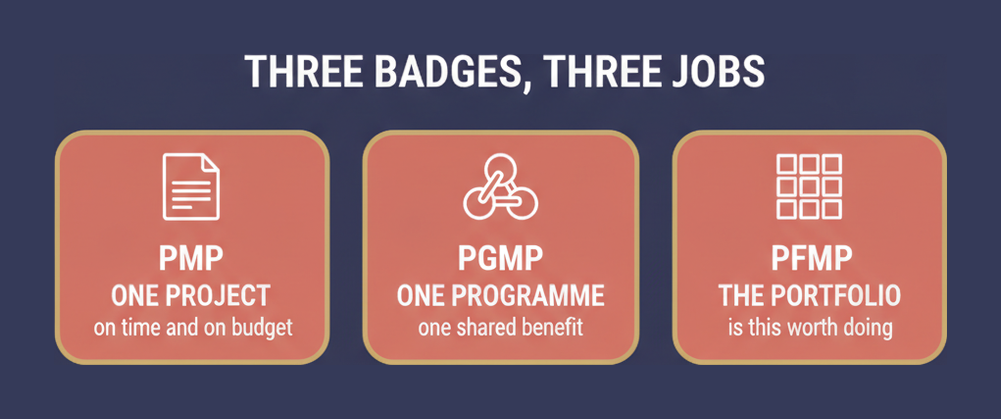
That is a different job, not a more senior version of the same one. The clearest way to see it is to look at what each credential manages. PMP manages a project. PgMP manages a programme, meaning a group of related projects delivering one coordinated benefit. PfMP manages a portfolio, meaning everything the organisation has chosen to invest in, related or not.
| Credential | What it manages | The central question it answers |
|---|---|---|
| PMP | A single project | Are we delivering this on time, on budget and to scope? |
| PgMP | A programme of related projects | Are these projects together producing the benefit we set out to get? |
| PfMP | The whole investment portfolio | Are these the right things to be doing at all? |
The practical consequence for a candidate is that PMP revision transfers poorly. Earned value, critical path, procurement types and change control are the substance of one exam and largely absent from the other. What transfers is the vocabulary and the habit of thinking in governance structures.
Because the credential sits in an unfamiliar discipline, the sensible first step is reading the exam’s own scope rather than a training provider’s summary of it. The money site’s PfMP certification overview sets out the five domains and the exam mechanics together, which is the fastest way to decide whether this is the credential you actually want.
What does the PfMP exam look like?
The PfMP exam is 170 multiple choice questions in 240 minutes, delivered through Pearson VUE, drawing on The Standard for Portfolio Management, Fourth Edition and the PMBOK Guide. Four hours over 170 questions works out at roughly 85 seconds each, which is generous by certification standards and necessary given how much reading each item carries.
| Field | Value |
|---|---|
| Exam name | PMI Portfolio Management Professional |
| Exam code | PfMP |
| Questions | 170 |
| Duration | 240 minutes |
| Format | Multiple choice |
| Result | Above Target, Target, Below Target or Needs Improvement |
| Exam fee | USD 800 for PMI members, USD 1000 full price |
| Delivered by | Pearson VUE |
| Reference works | The Standard for Portfolio Management, Fourth Edition, and the PMBOK Guide |
| Domains | 5, weighted |
The length is the part candidates under-rate. Four hours of dense scenario reading is a physical test as much as a knowledge one, and people who have only ever sat 60 or 90 minute papers routinely find their accuracy falling away in the final hour rather than their knowledge.
A note on what is not published here
PMI’s own certification pages could not be read while researching this article, so every figure above comes from the money site’s syllabus page rather than from vendor confirmation. The eligibility rules, which govern how much portfolio experience you need before you may apply, are not published on that page either, and they are not guessed at here. They live in the official PfMP handbook, which is the document to read before paying anything.
How is PfMP scored when there is no pass percentage?
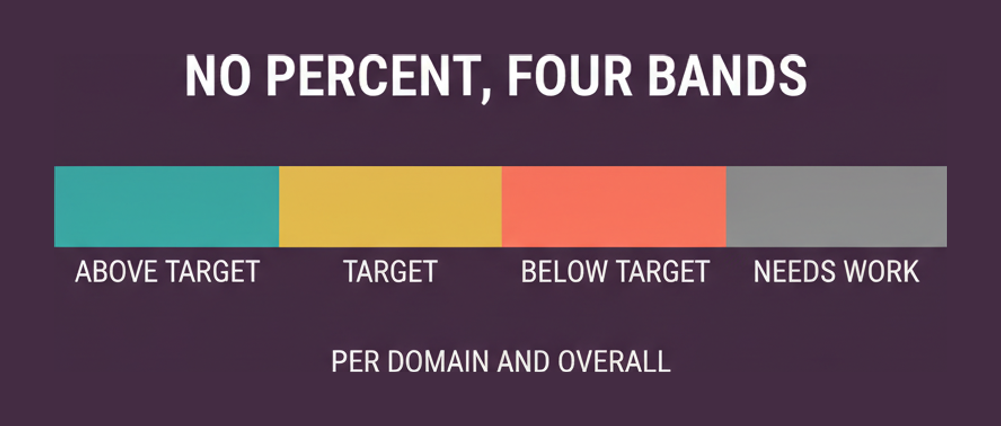
PfMP does not report a percentage. The result is one of four performance bands: Above Target, Target, Below Target or Needs Improvement. Any page quoting a specific pass percentage for this exam has invented it, because no such number is published for the credential at all.
This matters more than it first appears, because it changes what a study plan should optimise for. With a numeric cut score you can trade a weak area against a strong one and still clear the line. With band reporting there is no arithmetic to do, and no published rule that lets you convert one domain’s strength into another domain’s weakness.
What the bands describe
The four bands describe performance against the standard expected of a competent portfolio manager, not against other candidates and not against a raw mark. Target means you met that expectation. Above Target means you exceeded it. The two lower bands mean you did not, with Needs Improvement being the further away of the two.
The result report breaks performance down by domain as well as overall, which is the genuinely useful part for anyone who has to retake. A candidate who lands Below Target overall but Target on four domains knows exactly where the work is.
How to prepare for band scoring
Aim for even competence rather than a spiky profile. That sounds like generic advice until you notice how easy the alternative is: a working portfolio manager usually arrives strong on governance and performance because those are the parts of the job with meetings attached, and thin on risk and communications because those are the parts that get delegated.
What do the five PfMP domains cover?
PfMP has five weighted domains: strategic alignment at 25 percent, governance at 20 percent, portfolio performance at 25 percent, portfolio risk management at 15 percent and communications management at 15 percent. Each is expressed as a set of tasks, and each task names both the technique and the purpose it serves.
| Domain | Weight | What it examines |
|---|---|---|
| Strategic Alignment | 25% | Evaluating organisational goals, setting prioritisation criteria, ranking priorities with stakeholders, building portfolio scenarios and recommending them, and keeping the roadmap aligned when strategy shifts |
| Governance | 20% | Establishing the governance model, its structures, policies and decision rights, setting portfolio management standards, and defining the processes that make decisions repeatable |
| Portfolio Performance | 25% | Measuring whether the portfolio is delivering the value it promised, and acting on what the measurement shows |
| Portfolio Risk Management | 15% | Identifying and managing risk at portfolio level, which includes the risk of the wrong mix rather than only the risk inside each component |
| Communications Management | 15% | Keeping stakeholders informed and engaged across a portfolio whose components have different audiences and different reporting rhythms |
Read the task lists rather than the domain names. Strategic alignment alone runs to eight tasks, and they describe a sequence: understand the strategy, set the criteria, rank the priorities, identify candidate components, model scenarios, recommend one, absorb strategy changes, publish the roadmap. That sequence is the exam’s spine.
Why strategic alignment and portfolio performance carry half the marks
Strategic alignment and portfolio performance are 25 percent each, so together they account for 50 percent of the exam. That is not an accident of drafting. They are the two ends of the same loop: alignment decides what should be in the portfolio, performance measures whether that decision turned out to be right.
Governance, risk and communications are the machinery that keeps the loop running. They matter, they carry marks, and a candidate who ignores them will not reach Target. But they are supporting disciplines, and the exam’s weighting says so plainly.
The techniques named in the syllabus are the ones to know
The strategic alignment tasks name their methods explicitly rather than leaving them abstract: document review and interviewing for gathering information, qualitative and quantitative analysis for ranking, and what-if scenario modelling using options analysis, risk analysis, SWOT and financial analysis for evaluating options. Those are examinable by name.
The same pattern of naming the technique alongside the purpose shows up across PMI’s credential family. Anyone who has worked through the PMI-RMP risk credential will recognise the style immediately, and the risk vocabulary transfers almost intact into this exam’s fourth domain.
Where candidates lose ground
Portfolio performance is the domain that catches experienced people out, because in practice most organisations measure component delivery and call it portfolio performance. The exam treats them as different things. Whether every project came in on time says nothing about whether the portfolio produced the value that justified funding it.
What does PfMP cost, and does membership pay for itself?
The PfMP exam costs USD 800 for PMI members and USD 1000 at full price. The gap is USD 200, and that single figure decides the membership question for almost everyone: if annual membership costs less than USD 200, joining before booking is cheaper than not joining, and you keep the membership benefits as well.
That arithmetic is worth doing deliberately rather than assuming. It is the same structure PMI uses across its credential range, and it is why the member price is quoted first on almost every summary of the exam.
The costs that are not in the fee
Two reference works sit behind this exam, The Standard for Portfolio Management and the PMBOK Guide, and both are paid publications unless you have access through membership. Budget for them, and budget for the time to read them, because the standard is the source the questions are written from rather than a companion to it.
Retakes are the other line item. Four hours is a long sitting and a resit is not a small commitment of either money or stamina, which is an argument for going in genuinely ready rather than treating the first attempt as reconnaissance.
Who is PfMP actually for?
PfMP suits somebody who already makes or shapes investment decisions: a portfolio manager, a PMO lead with a funding remit, a head of delivery who sits in prioritisation meetings, or a programme manager whose scope has quietly grown into a portfolio. It is a poor fit for somebody who wants a more impressive project management credential.
The career case is genuine but narrower than PMP’s. Portfolio management roles are fewer, more senior and concentrated in organisations large enough to run a formal investment process. Published portfolio manager salary data shows a wide band, which is exactly what you would expect from a title that means something different in financial services than it does in a technology PMO.
The recognition question
Portfolio management as a discipline is considerably older than the credential and considerably broader than PMI’s treatment of it. Reading around project portfolio management is worth an hour before committing, because it makes clear which parts of the exam are PMI’s particular framing and which are the discipline’s common ground.
If you are weighing PfMP against a newer PMI credential in an adjacent space, the cost comparison is a useful reality check. The CPMAI credential pricing sits in similar territory for a very different skill set, and comparing what each actually buys is more informative than comparing badge prestige.
How should you prepare for a four-hour paper?
PfMP preparation is longer than most certification study plans, typically two to four months alongside a senior role, and it divides into learning an unfamiliar discipline and then building the stamina to reason about it for four hours. Skipping the second half is the most common mistake.
- Read The Standard for Portfolio Management end to end before touching any question bank, because the exam is written from it rather than from general project management practice.
- Work through the strategic alignment tasks as a sequence rather than a list, following it from understanding the strategy to publishing the roadmap.
- Learn the named analysis techniques by name, covering options analysis, risk analysis, SWOT and financial analysis, since the syllabus examines them explicitly.
- Build a governance model on paper for an imaginary portfolio, defining the boards, the policies and the decision rights, which converts the second domain from theory into something you have actually done.
- Separate component performance from portfolio performance deliberately in your own mind, because conflating them is the single most reliable way to lose marks in the highest-weighted pair.
- Study risk and communications last and hardest, since they carry 30 percent between them and are the two areas working portfolio managers usually delegate.
- Sit at least one full 170 question paper in a single four hour block to find out where your accuracy starts to fall away.
Booking and the day itself
The exam runs through Pearson VUE delivery centres and online proctoring, and the choice between them matters more at four hours than it would at one. A centre removes the risk of a connection failure two hours in; a home sitting removes the commute and lets you control the chair you spend four hours in.
Frequently Asked Questions
How many questions are on the PfMP exam?
One hundred and seventy multiple choice questions, taken over 240 minutes, which works out at roughly 85 seconds each.
What is the passing score for PfMP?
There is no published percentage. The result is reported as Above Target, Target, Below Target or Needs Improvement, with a breakdown by domain. Any source quoting a percentage has invented it.
How long is the PfMP exam?
Four hours. It is one of the longer certification sittings in the field, and stamina is a genuine factor rather than a throwaway concern.
What does PfMP cost?
USD 800 for PMI members and USD 1000 at full price. The USD 200 gap usually makes membership worth taking out before booking.
Is PfMP harder than PMP?
It is not a harder version of PMP, it is a different subject. PMP examines delivering a project; PfMP examines choosing and balancing investments. PMP revision transfers only partly.
What are the PfMP domains and their weightings?
Strategic alignment 25 percent, governance 20 percent, portfolio performance 25 percent, portfolio risk management 15 percent and communications management 15 percent.
What experience do you need to apply for PfMP?
The money-site syllabus page does not publish the eligibility rules, and PMI’s certification pages could not be read while researching this article, so no requirement is asserted here. The official PfMP handbook is where those rules are set out.
Which books does the PfMP exam draw on?
The Standard for Portfolio Management, Fourth Edition, and the PMBOK Guide. The standard is the primary source; the guide is supporting context.
Where is the PfMP exam delivered?
Through Pearson VUE. Over a four hour sitting the choice between a test centre and online proctoring is worth thinking about properly.
How long does preparation usually take?
Two to four months alongside a senior role is typical, with the last few weeks given over to full-length timed practice rather than new material.
Conclusion
PfMP is a credential for people who decide what gets funded, and the syllabus says so in the only way that counts: five domains, none of them about delivery, with alignment and performance carrying half the marks between them. Approaching it as an advanced project management exam is the fastest route to a Below Target report.
Read the standard first, learn the strategic alignment sequence as a sequence, give risk and communications more time than instinct suggests, and sit at least one full four hour paper before the real one. The band scoring rewards even competence, so the goal is a flat profile rather than a spiky one.
And do the membership arithmetic before you book. A USD 200 gap on a single exam fee is the easiest saving available on this credential.


